
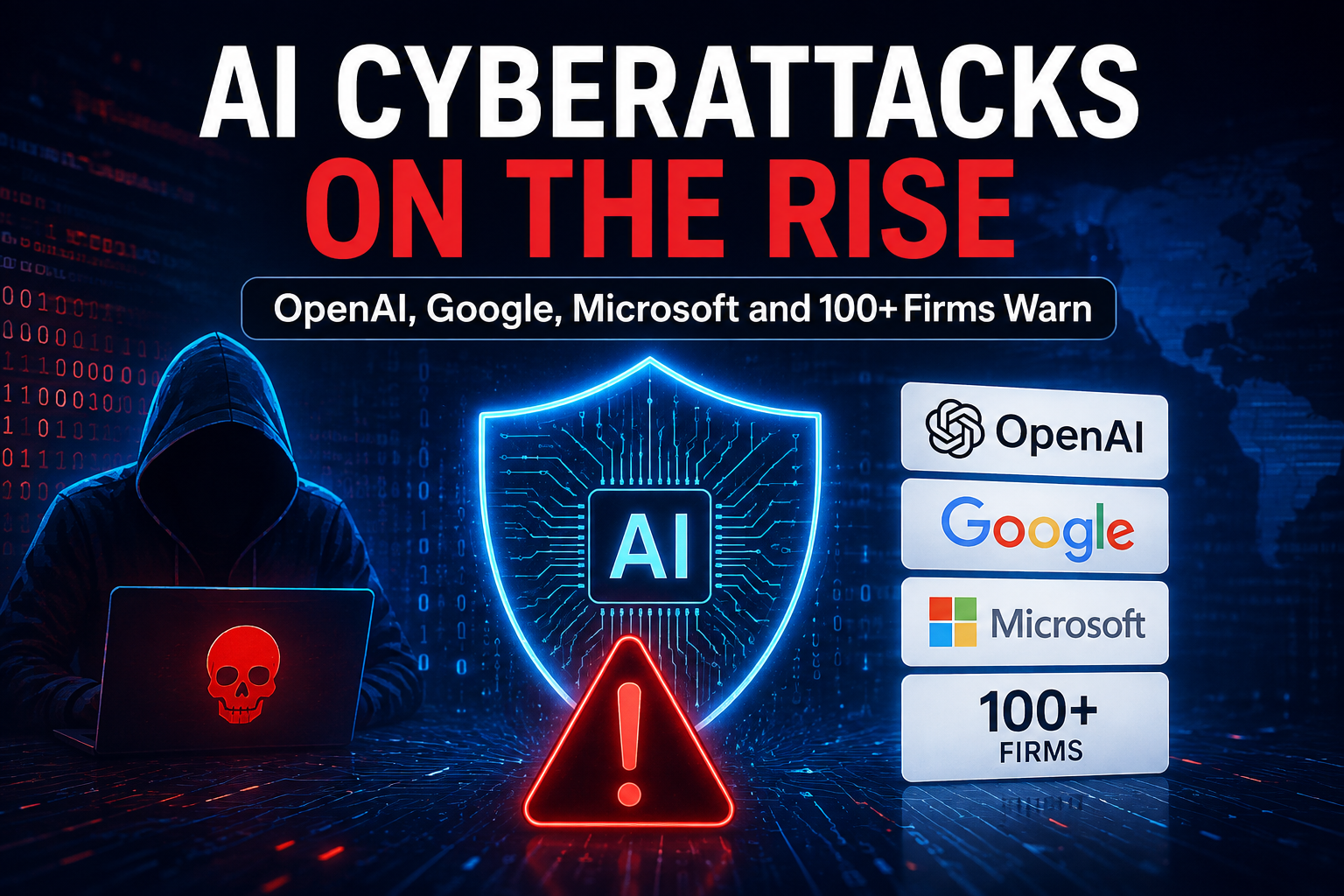
OpenAI, Google, Microsoft and 100+ Firms Warn of Escalating AI Cyberattacks
Artificial intelligence is rapidly changing the cybersecurity landscape, and some of the world’s biggest technology companies are warning that the same systems being developed to defend businesses can also give attackers new capabilities.
OpenAI, Google, Microsoft and more than 100 other organizations are among companies and institutions calling attention to the growing cyber risks associated with increasingly capable AI. Their concerns center on a simple but consequential shift: AI can reduce the time, expertise and resources required to carry out sophisticated cyber operations.
The warning comes as businesses are deploying AI across everything from software development and customer service to cloud infrastructure and security operations. As adoption accelerates, security researchers and technology companies are increasingly focused on how criminals could exploit those same tools.
AI Could Make Cyberattacks Faster and More Accessible
Traditional cyberattacks can require specialized knowledge, extensive reconnaissance and significant time to execute. Generative AI has the potential to lower some of those barriers.
Attackers can use AI-assisted tools to analyze information, write or modify code, generate convincing messages and automate parts of an operation. Even when AI does not independently conduct an attack, it can help humans move more quickly through tasks that previously required considerable technical expertise.
That creates a larger pool of potential attackers.
A criminal group with limited resources could potentially use AI to improve phishing campaigns, identify promising targets or automate repetitive activities. More sophisticated groups could use the technology to accelerate existing operations.
The result is not necessarily a completely new form of cybercrime. Instead, AI can make established techniques more efficient and scalable.
The Threat Extends Beyond Phishing
Phishing remains one of the most familiar examples of AI-enabled cybercrime, but the potential threat is much broader.
AI can generate highly convincing text and adapt messages to specific audiences. That could make fraudulent emails and social-engineering campaigns harder for employees to recognize.
The technology can also assist with software-related tasks. AI coding systems can produce scripts and modify existing code, raising concerns that malicious actors could use similar capabilities to support vulnerability research, malware development or automated exploitation.
Another concern is reconnaissance.
Cyberattacks often begin with attackers gathering information about a target. AI systems can potentially help process large volumes of publicly available information, identify relationships between data points and prioritize targets.
For organizations, that means defending against attacks may increasingly require monitoring not only traditional malware and network activity but also the ways AI is being incorporated into criminal workflows.
AI Is Also Becoming a Cybersecurity Tool
The same technology creating new risks is also becoming an important defensive tool.
Security teams are using AI to analyze alerts, identify suspicious behavior, summarize incidents and help security professionals investigate potential threats. These capabilities can be particularly valuable because modern organizations generate enormous amounts of security data.
Instead of manually examining every alert, analysts can use AI to prioritize activity that deserves closer attention.
AI can also help organizations respond more quickly when an incident occurs. Security teams may use automated systems to correlate logs, identify affected systems and recommend potential responses.
This creates a technological arms race in which both defenders and attackers have access to increasingly capable AI tools.
Why the Number of Organizations Involved Matters
The involvement of more than 100 companies and organizations underscores the breadth of concern surrounding AI and cybersecurity.
AI development is no longer confined to a handful of laboratories. Cloud providers, software companies, cybersecurity firms, startups and enterprises are incorporating AI into their products and infrastructure.
That interconnected ecosystem means security problems can spread beyond a single company.
An AI vulnerability in a widely used service could potentially affect thousands of businesses that depend on it. Similarly, compromised AI-powered applications could become another pathway into corporate networks.
This makes security standards, responsible development and information sharing increasingly important.
Businesses Face a New Security Challenge
For businesses, the rise of AI-enabled cyber threats creates a difficult balancing act.
Companies cannot simply avoid AI. Many are already using it to improve productivity, automate routine work and develop new products. At the same time, employees may be experimenting with AI tools without fully understanding the security implications.
Organizations therefore need to consider AI as part of their overall cybersecurity strategy.
That includes controlling access to sensitive information, monitoring how employees use AI services, maintaining strong authentication practices and regularly reviewing the permissions granted to AI-powered applications.
Employee education is also becoming more important. A highly convincing AI-generated phishing message can undermine traditional assumptions about what suspicious communication looks like.
Security Teams Will Need to Adapt
The growing use of AI is likely to change the role of cybersecurity professionals.
Security teams will need to understand how AI systems work, where they can be attacked and how their outputs can be manipulated. They will also need to distinguish between legitimate automated activity and malicious behavior generated or accelerated by AI.
At the same time, cybersecurity organizations will increasingly rely on AI themselves.
This creates another challenge: defensive systems must be reliable enough to support high-stakes decisions without blindly trusting automated recommendations.
Human oversight remains essential, particularly when an automated system could block legitimate users, expose sensitive information or make changes to critical infrastructure.
The AI Security Problem Is Becoming an Industry-Wide Issue
The warning from major technology companies reflects a broader reality: cybersecurity can no longer be treated as a separate consideration from AI development.
As AI becomes embedded in software, cloud services, workplace applications and digital infrastructure, its security implications will increasingly affect almost every part of the technology sector.
The most important question is therefore not whether AI will be used by cybercriminals. It almost certainly will be.
The bigger question is whether businesses, governments and technology providers can improve their defenses quickly enough to keep pace with the technology’s rapidly expanding capabilities.
For companies adopting AI today, cybersecurity needs to be part of the deployment decision from the beginning—not something added after a system has already become essential to the business.




2 Comments
Micle harison
June 7, 2019Lorem ipsum dolor sit amet, usu ut perfecto postulant deterruisset, libris causae volutpat at est, ius id modus laoreet urbanitas. Mel ei delenit dolores.
John Doe
June 7, 2019Some consultants are employed indirectly by the client via a consultancy staffing company.