
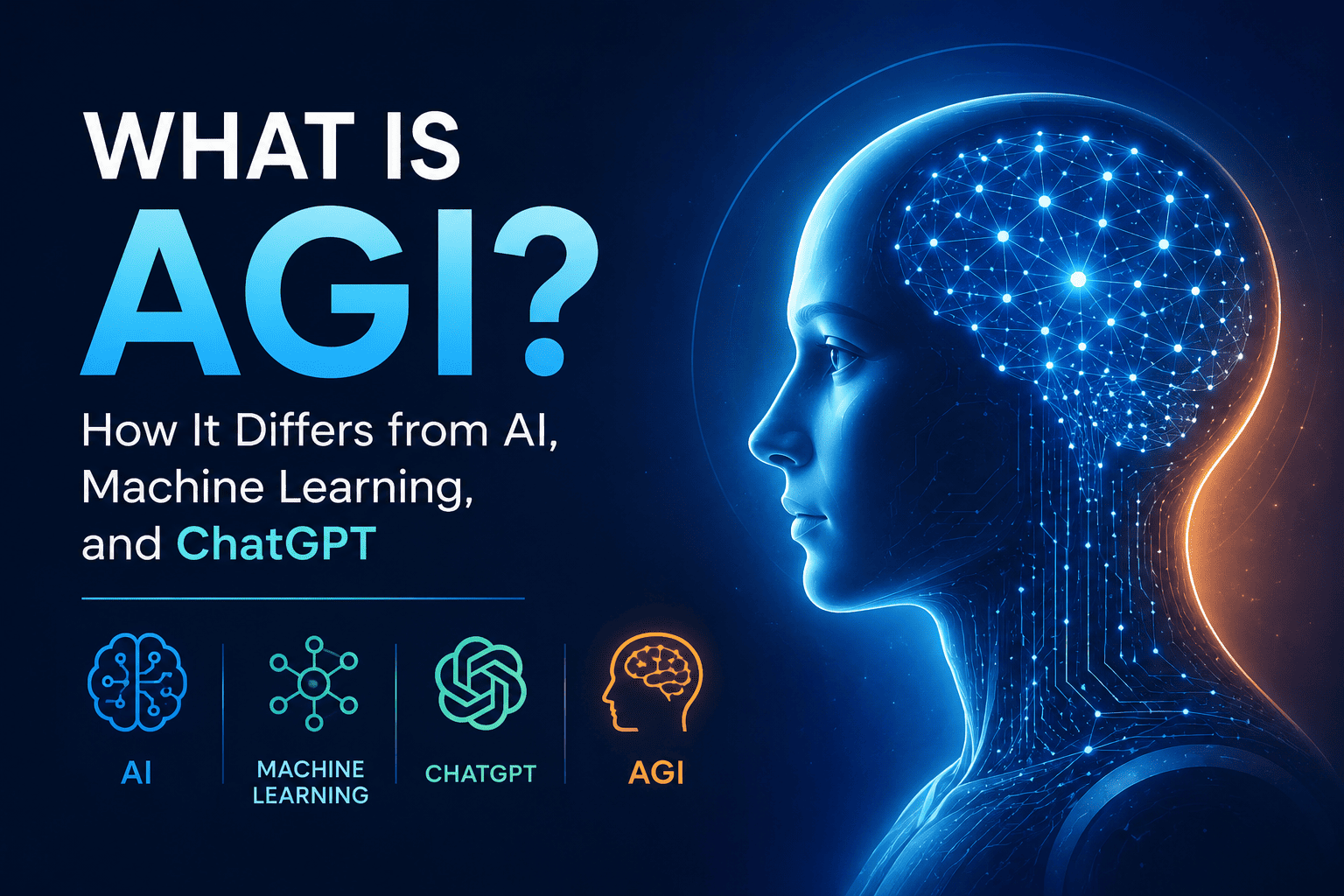
What Is Artificial General Intelligence (AGI)? How It Differs from AI, Machine Learning, and ChatGPT
AGI Explained: Understanding the Next Frontier of Artificial Intelligence
Artificial intelligence has moved from science fiction into everyday life.
Millions of people now use AI assistants to write emails, generate images, analyze data, translate languages, create software, and answer complex questions. Tools like ChatGPT have introduced the world to a new generation of intelligent systems that can communicate naturally and perform tasks that once required human expertise.
But a bigger question is emerging:
What happens when artificial intelligence stops being specialized and begins thinking more like a human?
That question leads us to one of the most debated concepts in technology today:
Artificial General Intelligence (AGI).
AGI represents the idea of machines that can understand, learn, reason, and adapt across a wide range of tasks—much like a human being.
Unlike today’s AI systems, which are designed to perform specific functions, AGI would theoretically possess a broad form of intelligence capable of solving unfamiliar problems, transferring knowledge between different fields, and continuously improving its abilities.
But is AGI real yet?
How does AGI compare with current artificial intelligence?
And what could the future of AGI mean for humanity?
Let’s explore.
What Is Artificial General Intelligence (AGI)?
Artificial General Intelligence is a theoretical form of artificial intelligence that can perform intellectual tasks at a level comparable to humans.
Simply put:
AGI is AI that can learn and think broadly instead of being limited to one specific task.
A human can:
- Learn mathematics
- Write poetry
- Repair a machine
- Learn a new language
- Understand emotions
- Adapt to completely new situations
AGI aims to create machines with similar flexibility.
Today’s AI might be excellent at writing text, recognizing images, or analyzing financial data, but it does not truly understand the world in the same adaptable way humans do.
A future AGI system could potentially:
- Learn a new skill without being specifically programmed
- Apply knowledge from one area to another
- Understand context and complex situations
- Reason through unfamiliar problems
- Make independent decisions
- Improve its own abilities over time
The goal of AGI is not simply creating a faster computer.
It is creating a machine capable of general intelligence.
AGI Explained: The Difference Between Narrow AI and General Intelligence
To understand AGI, it helps to understand the AI systems we already use.
Most modern artificial intelligence is known as Artificial Narrow Intelligence (ANI).
Narrow AI is designed for specific tasks.
Examples include:
- Voice assistants recognizing speech
- Recommendation systems suggesting movies or products
- Fraud detection systems identifying suspicious transactions
- AI programs analyzing medical images
- Customer service chatbots
These systems can be incredibly powerful.
However, they operate within defined boundaries.
For example:
- A chess AI can defeat the world’s best players but cannot cook dinner or write a novel.
- A medical AI can identify diseases from scans but cannot suddenly become an expert in engineering or history.
Narrow AI
- Specializes in one area
- Performs specific tasks
- Does not transfer knowledge easily
- Requires human-designed objectives
Artificial General Intelligence
- Handles many different domains
- Learns new skills independently
- Applies knowledge broadly
- Adapts to unfamiliar situations
The difference is similar to comparing a calculator with a mathematician.
A calculator performs calculations faster than any human, but it does not understand mathematics.
A mathematician understands concepts, creates new ideas, and solves unfamiliar problems.
AGI aims to achieve that second capability.
AGI vs AI: What Is the Difference?
One of the most common questions is:
What is the difference between AI and AGI?
The simplest answer:
AI is the broader category. AGI is a specific type of AI that aims to achieve human-like intelligence.
Think of AI as the entire ocean.
AGI is one specific destination within that ocean.
Artificial intelligence includes:
- Machine learning
- Deep learning
- Computer vision
- Natural language processing (NLP)
- Robotics
- Generative AI
AGI represents a future stage where these capabilities are combined into a flexible, general-purpose intelligence.
A modern AI system may answer questions, but it does not necessarily understand the world behind those answers.
AGI would theoretically possess deeper reasoning and understanding.
Machine Learning vs AGI: Why They Are Not the Same
Machine learning is one of the technologies that powers modern AI.
Machine learning allows computers to identify patterns from data and improve performance without being manually programmed for every situation.
Examples include:
- Streaming platforms recommending shows
- Email providers detecting spam
- Banks identifying suspicious transactions
However, machine learning systems are generally trained for specific purposes.
AGI requires something much broader.
An AGI system would need to combine multiple abilities, including:
- Learning
- Reasoning
- Memory
- Planning
- Problem-solving
- Understanding
- Adaptation
Machine learning is a building block.
AGI is the larger vision.
Artificial General Intelligence vs ChatGPT: Is ChatGPT AGI?
Since the launch of ChatGPT, many people have asked:
Is ChatGPT AGI?
The short answer:
No. ChatGPT is not considered Artificial General Intelligence.
ChatGPT is a powerful example of generative AI.
It can:
- Write articles
- Explain concepts
- Generate code
- Summarize information
- Assist with research
- Hold conversations
However, it still operates differently from human intelligence.
ChatGPT does not have:
- Human consciousness
- Personal experiences
- Independent goals
- Real-world understanding like humans
- The ability to freely learn any skill without limitations
Modern AI models are incredibly advanced, but they remain specialized systems.
The difference between ChatGPT and AGI is not simply about intelligence level.
It is about flexibility.
A human can wake up tomorrow and decide to learn architecture, study biology, write music, or start a business.
A current AI system cannot independently navigate the world in that way.
Is AGI Real Yet?
This is one of the biggest debates in technology.
The honest answer:
No one knows exactly when—or if—AGI will arrive.
Some researchers believe AGI could emerge within decades.
Others argue that creating human-level intelligence may be far more difficult than expected.
Predictions vary widely.
Current AI systems still struggle with challenges such as:
- Common-sense reasoning
- Understanding physical reality
- Long-term planning
- Reliability
- Independent learning
The difficulty is that intelligence itself remains poorly understood.
Scientists can build increasingly powerful systems, but they are still trying to explain how human intelligence truly works.
Why Companies Are Racing Toward AGI
The potential economic impact of AGI is enormous.
A successful AGI system could transform nearly every industry.
Healthcare
AGI could assist doctors by analyzing medical research, developing treatments, and helping diagnose complex conditions.
Education
Personalized AI tutors could provide customized learning experiences for students worldwide.
Science
AGI could accelerate discoveries in:
- Climate research
- Physics
- Medicine
Business
Companies could use AGI for:
- Strategy
- Automation
- Research
- Decision-making
Engineering
AGI could help:
- Design advanced technologies
- Improve manufacturing
- Solve complex technical problems
This potential explains why companies such as OpenAI, Google DeepMind, Microsoft, and others are investing heavily in advanced AI research.
The Risks and Challenges of AGI
While AGI could create enormous benefits, it also raises serious questions.
Job Disruption
If machines can perform a wide range of human tasks, many industries could experience significant change.
Jobs may not simply disappear, but the nature of work could evolve dramatically.
Safety Concerns
A highly capable AI system would require strong safeguards.
Researchers are studying how to ensure advanced AI systems remain aligned with human values and goals.
Economic Inequality
If AGI benefits are controlled by only a small number of organizations, wealth gaps could increase.
Security Risks
Advanced AI could potentially be misused for:
- Cyberattacks
- Misinformation
- Other harmful activities
These challenges are why many experts emphasize responsible AI development.
The Future of AGI: What Could Happen Next?
The future of AGI remains uncertain.
Several possibilities exist.
A Positive Future
AGI could become one of humanity’s greatest tools.
It could help solve difficult problems, improve healthcare, accelerate scientific discoveries, and increase global prosperity.
A Transformative Future
AGI could completely reshape how people:
- Work
- Learn
- Interact with technology
Many existing jobs could change while entirely new industries emerge.
A Challenging Future
Without careful management, AGI could create serious social, economic, and security challenges.
The outcome will depend not only on technological progress but also on decisions made by governments, researchers, businesses, and society.
Why AGI Matters to Everyone
Even if AGI does not arrive tomorrow, the conversation around it already affects the world.
AI is changing:
- How businesses operate
- How people work
- How students learn
- How information is created
- How decisions are made
Understanding AGI helps people prepare for a future where intelligent machines may become increasingly integrated into daily life.
The question is no longer whether artificial intelligence will influence society.
It already does.
The bigger question is:
How far can intelligence created by humans go?
Final Thoughts
Artificial General Intelligence represents one of the most ambitious goals in the history of technology.
While today’s AI systems are powerful, they remain fundamentally different from the flexible intelligence humans possess.
AGI aims to bridge that gap by creating machines capable of learning, reasoning, and adapting across many areas of knowledge.
Whether AGI arrives in years, decades, or never remains uncertain.
But one thing is clear:
The race to understand and develop advanced artificial intelligence will shape the future of humanity.
The age of intelligent machines has already begun.
The next chapter may define the century ahead.




2 Comments
Micle harison
June 7, 2019Lorem ipsum dolor sit amet, usu ut perfecto postulant deterruisset, libris causae volutpat at est, ius id modus laoreet urbanitas. Mel ei delenit dolores.
John Doe
June 7, 2019Some consultants are employed indirectly by the client via a consultancy staffing company.