
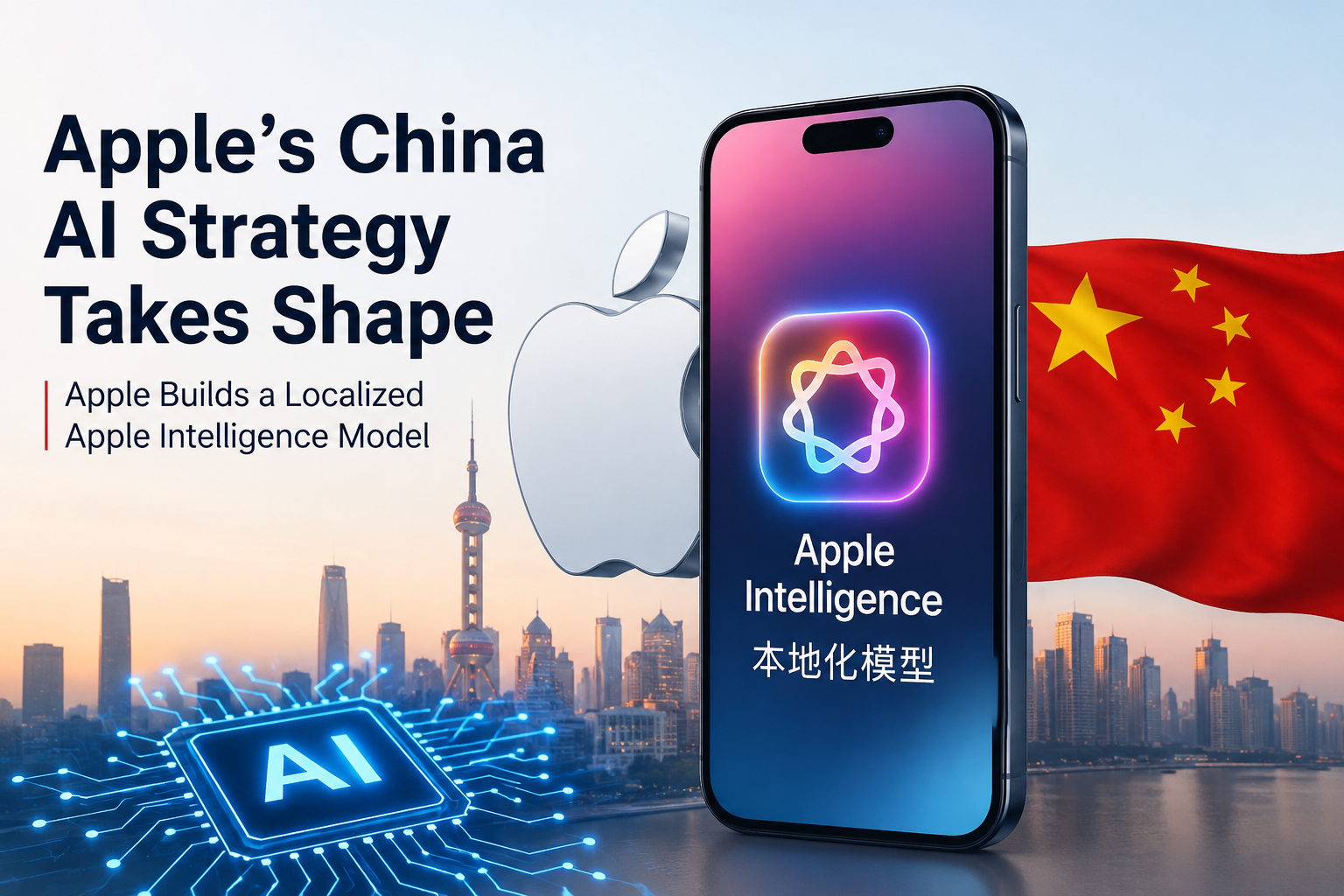
Apple’s China AI Strategy Takes Shape as the iPhone Maker Builds a Localized Apple Intelligence Model
Apple is taking a more localized approach to artificial intelligence in China as the iPhone maker works to adapt Apple Intelligence to one of its most important and complicated markets.
The strategy reflects a broader shift in the global AI industry. Rather than relying entirely on a single AI architecture or one set of cloud services worldwide, major technology companies are increasingly tailoring AI products to individual countries because of differences in regulation, data governance, language, infrastructure and consumer expectations.
For Apple, China presents an especially important challenge. The country remains a major manufacturing base and a significant market for the iPhone, but its regulatory environment for generative AI differs substantially from that of the United States and other markets.
Why China Matters to Apple’s AI Ambitions
Apple Intelligence is designed to bring generative AI capabilities directly into Apple’s ecosystem, including writing assistance, notification summaries, image creation, Siri improvements and other features integrated into iPhone, iPad and Mac experiences.
But delivering those capabilities in China requires more than simply translating Apple’s existing AI systems into Mandarin.
China has established rules governing generative artificial intelligence services, including requirements concerning data, security, content management and regulatory oversight. Foreign technology companies therefore face additional hurdles when attempting to introduce AI services that were developed primarily for other markets.
That has pushed Apple toward a localized strategy.
Instead of treating China as another market where the global version of Apple Intelligence can simply be switched on, Apple appears to be building an AI experience designed around local requirements.
Apple Intelligence Needs a Different Model for China
The development of a China-specific Apple Intelligence model could allow Apple to control more closely how its AI features operate within the country’s regulatory framework.
A localized model could be trained, fine-tuned or deployed using infrastructure and datasets that meet Chinese requirements. It could also be designed to handle Chinese-language prompts and cultural context more effectively.
This matters because generative AI performance depends heavily on language and context.
A system that performs impressively in English does not automatically provide the same quality in Mandarin. Chinese users may expect accurate handling of regional expressions, writing conventions, search behavior and cultural references.
Localization could therefore improve both regulatory compliance and the actual user experience.
Apple Has Been Exploring Local AI Partnerships
Apple’s approach in China has reportedly involved working with domestic technology companies as it looks for partners capable of supporting its AI ambitions.
The company’s challenge is unusual because Apple has historically emphasized tight control over its hardware, software and services ecosystem.
AI introduces a different set of requirements.
Large-scale AI systems require enormous computing resources, specialized models, extensive training data and cloud infrastructure. In a market where Apple must navigate local regulations, partnering with established Chinese technology companies can potentially provide access to capabilities that would be difficult to build independently.
That could make Apple’s China AI strategy less about choosing one global model and more about creating an ecosystem of local partnerships.
The Regulatory Challenge Is Central to the Strategy
The biggest obstacle for Apple is not necessarily the technical difficulty of creating an AI model.
It is the need to ensure that the model and the services built around it satisfy China’s regulatory requirements.
Chinese authorities have developed a regulatory framework for generative AI that places significant emphasis on areas such as information security, responsible AI development and content management.
For Apple, this creates a fundamentally different product-development environment from the one it faces in many Western markets.
An AI assistant must generate useful answers while also operating within applicable local rules. That can influence everything from model training and content filtering to where information is processed and which companies provide the underlying technology.
The result is likely to be a more fragmented Apple Intelligence experience globally.
A Separate Chinese AI Stack Could Become Necessary
Apple’s broader AI architecture has emphasized a combination of on-device processing and cloud-based computation through its Private Cloud Compute infrastructure.
That approach allows Apple to perform certain AI tasks locally on compatible devices while sending more demanding requests to specialized cloud infrastructure when necessary.
China could require a different implementation.
Local data-processing requirements, infrastructure restrictions and regulatory considerations may mean that some AI workloads need to be handled through China-based systems or partnerships.
If that happens, Apple could effectively operate different versions of its AI infrastructure in different regions.
That would represent a significant departure from the traditional simplicity of Apple’s software strategy.
For users, the difference could be invisible. Apple could maintain the same interface and branding while the technology underneath varies depending on where the device is being used.
The China Strategy Could Affect the iPhone Experience
AI is becoming an increasingly important part of the smartphone competition.
Companies such as Samsung Electronics and Chinese smartphone manufacturers are already incorporating generative AI into cameras, search, translation, productivity tools and digital assistants.
That puts pressure on Apple to make Apple Intelligence broadly available.
If Chinese iPhone users cannot access the same AI features as customers in other major markets, the difference could become increasingly noticeable as AI becomes a standard part of smartphone software.
A localized Chinese Apple Intelligence system could help close that gap.
It could also give Apple greater control over how AI is integrated into the iPhone without requiring the company to abandon its global approach.
China’s Domestic AI Industry Changes the Competitive Landscape
Apple is entering a Chinese AI market that already has a large and rapidly developing domestic ecosystem.
Companies including Baidu, Alibaba Group and other major technology firms have invested heavily in large language models and generative AI products.
China’s smartphone manufacturers are also building AI directly into their devices.
This creates a different competitive environment for Apple than it faces in markets where Apple’s ecosystem and brand have historically provided a significant advantage.
The company needs its AI experience to be competitive while also satisfying local requirements.
That makes partnerships potentially important, but it also raises questions about how much control Apple will retain over the underlying technology.
Privacy Could Become an Important Differentiator
Privacy has been one of Apple’s central selling points as it has expanded into AI.
The company has emphasized processing information on-device where possible and using specialized cloud infrastructure for more complex requests.
A China-specific AI architecture could complicate that message.
Apple will need to balance its privacy principles with the technical and regulatory requirements of operating AI services in China.
The company may therefore need to explain carefully how user data is processed, where AI requests are handled and what information is retained.
For consumers, those details could become just as important as the AI features themselves.
Apple’s China AI Strategy Reflects a Bigger Industry Shift
The development of localized AI systems is not unique to Apple.
Artificial intelligence is increasingly being shaped by national regulations, data sovereignty rules and geopolitical competition.
Governments want greater control over how AI systems operate within their borders, while technology companies want to deploy products globally without creating entirely separate platforms for every country.
Those objectives do not always align.
The result is a likely future in which AI services become more regionally differentiated.
A chatbot in the United States may rely on one model and infrastructure stack, while a similar product in China, Europe or another heavily regulated market could use a different combination of models, servers and technology partners.
Apple’s China strategy provides an early example of what that future could look like.
What Apple’s Localized AI Model Could Mean for Consumers
For Chinese iPhone users, the most important question will ultimately be whether Apple’s localized approach delivers a competitive AI experience.
Users are likely to care less about which model sits behind Apple Intelligence and more about whether Siri understands them, whether writing tools work naturally in Chinese, whether image-generation features are useful and whether AI can interact effectively with everyday apps.
Apple’s ability to make those experiences feel seamless will be crucial.
The company has spent years building an ecosystem in which hardware and software work together closely. AI gives Apple an opportunity to extend that advantage, but only if its AI services are available and effective across its major markets.
The Bigger Business Implications for Apple
China remains strategically important to Apple’s global business, making AI availability there more than a software feature issue.
The company’s future growth increasingly depends on keeping the iPhone competitive as smartphone manufacturers differentiate themselves through AI.
A successful localized Apple Intelligence platform could help Apple preserve the iPhone’s appeal among Chinese consumers while demonstrating that its AI strategy can adapt to highly regulated markets.
It could also create a template for Apple to use elsewhere.
As governments introduce their own AI rules, Apple may increasingly need to build regional versions of services while maintaining a consistent global product identity.
A More Regional Future for Apple Intelligence
Apple’s emerging China AI strategy signals that the next phase of the company’s artificial intelligence push may be less centralized than its traditional software model.
The goal will not simply be to build one powerful Apple Intelligence system and deploy it everywhere. Instead, Apple may need to combine its own technology with local models, infrastructure and partners to satisfy the requirements of individual markets.
China is likely to be one of the most demanding tests of that approach.
If Apple can deliver a localized AI experience without compromising the integration, privacy positioning and simplicity that define its products, the China strategy could become an important part of the company’s broader AI playbook.
For the iPhone maker, the race is no longer only about building better AI. It is increasingly about building AI that can work wherever Apple’s customers are—and under very different rules.




2 Comments
Micle harison
June 7, 2019Lorem ipsum dolor sit amet, usu ut perfecto postulant deterruisset, libris causae volutpat at est, ius id modus laoreet urbanitas. Mel ei delenit dolores.
John Doe
June 7, 2019Some consultants are employed indirectly by the client via a consultancy staffing company.