
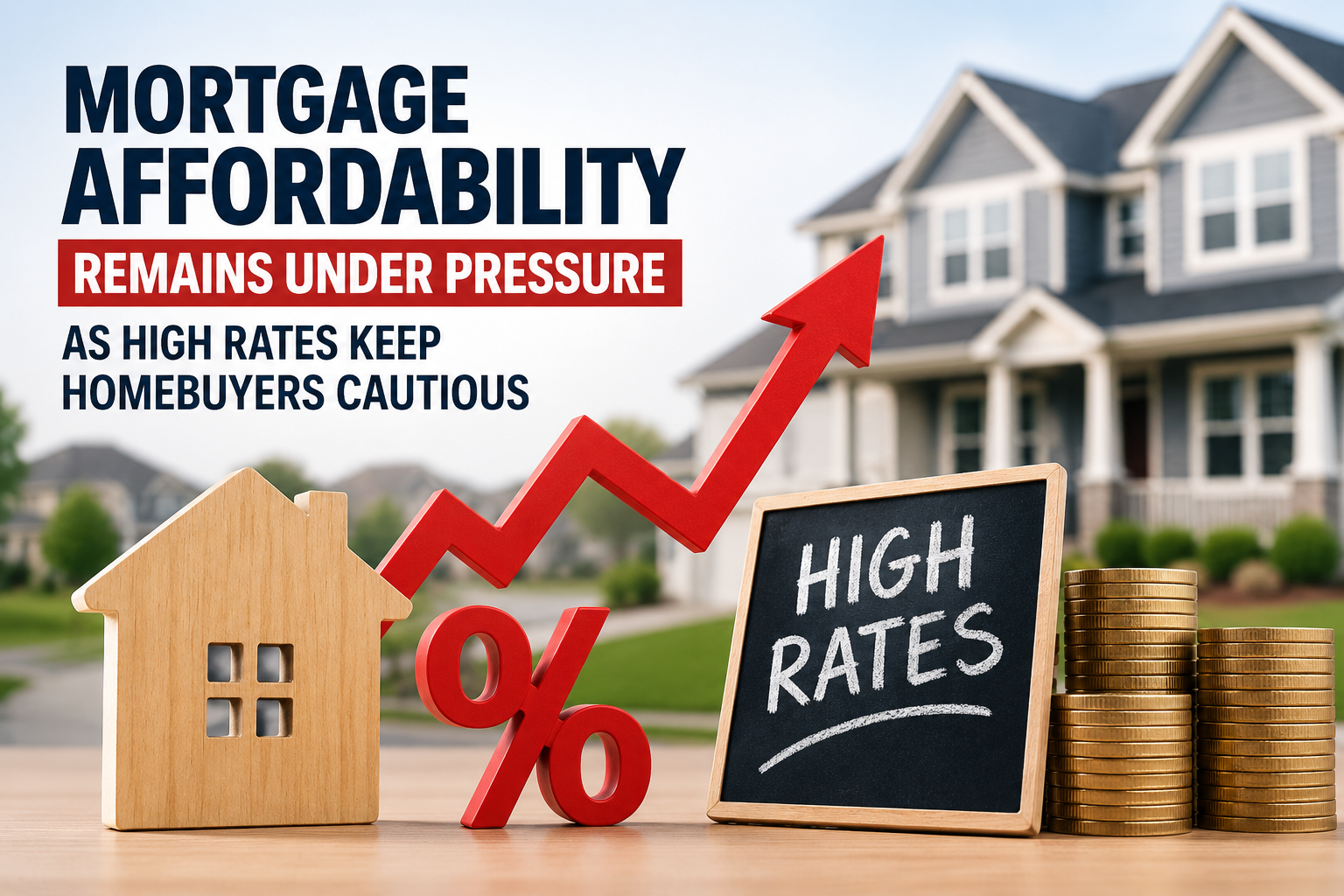
Mortgage Affordability Remains Under Pressure as High Rates Keep Homebuyers Cautious
For many Americans hoping to buy a home, the biggest obstacle is no longer simply finding a property they like. It is figuring out whether the monthly payment fits comfortably within the household budget.
Mortgage rates remain elevated, keeping borrowing costs well above the levels many buyers became accustomed to during the pandemic. Freddie Mac reported that the average U.S. 30-year fixed mortgage rate was 6.67% on August 13, 2026, compared with 6.58% a year earlier. The 15-year fixed rate averaged 5.96%. (Freddie Mac)
That relatively small year-over-year change can make a meaningful difference when combined with home prices, property taxes, insurance, maintenance and other costs of homeownership.
Why Mortgage Rates Matter So Much for Affordability
A mortgage rate affects far more than the interest portion of a loan. It directly determines how much a borrower must pay every month and, consequently, how expensive a home a household can reasonably afford.
Consider a simplified example. On a $300,000 30-year mortgage, the principal-and-interest payment would be roughly:
| Interest Rate | Approx. Monthly Payment |
|---|---|
| 4% | $1,432 |
| 5% | $1,610 |
| 6% | $1,799 |
| 6.67% | $1,929 |
| 7% | $1,996 |
These figures exclude property taxes, homeowners insurance, mortgage insurance and other housing expenses.
Freddie Mac’s own examples show the same relationship: a $300,000 mortgage at 6.5% carries an approximate principal-and-interest payment of $1,896, compared with about $1,996 at 7%. (My Home)
The lesson is straightforward: even a relatively modest change in mortgage rates can materially change purchasing power.
Homebuyers Are Facing More Than Just Interest Costs
Mortgage affordability cannot be judged by the interest rate alone.
A household purchasing a home also has to account for:
- Down payment requirements
- Property taxes
- Homeowners insurance
- Mortgage insurance
- Homeowners association fees
- Utilities
- Repairs and maintenance
- Closing costs
- Moving expenses
- Furnishing and renovation costs
That means a mortgage payment that looks manageable on paper can become uncomfortable once the full cost of owning the property is included.
This is one reason financial planners often encourage buyers to evaluate total housing costs, rather than focusing only on the mortgage payment a lender says they qualify for.
Higher Rates Reduce How Much Buyers Can Borrow
The relationship between rates and purchasing power is particularly important.
Suppose two households have exactly the same income and down payment. The household shopping when mortgage rates are 4% can generally afford a larger loan payment for the same monthly budget than the household shopping at 6.67%.
In other words, higher rates effectively reduce the amount of house a buyer can afford.
That can force prospective homeowners to make difficult choices:
- Look at less expensive homes
- Increase the down payment
- Reduce other monthly expenses
- Delay purchasing
- Consider a different location
- Wait for more favorable financing conditions
Some buyers may also choose to continue renting while building savings and waiting for a better opportunity.
Buyers Are Becoming More Cautious
The current housing environment shows signs of hesitation among both buyers and builders.
Recent reporting indicates that mortgage rates around the upper-6% range are weighing on demand, while housing starts have also weakened. Builders have increasingly used incentives such as mortgage-rate buydowns and price reductions to attract buyers. (The Wall Street Journal)
That creates an unusual dynamic.
Buyers may have more negotiating power than they did during periods of extremely limited inventory, but financing remains expensive enough to prevent many households from taking advantage of it.
For someone who can afford a $2,000 monthly housing payment, for example, a lower mortgage rate could potentially translate into substantially more purchasing power without increasing the household’s budget.
Home Prices and Mortgage Rates Work Together
It is tempting to think that falling home prices automatically make housing more affordable.
But affordability depends on both the price of the property and the cost of financing it.
Imagine a $400,000 home becomes 5% cheaper. That sounds like significant relief. But if mortgage rates rise at the same time, the reduction in the purchase price may not fully offset the increase in monthly financing costs.
The reverse is also possible.
A buyer could face relatively high home prices but benefit from a meaningful decline in mortgage rates, making the monthly payment more manageable.
This is why prospective homeowners need to watch the entire affordability equation rather than focusing on house prices alone.
The Bond Market Is Also Part of the Story
Mortgage rates do not move in lockstep with the Federal Reserve’s benchmark interest rate.
Long-term mortgage rates are strongly influenced by conditions in the bond market, particularly the yield on longer-term U.S. Treasury securities.
Recent increases in Treasury yields have therefore created another source of pressure for prospective homeowners. Some long-term Treasury yields recently reached their highest levels in years, pushing borrowing costs higher across the economy. (Investopedia)
That means even if investors expect the Federal Reserve to eventually lower its policy rate, mortgage rates do not necessarily fall immediately.
Inflation expectations, government borrowing, bond-market demand and economic conditions can all influence mortgage rates.
Why Waiting for Lower Rates Is Not a Guaranteed Win
For buyers who are currently priced out, waiting may be sensible.
But there is no guarantee that waiting will produce a cheaper home.
If mortgage rates decline, more buyers could return to the market. Increased competition could then support home prices, reducing some of the benefit from lower financing costs.
There is also no certainty about when rates will fall substantially.
Freddie Mac’s latest data showed the 30-year fixed rate at 6.67% in mid-August, only slightly below the previous week’s 6.69%. The rate remained above its level from the same period a year earlier. (Freddie Mac)
For that reason, buyers should generally base a purchase decision on whether the home is affordable under today’s conditions, rather than assuming a future refinance will make the numbers work.
What Prospective Buyers Can Do Now
Higher mortgage rates do not necessarily mean buyers have no options.
Strengthen Your Credit Profile
A stronger credit history can improve the mortgage offers available to you. Before applying, check your credit reports for errors and avoid taking on unnecessary new debt.
Increase Your Down Payment When Practical
A larger down payment reduces the amount borrowed and may lower monthly payments. However, buyers should avoid draining their entire savings account just to reach a particular down-payment percentage.
Maintaining cash reserves after closing is important.
Compare Multiple Lenders
Mortgage offers can vary considerably between lenders.
Shopping around can potentially save borrowers thousands of dollars over the life of a loan, particularly when differences in rates, fees and closing costs are considered.
Look Beyond the Headline Rate
A mortgage with a slightly lower advertised rate is not automatically the cheapest option.
Compare:
- Annual percentage rate
- Origination fees
- Discount points
- Closing costs
- Rate-lock terms
- Prepayment provisions
- Loan features
The goal is to evaluate the total cost of borrowing, not just one percentage.
Consider the Full Monthly Housing Budget
Before making an offer, estimate:
Mortgage + taxes + insurance + HOA + utilities + maintenance + other recurring costs
That number provides a much more realistic picture of affordability.
Mortgage Rate Changes Can Create Big Differences
The effect becomes particularly clear when comparing different rates on a $300,000 loan.
At 4%, principal and interest would be about $1,432 per month.
At 6.67%, the payment rises to approximately $1,929.
That is almost $500 more every month, or roughly $6,000 a year, before considering taxes and insurance.
Over decades, the cumulative difference in interest can become enormous.
This illustrates why mortgage rates receive so much attention from homebuyers: the rate can determine whether a particular property fits within a household’s long-term financial plan.
Sellers May Need to Adjust Too
The affordability problem does not affect buyers alone.
When financing becomes expensive, fewer potential buyers may be able or willing to purchase homes at previous prices. Sellers may therefore have to compete more aggressively for available buyers.
That can result in:
- Price reductions
- Seller-paid closing costs
- Mortgage-rate buydowns
- Home repair credits
- Longer listing periods
- Greater negotiation over terms
Recent builder data already points toward increased use of incentives in an effort to stimulate demand. (Reuters)
For buyers with strong finances, this environment can create opportunities that were less available during highly competitive housing markets.
Renting Can Still Be a Rational Financial Choice
Homeownership is often presented as the ultimate financial goal, but buying is not automatically the better decision in every market.
Renting can make sense for households that:
- Expect to move within a few years
- Have limited savings
- Would struggle with maintenance costs
- Cannot comfortably afford current mortgage payments
- Want to avoid taking on excessive debt
- Are still building an emergency fund
The key question is not simply “Can I qualify for a mortgage?”
It is:
“Can I comfortably own this home without putting the rest of my financial life under pressure?”
That distinction can prevent households from becoming house poor—owning a home while having too little money left for savings, emergencies, retirement or everyday expenses.
What Could Improve Housing Affordability?
There are several possible paths toward better affordability.
Lower Mortgage Rates
A sustained decline in long-term borrowing costs would improve purchasing power for many households.
Slower Home-Price Growth
If home prices stop rising rapidly while wages continue increasing, affordability could gradually improve.
Higher Household Incomes
Income growth can help offset elevated mortgage costs, although the benefit depends on how quickly wages grow relative to housing expenses.
More Housing Supply
An increase in available homes could reduce competition and create more opportunities for buyers.
The current environment shows why none of these factors should be viewed in isolation.
The Bigger Financial Question for Homebuyers
The housing market is not simply waiting for mortgage rates to fall.
It is adjusting to a new environment in which borrowing costs remain substantially higher than the ultra-low rates that shaped housing decisions during the pandemic.
For prospective buyers, that means affordability needs to be treated as a household-budget decision rather than a race to qualify for the largest possible mortgage.
A buyer who chooses a slightly less expensive home, keeps a healthy emergency fund and maintains room for retirement savings may ultimately be in a stronger financial position than someone who stretches to purchase a more expensive property simply because a lender approves the loan.
A More Sustainable Path to Homeownership
The latest mortgage-rate data suggests that meaningful affordability relief may not arrive simply because buyers hope rates will fall. Freddie Mac’s August figures remain in the mid-6% range, while broader bond-market conditions continue to influence borrowing costs. (Freddie Mac)
For households considering a purchase, the most useful strategy is therefore to control the factors they can: build savings, protect credit, compare lenders, understand the complete cost of ownership and choose a payment that leaves room for the rest of life.
If rates eventually decline, refinancing could provide an opportunity for some homeowners. But a home purchase should ideally make financial sense before that possibility enters the equation.



2 Comments
Micle harison
June 7, 2019Lorem ipsum dolor sit amet, usu ut perfecto postulant deterruisset, libris causae volutpat at est, ius id modus laoreet urbanitas. Mel ei delenit dolores.
John Doe
June 7, 2019Some consultants are employed indirectly by the client via a consultancy staffing company.