
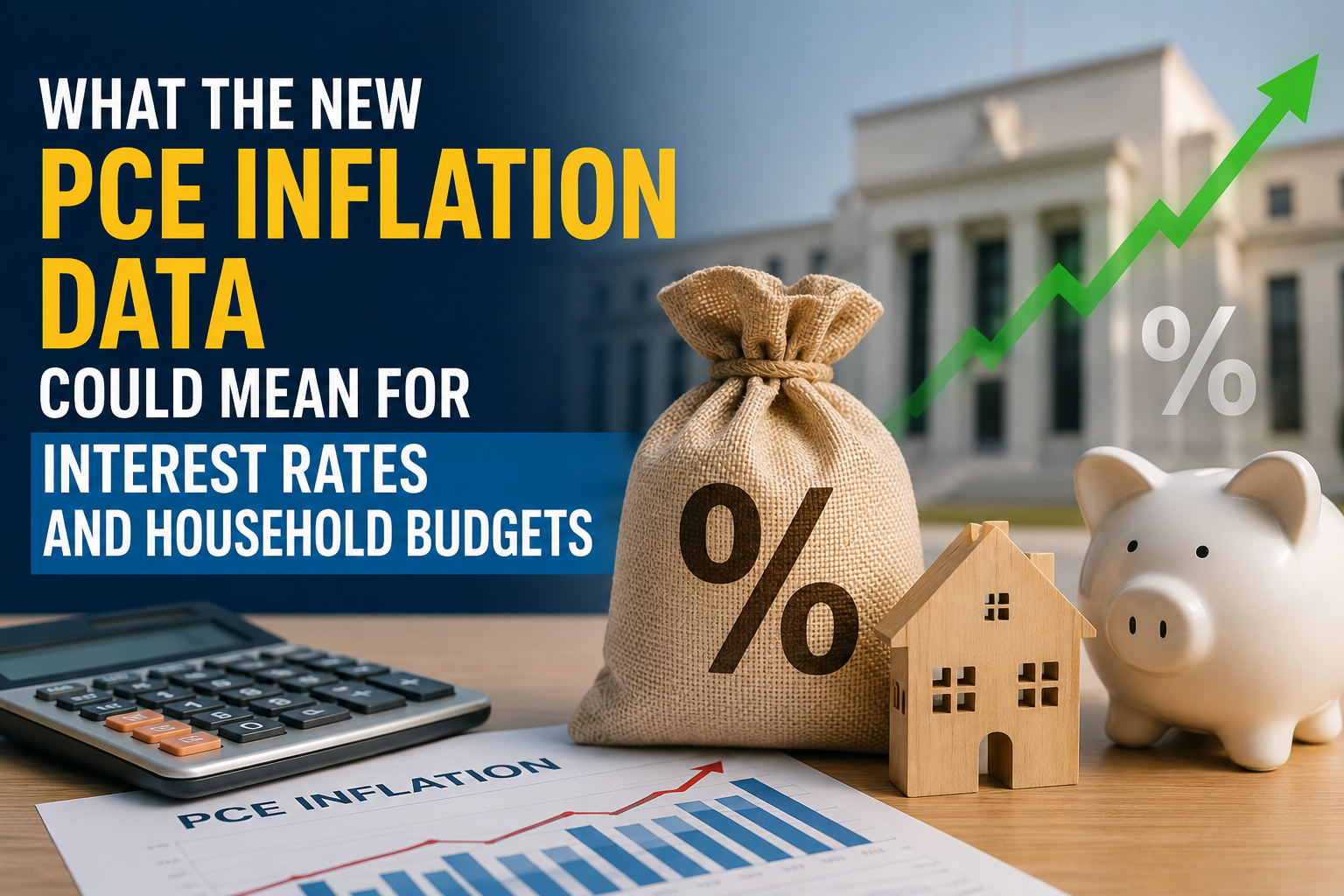
What the New PCE Inflation Data Could Mean for Interest Rates and Household Budgets
The latest inflation picture is putting the Federal Reserve in a difficult position: price pressures remain well above its 2% target, but parts of the economy are beginning to show signs of cooling.
That makes the upcoming Personal Consumption Expenditures (PCE) inflation report for July particularly important. The U.S. Bureau of Economic Analysis is scheduled to release the data on August 26, giving policymakers and investors another important look at whether inflation is continuing to ease or proving more persistent than hoped. (Bureau of Economic Analysis)
For households, the report is about more than a number on an economic calendar. The inflation figures could influence expectations for interest rates, borrowing costs, savings returns and the amount of purchasing power consumers have left at the end of each month.
Why the PCE Report Matters
The PCE price index measures changes in the prices consumers pay for a broad range of goods and services. Unlike the Consumer Price Index (CPI), the PCE measure can better capture changes in consumer spending patterns, which is one reason it receives particular attention from the Federal Reserve. (Bureau of Economic Analysis)
The core PCE index, which excludes food and energy prices, is especially important because it provides a clearer view of underlying inflation trends. The Federal Reserve closely watches this measure when assessing monetary policy. (Bureau of Economic Analysis)
The most recent available PCE data showed headline inflation at 3.7% year over year in June, while core PCE inflation was 3.3%. Both figures were still significantly above the Fed’s 2% inflation goal. (Bureau of Economic Analysis)
That leaves policymakers with little room to declare victory over inflation.
The Fed Is Already Facing a Difficult Rate Decision
At its July 28–29 meeting, the Federal Reserve left its benchmark interest-rate target unchanged at 3.50% to 3.75%. The decision was notable because three policymakers preferred a quarter-point rate increase rather than keeping rates unchanged. (Federal Reserve)
The meeting minutes subsequently showed that inflation concerns had intensified among some officials. Several policymakers indicated that higher rates could become necessary if inflation remains elevated. (Reuters)
That means the July PCE figures arrive at an especially important moment.
If inflation comes in hotter than expected, investors could increase their expectations for another rate increase. If the report shows a meaningful slowdown, however, policymakers may have more reason to wait and assess whether inflation is naturally moving lower.
Recent economic forecasts have generally leaned toward the Fed holding rates steady rather than immediately raising them, although a September increase remains a possibility. A Reuters survey of economists found that a strong majority expected the central bank to keep rates unchanged through the end of 2026. (Reuters)
What a Hotter-Than-Expected PCE Reading Could Mean
A higher-than-expected PCE reading would reinforce the argument that inflation is proving stubborn.
For the Federal Reserve, that could mean keeping monetary policy restrictive for longer—or potentially raising rates if officials believe inflation is becoming entrenched.
For consumers, the consequences could appear in several places.
Borrowing Could Stay Expensive
Credit cards, personal loans and other forms of variable-rate borrowing can remain costly when interest rates are elevated.
Mortgage borrowers may also feel the impact indirectly. Although mortgage rates are influenced by long-term Treasury yields and broader financial-market conditions rather than simply moving in lockstep with the Fed’s policy rate, expectations for future monetary policy can affect borrowing costs.
Mortgage rates have remained elevated, with the average 30-year fixed mortgage rate recently around 6.65%, according to recent reporting. (AP News)
For someone planning to buy a home, even a relatively small change in mortgage rates can translate into a significant difference in monthly payments.
Savings Could Continue to Benefit
Higher interest rates are not necessarily bad news for every household.
People with money in high-yield savings accounts, money-market accounts or certificates of deposit can benefit from elevated yields. Current savings rates remain closely connected to expectations for Federal Reserve policy and broader market conditions. (The Wall Street Journal)
If inflation remains high and the Fed keeps rates elevated, savers may continue to find attractive opportunities to earn interest on cash.
But there is an important catch: a high savings rate does not automatically mean your money is gaining purchasing power.
If inflation is rising faster than the return on your savings, the real value of that money can still decline.
A Cooler PCE Reading Could Change the Conversation
The opposite scenario could be more encouraging.
If July PCE inflation shows that price pressures are cooling faster than expected, it could strengthen the argument for leaving interest rates unchanged rather than raising them.
That would not necessarily lead to immediate rate cuts. The Federal Reserve still has to be confident that inflation is moving sustainably toward its 2% objective.
Recent economic data have given policymakers competing signals. Inflation has shown some signs of moderation, while the labor market and consumer spending have also displayed areas of weakness. Those developments have contributed to a more cautious outlook for additional rate increases. (Reuters)
In other words, one PCE report is unlikely to determine the Fed’s next move by itself. Policymakers will be looking for a trend rather than a single month of data.
What It Could Mean for Household Budgets
For families, the most important issue is not whether inflation is 3.2%, 3.4% or 3.6%.
The bigger question is what happens to monthly purchasing power.
When prices continue rising faster than wages, households have to spend more to maintain the same lifestyle. A family that once spent $500 a month on groceries, transportation and household necessities may eventually need considerably more to purchase the same basket of goods and services.
Higher interest rates can add another layer of pressure through:
- Larger credit-card interest charges
- Higher personal-loan payments
- More expensive auto financing
- Costlier mortgages
- Higher financing costs for businesses that eventually reach consumers through prices
At the same time, households with substantial savings may benefit from higher interest income.
That creates an uneven inflation environment: borrowers generally feel more pressure from high rates, while disciplined savers can benefit from them.
Housing Could Remain One of the Biggest Pressure Points
Housing is particularly important because mortgage costs can dominate a household’s monthly budget.
Even if inflation begins to moderate, prospective homeowners may not immediately see dramatic relief. Mortgage rates depend on several factors, including expectations for future inflation, Treasury yields, financial-market conditions and lender pricing.
That means a cooling PCE report could eventually improve the interest-rate outlook without immediately making homes affordable.
For existing homeowners with fixed-rate mortgages, the direct effect may be limited. But renters, prospective buyers and households carrying variable-rate debt can remain exposed to the broader interest-rate environment.
Credit-Card Debt Deserves Extra Attention
One of the clearest personal-finance implications of prolonged higher rates is the cost of revolving debt.
Credit-card balances can become increasingly expensive when interest rates remain elevated. Unlike a fixed-rate loan, a revolving balance can continue generating interest month after month if the borrower does not pay it off.
For households already carrying debt, an uncertain inflation outlook is a reminder to prioritize high-interest balances where possible.
Paying down expensive debt can effectively provide a guaranteed financial benefit because every dollar of interest avoided is money that does not have to be earned later.
Investors Will Also Be Watching Closely
The PCE report is likely to matter beyond household finances.
Financial markets will use the inflation figures to reassess expectations for Federal Reserve policy. A hotter reading could push Treasury yields higher and put pressure on interest-rate-sensitive investments, while a softer report could have the opposite effect.
The broader market is already dealing with uncertainty over inflation, government borrowing and long-term interest rates. Recent reporting has highlighted elevated concerns in the Treasury market as investors assess whether inflation could remain above the Fed’s target for an extended period. (Financial Times)
That uncertainty can spill into mortgage rates, corporate borrowing costs and investment returns.
What Households Can Do Right Now
Consumers do not need to predict the PCE number to make sensible financial decisions.
Instead, the focus should be on making a household budget more resilient to either outcome.
If rates remain high:
- Pay down high-interest debt aggressively where possible.
- Avoid taking on unnecessary variable-rate debt.
- Compare savings accounts and certificates of deposit for better yields.
- Reconsider large purchases that require expensive financing.
- Keep an adequate emergency fund.
If rates eventually fall:
- Reassess refinancing opportunities.
- Review whether cash savings are still earning a competitive return.
- Consider how lower borrowing costs could affect major purchases.
- Continue prioritizing long-term savings rather than increasing spending simply because credit becomes cheaper.
The goal is not to make a perfect prediction about the Federal Reserve. It is to avoid having a household budget that depends on rates moving in a particular direction.
The Bigger Question Is Whether Inflation Is Actually Cooling
The upcoming PCE report will provide another important piece of evidence, but the bigger story is the direction of inflation over time.
The Federal Reserve has made clear that its target remains 2%, while current inflation is still considerably higher. (Federal Reserve)
That means even a modest improvement could still leave policymakers uncomfortable if prices continue rising faster than their objective.
For consumers, the best approach is therefore to prepare for an environment in which borrowing costs may stay elevated while prices remain higher than they were before the inflation surge.
The August 26 release could move expectations around interest rates, but the real financial impact will come from what happens afterward: whether inflation continues to cool, whether the labor market weakens further, and whether the Fed becomes more confident that price pressures are finally moving sustainably lower.
For household budgets, that distinction matters. The end of high inflation is not the same thing as the return of low prices. Even if inflation slows, consumers are still living with the higher price levels built up over previous years.
That is why the smartest response to the new PCE data may not be trying to guess the Fed’s next move. It may simply be making sure your finances can withstand either higher rates for longer or a gradual shift toward easier monetary policy.


2 Comments
Micle harison
June 7, 2019Lorem ipsum dolor sit amet, usu ut perfecto postulant deterruisset, libris causae volutpat at est, ius id modus laoreet urbanitas. Mel ei delenit dolores.
John Doe
June 7, 2019Some consultants are employed indirectly by the client via a consultancy staffing company.