
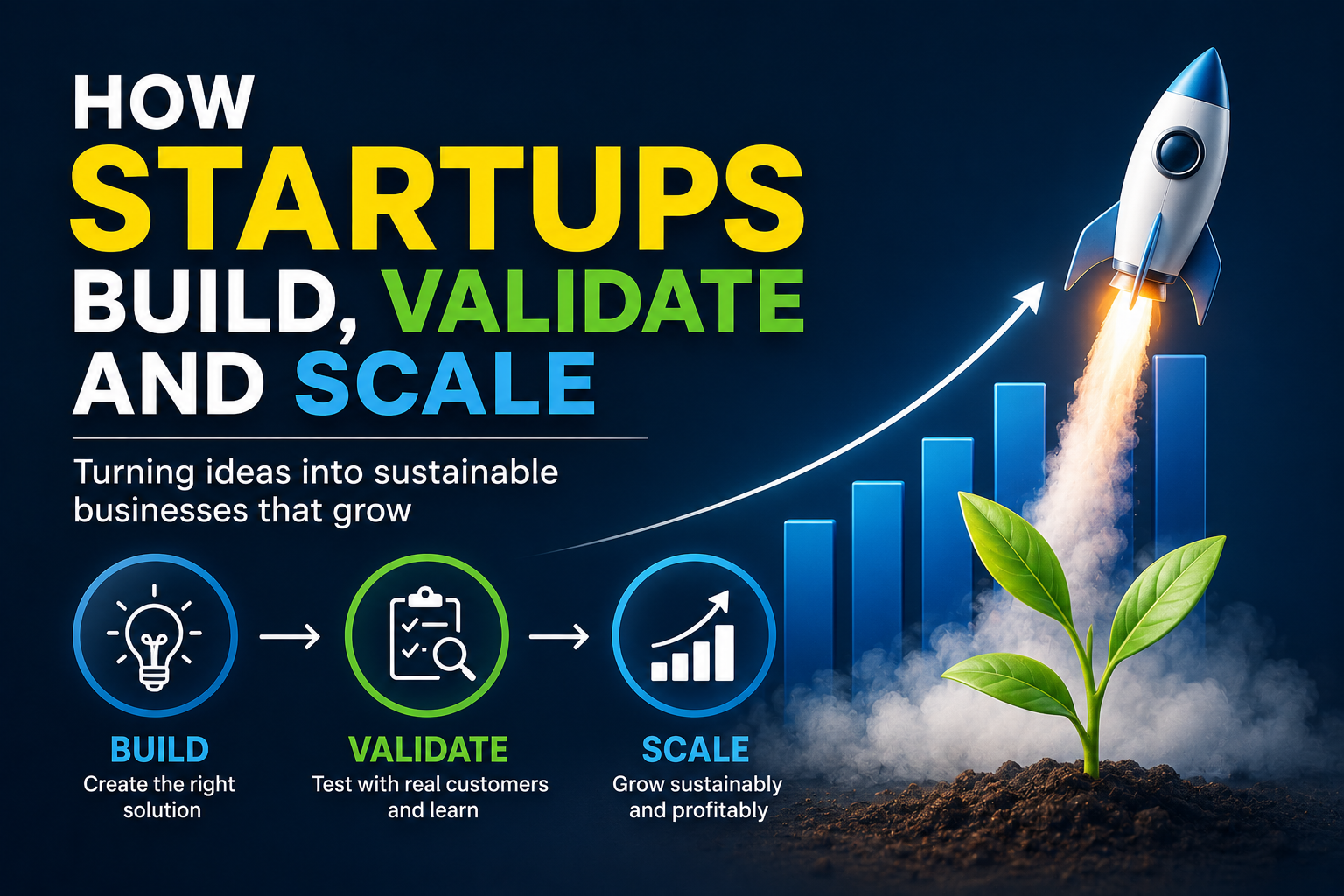
How Startups Build, Validate and Scale New Businesses
Starting a business is often portrayed as a simple formula: come up with a great idea, launch a product, attract customers and grow.
In reality, successful startups rarely follow such a straight path.
Building a new business usually involves testing assumptions, discovering what customers actually want, adjusting the product, finding a sustainable way to make money and eventually developing systems that can support growth. Many ideas fail along the way, while others evolve into businesses that look very different from what their founders originally imagined.
The most successful startups tend to treat entrepreneurship as a process of building, validating and scaling rather than simply launching a product and hoping customers arrive.
Understanding how those three stages work can help explain why some young companies gain traction while others struggle despite having promising ideas.
Start With a Real Customer Problem
A startup begins with an idea, but a sustainable business usually begins with a problem.
The distinction matters.
An entrepreneur may believe that customers need a particular product, but that assumption is not necessarily evidence of demand. People may like the idea without being willing to pay for it. They may already have another solution. Or the problem may not be important enough for them to change their behavior.
Strong startups therefore spend time understanding the problem before investing heavily in the solution.
That can involve talking directly with potential customers, studying existing products, examining industry data and observing how people currently solve the problem.
The goal is not simply to hear that an idea sounds good.
The more important question is whether the problem is significant enough that customers will actually take action to solve it.
Define the Target Customer
Trying to sell to everyone can make it difficult for a new business to develop a clear product and marketing strategy.
Startups often begin with a relatively specific customer segment.
That segment could be defined by factors such as:
- Industry
- Age group
- Location
- Income level
- Business size
- Professional role
- Specific customer problem
- Buying behavior
A narrowly defined initial market does not necessarily limit a company’s long-term potential.
Instead, it can give the startup a clear group of people to learn from.
For example, a software company might initially focus on independent accounting firms rather than attempting to sell to every business. By concentrating on one group, the company can better understand its customers’ workflows, frustrations and purchasing decisions.
Once the product works well for that group, the company can consider expanding into adjacent markets.
Build the Minimum Viable Product
One of the biggest mistakes new businesses can make is spending too much time building a perfect product before testing whether customers actually want it.
This is where the idea of a minimum viable product, or MVP, becomes useful.
An MVP is an early version of a product that contains enough functionality to test the most important business assumptions.
It does not necessarily mean building something cheap or poorly designed.
Instead, the objective is to avoid investing significant resources in features that customers may never use.
A startup developing a food-delivery platform, for example, might initially operate in one neighborhood with a limited number of restaurants rather than immediately building a nationwide service.
The first version provides an opportunity to answer fundamental questions:
- Will customers use the service?
- How frequently will they return?
- What are they willing to pay?
- Can restaurants participate profitably?
- How much does it cost to acquire each customer?
- Can orders be fulfilled reliably?
Those answers are often more valuable than months of development based entirely on assumptions.
Validation Is More Than Customer Feedback
Validation is one of the most important stages of building a startup.
It involves gathering evidence that the business solves a real problem and that customers are willing to exchange something valuable for the solution.
Positive feedback can be encouraging, but it is not necessarily proof of demand.
Someone saying, “That’s a great idea,” is very different from someone signing up, placing an order, subscribing or paying.
This is why startups often look for behavioral evidence.
Useful signals can include:
- Customers returning to use the product
- People paying for the service
- Growing subscription numbers
- Increasing order frequency
- Referrals between customers
- Customers requesting additional features
- Businesses renewing contracts
- Improving retention rates
The closer customer behavior is to an actual transaction or repeated use, the stronger the evidence that the business is solving a meaningful problem.
Measure Product-Market Fit
Eventually, a startup needs to determine whether it has achieved what is commonly called product-market fit.
There is no single universal measurement for product-market fit, but the underlying concept is straightforward: the product has become sufficiently valuable to a defined group of customers that demand begins to sustain the business.
Signs can include strong retention, organic referrals, increasing demand and customers actively seeking the product rather than needing to be convinced to try it.
Before product-market fit, startups often have to push aggressively to attract users.
After finding a strong fit, growth can become easier because customers themselves begin contributing to the momentum.
This distinction is critical.
Scaling a product that customers do not truly want does not solve the underlying problem. It simply allows the company to lose money faster.
Learn From Failure and Change Direction
Validation sometimes produces an uncomfortable result: the original idea does not work.
That does not necessarily mean the startup has failed.
Entrepreneurs may discover that customers have a different problem than expected, that the target market is too small or that a different business model makes more sense.
This can lead to a pivot.
A pivot involves making a significant change to the product, target market, business model or strategy based on evidence gathered during the company’s development.
Some successful companies have changed direction substantially from their original concepts.
The important principle is that startups should distinguish between persistence and stubbornness.
Persistence means continuing to pursue a meaningful opportunity despite obstacles.
Stubbornness means refusing to change an assumption after evidence shows that it is wrong.
Build a Business Model That Can Actually Work
A startup can have thousands of users and still struggle if it cannot generate sustainable economics.
A business model explains how a company creates value for customers and captures enough of that value to support its operations and growth.
Depending on the business, revenue might come from:
- Product sales
- Subscriptions
- Advertising
- Transaction fees
- Licensing
- Commissions
- Enterprise contracts
- Freemium upgrades
- Usage-based pricing
The model must also account for costs.
A company that earns $100 from a customer but spends $150 acquiring and serving that customer cannot build a sustainable business simply by acquiring more customers.
This is why founders increasingly pay attention to unit economics.
Understand Customer Acquisition Costs
Customer acquisition cost, commonly abbreviated as CAC, measures how much a business spends to acquire a customer.
The calculation can include advertising, sales salaries, marketing software, commissions and other acquisition expenses.
If a startup spends $10,000 on marketing and sales and gains 500 new customers, its average acquisition cost is $20 per customer.
That number becomes more meaningful when compared with the revenue and profit generated by those customers over time.
If customers generate substantially more value than the cost of acquiring them, the business has a potentially attractive foundation for growth.
If acquisition costs continue rising while customer value remains low, scaling can make the company’s financial position worse.
Retention Can Matter More Than Acquisition
New businesses often become obsessed with acquiring customers.
But bringing people through the front door means little if they immediately leave.
Customer retention measures how effectively a business keeps its customers over time.
For subscription companies, retention can be especially important because recurring revenue depends on customers continuing to pay.
A company with strong retention may be able to grow steadily even without enormous marketing budgets.
A company with poor retention may have to constantly replace customers who leave, creating a cycle in which sales and marketing costs remain high.
This is why startups often track metrics such as churn, repeat purchases, subscription renewals and customer lifetime value.
Use Data Without Losing Sight of the Customer
Data can help founders understand what is happening inside a business.
Analytics can reveal where customers come from, which features they use, where they abandon a purchase and how frequently they return.
But data should support decision-making rather than replace judgment.
A dashboard might show that thousands of people clicked a particular advertisement. That does not necessarily mean the campaign produced valuable customers.
Similarly, a feature might receive many clicks while having little effect on customer retention.
Good startup teams therefore connect metrics to specific business questions.
Instead of asking, “What numbers are going up?” they ask:
What evidence tells us whether our most important assumption is correct?
That mindset makes data much more useful.
Find a Repeatable Way to Grow
Once a startup has demonstrated demand, the next challenge is creating a repeatable growth engine.
Early growth may come from founders personally contacting customers, attending events, asking for referrals or manually completing tasks that will eventually be automated.
That is acceptable in the beginning.
The problem arises when a company tries to scale a process that only works because the founders are personally involved in every step.
A scalable business needs repeatable processes for areas such as:
- Customer acquisition
- Sales
- Product delivery
- Customer support
- Hiring
- Financial management
- Operations
- Quality control
The goal is to make growth increasingly systematic rather than increasingly chaotic.
Hiring Changes the Startup
A company with five employees operates very differently from one with 50 or 500.
As the organization grows, founders cannot personally make every decision or manage every customer relationship.
Hiring therefore becomes one of the most important scaling decisions.
Early employees often have unusually broad responsibilities. They may need to work across multiple functions, adapt quickly and operate without extensive processes.
Later-stage companies generally need more specialized expertise.
The challenge is to add structure without creating unnecessary bureaucracy.
Too little structure can produce confusion.
Too much structure can slow decision-making.
The right balance changes as the company matures.
Build Systems Before Growth Exposes Their Weaknesses
A startup may survive with informal processes when it has a handful of customers.
That same approach can collapse when customer numbers increase dramatically.
Imagine a company handling customer support through a founder’s personal messaging account. It might work for the first 20 customers. At 2,000 customers, it becomes a serious operational problem.
Scaling requires systems.
These can include customer relationship management tools, accounting systems, inventory management, automated communications, internal documentation, security controls and performance dashboards.
The objective is not automation for its own sake.
The objective is to create reliable processes that allow the business to serve more customers without requiring an equivalent increase in manual effort.
Funding Can Accelerate Growth, But It Is Not the Business
Some startups raise money from angel investors, venture capital firms or other sources to accelerate development.
External capital can help a company hire employees, develop technology, enter new markets and compete more aggressively.
But funding does not automatically create a viable business.
A startup can raise millions of dollars and still fail to find product-market fit.
In fact, significant funding can sometimes encourage companies to spend heavily before their business model has been properly validated.
The strongest use of capital depends on the company’s stage and objectives.
Early funding may support experimentation and product development. Later funding may help scale a model that has already demonstrated demand.
Know When to Scale
Scaling too early is one of the most dangerous mistakes a startup can make.
If a company has not established a strong product-market fit, expanding rapidly can multiply unresolved problems.
More customers mean more support requests. More employees increase operating costs. More marketing can amplify an ineffective acquisition strategy.
Before scaling, founders should have evidence that several core pieces of the business work:
- Customers have a meaningful problem.
- The product provides a valuable solution.
- Customers are willing to pay.
- Customers continue using the product.
- The company can acquire customers at sustainable economics.
- Operations can handle increasing demand.
- The business has a credible path to profitability or sustainable funding.
The exact thresholds vary by industry, but the principle remains consistent: scale what works, rather than scaling assumptions.
Technology Is Changing How Startups Are Built
Modern startups have access to tools that were once available primarily to large companies.
Cloud computing allows small teams to deploy sophisticated software without building their own data centers. No-code and low-code platforms can reduce development time for certain applications. Digital payments make it easier to sell across borders, while analytics platforms allow small businesses to understand customer behavior in real time.
Artificial intelligence is adding another layer.
AI tools can assist with research, software development, customer support, marketing, data analysis and administrative work.
This can give small teams leverage, allowing them to accomplish tasks that previously required larger departments.
However, technology does not remove the fundamental challenge of entrepreneurship.
A startup still needs customers who value its product.
The ability to build something quickly is only useful if the business is building the right thing.
The Importance of Cash Flow
Revenue and profit are important, but startups also need to understand cash flow.
A profitable company on paper can still experience financial problems if money arrives significantly later than bills have to be paid.
Cash flow planning helps businesses understand how much money is available, when expenses must be paid and how long existing funds can support operations.
For startups that are not yet profitable, this becomes particularly important.
Founders need to understand their runway—how long the business can continue operating before it needs additional revenue or financing.
A longer runway gives a startup more time to experiment, learn and improve its business model.
Scaling Without Losing the Original Customer Focus
Growth can create a new challenge: the company may gradually become disconnected from the customers who made it successful.
As teams expand, founders may spend more time managing employees, investors and financial targets and less time speaking with customers.
That can become dangerous.
Customer needs continue changing. Competitors introduce new products. New technologies create alternative solutions.
Businesses therefore need mechanisms for continuously collecting customer feedback.
Regular interviews, support conversations, product analytics, surveys and user testing can help companies remain connected to the market even after they become large organizations.
The process of validation does not truly end.
It simply becomes an ongoing part of operating the business.
From Startup Idea to Sustainable Company
The journey from an idea to a successful business is rarely a single breakthrough moment.
It is usually a sequence of smaller decisions.
Founders identify a problem, develop an initial solution, test it with customers, learn from the results and refine the business. They then work toward product-market fit, establish sustainable economics and build systems capable of handling more customers.
Only after those foundations become stronger does rapid scaling make sense.
That is why successful entrepreneurship is often less about predicting the future perfectly and more about learning faster than the assumptions around the business become outdated.
The startups most capable of building lasting companies are not necessarily those that begin with the biggest idea. They are often the ones that listen carefully to customers, test their assumptions, manage their resources and remain willing to change direction when the evidence demands it.
Growth then becomes more than simply getting bigger. It becomes the process of turning a promising solution into a durable business that can create value for customers, employees, owners and the wider market.


2 Comments
Micle harison
June 7, 2019Lorem ipsum dolor sit amet, usu ut perfecto postulant deterruisset, libris causae volutpat at est, ius id modus laoreet urbanitas. Mel ei delenit dolores.
John Doe
June 7, 2019Some consultants are employed indirectly by the client via a consultancy staffing company.