
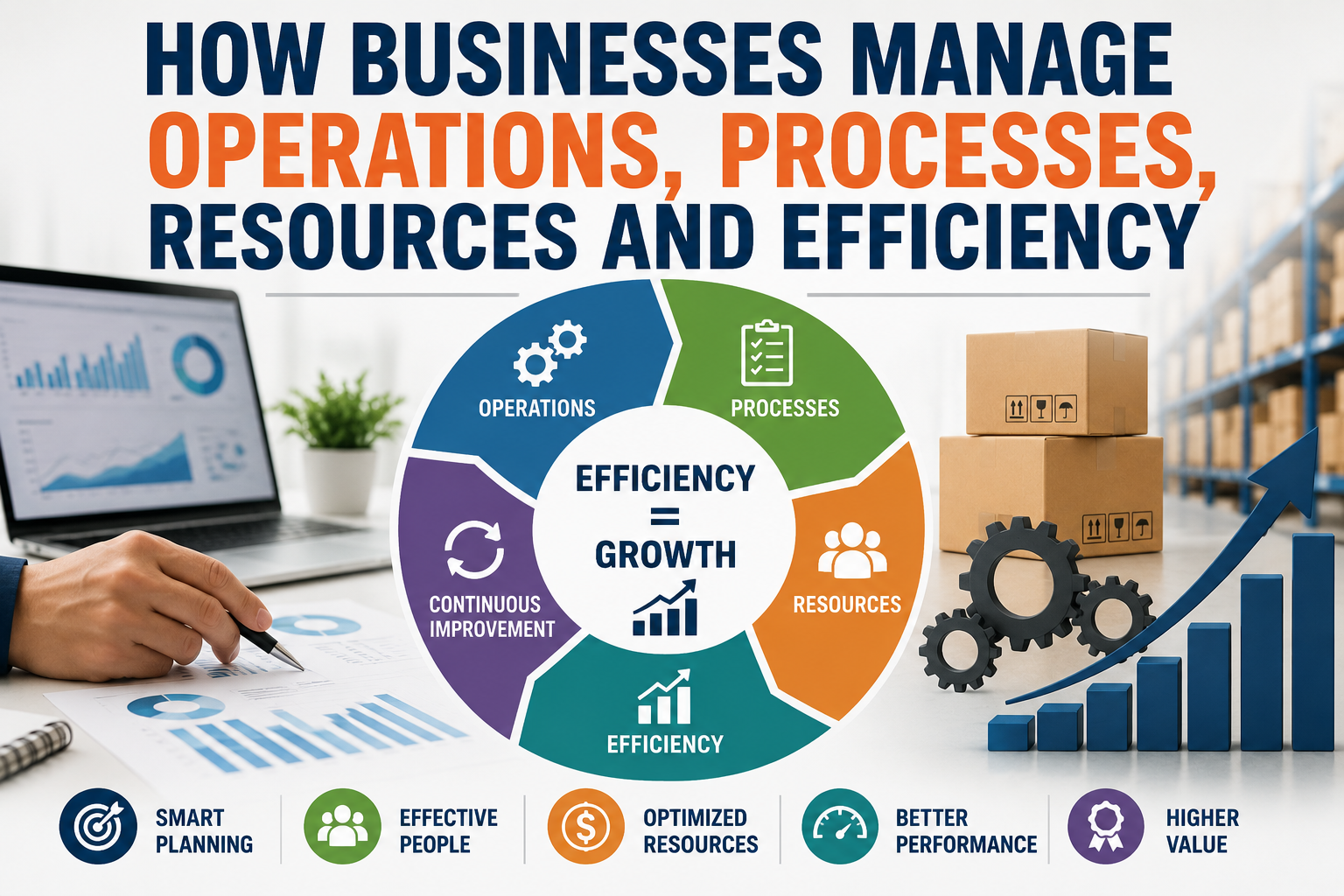
How Businesses Manage Operations, Processes, Resources, and Efficiency
Every successful business depends on more than a good product or strong marketing. Behind the scenes, companies must coordinate people, processes, technology, equipment, information and money to deliver products or services consistently.
This work falls largely under business operations management.
Whether it is a small company serving a local market or a multinational corporation managing thousands of employees, the fundamental challenge is similar: how can limited resources be organized effectively to produce the greatest possible value?
Understanding how businesses manage operations, processes, resources and efficiency provides a useful look at what keeps organizations productive, competitive and capable of growing.
What Business Operations Management Means
Business operations management is the coordination of the activities and resources a company uses to produce goods or deliver services.
Operations can include:
- Purchasing materials
- Managing suppliers
- Producing goods
- Delivering services
- Scheduling employees
- Managing inventory
- Maintaining equipment
- Processing orders
- Managing information
- Controlling quality
- Serving customers
- Monitoring costs
- Improving workflows
The exact activities depend on the industry.
A restaurant, for example, must coordinate ingredients, kitchen staff, equipment, orders and customer service. A software company may instead manage developers, cloud infrastructure, product releases, customer support and data.
Despite those differences, the underlying objective is similar: turn available resources into valuable outcomes as efficiently and reliably as possible.
Why Efficient Operations Matter
Operational efficiency can have a direct impact on a company’s financial performance.
When businesses use resources effectively, they may be able to:
- Reduce unnecessary costs
- Complete work faster
- Improve product quality
- Serve more customers
- Reduce waste
- Improve employee productivity
- Respond faster to changes
- Increase profitability
- Strengthen customer satisfaction
Efficiency does not simply mean doing everything as quickly as possible.
A process that saves five minutes but creates frequent errors may actually make a business less efficient because employees must spend additional time correcting those mistakes.
Effective operations therefore balance speed, cost, quality, reliability and customer value.
How Businesses Design Their Processes
A business process is a series of activities that produces a particular result.
For example, an online retailer might have a process that looks like this:
Customer order → Payment confirmation → Inventory check → Picking → Packing → Shipping → Delivery → Customer notification
Each stage depends on the previous one.
If inventory information is inaccurate, an order may be accepted even though the product is unavailable. If packing is inefficient, shipping may be delayed. If delivery information is incorrect, the customer experience suffers.
Businesses therefore map and analyze their processes to identify where problems occur.
Process mapping
Process mapping involves documenting the steps involved in completing a task.
A company might examine:
- What triggers the process?
- Who performs each step?
- What information is required?
- Which systems are used?
- Where are decisions made?
- Where do delays occur?
- What happens when something goes wrong?
- What is the final output?
Once the process is visible, managers can identify unnecessary steps, duplicated work and bottlenecks.
Managing Human Resources
People remain one of the most important operational resources in almost every business.
Managing employees effectively involves much more than assigning tasks.
Companies need to consider:
- Workforce planning
- Recruitment
- Training
- Scheduling
- Performance management
- Communication
- Compensation
- Employee development
- Workplace safety
- Retention
The goal is to ensure that the organization has the right skills available at the right time.
Workforce planning
A company experiencing rapid growth may discover that its existing workforce cannot handle increasing demand.
Hiring too quickly, however, can create unnecessary costs.
Workforce planning attempts to balance these competing needs by forecasting how many employees and what types of skills the business will require.
For businesses with variable demand, scheduling can become particularly important.
A retailer may require more workers during busy periods, while a professional-services company may need additional specialists when large projects begin.
Managing Financial Resources
Money is another fundamental operational resource.
Businesses must decide how to allocate available capital among competing priorities.
These may include:
- Employee compensation
- Inventory
- Equipment
- Technology
- Marketing
- Facilities
- Research and development
- Debt payments
- Expansion
- Emergency reserves
Good financial management helps businesses avoid spending heavily in areas that do not generate sufficient value.
It also provides managers with information for making decisions about pricing, hiring, investment and growth.
Cash flow is especially important.
A profitable business can still experience financial difficulties if cash arrives significantly later than payments become due.
This is why operational decisions and financial management are closely connected.
Managing Inventory and Materials
For companies that sell physical products, inventory management can have a major effect on efficiency.
Too much inventory ties up capital and increases storage costs.
Too little inventory can lead to:
- Stockouts
- Delayed orders
- Lost sales
- Dissatisfied customers
- Production interruptions
Businesses therefore try to find an appropriate balance between availability and cost.
Inventory systems can track quantities, sales rates, supplier lead times and reorder points.
Modern businesses may use automated systems to identify when inventory is approaching a predetermined threshold.
The objective is not necessarily to maintain the largest possible inventory.
It is to maintain enough inventory to support operations without unnecessarily tying up resources.
Managing Equipment and Physical Assets
Equipment can be another critical operational resource.
Manufacturing businesses depend on machinery. Construction companies rely on vehicles and tools. Restaurants depend on cooking equipment and refrigeration. Offices rely on computers, networks and communication systems.
Equipment failures can interrupt operations and create unexpected costs.
This makes maintenance an important part of operational management.
Preventive maintenance
Preventive maintenance involves inspecting and servicing equipment before failures occur.
Instead of waiting for a machine to break down, businesses may schedule:
- Inspections
- Cleaning
- Lubrication
- Component replacement
- Software updates
- Safety checks
The objective is to reduce unexpected downtime and extend the useful life of assets.
Using Technology to Improve Operations
Technology has transformed how businesses manage operations.
Companies now use software to coordinate many activities that previously required manual work.
Examples include:
- Enterprise resource planning systems
- Customer relationship management platforms
- Inventory management software
- Accounting systems
- Project management tools
- Workforce scheduling systems
- Supply-chain platforms
- Data analytics systems
Technology can make information available more quickly and reduce repetitive administrative work.
However, simply purchasing new software does not automatically make an organization more efficient.
The technology must solve a genuine operational problem.
A company that automates a poorly designed process may simply create a faster version of an inefficient process.
Automation and Business Efficiency
Automation allows certain tasks to be performed with limited human intervention.
Businesses commonly automate repetitive activities such as:
- Invoice processing
- Data entry
- Email notifications
- Inventory alerts
- Appointment scheduling
- Payroll calculations
- Order confirmations
- Reporting
Automation can reduce repetitive work and allow employees to focus on activities requiring judgment, creativity or interpersonal skills.
However, effective automation requires careful process design.
Businesses should first understand the task they are trying to automate and determine whether automation will actually improve the outcome.
Measuring Operational Efficiency
Businesses cannot manage efficiency effectively if they do not measure performance.
This is where key performance indicators, commonly known as KPIs, become important.
Different companies use different measurements depending on their objectives.
Common operational metrics include:
- Cost per unit
- Revenue per employee
- Order fulfillment time
- Production time
- Defect rate
- Customer wait time
- Inventory turnover
- On-time delivery rate
- Equipment utilization
- Employee productivity
- Customer retention
A company may also monitor broader financial indicators such as operating margins and cash conversion.
The important point is that metrics should help managers understand whether the business is achieving its objectives.
Understanding Bottlenecks
A bottleneck occurs when one part of a process limits the performance of the entire system.
Imagine a company that can manufacture 1,000 products per day but has a packaging department capable of processing only 700.
Even if manufacturing capacity increases, total output may remain close to 700 units because packaging has become the limiting factor.
Businesses therefore need to identify constraints rather than simply improving individual departments independently.
A faster production line does not necessarily increase total output if another stage cannot handle the additional volume.
Improving Processes Through Continuous Improvement
Operational improvement is rarely a one-time project.
Markets change, customer expectations evolve, technology develops and employees discover better ways to perform tasks.
Businesses therefore use continuous-improvement approaches to regularly evaluate their operations.
One widely known approach is the Plan-Do-Check-Act cycle:
- Plan — Identify a problem and determine what change might improve it.
- Do — Test the change.
- Check — Measure the results.
- Act — Standardize the improvement or adjust the approach.
This creates a feedback loop in which businesses learn from their own operations.
Lean Operations and Waste Reduction
Lean management focuses on maximizing customer value while reducing activities that do not contribute to that value.
Waste can take many forms.
For example:
- Producing more than customers need
- Waiting for approvals
- Unnecessary transportation
- Excess inventory
- Rework caused by errors
- Unnecessary processing
- Underusing employee skills
Reducing waste does not mean cutting everything that costs money.
Some activities are necessary even though they do not directly produce revenue.
The objective is to understand which activities create value and which can be redesigned, reduced or eliminated without damaging quality.
Quality Management
Efficiency without quality can create serious problems.
A company that produces products rapidly but has a high defect rate may ultimately become less efficient because it has to deal with returns, repairs, replacements and dissatisfied customers.
Quality management therefore forms an important part of operations.
Businesses may establish standards for:
- Product specifications
- Service delivery
- Safety
- Accuracy
- Reliability
- Customer support
- Regulatory compliance
Quality control can involve inspections and testing, while quality assurance focuses more broadly on designing processes that consistently produce the desired results.
Managing Suppliers and Supply Chains
Many businesses depend on external suppliers.
A manufacturer may need raw materials. A retailer needs products from wholesalers or manufacturers. A restaurant requires food suppliers. A technology company may rely on cloud providers and specialized contractors.
Supply-chain management involves coordinating these relationships.
Companies may evaluate suppliers based on:
- Price
- Quality
- Reliability
- Delivery times
- Capacity
- Financial stability
- Geographic location
- Risk
- Compliance
Relying heavily on a single supplier can sometimes create operational risk.
Businesses may therefore diversify suppliers or maintain contingency plans for critical materials.
Managing Business Risk
Every operation contains some degree of risk.
Potential disruptions can come from:
- Supplier failures
- Equipment breakdowns
- Cybersecurity incidents
- Natural disasters
- Economic changes
- Labor shortages
- Regulatory changes
- Transportation disruptions
- Technology failures
Operational risk management involves identifying important vulnerabilities and preparing responses.
A business might maintain backup suppliers, redundant technology systems, emergency procedures or alternative distribution channels.
The objective is not to eliminate every possible risk.
That would usually be impossible and prohibitively expensive.
Instead, businesses prioritize the risks that could have the greatest consequences.
Balancing Efficiency With Resilience
One of the most important operational lessons is that maximum efficiency is not always the same as maximum resilience.
For example, keeping extremely low inventory may reduce storage costs.
But if a critical supplier suddenly becomes unavailable, the company may be unable to serve customers.
Similarly, relying on a single technology provider can reduce complexity but increase vulnerability if that provider experiences an outage.
Effective businesses therefore consider both:
How efficiently can we operate?
and
How well can we continue operating when something goes wrong?
The right balance depends on the company’s industry, risk tolerance and business model.
How Data Supports Better Decisions
Data has become increasingly important to operations management.
Businesses can collect information about:
- Sales
- Customers
- Inventory
- Employee productivity
- Production
- Delivery
- Costs
- Equipment
- Website activity
Managers can use this information to identify patterns and make better decisions.
For example, if data shows that orders consistently accumulate at one stage of a process, management may investigate whether staffing, equipment or workflow design is causing the delay.
However, more data does not automatically produce better decisions.
Businesses need reliable information and appropriate analytical methods.
Poor-quality data can lead to poor operational decisions.
The Role of Managers in Operational Efficiency
Technology can improve operations, but people remain responsible for designing systems, interpreting information and making decisions.
Effective operations managers often need to balance competing priorities.
They may have to decide whether to:
- Hire additional employees
- Purchase new equipment
- Outsource a task
- Automate a process
- Increase inventory
- Change suppliers
- Redesign workflows
- Invest in employee training
Each decision involves costs, benefits and risks.
Good operational management therefore requires both analytical skills and practical judgment.
Creating a More Efficient Business
Businesses seeking to improve operational efficiency can begin with relatively simple questions:
1. What are we trying to achieve?
Efficiency should support a clear business objective.
2. Where are resources being wasted?
Look for unnecessary waiting, duplication, errors, excess inventory and inefficient processes.
3. Where are the bottlenecks?
Identify the stages limiting the performance of the overall system.
4. Which processes should be standardized?
Repeated tasks often benefit from clearly defined procedures.
5. What should be automated?
Prioritize repetitive, predictable tasks where automation can produce a measurable benefit.
6. What should remain human-led?
Tasks involving complex judgment, creativity, empathy or relationship management may benefit from human involvement.
7. Which metrics matter?
Track measurements that connect operational activity to business outcomes.
8. What could disrupt operations?
Consider suppliers, technology, employees, facilities and external risks.
9. Are improvements actually working?
Measure the results rather than assuming that a new system or process has improved performance.
Why Operations Become a Competitive Advantage
Businesses often compete on more than their products.
Two companies may sell similar products at similar prices, yet one can outperform the other because it has better operations.
It may deliver faster, maintain higher quality, respond more effectively to customers or operate at a lower cost.
Over time, these differences can become difficult for competitors to replicate.
A well-designed operational system can therefore become a genuine competitive advantage.
The strongest organizations do not simply work harder. They build systems that allow people, technology, capital, information and physical resources to work together effectively.
Building Operations That Can Scale
A process that works for 10 customers may not work for 10,000.
As businesses grow, informal systems often begin to create problems.
Employees may rely on personal knowledge rather than documented procedures. Communication becomes more complicated. Manual spreadsheets become difficult to maintain. Managers lose visibility into performance.
Scalable operations require systems that can accommodate greater complexity without creating disproportionate increases in cost or errors.
This can involve:
- Standardized procedures
- Clear responsibilities
- Reliable technology
- Employee training
- Performance metrics
- Documented workflows
- Strong management systems
- Appropriate automation
Scaling successfully is therefore not simply about doing more work.
It is about building the capacity to handle more work without allowing costs, errors and complexity to grow uncontrollably.
The Bigger Picture of Business Efficiency
Managing operations, processes, resources and efficiency is ultimately about creating a system in which every important part of an organization supports the others.
People need appropriate tools and information.
Processes need to be clear but flexible.
Technology needs to solve genuine problems.
Resources need to be allocated according to priorities.
Performance needs to be measured.
And improvements need to be tested rather than assumed.
The most efficient businesses are not necessarily those that minimize every expense. They are the ones that understand where resources create the greatest value, eliminate avoidable waste and continuously improve the way work gets done.
As businesses become more data-driven and increasingly adopt automation and artificial intelligence, the fundamental challenge remains the same: use limited resources intelligently while delivering reliable value to customers.
That principle is likely to remain at the heart of effective business operations regardless of how much technology changes.





2 Comments
Micle harison
June 7, 2019Lorem ipsum dolor sit amet, usu ut perfecto postulant deterruisset, libris causae volutpat at est, ius id modus laoreet urbanitas. Mel ei delenit dolores.
John Doe
June 7, 2019Some consultants are employed indirectly by the client via a consultancy staffing company.