
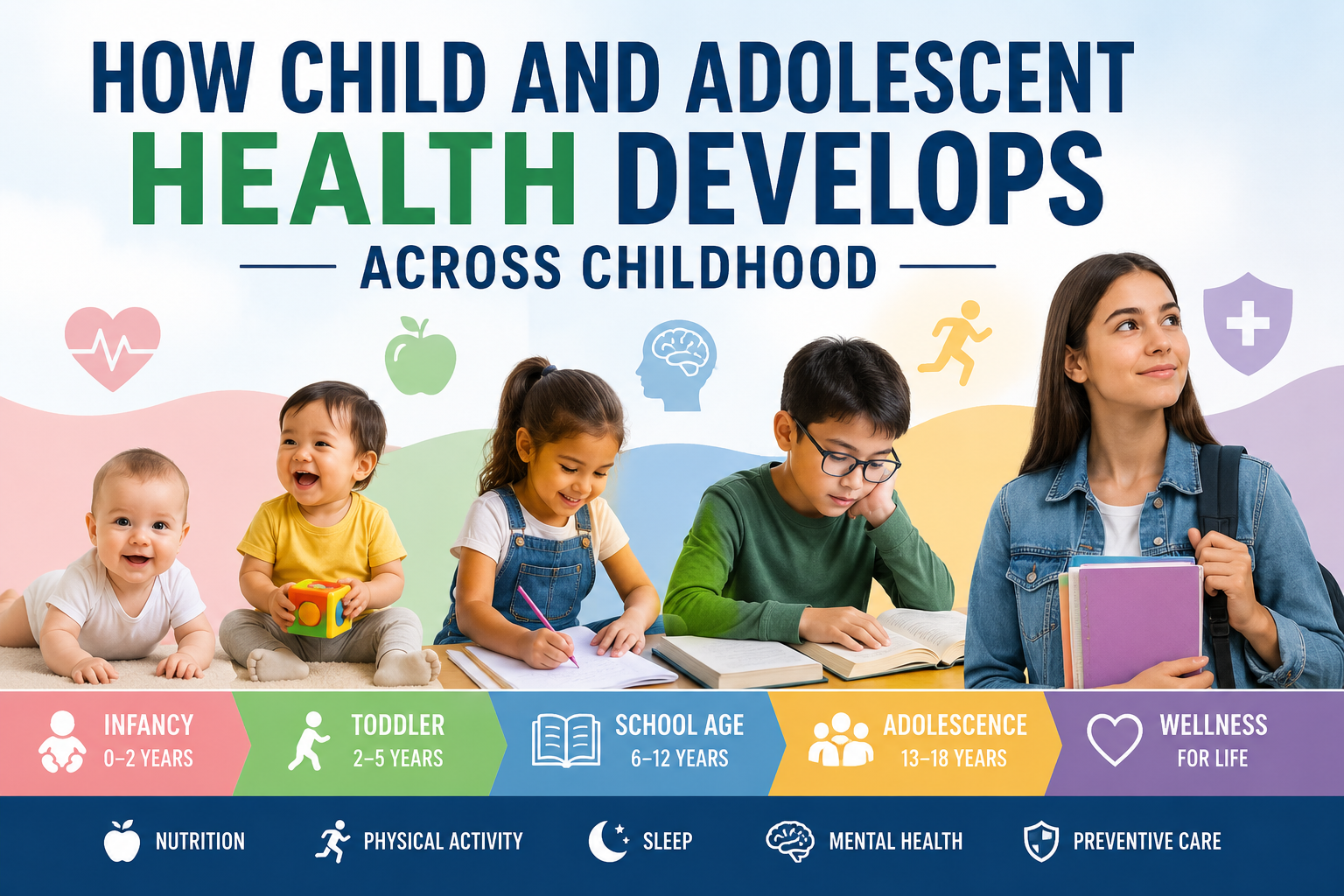
How Child and Adolescent Health Develops Across Childhood
Child and adolescent health is not a single stage or a checklist of milestones. It develops continuously from infancy through the teenage years, with each period bringing important changes in physical growth, brain development, emotional well-being, relationships, nutrition, learning and independence.
The needs of a toddler are naturally different from those of a school-age child, just as the health priorities of a 17-year-old differ from those of a young child. Understanding these changes can help parents, caregivers, educators and communities recognize what supports healthy development at different ages—and when a child may need additional support.
The World Health Organization defines adolescence as the period from 10 to 19 years and describes it as a particularly important stage for physical, cognitive and psychosocial development. The organization also emphasizes that experiences during adolescence can influence health and well-being later in life. (World Health Organization)
What Child and Adolescent Health Includes
Health during childhood and adolescence goes well beyond the absence of disease.
It includes several interconnected areas:
- Physical growth and development
- Brain and cognitive development
- Emotional and mental well-being
- Nutrition and healthy eating
- Physical activity
- Sleep
- Immunization and preventive healthcare
- Oral and dental health
- Healthy relationships
- Safety and injury prevention
- Sexual and reproductive health during adolescence
- Development of healthy behaviors and independence
These areas influence one another. Poor nutrition, for example, can affect physical growth and learning, while chronic stress can influence sleep, emotional health and school performance.
This is why child health is best viewed as a continuum of development, rather than a series of isolated medical appointments.
Infancy: Building the Foundations of Health
The earliest months of life are a period of extraordinary development.
Infants grow rapidly and undergo major changes in their brains, senses, movement and ability to interact with caregivers. Feeding, responsive caregiving, sleep, immunization, protection from illness and a safe environment all contribute to healthy development.
WHO describes this broader approach as nurturing care, which includes adequate nutrition, good health, safety and security, and opportunities for learning from birth. (World Health Organization)
During infancy, healthcare commonly focuses on:
- Monitoring growth
- Feeding and nutrition
- Vaccinations
- Developmental progress
- Hearing and vision
- Safe sleeping environments
- Prevention of injuries
- Recognition and treatment of illness
- The relationship between babies and their caregivers
Responsive caregiving matters
Babies depend heavily on adults to meet their physical and emotional needs.
Responding to a baby’s hunger, discomfort, facial expressions, sounds and need for interaction provides opportunities for communication and learning. Talking, singing, reading and playing with infants can also support early development.
The quality of the environment matters as much as individual activities. WHO emphasizes that children need to be healthy, adequately nourished, safe and secure, and provided with opportunities for learning. (World Health Organization)
Early Childhood: Growing Independence
As children move into toddlerhood and the preschool years, development becomes increasingly visible.
They begin walking and running, develop more complex language, learn to interact with other children and become increasingly independent in everyday activities.
This stage can bring rapid progress in:
- Language
- Coordination
- Problem-solving
- Emotional expression
- Social interaction
- Self-care
- Imagination and play
Nutrition continues to be important, while opportunities for active play and learning become increasingly significant.
Children also begin developing behavioral patterns that can influence their health later in life. Establishing healthy routines around food, movement, sleep, hygiene and safety can make healthy behaviors easier to maintain as children become older.
School-Age Children: Health Meets Learning
The school years bring another major transition.
Children spend more time outside the home, develop stronger friendships and become increasingly exposed to social expectations. Their ability to solve problems, understand rules and manage emotions generally becomes more sophisticated.
Health and education become closely connected during this period.
A child experiencing untreated hearing or vision problems, persistent sleep difficulties, nutritional problems or emotional distress may have difficulty concentrating or participating fully at school.
Regular healthcare therefore has an important preventive role.
Physical health continues to evolve
School-age children develop greater strength, coordination and physical skills. Regular physical activity supports healthy development and provides opportunities to develop motor skills, confidence and social connections.
Healthy eating remains important because children need adequate energy and nutrients to support both growth and daily activity.
At the same time, families can begin teaching children practical health skills, such as understanding food choices, personal hygiene, basic safety and why sleep matters.
Emotional development becomes more complex
Children gradually become better at identifying and expressing emotions, but they still rely heavily on adults to help them understand difficult experiences.
Friendships become increasingly important, and experiences at school can influence confidence and self-esteem.
Bullying, social exclusion, family conflict or persistent academic difficulties can affect a child’s emotional well-being.
Creating an environment in which children can talk openly about problems can make it easier to identify difficulties before they become more serious.
The Transition Into Adolescence
Around adolescence, development accelerates again.
Puberty produces substantial physical changes, but adolescence is not simply a period of physical maturation. It also involves major changes in thinking, emotional regulation, relationships and independence.
WHO describes adolescence as a period of rapid physical, cognitive and psychosocial growth. (World Health Organization)
The timing of these changes varies considerably between individuals.
Two teenagers of the same age can be at noticeably different stages of puberty and development without either necessarily having a health problem.
Puberty changes the body
During puberty, hormonal changes lead to sexual maturation and other physical changes.
Depending on the individual, these can include:
- Rapid increases in height and weight
- Changes in body composition
- Development of secondary sexual characteristics
- Changes in skin and hair
- Menstruation
- Voice changes
- Increasing reproductive maturity
The sequence of many developmental changes is relatively consistent, but their timing and pace can vary. WHO notes that individual characteristics and environmental factors can influence adolescent development. (World Health Organization)
This is one reason comparisons between teenagers can sometimes create unnecessary anxiety.
The Adolescent Brain Continues Developing
Adolescence is also a period of significant neurological development.
Young people become increasingly capable of abstract thinking, reasoning, planning and making more complex judgments. At the same time, brain systems involved in reward, emotion and motivation are undergoing important changes.
WHO notes that development involving the prefrontal cortex—an area associated with executive functions such as planning, organization and impulse control—continues later into adolescence. (World Health Organization)
This helps explain why teenagers can demonstrate sophisticated reasoning in some situations while still making impulsive decisions in others.
It also highlights why adolescents benefit from a combination of:
- Appropriate independence
- Clear boundaries
- Supportive relationships
- Opportunities to make decisions
- Guidance about risk
- Safe environments
The goal is not simply to control adolescent behavior. It is to help young people gradually develop the skills required to manage their own health and decisions.
Mental and Emotional Health Becomes Increasingly Important
Mental health is an essential part of child and adolescent health at every stage, but the issues children face can change as they grow.
Younger children may communicate distress through behavior, changes in sleep, changes in eating or difficulty separating from caregivers.
Older children may experience anxiety related to school, friendships, family circumstances or self-esteem.
Adolescents may encounter additional pressures involving identity, relationships, academic expectations, social acceptance, body image and independence.
WHO reports that many mental health disorders that occur in adulthood begin by age 18, making early recognition and appropriate support particularly important. (World Health Organization)
This does not mean that normal teenage mood changes should automatically be considered a mental health disorder.
Instead, persistent or severe changes deserve attention, particularly when they interfere with school, relationships, sleep, daily activities or safety.
Nutrition Changes as Children Grow
Nutritional needs evolve throughout childhood and adolescence.
Infants have different nutritional requirements from toddlers. School-age children require sufficient energy and nutrients for growth and activity, while adolescents experience another period of rapid physical development.
A balanced diet generally needs to provide:
- Protein
- Carbohydrates
- Healthy fats
- Vitamins
- Minerals
- Fiber
- Adequate fluids
During adolescence, certain nutritional needs can become particularly important because of rapid growth.
WHO identifies nutrition as an important component of adolescent health and notes that both undernutrition and nutritional deficiencies remain concerns in many populations. (World Health Organization)
For families, the emphasis should generally be on a varied, balanced eating pattern rather than restrictive diets or pressure to achieve a particular body shape.
Physical Activity Changes With Age
Movement is important throughout childhood.
For young children, physical activity often takes the form of active play. As children grow, it can include walking, running, cycling, sports, dancing, swimming and other recreational activities.
Regular movement supports physical fitness and can also contribute to psychological well-being and social development.
However, activity patterns can change dramatically during adolescence. Schoolwork, technology, transportation and changing social habits may reduce opportunities for movement.
WHO has identified physical inactivity as an important adolescent health concern. (World Health Organization)
Encouraging enjoyable activities rather than treating exercise purely as a way to change body weight can help establish healthier long-term attitudes toward movement.
Sleep Remains Important Across Development
Sleep requirements change as children grow, but adequate sleep remains important throughout childhood and adolescence.
Sleep supports:
- Physical growth
- Learning
- Memory
- Emotional regulation
- Concentration
- Immune function
- Daily energy
Teenagers may naturally develop later sleep schedules as their biological rhythms change, while school and family schedules may continue to require early mornings.
This can create a persistent mismatch between when adolescents feel tired and when they need to wake up.
Families can support healthy sleep by establishing consistent routines, creating a comfortable sleep environment and discussing habits that interfere with sleep.
Persistent sleep problems, however, may warrant discussion with a healthcare professional.
Preventive Healthcare Changes With Age
Preventive healthcare does not end when a child becomes a teenager.
Instead, the focus evolves.
For younger children, healthcare may emphasize growth, development, immunization, nutrition and prevention of common childhood illnesses.
For older children and adolescents, healthcare increasingly includes:
- Puberty and developmental assessment
- Mental health
- Nutrition and physical activity
- Substance-use prevention
- Injury prevention
- Sexual and reproductive health
- Vaccination
- Healthy relationships
- Risk behaviors
- Confidential opportunities to discuss health concerns
WHO emphasizes that adolescents need health services that are appropriate, acceptable, equitable and effective, along with accurate information and opportunities to develop life skills. (World Health Organization)
The transition toward greater privacy can also help teenagers become more comfortable discussing sensitive health concerns.
Safety Needs Change as Children Become More Independent
The risks children encounter also change with age.
Young children may be particularly vulnerable to household accidents, falls, burns and accidental poisoning.
As children become more mobile and independent, risks can expand to include traffic injuries, sports injuries and other accidents.
For adolescents, risks can increasingly involve road traffic, violence, substance use and other behaviors associated with greater independence. WHO identifies injuries and violence among important causes of illness and death during adolescence. (World Health Organization)
This means safety education should evolve rather than simply becoming less important.
A young child may need direct supervision around roads. An older teenager may instead need education about road safety, responsible decision-making and the risks associated with driving or riding with others.
Social Relationships Become More Influential
Relationships are important throughout childhood, but their role changes as children mature.
Young children depend heavily on parents and caregivers. School-age children increasingly develop friendships and learn to negotiate social situations.
During adolescence, peer relationships can become especially influential while young people simultaneously seek greater independence from parents.
Supportive relationships can provide a sense of belonging and security.
WHO’s adolescent well-being framework emphasizes the importance of supportive relationships and environments in helping young people thrive. (World Health Organization)
Parents do not necessarily need to eliminate every difficulty their children encounter. Instead, creating a relationship where young people feel able to seek help can become increasingly important as they gain independence.
What Healthy Development Does Not Look Like
There is no single timetable that every child must follow.
Children develop at different rates, and normal variation can be considerable.
A child who is shorter than classmates, a teenager who enters puberty later than peers, or an adolescent who develops certain social or academic skills at a different pace does not automatically have a health problem.
At the same time, significant or persistent changes should not simply be dismissed as “a phase.”
Healthcare professionals can evaluate concerns involving:
- Growth
- Development
- Puberty
- Learning
- Speech and language
- Behavior
- Emotional health
- Nutrition
- Sleep
- Vision or hearing
- Physical symptoms
Early assessment can be particularly valuable when a concern is persistent or affects everyday functioning.
Why the Early Years Matter for Later Health
Child and adolescent health should not be viewed as separate from adult health.
The foundations established during childhood can influence health behaviors and outcomes later in life.
WHO describes early childhood as a particularly important period, noting that nurturing care can have lifelong benefits for health and development. (World Health Organization)
Adolescence also provides an important opportunity to establish patterns involving:
- Nutrition
- Physical activity
- Sleep
- Tobacco and substance use
- Relationships
- Sexual health
- Mental health
- Healthcare use
WHO notes that behaviors established during adolescence can either protect health or contribute to health risks later in life. (World Health Organization)
This makes adolescence both a period of vulnerability and an important opportunity for prevention.
Supporting Health Through Every Stage
The most effective approach is not to focus on a single milestone or health behavior.
Children need an environment that evolves with them.
For infants, that may mean responsive caregiving, appropriate nutrition, immunization and a safe environment.
For young children, it increasingly means opportunities to play, learn, communicate and develop independence.
For school-age children, it includes healthy routines, physical activity, nutrition, learning support, friendships and emotional security.
For adolescents, it means combining appropriate independence with reliable support, accurate health information, preventive care and opportunities to make increasingly responsible decisions.
The central principle is simple: healthy development is a continuous process.
Every stage builds on what came before it, while also introducing new physical, emotional, cognitive and social needs. Supporting children effectively therefore means paying attention not only to whether they are growing, but also to whether they have the nutrition, relationships, safety, opportunities and healthcare they need to thrive.
And as children move toward adulthood, one of the most valuable outcomes is not simply that they avoid illness—it is that they gradually acquire the knowledge, confidence and skills to take an active role in protecting their own health.



2 Comments
Micle harison
June 7, 2019Lorem ipsum dolor sit amet, usu ut perfecto postulant deterruisset, libris causae volutpat at est, ius id modus laoreet urbanitas. Mel ei delenit dolores.
John Doe
June 7, 2019Some consultants are employed indirectly by the client via a consultancy staffing company.