
How Blood Sugar Regulation Works
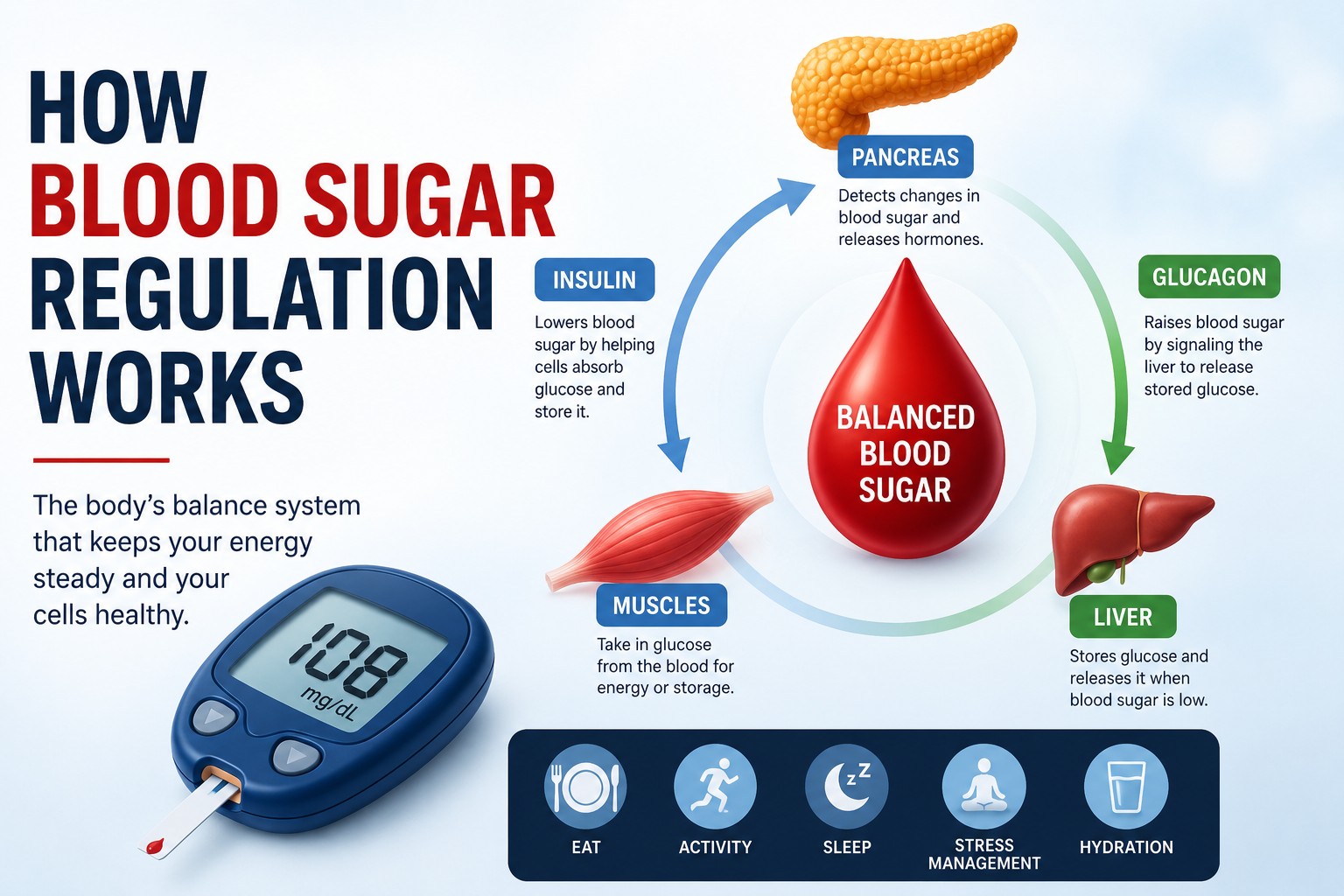
Blood sugar regulation is one of the body’s most important balancing acts. Every cell needs glucose for energy, yet too much glucose circulating in the blood can damage tissues over time. Too little can deprive the brain and other organs of the fuel they need to function properly.
The body therefore uses a sophisticated system involving the pancreas, liver, muscles, fat tissue, hormones, digestive system, and nervous system to keep blood glucose within a relatively stable range. This process is known as glucose homeostasis. (NIDDK)
Two hormones play especially important roles: insulin, which generally lowers blood glucose, and glucagon, which helps raise it when levels fall. Together, they allow the body to respond to meals, fasting, physical activity, and changing energy demands.
Understanding how this system works also helps explain what happens in conditions such as diabetes, insulin resistance, and hypoglycemia.
What Is Blood Sugar?
Blood sugar, more accurately called blood glucose, refers to the amount of glucose circulating in the bloodstream.
Glucose is a simple sugar and one of the body’s major sources of energy. Some glucose comes directly from carbohydrates in food, while the body can also produce glucose when it needs additional fuel. (NIDDK)
After carbohydrates are digested, glucose enters the bloodstream. Blood glucose then becomes available to cells throughout the body.
However, glucose cannot simply remain in the bloodstream indefinitely. The body must continuously adjust how much glucose is:
- Entering the bloodstream
- Being absorbed by cells
- Being stored for later use
- Being produced by the liver
- Being used immediately for energy
That constant adjustment is what keeps blood glucose from rising or falling too far.
The Pancreas Acts as a Key Control Center
The pancreas plays a central role in blood sugar regulation.
Within the pancreas are clusters of specialized cells called pancreatic islets. Two particularly important cell types are:
- Beta cells, which produce insulin
- Alpha cells, which produce glucagon
When blood glucose rises, beta cells respond by releasing insulin. When blood glucose becomes too low, alpha cells release glucagon. (NIDDK)
These hormones work in opposite directions, creating a feedback system that helps the body respond to changing glucose levels.
Think of insulin and glucagon as two sides of the same control system: one helps move glucose out of the bloodstream, while the other helps make additional glucose available when the body needs it.
What Happens After You Eat?
Blood sugar regulation becomes particularly active after a meal.
When you eat foods containing carbohydrates, digestion breaks some of those carbohydrates down into glucose. The glucose is absorbed through the digestive tract and enters the bloodstream.
As blood glucose rises, the pancreas detects the change and releases insulin.
Insulin then helps the body respond in several ways.
1. Cells Take Up More Glucose
Insulin signals certain cells, particularly muscle and fat cells, to increase their uptake of glucose from the bloodstream.
This allows glucose to move from the blood into cells where it can be used for energy or stored.
2. The Liver Stores Glucose
Insulin also encourages the liver to store some excess glucose as glycogen.
Glycogen is essentially a stored form of glucose. It provides the body with a readily accessible energy reserve that can be mobilized later.
3. The Liver Reduces Glucose Production
When plenty of glucose is already available after a meal, insulin signals the liver to reduce its production and release of glucose.
Together, these actions help bring elevated blood glucose back toward its normal range. (NIDDK)
What Happens Between Meals?
Blood glucose does not stop being regulated once a meal has been digested.
Several hours may pass between meals, and overnight the body can go many hours without receiving glucose from food.
During these periods, blood glucose gradually falls.
The pancreas responds by reducing insulin secretion and increasing the release of glucagon.
Glucagon sends an important message to the liver: release more glucose into the bloodstream.
The liver can break down stored glycogen and release glucose. When glycogen stores become insufficient, the liver can also produce new glucose through a process called gluconeogenesis. (NIDDK)
This is why the liver is so important to blood sugar regulation. It effectively functions as both a glucose storage site and a source of glucose when the body needs it.
The Role of the Liver
The liver is one of the body’s major glucose regulators.
After eating, it can take up glucose and store some of it as glycogen. Later, when glucose levels begin to fall, the liver can release glucose back into the bloodstream.
This allows the body to maintain an energy supply even when no food is currently being consumed.
The liver can also manufacture glucose from other substances when necessary.
In healthy glucose regulation, these processes are carefully coordinated with insulin and glucagon. In diabetes, however, the balance can become disrupted. For example, excessive glucose production by the liver can contribute to high blood glucose levels. (NIDDK)
How Insulin Keeps Blood Sugar Under Control
Insulin is often described simply as a hormone that lowers blood sugar, but its role is more complex.
Its major functions include helping cells absorb glucose, encouraging glucose storage and suppressing unnecessary glucose production by the liver.
After a meal, insulin essentially tells the body that energy is available.
The message is something like:
Glucose is available now, so use it, store some of it, and stop producing more than necessary.
This coordinated response prevents blood glucose from remaining elevated after every meal.
Insulin secretion itself also changes depending on whether the body is fed or fasting. Research supported by the National Institute of Diabetes and Digestive and Kidney Diseases has shown that insulin-producing beta cells adjust their activity according to nutritional conditions. (NIDDK)
How Glucagon Raises Blood Sugar
Glucagon performs an important counterbalancing function.
When blood glucose falls, pancreatic alpha cells release glucagon. The hormone primarily acts on the liver, encouraging it to make stored or newly produced glucose available to the bloodstream.
This becomes particularly important during:
- Overnight fasting
- Long periods between meals
- Prolonged physical activity
- Situations where the body needs additional fuel
Glucagon therefore helps prevent blood glucose from falling too low.
The relationship between insulin and glucagon is dynamic rather than static. When insulin levels rise, glucagon activity is generally suppressed; when glucose levels fall, glucagon becomes more important. (NIDDK)
Blood Sugar Regulation During Exercise
Physical activity adds another layer to glucose regulation.
Working muscles require energy, and glucose is one of the fuels they can use. During exercise, muscles can increase their uptake and use of glucose.
The body simultaneously adjusts hormone levels and energy production to meet changing demands.
Depending on the duration and intensity of activity, the body can draw on stored glycogen and increase glucose production by the liver.
This is one reason physical activity can affect blood glucose levels for hours after exercise.
For people who use insulin or certain glucose-lowering medicines, exercise can sometimes contribute to low blood glucose, making individualized advice from a healthcare professional important. (NIDDK)
What Happens During Fasting?
Fasting creates a different metabolic environment from eating.
When food is no longer entering the digestive system, insulin levels generally decline while the body increasingly relies on stored energy.
The liver releases glucose from glycogen stores, while the body can gradually increase glucose production when necessary.
The goal is not to keep blood glucose completely unchanged. Instead, the body continuously adjusts glucose availability according to its energy requirements.
This is an important distinction: healthy blood sugar regulation is a dynamic process, not a fixed number that remains identical throughout the day.
What Are Incretins?
Blood sugar regulation involves more than insulin and glucagon.
The digestive system also communicates with the pancreas after food is consumed through hormones known as incretins.
These hormones help the body anticipate and respond to nutrients arriving from the digestive tract. Research into incretins eventually contributed to important developments in treatments for metabolic diseases. (NIDDK)
One reason this matters is that the body’s response to eating is not simply a reaction to glucose already circulating in the blood. The digestive system participates in coordinating the metabolic response to a meal.
This helps explain why blood sugar regulation involves multiple organs and signaling pathways working together.
What Happens When Insulin Does Not Work Properly?
In some people, the body’s cells become less responsive to insulin. This is commonly described as insulin resistance.
When insulin is less effective, the pancreas may initially compensate by producing more insulin.
Over time, however, the pancreas may not be able to produce enough insulin to keep blood glucose within the normal range.
This is a major feature of the development of type 2 diabetes. NIDDK explains that type 2 diabetes involves cells not using insulin properly, while the pancreas may eventually be unable to produce enough insulin to maintain normal blood glucose. (NIDDK)
The result can be persistently elevated blood glucose.
What Happens in Type 1 Diabetes?
Type 1 diabetes involves a different problem.
The immune system attacks and destroys the pancreatic beta cells responsible for producing insulin. As a result, the body produces little or no insulin.
Without sufficient insulin, glucose cannot be properly moved from the bloodstream into cells for normal energy use.
People with type 1 diabetes therefore require insulin treatment to survive. (NIDDK)
This illustrates just how essential insulin is to normal glucose regulation.
What Is Hypoglycemia?
Hypoglycemia means blood glucose has fallen too low.
Symptoms can include shakiness, sweating, irritability, fatigue, confusion and other changes. Severe hypoglycemia can cause loss of consciousness and become a medical emergency. (NIDDK)
In people with diabetes, hypoglycemia can occur as a side effect of insulin or certain glucose-lowering medicines, particularly when medication, food intake and physical activity are not appropriately balanced. (NIDDK)
The body’s natural response to falling glucose includes increasing counter-regulatory signals such as glucagon.
In severe hypoglycemia, medically prescribed glucagon can be used to rapidly raise blood glucose when a person cannot safely treat the episode themselves. (NIDDK)
What Is Hyperglycemia?
The opposite problem is hyperglycemia, or blood glucose that is too high.
Occasional changes in blood glucose are normal, particularly after eating. The concern arises when glucose remains elevated or frequently exceeds an individual’s recommended range.
Persistent high blood glucose is a defining feature of diabetes and, over time, can contribute to damage involving the eyes, kidneys, nerves and cardiovascular system. (NIDDK)
Hyperglycemia can also occur when the body does not produce enough insulin, when insulin does not work effectively, or when the liver releases more glucose than the body needs.
How Food Affects Blood Sugar Regulation
Food has an obvious influence on blood glucose because carbohydrates are broken down into glucose and other sugars during digestion.
However, the effect of a meal depends on more than its carbohydrate content alone.
The overall composition of a meal, portion size, digestion, physical activity, individual metabolism and other factors can influence how glucose levels change.
This is why two people can eat the same meal and experience somewhat different blood glucose responses.
For people with diabetes, healthcare professionals may recommend individualized approaches to meal planning, medication and glucose monitoring rather than relying on a single universal eating pattern.
Sleep, Stress and Other Factors Matter Too
Blood sugar regulation is connected to the body’s broader metabolic and hormonal systems.
Sleep, physical activity, illness, stress and medications can all affect glucose levels.
For someone living with diabetes, these changes can become particularly noticeable because the body’s natural glucose-regulation system may already be impaired.
That is one reason diabetes management often involves looking at glucose readings alongside meals, activity, medications and other daily circumstances rather than treating every blood sugar reading as an isolated event.
Why Blood Sugar Regulation Matters
Stable blood glucose is important because glucose is essential fuel, but the body also needs to prevent excessive exposure to high or low glucose levels.
Healthy regulation allows the body to:
- Supply cells with energy
- Provide glucose to organs that depend on it
- Store excess energy for later
- Release stored energy during fasting
- Respond to meals
- Adapt to physical activity
- Prevent glucose from falling dangerously low
The system is remarkably coordinated. The pancreas senses changes, hormones transmit signals, the liver stores and releases glucose, muscles use energy, and other tissues contribute to the overall metabolic response. (NIDDK)
Blood Sugar Regulation Is a Constant Balancing Act
Blood sugar regulation is not controlled by a single organ or hormone. It is an ongoing conversation between the pancreas, liver, muscles, digestive system and other parts of the body.
Insulin helps lower circulating glucose and promotes its use and storage, while glucagon helps make glucose available when levels fall. Together, they help maintain glucose homeostasis across changing conditions such as eating, sleeping, exercising and fasting. (NIDDK)
When this system becomes impaired, blood glucose can remain too high or fall too low, contributing to conditions such as diabetes and hypoglycemia.
Understanding the process makes one thing clear: blood sugar is not simply a number that rises after eating and falls afterward. It is part of a sophisticated metabolic system that is constantly adjusting to keep the body’s cells supplied with the energy they need.



2 Comments
Micle harison
June 7, 2019Lorem ipsum dolor sit amet, usu ut perfecto postulant deterruisset, libris causae volutpat at est, ius id modus laoreet urbanitas. Mel ei delenit dolores.
John Doe
June 7, 2019Some consultants are employed indirectly by the client via a consultancy staffing company.