
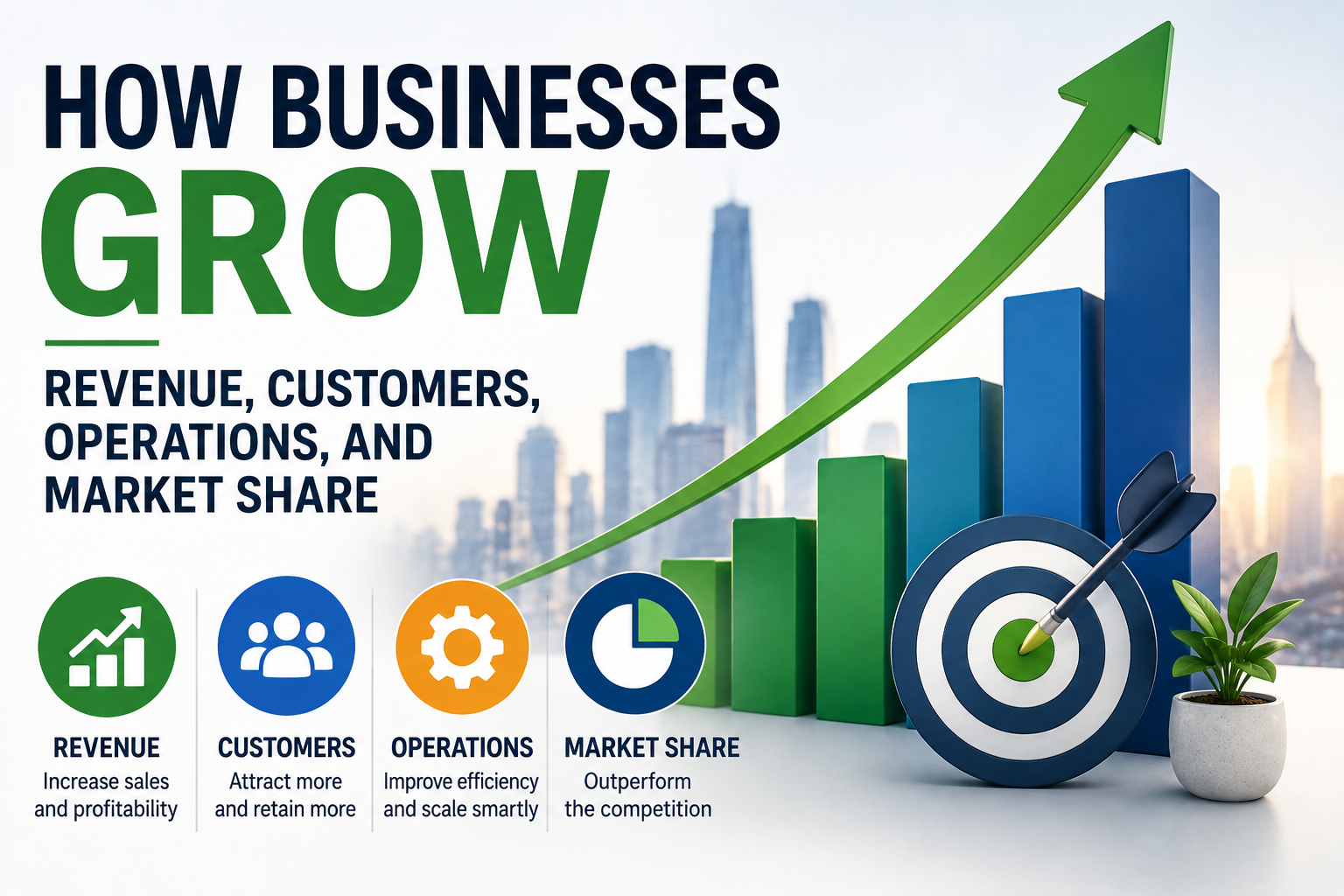
How Businesses Grow Revenue, Customers, Operations, and Market Share
Business growth is often described in simple terms: attract more customers, increase sales, expand into new markets, and become more profitable.
In practice, sustainable growth is much more complicated.
A business can increase revenue while losing money. It can gain customers while overwhelming its operations. It can expand its market share while damaging customer satisfaction. It can also become highly efficient without generating enough demand to support its long-term ambitions.
Successful companies therefore treat growth as a connected system rather than a single target.
Revenue, customers, operations, profitability, and market share influence one another. When these areas develop together, a business can grow without sacrificing the foundations that made it successful.
Understanding how these growth engines work can help business owners, managers, investors, and entrepreneurs make better decisions about where to invest resources and how to build a company that can scale.
What Business Growth Really Means
Business growth refers to an increase in the size, value, reach, or economic performance of a company.
Growth can take several forms, including:
- Higher revenue
- More customers
- Increased profitability
- Greater market share
- Expansion into new geographic markets
- More products or services
- Larger production capacity
- More employees
- Greater brand recognition
- Higher customer retention
- Stronger distribution
- Improved operational efficiency
These forms of growth do not always happen at the same speed.
A company might initially focus on acquiring customers before revenue becomes substantial. Another company might increase revenue by selling more to its existing customers rather than acquiring large numbers of new ones.
The most durable growth usually comes from improving several of these dimensions simultaneously.
Revenue Is One of the Most Visible Growth Measures
Revenue is the money a business generates from selling its products or services before expenses are deducted.
It is one of the most commonly used indicators of business growth because it provides a direct view of the company’s ability to generate sales.
Businesses can increase revenue in several fundamental ways:
- Acquire more customers.
- Increase the amount existing customers spend.
- Increase purchase frequency.
- Introduce new products or services.
- Raise prices where the market allows.
- Enter new markets.
- Improve conversion rates.
- Develop additional sales channels.
A company does not necessarily need millions of customers to generate substantial revenue.
A smaller business with a valuable product, strong customer retention, and high average transaction value can sometimes outperform a much larger company with low margins and weak customer loyalty.
Customer Acquisition Creates the Foundation for Growth
Customers are the engine behind most commercial businesses.
Without a reliable way to attract new customers, growth eventually slows as the existing customer base reaches its natural limits.
Customer acquisition can happen through many channels:
- Search engines
- Social media
- Advertising
- Referrals
- Partnerships
- Email marketing
- Sales teams
- Events
- Retail locations
- Marketplaces
- Content marketing
- Word-of-mouth recommendations
The best acquisition strategy depends on the business model.
A local service company may depend heavily on referrals and local search. A software company may use content marketing, demonstrations, sales teams, and free trials. A consumer brand might rely on retail distribution, advertising, social media, and influencer partnerships.
The important question is not simply how many customers a business can acquire.
It is how efficiently it can acquire customers who are likely to stay and generate profitable revenue.
Customer Acquisition Cost Matters
One of the most useful metrics for understanding growth is customer acquisition cost, commonly called CAC.
CAC estimates how much a company spends to acquire a new customer.
For example, if a business spends $10,000 on sales and marketing during a period and acquires 200 new customers, its average customer acquisition cost would be:
$10,000 ÷ 200 = $50 per customer
The number becomes more meaningful when compared with the economic value of those customers.
If customers typically generate only $40 in gross profit, spending $50 to acquire each one may not be sustainable.
If customers generate hundreds or thousands of dollars in profit over their relationship with the company, the same acquisition cost could be attractive.
Customer Retention Can Be More Powerful Than Constant Acquisition
Growth is not only about finding new customers.
Keeping existing customers can be equally important.
Customer retention reduces the need to continually replace customers who leave and can increase revenue without requiring the same level of acquisition spending.
A loyal customer may also:
- Purchase more frequently
- Upgrade to higher-value products
- Try additional services
- Recommend the business to others
- Provide useful feedback
- Become less sensitive to competitors
This creates a compounding effect.
A business that consistently acquires customers but loses many of them has to run faster simply to maintain its customer base.
A business that combines strong acquisition with strong retention can build a much more stable growth engine.
Customer Lifetime Value Helps Explain Sustainable Growth
Customer lifetime value, or CLV, estimates the economic value a customer generates throughout their relationship with a business.
The calculation varies by business model, but it generally considers factors such as:
- Average purchase value
- Purchase frequency
- Gross margin
- Customer retention
- Expected customer lifespan
A company with a strong CLV can potentially justify higher customer acquisition costs.
This is why businesses should not evaluate marketing campaigns solely by looking at the immediate sale.
A customer acquired today may purchase repeatedly over several years.
The real economic value of that relationship can be significantly greater than the first transaction.
Pricing Is a Major Growth Lever
Businesses sometimes focus heavily on acquiring more customers while overlooking pricing.
Pricing can have a major impact on revenue and profitability.
A company can potentially increase revenue by:
- Raising prices
- Introducing premium versions
- Creating bundles
- Offering subscriptions
- Adding paid features
- Creating different service tiers
- Charging for additional services
However, higher prices do not automatically produce higher profits.
Customers may respond by purchasing less, switching to competitors, or choosing cheaper alternatives.
Effective pricing therefore requires an understanding of customer willingness to pay, competitive positioning, perceived value, costs, and market conditions.
New Products Can Expand Revenue Opportunities
Another common growth strategy is expanding the company’s product or service offering.
A business that already has a strong customer base may have opportunities to sell additional products to those same customers.
For example, a company selling business software might add:
- Advanced analytics
- Security features
- Premium support
- Automation tools
- Additional user licenses
- Consulting services
This can be more efficient than entering an entirely new market because the company already understands its customers and has existing distribution channels.
However, product expansion can also create complexity.
Adding too many products can increase inventory, support requirements, development costs, and operational challenges.
Growth should therefore focus on products that strengthen the overall business rather than simply increasing the number of things a company sells.
Operations Determine Whether Growth Can Be Sustained
Sales create demand, but operations determine whether the company can fulfill that demand.
This distinction becomes increasingly important as a business grows.
A company might successfully double its customer base but discover that:
- Orders take longer to process
- Customer service becomes overwhelmed
- Inventory runs out
- Employees become overloaded
- Delivery times increase
- Quality becomes inconsistent
- Technology systems fail under higher demand
These problems can turn successful growth into a customer experience crisis.
Operational scalability is therefore one of the most important components of sustainable business expansion.
What Operational Scalability Means
A scalable operation can handle increasing demand without costs and complexity increasing at the same rate.
Technology can play an important role.
Automation can help businesses manage repetitive activities such as:
- Invoicing
- Customer communications
- Scheduling
- Inventory updates
- Reporting
- Data entry
- Marketing workflows
- Order processing
Standardized processes can also make it easier to train employees and maintain consistent quality.
The objective is not necessarily to eliminate human involvement.
Instead, businesses should allow technology and well-designed processes to handle predictable tasks so employees can focus on activities that require judgment, creativity, relationships, or specialized expertise.
Employees Become a Critical Growth Asset
People are central to business growth, particularly when operations become more complex.
A growing company needs employees with the skills to manage increasing demand without allowing quality to deteriorate.
This can require investment in:
- Recruitment
- Training
- Leadership
- Management systems
- Performance measurement
- Employee development
- Communication
- Company culture
Hiring too quickly can create unnecessary costs and organizational confusion.
Hiring too slowly can create bottlenecks and burnout.
The challenge is to build the workforce at a pace that matches the company’s growth and operational requirements.
Technology Can Accelerate Business Growth
Technology can allow companies to serve more customers, analyze more information, and automate more processes without proportionally increasing their costs.
Common technologies used to support growth include:
- Customer relationship management systems
- Accounting software
- Enterprise resource planning systems
- E-commerce platforms
- Business intelligence tools
- Cloud computing
- Artificial intelligence
- Marketing automation
- Communication platforms
- Inventory management systems
Technology is most valuable when it solves a genuine business problem.
Buying software simply because competitors use it does not necessarily improve performance.
Companies should first identify the bottleneck or opportunity and then determine whether technology can address it effectively.
Market Share Shows Competitive Position
Revenue tells a company how much it sells.
Market share tells it how well it is performing relative to competitors in the same market.
Market share is commonly expressed as the company’s sales divided by total sales in the relevant market.
For example, if a company’s annual sales are $50 million and the total market generates $500 million, the company has approximately a 10% market share.
Increasing market share can indicate that a company is outperforming competitors.
But market share must always be interpreted in context.
A growing market can allow several companies to increase sales without taking market share from one another.
A mature market, by contrast, may require a company to win customers away from competitors to achieve significant growth.
Businesses Gain Market Share in Several Ways
Companies can increase market share through:
- Better products
- Lower prices
- Stronger branding
- Better customer service
- Wider distribution
- Faster delivery
- More effective marketing
- Strategic acquisitions
- Geographic expansion
- Product innovation
- Stronger partnerships
The right approach depends on the market.
A premium brand may gain share by improving product quality and customer experience rather than competing primarily on price.
A cost-focused company may compete through efficiency and affordability.
A technology company might differentiate itself through innovation and ease of use.
Geographic Expansion Opens New Markets
Once a business has established a successful model in one location, it may consider expanding geographically.
Expansion can create access to new customers and revenue opportunities.
However, a successful business model in one market does not automatically work everywhere.
Companies may encounter differences in:
- Consumer preferences
- Regulations
- Taxes
- Competition
- Infrastructure
- Purchasing power
- Culture
- Distribution
- Labor costs
Successful expansion therefore requires research rather than simply copying an existing strategy into a new location.
Partnerships Can Speed Up Growth
Strategic partnerships can give businesses access to customers, technology, distribution, expertise, or infrastructure they would otherwise need years to build.
Potential partners include:
- Distributors
- Retailers
- Technology companies
- Service providers
- Financial institutions
- Manufacturers
- Industry organizations
- Complementary brands
A good partnership creates value for both sides.
For example, one company might have a strong product while another has access to a large customer network.
Working together can allow both businesses to expand more quickly than they could independently.
Acquisitions Can Produce Rapid Expansion
Some companies use acquisitions to accelerate growth.
Instead of building a new customer base, entering a market from scratch, or developing new capabilities internally, a company can acquire another organization that already has them.
Acquisitions can provide:
- Customers
- Employees
- Intellectual property
- Technology
- Distribution networks
- Brand recognition
- Geographic presence
But acquisitions also carry significant risks.
Integrating two organizations can be difficult, particularly when they have different cultures, technology systems, management structures, or operating processes.
Buying a company is therefore only the beginning. Creating value from the acquisition depends heavily on successful integration.
Profitability Must Keep Pace With Growth
Revenue growth receives considerable attention, but revenue alone does not guarantee a healthy business.
A company generating $100 million in sales may be less financially attractive than one generating $20 million if the larger business has substantially higher costs and lower margins.
Important financial measures include:
- Gross margin
- Operating margin
- Net profit
- Cash flow
- Return on investment
- Customer acquisition cost
- Customer lifetime value
- Revenue per employee
The objective is not simply to maximize sales.
It is to build a business where additional sales create meaningful economic value.
Cash Flow Can Become a Growth Constraint
Rapid growth can sometimes create cash-flow problems.
This may seem counterintuitive.
If a company is selling more products, why would it run out of cash?
The answer is that businesses often have to spend money before they receive payment.
A growing company may need to purchase more inventory, hire employees, open new locations, invest in equipment, increase marketing spending, or extend credit to customers.
If cash leaves the business faster than it comes in, growth itself can create financial pressure.
Managing working capital is therefore essential as companies expand.
Data Helps Businesses Make Better Growth Decisions
Modern companies have access to enormous amounts of information.
The challenge is turning that information into useful decisions.
Businesses can monitor metrics such as:
- Revenue growth
- Conversion rate
- Customer acquisition cost
- Retention rate
- Churn
- Average order value
- Gross margin
- Customer lifetime value
- Inventory turnover
- Employee productivity
- Market share
- Cash flow
These metrics should not be viewed independently.
For example, increasing sales while customer acquisition costs rise rapidly may not represent healthy growth.
Similarly, higher revenue combined with declining customer retention could signal an underlying problem.
The strongest management teams examine relationships between metrics rather than focusing on one number.
Brand Strength Can Lower the Cost of Growth
A strong brand can make customer acquisition easier.
When consumers recognize and trust a company, they may require less convincing before making a purchase.
Brand strength can come from:
- Consistent quality
- Reliability
- Customer experience
- Reputation
- Clear positioning
- Effective communication
- Strong products
- Positive recommendations
Over time, brand recognition can become an economic asset.
Customers may seek out a company instead of the company having to compete for every individual sale.
Innovation Keeps Growth From Stalling
Markets change.
Customer expectations evolve, competitors introduce new products, technology creates new opportunities, and economic conditions shift.
A company that stops improving can eventually lose its competitive advantage.
Innovation does not always mean inventing an entirely new product.
It can involve:
- Improving an existing service
- Simplifying the customer experience
- Reducing costs
- Automating processes
- Developing new pricing models
- Entering a new customer segment
- Using new technology
- Improving distribution
Continuous improvement can help businesses remain relevant while avoiding unnecessary disruption.
The Growth Flywheel
The strongest businesses often develop a cycle in which improvements in one area reinforce improvements in another.
For example:
Better product → happier customers → stronger retention → more referrals → lower acquisition costs → more customers → higher revenue → greater investment capacity → better product
This creates a growth flywheel.
The exact sequence varies by company, but the principle is important.
Sustainable growth becomes easier when the business has systems that reinforce one another.
Common Growth Mistakes Businesses Make
Growth can fail when companies prioritize expansion without strengthening the underlying business.
Common mistakes include:
Growing Too Quickly
Rapid expansion can overwhelm employees, systems, suppliers, and customer service.
Chasing Revenue at Any Cost
Sales that produce little or no profit can weaken the company despite impressive top-line growth.
Ignoring Existing Customers
Focusing exclusively on acquisition can cause retention and customer experience to deteriorate.
Expanding Before the Business Model Is Ready
Opening new locations or entering new markets before establishing a repeatable model can magnify operational problems.
Adding Too Much Complexity
Too many products, markets, systems, or processes can make a company difficult to manage.
Failing to Measure Unit Economics
A business should understand whether individual customers, products, orders, or locations generate economic value.
A Practical Framework for Sustainable Business Growth
Companies looking to grow can organize their strategy around five questions.
1. How Can We Attract More Valuable Customers?
Identify the customer groups that generate the strongest combination of revenue, retention, profitability, and strategic value.
2. How Can We Increase Customer Value?
Consider higher purchase frequency, larger transactions, premium offerings, subscriptions, complementary products, and improved retention.
3. Can Our Operations Handle More Demand?
Examine staffing, technology, supply chains, customer service, production capacity, and internal processes.
4. How Can We Become More Competitive?
Determine whether the company should compete through price, quality, convenience, innovation, service, specialization, distribution, or brand.
5. Can Growth Generate Sustainable Returns?
Measure profitability, cash flow, acquisition costs, retention, margins, and the capital required to support expansion.
These questions help turn the vague objective of “growing the business” into a practical strategy.
Growth Looks Different at Every Stage
A startup, small business, growing company, and large corporation may all have different growth priorities.
A startup may need to prove that customers actually want its product.
A small business may focus on improving customer acquisition and operational consistency.
A growing company may need to build management systems, hire specialized employees, and expand distribution.
A mature company may focus on innovation, international expansion, acquisitions, efficiency, or entering adjacent markets.
There is no single growth strategy that works for every company.
The right strategy depends on the company’s industry, resources, competitive position, customers, and stage of development.
Building a Business That Can Grow Without Breaking
Business growth is ultimately a balancing exercise.
Companies need enough customers to generate demand, enough operational capacity to serve them, enough financial discipline to remain profitable, and enough innovation to stay competitive.
Revenue provides the financial engine. Customers provide demand. Operations provide the capacity to deliver. Technology can increase efficiency. Employees execute the strategy. Brand and customer experience strengthen loyalty. Market share provides a measure of competitive position.
When these components work together, growth can become self-reinforcing.
The most successful businesses therefore do not simply ask “How can we sell more?”
They ask a broader question:
“How can we create more value for customers while building a system that becomes stronger, more efficient, and more profitable as it grows?”
That question shifts the focus from short-term expansion to sustainable business building—and that is where durable growth begins.



2 Comments
Micle harison
June 7, 2019Lorem ipsum dolor sit amet, usu ut perfecto postulant deterruisset, libris causae volutpat at est, ius id modus laoreet urbanitas. Mel ei delenit dolores.
John Doe
June 7, 2019Some consultants are employed indirectly by the client via a consultancy staffing company.