
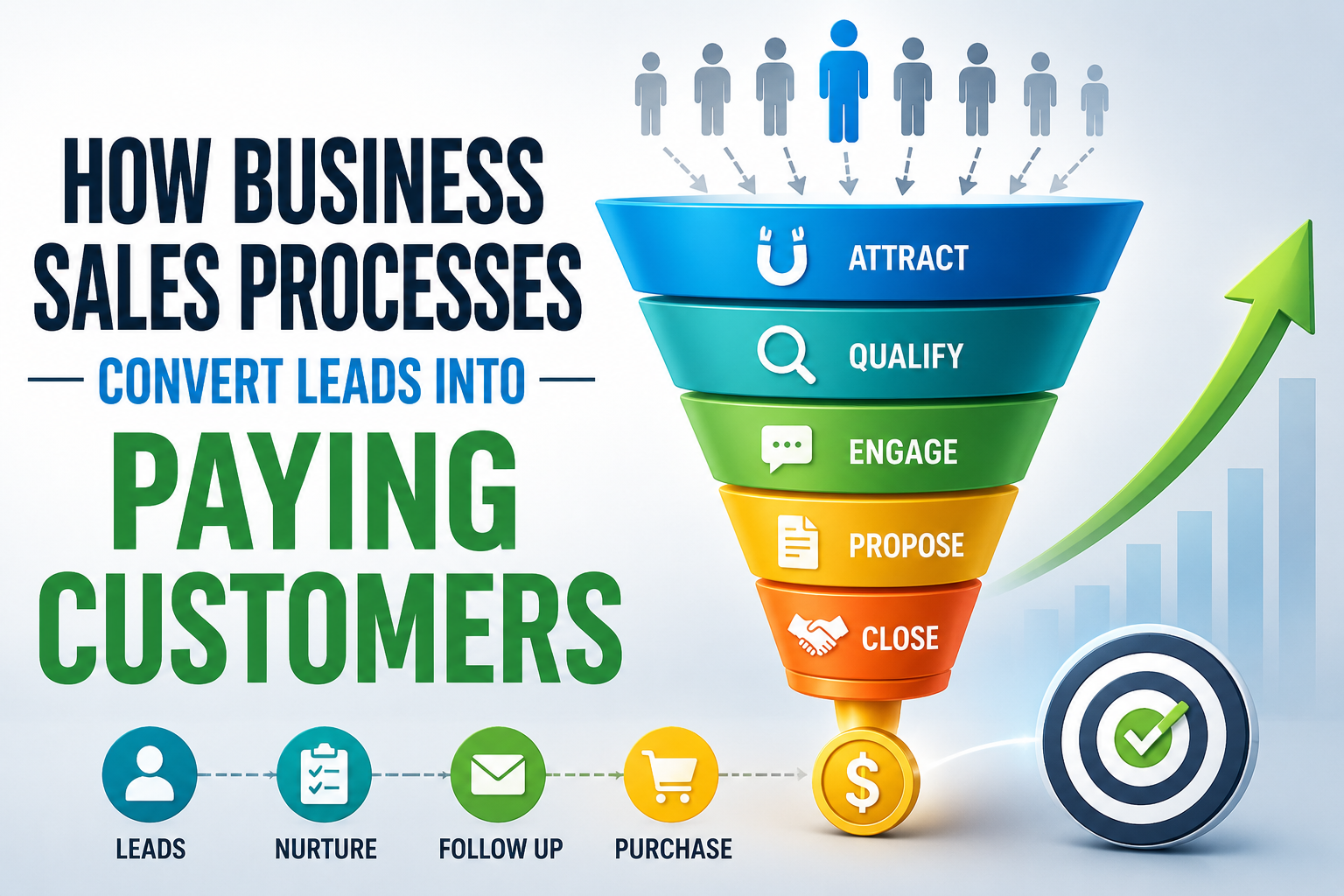
How Business Sales Processes Convert Leads Into Paying Customers
Turning an interested prospect into a paying customer rarely happens by accident. Behind most successful sales teams is a structured process that helps businesses identify potential buyers, understand their needs, demonstrate value, overcome concerns, and make purchasing easier.
A sales process provides a repeatable path from the first interaction with a potential customer to a completed transaction and, ideally, a long-term relationship.
While businesses use different sales models, the underlying principle is similar: the right information and interaction must reach the right prospect at the right stage of the buying journey.
Understanding how this process works can help businesses improve conversion rates, reduce wasted sales effort, and create better customer experiences.
What Is a Business Sales Process?
A business sales process is a series of steps that a company follows to move a prospect from initial awareness or interest toward a purchase.
The exact stages vary by business, product, industry, and customer type. A simple process might include:
- Lead generation
- Lead qualification
- Initial contact
- Needs discovery
- Product or service presentation
- Handling objections
- Proposal or quotation
- Negotiation
- Closing the sale
- Onboarding and follow-up
The process is not simply about persuading someone to buy. Effective sales processes help both sides determine whether a product or service is a good fit.
That distinction matters because pushing unsuitable customers through a sales funnel can create refunds, complaints, poor reviews, and high customer churn.
How Leads Enter the Sales Funnel
The sales process begins before a salesperson speaks with a potential customer.
Businesses can generate leads through many channels, including:
- Search engines
- Social media
- Email marketing
- Referrals
- Advertising
- Events
- Networking
- Content marketing
- Direct outreach
- Partnerships
- Existing customers
A lead is generally a person or organization that has shown some level of potential interest in a company’s offering.
Not every lead has the same level of buying intent.
Someone who downloads an educational article may simply be researching a problem. Someone who requests a quotation is much closer to making a purchasing decision.
Recognizing this difference is one of the foundations of an effective sales process.
Lead Qualification Determines Where Sales Effort Goes
Sales teams have limited time, so businesses need a way to determine which prospects deserve immediate attention.
Lead qualification evaluates whether a prospect is likely to become a customer and whether the company’s offering is appropriate for that prospect.
Sales teams may consider factors such as:
- The prospect’s specific problem
- Budget
- Decision-making authority
- Business size
- Urgency
- Existing solutions
- Purchasing timeline
- Product requirements
- Geographic availability
- Fit with the company’s ideal customer profile
A qualified lead is not necessarily someone who will definitely purchase. Instead, qualification helps estimate whether continuing the sales conversation makes sense.
Why Qualification Matters
Without qualification, sales representatives can spend hours pursuing prospects who have little interest, insufficient budget, or no authority to make a purchase.
A good qualification process allows salespeople to prioritize opportunities while giving less-qualified prospects appropriate educational or marketing content.
The Discovery Stage Uncovers Customer Needs
Once a prospect appears qualified, the sales process often moves into discovery.
Discovery is the stage where sales professionals try to understand the customer’s situation rather than immediately delivering a sales pitch.
Useful discovery questions might explore:
- What problem are you trying to solve?
- How is that problem affecting your business?
- What solution are you currently using?
- What isn’t working?
- What would a successful outcome look like?
- Who is involved in the purchasing decision?
- How soon do you need a solution?
The goal is to uncover the difference between the customer’s current situation and their desired outcome.
That gap creates the context in which a product or service can demonstrate value.
Effective Sales Presentations Focus on Benefits
Once a salesperson understands the customer’s needs, the next step is to explain how the offering addresses those needs.
This is where businesses often make a common mistake: focusing too heavily on features.
A feature describes what a product does.
A benefit explains why that feature matters to the customer.
For example:
Feature: A business software platform automatically generates invoices.
Benefit: The customer can reduce the amount of manual administrative work required to create and send invoices.
The strongest sales presentations connect specific capabilities to specific customer problems.
Instead of explaining everything a product can do, the salesperson should emphasize the capabilities that matter most to the individual prospect.
Demonstrations Can Reduce Buying Uncertainty
For products that are difficult to understand from descriptions alone, demonstrations can play an important role.
A demonstration allows prospects to see how a solution works in a realistic situation.
Depending on the business, this could involve:
- A software demonstration
- A product trial
- A sample
- A consultation
- A walkthrough
- A prototype
- A case study
- A live test
The objective is not simply to impress the prospect. It is to provide evidence that the product can solve the problem discussed during the discovery stage.
A demonstration is most effective when it is customized around the customer’s priorities.
Social Proof Helps Build Trust
Customers often want evidence that a business can deliver what it promises.
This is particularly important when the purchase involves significant financial risk or a long-term commitment.
Businesses can provide evidence through:
- Customer testimonials
- Case studies
- Reviews
- References
- Demonstrated results
- Industry certifications
- Product guarantees
- Transparent policies
- Demonstrations
- Relevant experience
Social proof works because prospects are often interested in knowing whether other people or organizations have successfully used the product.
However, businesses should use genuine evidence rather than exaggerated or misleading claims.
Handling Sales Objections
Prospects frequently raise concerns before making a purchase.
Common objections include:
- “It’s too expensive.”
- “We need to think about it.”
- “We already have a supplier.”
- “We’re not ready yet.”
- “I need to speak with someone else.”
- “I’m not sure this will work for us.”
- “Can you offer a better price?”
An objection does not always mean that the prospect has rejected the product.
Sometimes it indicates that the customer needs more information.
Listen Before Responding
A salesperson who immediately argues against an objection can make the prospect feel pressured.
A better approach is to understand what is behind the concern.
For example, when a prospect says something is too expensive, the underlying issue might be:
- The budget is genuinely too small.
- The customer does not understand the value.
- A competitor offers a cheaper alternative.
- The customer is uncertain about the return on investment.
- The timing is wrong.
Identifying the real concern makes it easier to provide a relevant response.
Pricing and Value Influence the Purchase Decision
Price is an important part of most purchasing decisions, but customers do not necessarily choose the cheapest option.
They often evaluate perceived value.
A customer’s perception of value can depend on factors such as:
- Product quality
- Reliability
- Convenience
- Customer service
- Time savings
- Risk reduction
- Performance
- Durability
- Brand reputation
- Expected financial return
This is why effective sales conversations connect price to outcomes.
Rather than simply saying that a product costs a particular amount, businesses can explain what the customer receives in return.
Proposals Turn Conversations Into Concrete Offers
For many business-to-business purchases, the next stage is a formal proposal or quotation.
A strong proposal should make the purchasing decision easier by clearly explaining:
- The customer’s problem
- The proposed solution
- Deliverables
- Pricing
- Timelines
- Responsibilities
- Terms and conditions
- Implementation details
- Expected outcomes
The proposal should be easy to understand and closely connected to the discovery conversation.
A generic proposal that could have been sent to any customer often feels less relevant than one that reflects the prospect’s specific requirements.
Negotiation Does Not Always Mean Lowering the Price
Negotiation is common, particularly for larger purchases.
Customers may request changes to:
- Price
- Payment terms
- Delivery dates
- Product specifications
- Contract length
- Service levels
- Implementation requirements
Businesses should avoid treating every negotiation as a request for a discount.
Sometimes the better solution is to adjust the package rather than reduce the price.
For example, a company might offer different service levels, payment schedules, quantities, or implementation options.
This allows the customer to choose an arrangement that better matches their needs while protecting the business’s margins.
The Closing Stage Converts Interest Into Action
The close is the point where the prospect commits to purchasing.
Closing can involve:
- Signing a contract
- Completing an online checkout
- Paying an invoice
- Placing an order
- Approving a purchase order
- Scheduling implementation
Effective closing should not feel like an unexpected pressure tactic.
Ideally, the salesperson and customer have already established:
- The problem
- The desired outcome
- The appropriate solution
- The value
- The price
- The terms
- The next steps
The final decision then becomes a logical continuation of the conversation.
Why Follow-Up Is Part of Selling
A sales process does not necessarily end when a proposal is sent.
Prospects can become distracted, encounter internal delays, or need additional information.
Appropriate follow-up helps keep the opportunity moving.
Useful follow-up can include:
- Answering unanswered questions
- Providing requested information
- Clarifying pricing
- Sending relevant case studies
- Confirming decision timelines
- Scheduling another conversation
- Checking whether requirements have changed
Effective follow-up should provide value rather than simply sending repeated messages asking whether the prospect has made a decision.
Customer Onboarding Completes the Transition
Once the customer agrees to buy, the business must deliver what was promised.
This is where sales connects with customer success, operations, finance, and other departments.
A strong onboarding process might include:
- Confirming the purchase
- Introducing the customer to the appropriate team
- Explaining what happens next
- Setting expectations
- Providing access to products or services
- Training the customer where necessary
- Establishing communication channels
- Checking early results
The transition from salesperson to customer service should be as smooth as possible.
A customer who experiences confusion immediately after purchasing may question whether they made the right decision.
Retention Can Be More Valuable Than One-Time Sales
A successful sales process should not focus exclusively on acquiring new customers.
For businesses with recurring revenue or repeat purchases, customer retention can be extremely important.
Satisfied customers may:
- Purchase again
- Upgrade their products
- Buy additional services
- Refer other customers
- Leave positive reviews
- Become long-term accounts
This creates a broader cycle:
Lead → Customer → Satisfied Customer → Repeat Customer → Advocate
The quality of the original sales process can influence every stage of that relationship.
Technology Can Make Sales Processes More Efficient
Modern sales teams often use technology to organize and automate parts of the sales process.
Common tools include:
- Customer relationship management systems
- Email marketing platforms
- Sales analytics software
- Scheduling tools
- Proposal software
- Communication platforms
- Customer support systems
- E-commerce platforms
A CRM, for example, can help salespeople track contacts, conversations, opportunities, follow-ups, and customer information.
Technology should support the sales process rather than replace thoughtful customer interactions.
Automating repetitive administrative tasks can give sales professionals more time to focus on activities that require judgment and human communication.
Measuring Sales Process Performance
Businesses need measurable indicators to understand whether their sales process is working.
Useful metrics can include:
Lead Conversion Rate
Measures the percentage of leads that become customers.
Opportunity Conversion Rate
Measures how many qualified sales opportunities eventually result in purchases.
Sales Cycle Length
Measures how long it typically takes to move an opportunity from initial qualification to purchase.
Average Deal Value
Shows the typical revenue generated from a completed sale.
Customer Acquisition Cost
Estimates how much the business spends to acquire a customer.
Win Rate
Measures the proportion of sales opportunities that result in successful deals.
Customer Retention Rate
Shows how effectively the company retains customers over time.
Looking at several metrics together provides a more useful picture than focusing on a single number.
For example, increasing conversion rates may appear positive, but if customer acquisition costs rise dramatically at the same time, the overall economics may not have improved.
Common Sales Process Mistakes
Businesses can lose potential customers even when their products are strong.
Some common mistakes include:
Treating Every Lead Equally
A person casually researching a product should not necessarily receive the same sales treatment as someone ready to purchase.
Talking Too Much
Salespeople who spend most of the conversation describing their product may miss important information about the customer.
Focusing Only on Price
Reducing every conversation to price can make it difficult to communicate the value of quality, reliability, service, and outcomes.
Ignoring Decision-Makers
A salesperson may spend considerable time working with someone who cannot approve the purchase.
Following Up Poorly
Too little follow-up can cause opportunities to disappear, while excessive or irrelevant follow-up can damage the customer relationship.
Making Unrealistic Promises
Overpromising to close a deal can create serious problems after the purchase.
Failing to Learn From Lost Deals
Every unsuccessful opportunity can potentially reveal information about pricing, positioning, product-market fit, customer needs, or the sales process itself.
How Businesses Can Improve Their Sales Processes
Improving a sales process does not necessarily mean adding more steps.
Often, businesses can improve performance by making existing stages clearer and more consistent.
Define the Ideal Customer
A clear customer profile helps sales teams focus on prospects who are most likely to benefit from the offering.
Establish Qualification Criteria
Define what makes a lead worth pursuing and what circumstances indicate poor fit.
Standardize Discovery Questions
A consistent discovery framework can help salespeople uncover important customer information without turning conversations into rigid scripts.
Build Useful Sales Materials
Case studies, demonstrations, FAQs, comparison information, pricing explanations, and product documentation can help prospects make informed decisions.
Reduce Friction
Complicated forms, unclear pricing, slow responses, difficult payment systems, and confusing contracts can all interfere with conversion.
Analyze Lost Opportunities
Understanding why prospects choose competitors, delay purchases, or abandon the process can reveal opportunities for improvement.
The Sales Process Should Match the Customer Journey
Not every customer buys in the same way.
A consumer purchasing an inexpensive product online may complete the entire process within minutes.
A company purchasing an enterprise software system may require months of research, demonstrations, negotiations, legal review, budgeting, and executive approval.
The sales process should therefore reflect:
- Product complexity
- Purchase price
- Customer risk
- Number of decision-makers
- Sales channel
- Buying frequency
- Industry requirements
The goal is not to create the longest or most sophisticated sales funnel. It is to create a process that gives customers the information and support they need without unnecessary friction.
Turning Sales Into a Repeatable Business System
A strong sales process transforms selling from a collection of individual conversations into a repeatable business system.
The basic progression is straightforward:
Attract the right leads → qualify opportunities → understand customer needs → demonstrate relevant value → address concerns → present a clear offer → make purchasing easy → deliver successfully → build the relationship.
When these stages work together, businesses can create a more predictable path from initial interest to revenue.
The most effective sales processes are ultimately customer-centered. They do not simply push prospects toward a transaction. They help potential customers understand their options, evaluate whether a solution fits their needs, and make confident purchasing decisions.
That approach can produce more than individual sales. It can create the trust, satisfaction, referrals, and repeat business that turn a sales process into a long-term engine for sustainable growth.


2 Comments
Micle harison
June 7, 2019Lorem ipsum dolor sit amet, usu ut perfecto postulant deterruisset, libris causae volutpat at est, ius id modus laoreet urbanitas. Mel ei delenit dolores.
John Doe
June 7, 2019Some consultants are employed indirectly by the client via a consultancy staffing company.