
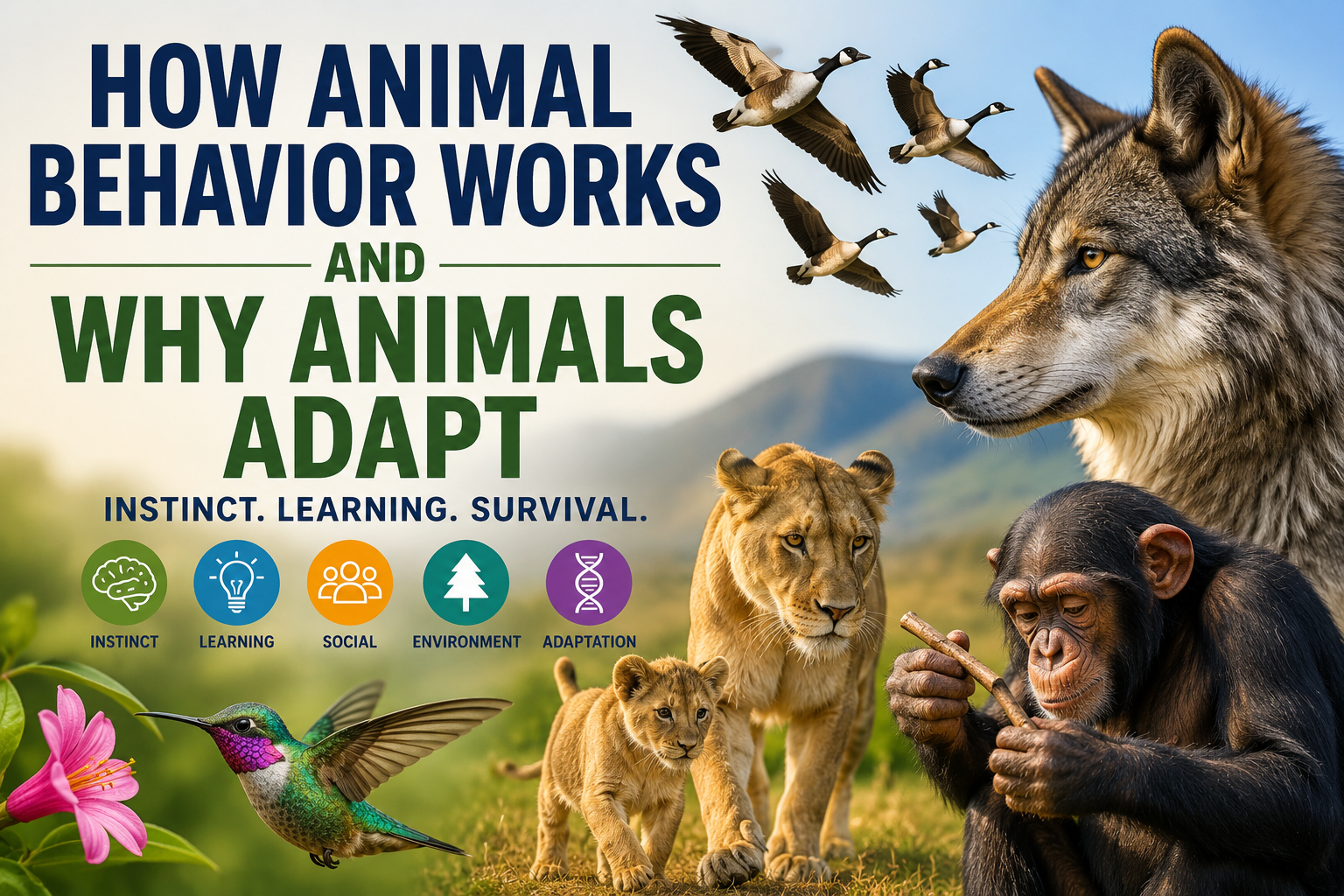
How Animal Behavior Works and Why Animals Adapt
Animals may spend their days finding food, avoiding predators, raising young, defending territory, or searching for mates, but these activities are far more than random reactions to the world around them. Animal behavior is shaped by a combination of genes, physiology, learning, experience, social relationships, and environmental conditions.
From birds changing their migration patterns to mammals learning where food is available, animals continually respond to challenges and opportunities. Understanding these behaviors helps scientists explain how species survive, how ecosystems function, and why some animals are better equipped than others to cope with environmental change.
What Is Animal Behavior?
Animal behavior refers to the ways animals respond to internal and external stimuli.
It includes both simple and complex actions, such as:
- Feeding
- Sleeping
- Hunting
- Escaping predators
- Finding mates
- Caring for offspring
- Communicating
- Establishing social hierarchies
- Defending territory
- Migrating
- Building nests or shelters
- Cooperating with other animals
Behavior can be relatively automatic, such as a reflex, or highly flexible, such as a chimpanzee learning to use a tool.
Scientists studying animal behavior often examine not only what an animal does, but also why it does it and how the behavior develops.
Nature and Experience Both Shape Behavior
One of the most important ideas in behavioral science is that animal behavior is rarely determined by a single factor.
Genes can influence how an animal develops and responds to particular situations. However, experience and environmental conditions can also substantially affect behavior.
A young animal may inherit tendencies that help it recognize predators or communicate with members of its species. At the same time, it may need experience to become an effective hunter, learn social rules, or identify safe places to find food.
This interaction between inherited characteristics and experience gives animals a degree of behavioral flexibility.
Instinctive Behaviors
Some behaviors occur without an animal needing to learn them.
These are often described as innate behaviors or instincts.
For example, many newly hatched sea turtles instinctively move toward the ocean after emerging from their nests. Certain spiders can construct characteristic webs without being taught how to build them.
Innate behavior can be especially valuable when an animal needs to respond quickly to a survival challenge.
However, instinct does not mean an animal’s behavior is completely inflexible. Many species combine inherited behavioral tendencies with learning and environmental information.
Learned Behavior Helps Animals Respond to Change
Learning allows animals to modify their behavior based on experience.
Animals can learn in several ways.
Habituation
Habituation occurs when an animal gradually stops responding strongly to a stimulus that repeatedly proves harmless.
For example, animals living near human settlements may become less alarmed by ordinary background noises over time.
Conditioning
Animals can also learn to associate one event with another.
A dog that repeatedly hears a food container being opened before receiving food may eventually respond to the sound itself.
Social Learning
Animals can learn by observing other members of their species.
Young mammals may learn feeding techniques from their parents, while some birds learn particular songs by listening to adults.
Social learning can allow useful behaviors to spread through a population without every individual having to discover the behavior independently.
Communication Is a Major Part of Animal Behavior
Animals need ways to exchange information.
Communication can involve:
- Sounds
- Body movements
- Facial expressions
- Scents
- Touch
- Color patterns
- Vibrations
- Chemical signals
Birdsong is one familiar example. Birds may use vocalizations to attract mates, establish territories, identify individuals, or warn others about danger.
Mammals can communicate through vocal sounds, body language and chemical signals. Insects also use sophisticated communication systems, including pheromones and movement patterns.
Communication can improve survival by helping animals coordinate their behavior.
Why Animals Migrate
Migration is one of the most striking examples of animal behavior.
Many species move between locations during particular periods of the year to find food, reproduce, avoid harsh environmental conditions, or improve their chances of survival.
Birds are especially well known for long-distance migration, but migration also occurs among:
- Mammals
- Fish
- Insects
- Marine reptiles
- Amphibians
The triggers for migration can include changes in daylight, temperature, rainfall, food availability, and hormonal activity.
Some animals appear to have remarkable navigational abilities. Depending on the species, they may use landmarks, the position of the sun, Earth’s magnetic field, chemical cues, or other environmental signals.
Feeding Behavior Is Closely Linked to Survival
Finding food is one of the most fundamental challenges animals face.
Different species have evolved different feeding strategies according to their environments and physical characteristics.
Predators may use speed, stealth, strength, venom, or coordinated group hunting. Herbivores may specialize in particular plants, while omnivores can take advantage of a wider variety of foods.
Some animals also modify their behavior when food becomes scarce.
They may:
- Travel farther
- Change feeding times
- Switch food sources
- Store food
- Cooperate with other animals
- Move to new habitats
Behavioral flexibility can therefore help animals survive changes in food availability.
Predator Avoidance Drives Many Behaviors
Avoiding predators is another major influence on animal behavior.
Animals may respond to danger by:
- Running away
- Hiding
- Freezing
- Fighting
- Forming groups
- Using camouflage
- Producing warning signals
- Mimicking other species
- Moving to safer habitats
Some animals have developed remarkable defensive strategies.
A prey species may become more cautious in areas where predators are common. Others alter when or where they feed to reduce the chance of being detected.
This creates an ongoing behavioral relationship between predators and prey.
When predators develop more effective hunting strategies, prey may face pressure to improve their defenses. Likewise, predators may adapt their behavior in response to changes in prey behavior.
Social Behavior Can Improve Survival
Many animals live alone, but others form highly organized social groups.
Wolves, elephants, dolphins, primates, meerkats and numerous other species interact in complex ways.
Social living can provide important advantages.
Groups may cooperate to:
- Find food
- Defend territory
- Protect young
- Detect predators
- Raise offspring
- Share information
But social living also creates competition.
Animals may compete for:
- Food
- Mates
- Territory
- Shelter
- Social status
As a result, social behavior often involves a mixture of cooperation and competition.
Animal Behavior and Reproduction
Reproduction is another powerful influence on behavior.
Animals have developed a wide range of strategies for finding mates and producing offspring.
Courtship behaviors may involve:
- Songs
- Displays
- Dances
- Color changes
- Gifts
- Territorial demonstrations
- Physical contests
These behaviors can help individuals identify potential mates and communicate information about their condition.
In some species, parents invest heavily in their offspring. Others provide little or no parental care.
The amount of parental investment often reflects the species’ ecological strategy and the likelihood that offspring will survive without assistance.
What Does It Mean for an Animal to Adapt?
In biology, adaptation refers to an inherited characteristic that becomes more common in a population because it improves reproductive success under particular environmental conditions.
Adaptations can be physical, physiological, or behavioral.
Examples include:
- Thick fur in animals living in cold environments
- Specialized beaks in birds
- Camouflage patterns
- Water-conserving physiological mechanisms
- Seasonal migration
- Nocturnal activity
- Cooperative hunting
Importantly, individual animals do not evolve because they decide to adapt.
Evolution occurs across generations as inherited differences influence survival and reproduction.
How Natural Selection Shapes Behavior
Natural selection is one of the central mechanisms of evolution.
Imagine a population in which individuals differ in their responses to predators. If animals with certain inherited behavioral tendencies are more likely to survive and reproduce, those tendencies can become more common over generations.
Over long periods, natural selection can contribute to sophisticated behavioral adaptations.
This can happen when a behavior consistently provides an advantage in a particular environment.
However, an adaptation that works well in one environment may provide little benefit—or even become a disadvantage—in another.
Animals Can Adapt Without Evolution
This distinction is important.
An animal can change its behavior during its lifetime without undergoing genetic evolution.
For example, an animal might learn where food is available or change its daily activity because temperatures become unusually high.
This is behavioral flexibility or acclimation, rather than evolutionary adaptation.
Evolutionary adaptation occurs when inherited characteristics change in frequency across generations.
The two processes can nevertheless interact.
Behavior can sometimes influence which environments animals use and which individuals survive and reproduce, potentially affecting evolutionary pressures over time.
Why Environmental Change Matters
Animals do not live independently of their surroundings.
Changes in climate, habitat, food supplies, pollution, disease and human activity can alter the conditions under which behaviors evolved.
For example, changing temperatures can affect:
- Migration timing
- Breeding seasons
- Food availability
- Hibernation
- Daily activity patterns
- Predator-prey relationships
Some species can respond relatively quickly by changing their behavior.
Others may have limited flexibility.
If environmental change happens faster than a species can respond through behavior or evolutionary processes, populations may face increasing survival challenges.
Human Activity Can Change Animal Behavior
Human development has transformed many animal habitats.
Roads, cities, agriculture, artificial lighting, noise, fishing and other activities can influence how animals move and behave.
Some species avoid heavily developed areas. Others adapt surprisingly well to human environments.
Urban animals may change:
- Feeding times
- Nesting locations
- Communication patterns
- Movement routes
- Responses to humans
- Activity levels
Animals that successfully exploit human environments can sometimes become increasingly common in cities, while less adaptable species may decline.
Animal Behavior Helps Scientists Understand Ecosystems
Behavior is not just an interesting subject on its own. It plays a central role in ecology.
When animals change what they eat, where they move, or when they reproduce, those changes can affect other organisms.
For example, predators influence prey populations, while herbivores influence vegetation. Pollinators affect plant reproduction, and seed-dispersing animals help plants spread.
A behavioral change in one species can therefore produce effects throughout an ecosystem.
Scientists study these relationships to better understand biodiversity and ecological stability.
How Scientists Study Animal Behavior
Researchers use a variety of methods to investigate animal behavior.
They may observe animals in natural habitats, conduct controlled experiments, track movement using electronic devices, analyze recordings, or compare behavior between populations.
Modern technology has expanded the possibilities considerably.
Researchers can now use:
- GPS tracking
- Camera traps
- Acoustic monitoring
- Drones
- Environmental sensors
- Genetic analysis
- Computer modeling
- Automated image recognition
These tools allow scientists to observe animals over longer periods and across larger geographic areas.
Why Behavioral Flexibility Can Be an Advantage
An animal living in a changing environment may benefit from being able to modify its behavior.
Suppose food that was once abundant becomes scarce. An inflexible animal may struggle, while a more flexible animal could explore alternative food sources.
The same principle can apply to temperature changes, human activity, predators and habitat disturbance.
Behavioral flexibility is not unlimited, however. Animals have physical, biological and ecological constraints.
A species cannot necessarily change every behavior quickly enough to keep pace with environmental change.
Not Every Behavior Is Beneficial
It can be tempting to assume that every animal behavior exists because it provides an advantage.
That is not necessarily true.
Some behaviors may be inherited consequences of other traits. Others may be neutral, while certain behaviors may become harmful when environmental conditions change.
Evolution also involves trade-offs.
A behavior that improves survival might require more energy. A strategy that helps an animal attract mates could increase its visibility to predators.
Natural selection therefore works with compromises rather than producing perfect organisms.
The Continuing Study of Animal Behavior
Animal behavior provides a window into how life responds to the environment.
From a bird changing its migration route to a predator modifying its hunting strategy, behavior helps animals navigate a world filled with competing demands. Some responses are inherited, others are learned, and many emerge from an interaction between biology and experience.
Understanding these processes is becoming increasingly important as environments change rapidly. The species most likely to persist are not necessarily those that are strongest or fastest, but those whose characteristics and behavioral strategies allow them to survive and reproduce under changing conditions.
Why Animal Behavior Matters Beyond the Animal Kingdom
Studying animal behavior ultimately reveals something broader about life itself: survival depends on the ability to respond to changing conditions.
Animal behavior connects genetics, evolution, ecology and environmental science. It explains why species interact in particular ways, how ecosystems remain connected, and why environmental changes can have consequences far beyond a single population.
As scientists continue combining field observations with tracking technology, genetics and advanced data analysis, the study of animal behavior is providing an increasingly detailed picture of how species adapt, compete and coexist—and how human-driven environmental changes may reshape those relationships in the years ahead.


2 Comments
Micle harison
June 7, 2019Lorem ipsum dolor sit amet, usu ut perfecto postulant deterruisset, libris causae volutpat at est, ius id modus laoreet urbanitas. Mel ei delenit dolores.
John Doe
June 7, 2019Some consultants are employed indirectly by the client via a consultancy staffing company.