
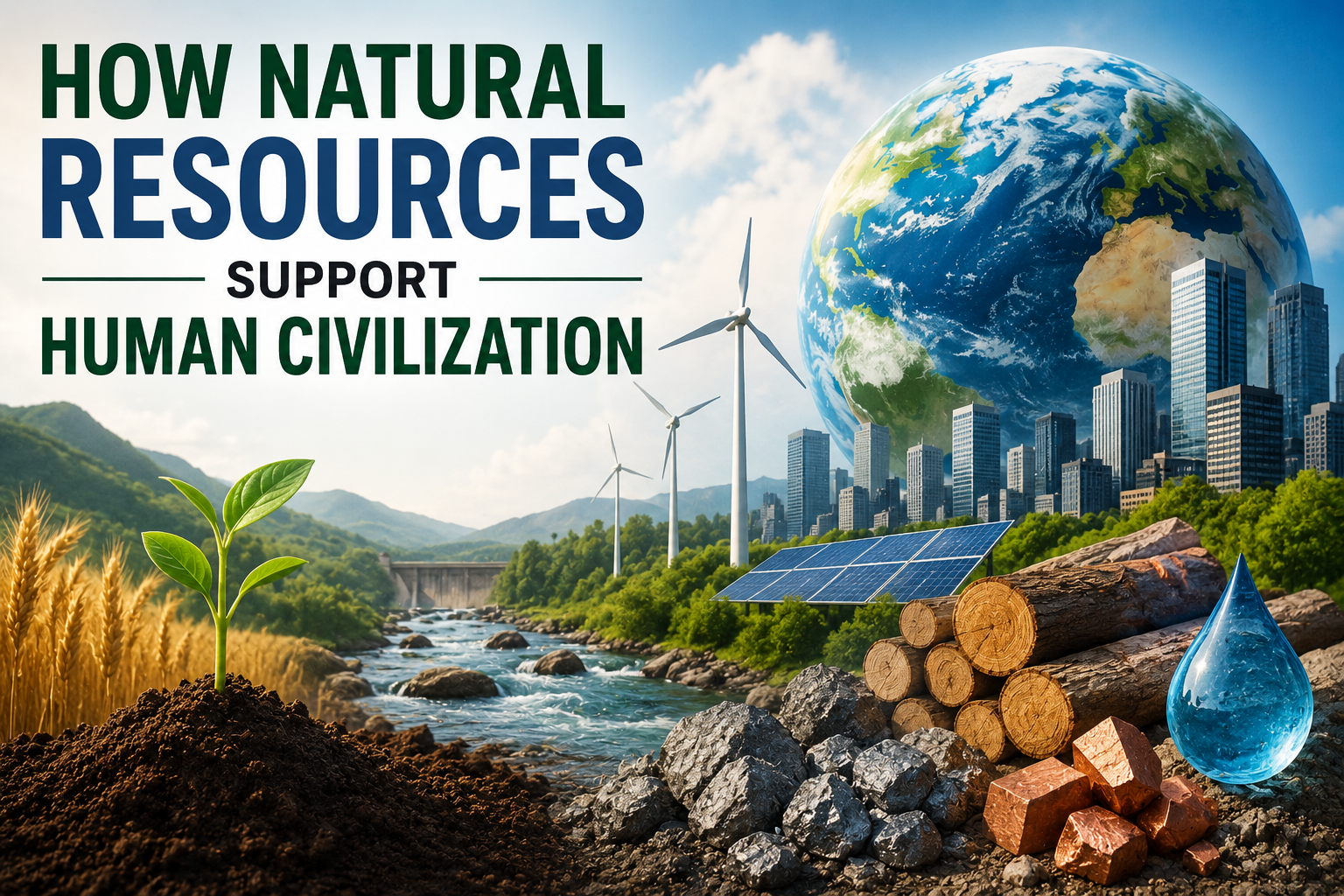
How Natural Resources Support Human Civilization
Human civilization depends on natural resources in ways that are easy to overlook. The food people eat, the water they drink, the energy used to power homes and businesses, and the materials used to build roads, vehicles, computers, and buildings all ultimately come from the natural world.
Natural resources include everything from freshwater, fertile soil, forests, and wildlife to minerals, fossil fuels, sunlight, wind, and other forms of energy. Some resources can regenerate naturally over time, while others take millions of years to form and are effectively finite on human timescales.
Modern society has developed sophisticated technologies and global supply chains, but those systems still depend on Earth’s physical resources. Understanding that connection is essential for making informed decisions about economic development, environmental protection, and the future of civilization.
What Are Natural Resources?
Natural resources are materials, substances, and forms of energy that occur naturally in the environment and can be used by humans.
They are commonly divided into two broad categories: renewable resources and nonrenewable resources.
Renewable resources can replenish themselves naturally within a relatively short period when they are managed responsibly. Examples include:
- Freshwater
- Forests
- Fish populations
- Agricultural crops
- Solar energy
- Wind energy
- Hydropower
- Geothermal energy
Nonrenewable resources are available in finite quantities or take extremely long periods to form. Examples include:
- Coal
- Oil
- Natural gas
- Iron ore
- Copper
- Gold
- Uranium
- Rare-earth minerals
The distinction is important because the way societies use each resource can determine whether it remains available for future generations.
Water: The Foundation of Civilization
Few natural resources are more important to civilization than water.
Every human being needs water for survival, but its importance extends far beyond drinking. Agriculture, manufacturing, electricity generation, sanitation, mining, transportation, and food processing all require water.
Historically, many major civilizations developed around reliable water sources. Ancient communities flourished along rivers such as the Nile, Tigris and Euphrates, Indus, and Yellow River because rivers provided drinking water, supported agriculture, enabled transportation, and helped sustain growing populations.
That relationship continues today.
Modern agriculture consumes enormous quantities of freshwater, particularly where crops depend on irrigation. Industries also use water for cooling, cleaning, processing, and manufacturing.
When freshwater becomes scarce or polluted, the consequences can extend beyond environmental damage. Water stress can affect food prices, public health, economic productivity, and migration.
Soil Makes Food Production Possible
Civilization also depends heavily on healthy soil.
Soil provides the physical foundation for growing crops and supports complex ecosystems that recycle nutrients and store carbon. It contains minerals, organic matter, microorganisms, air, and water that work together to support plant growth.
Agriculture transformed human history by allowing communities to produce food more reliably and settle in permanent locations. As agricultural productivity increased, populations grew and societies developed increasingly complex political, economic, and cultural institutions.
Today, modern food systems depend on productive agricultural soils for crops used directly as food as well as for livestock feed, fibers, biofuels, and industrial products.
However, soil is not an unlimited resource. Erosion, contamination, excessive cultivation, deforestation, poor irrigation practices, and the loss of organic matter can reduce soil quality.
Healthy soil can take decades or centuries to develop, making its conservation an important part of long-term food security.
Forests Provide More Than Timber
Forests are another critical natural resource.
Wood has been used by humans for thousands of years as a construction material, fuel source, tool-making material, and raw ingredient for countless products. Modern industries continue to rely on forest resources for timber, paper, furniture, packaging, and other materials.
But forests provide services that are far more valuable than their physical products.
Forested ecosystems:
- Store carbon
- Help regulate local and regional climates
- Protect watersheds
- Reduce soil erosion
- Provide habitat for wildlife
- Support biodiversity
- Contribute to the water cycle
- Provide food and medicinal resources
- Support millions of livelihoods
Forests therefore represent both an economic resource and an ecological system.
When forests are cleared faster than they can regenerate, societies can lose these benefits while increasing pressure on wildlife and ecosystems.
Minerals Build the Modern World
Look around a modern city and it becomes clear how dependent civilization is on minerals.
Buildings require materials such as iron, steel, aluminum, limestone, sand, gravel, and other mineral resources. Roads depend heavily on aggregates and construction materials. Electrical grids require copper and aluminum. Vehicles require numerous metals and mineral-based materials.
Digital technology has expanded this dependence.
Smartphones, computers, batteries, data centers, electric vehicles, telecommunications equipment, and renewable-energy technologies require a wide range of minerals. These can include copper, lithium, nickel, cobalt, graphite, silicon, and rare-earth elements.
This creates an important challenge for modern economies.
Technological progress can reduce dependence on certain resources while increasing demand for others. Electric vehicles, for example, can reduce petroleum consumption but require significant quantities of materials for batteries, motors, electrical systems, and infrastructure.
The transition toward cleaner technologies therefore does not eliminate resource consumption. Instead, it changes which resources are most important.
Energy Powers Economic Activity
Energy is fundamental to modern civilization.
Homes require energy for heating, cooling, lighting, cooking, communications, and appliances. Businesses depend on energy to operate machinery, transport goods, maintain buildings, and provide services.
Factories require energy to transform raw materials into finished products. Transportation systems depend on energy to move people and goods across cities, countries, and oceans.
For much of the industrial era, fossil fuels such as coal, oil, and natural gas provided the majority of this energy.
These resources played a major role in industrialization because they offered concentrated and transportable sources of energy. Coal powered early factories and railways, while petroleum became central to automobiles, aviation, shipping, and petrochemical industries.
Today, societies are increasingly expanding renewable sources such as solar, wind, hydropower, and geothermal energy.
The changing energy system illustrates a broader principle: civilization is continually adapting how it obtains and uses natural resources.
Natural Resources Support Economies
Natural resources are also deeply connected to economic development.
Countries extract, process, trade, and manufacture products from natural materials. Agriculture supports farmers, food processors, distributors, retailers, and export industries. Mining supports workers, transportation companies, manufacturers, engineers, and equipment suppliers.
Resource-rich regions can generate substantial economic activity through exports and investment.
At the same time, dependence on natural resources can create vulnerabilities. Commodity prices can rise and fall sharply, affecting government revenues, employment, investment, and household incomes.
This is one reason many economies seek to diversify beyond the extraction or export of raw materials.
The greatest economic value may come not from simply extracting a resource, but from processing it, developing technology around it, and creating higher-value products and services.
Natural Resources and Human Health
The condition of natural resources directly affects human health.
Clean water is essential for drinking and sanitation. Healthy ecosystems can help regulate disease risks and provide food and medicinal resources. Clean air depends partly on functioning natural systems as well as responsible human activity.
Contaminated water can expose communities to harmful microorganisms and chemicals. Poor soil management can reduce agricultural productivity and affect food security. Air pollution associated with energy production and industrial activity can contribute to serious health problems.
Environmental protection is therefore not separate from public health. The quality of the natural systems that support human communities can influence health outcomes across entire populations.
Biodiversity Is a Resource Too
Biodiversity is sometimes overlooked when people discuss natural resources.
Plants, animals, fungi, and microorganisms perform countless ecological functions that help maintain functioning ecosystems. They also provide resources that humans directly use.
Agriculture, for example, benefits from pollinators and organisms that contribute to healthy soils. Fisheries depend on functioning aquatic ecosystems. Pharmaceutical research has historically drawn on biological compounds found in plants, microorganisms, and other organisms.
Genetic diversity can also help crops, livestock, and wild species adapt to changing environmental conditions.
When species disappear, humanity may lose ecological functions and potentially valuable biological resources that cannot easily be replaced.
The Hidden Resources Behind Everyday Products
A useful way to understand humanity’s dependence on nature is to consider an ordinary consumer product.
A laptop, for example, requires much more than electricity and a factory. Its production can involve metals, glass, plastics, chemicals, water, energy, transportation networks, and specialized manufacturing equipment.
A loaf of bread depends on soil, freshwater, sunlight, seeds, agricultural machinery, fertilizers, transportation, processing facilities, packaging, and energy.
A house requires timber, metals, minerals, water, energy, and manufactured construction materials.
This means that natural resources are embedded in modern supply chains even when consumers never see the original source.
The more complex a product becomes, the more extensive its network of resource inputs can be.
Why Resource Efficiency Matters
Because natural resources are limited or environmentally sensitive, using them efficiently has become increasingly important.
Resource efficiency means producing goods and services while using fewer raw materials, less energy, and less water and generating less waste.
Several approaches can contribute to this goal:
- Improving agricultural practices
- Reducing food waste
- Recycling materials
- Designing products for repair and reuse
- Improving energy efficiency
- Protecting forests and watersheds
- Developing cleaner production technologies
- Using water more efficiently
- Expanding renewable energy
- Recovering valuable materials from discarded products
Efficiency does not mean eliminating resource use. Civilization will continue to need materials and energy. The goal is to obtain greater social and economic value from each unit of resource consumed.
The Importance of Sustainable Resource Management
Sustainable resource management involves using natural resources in ways that meet present needs without undermining the ability of future generations to meet their own needs.
The challenge is complicated because different resources behave differently.
A forest can regenerate if harvesting remains within ecological limits. A fish population can recover when fishing pressure is reduced. Freshwater supplies can be renewed through the water cycle, although local supplies can still become depleted or contaminated.
Mineral deposits, by contrast, cannot be naturally replenished on timescales relevant to human societies.
Sustainable management therefore requires understanding the physical characteristics of each resource and the limits of the ecosystems that support it.
Technology Can Change How Resources Are Used
Technology has repeatedly changed humanity’s relationship with natural resources.
Improved agricultural equipment and irrigation systems can increase food production. Modern recycling technologies can recover materials from waste. Energy-efficient buildings can provide the same services while consuming less energy.
Digital technologies can also reduce some forms of physical resource use. Digital documents, for example, can reduce demand for certain paper products, while advanced logistics systems can improve the efficiency of transportation networks.
At the same time, technology can create new demands.
The expansion of data centers, electric vehicles, advanced electronics, and renewable-energy infrastructure requires significant amounts of electricity, metals, construction materials, and other resources.
Technology is therefore not automatically sustainable. Its environmental impact depends on how it is designed, powered, manufactured, deployed, and eventually disposed of.
Population Growth and Rising Consumption
The relationship between natural resources and civilization becomes more complicated as populations grow and living standards change.
A larger global population requires more food, water, housing, transportation, and infrastructure. Rising incomes can also increase demand for energy-intensive goods and services.
However, consumption is not distributed equally. Resource use varies considerably among countries, industries, households, and individuals.
This makes sustainable development a balancing exercise.
Societies need to improve living standards and provide essential services while limiting unnecessary resource consumption, pollution, and ecological damage.
The challenge is not simply about using fewer resources. It is about using resources in ways that produce greater human benefits while preserving the environmental systems on which those benefits depend.
Climate Change Adds Another Layer of Risk
Climate change can affect the availability and reliability of many natural resources.
Changes in temperature and precipitation can influence agricultural productivity and freshwater supplies. Extreme weather can damage forests, infrastructure, fisheries, and coastal ecosystems.
At the same time, the extraction and use of some resources contribute significantly to greenhouse-gas emissions.
This creates a complicated feedback loop. Human societies depend on natural resources, but certain ways of extracting and using those resources can contribute to environmental changes that make resources more difficult to manage.
Addressing this challenge requires improvements in energy systems, land management, agriculture, transportation, industry, and resource efficiency.
Building a Civilization That Can Last
Human civilization has always been shaped by its relationship with nature. Ancient communities depended on rivers, fertile land, forests, and wildlife. Industrial societies expanded that relationship through large-scale mining, energy production, manufacturing, and global trade.
Modern civilization has more technological capabilities than any previous society, but technology has not removed the underlying dependence on Earth’s natural systems.
Water still has to come from somewhere. Food still requires productive ecosystems. Buildings still require physical materials. Energy still has to be generated. Electronic devices still require minerals. Human health still depends on functioning environmental systems.
The central challenge for the future is therefore not whether humanity can stop using natural resources. It is whether societies can manage them intelligently enough to support economic development and human well-being without exhausting the ecological foundations that make civilization possible.
From Resource Consumption to Resource Stewardship
The future of civilization will depend partly on a shift in perspective: natural resources should not be viewed only as commodities waiting to be extracted, but as components of interconnected systems that sustain human life.
Protecting watersheds can protect drinking water. Maintaining healthy soils can strengthen food security. Preserving forests can support biodiversity and climate regulation. Using minerals efficiently can reduce waste and pressure on new extraction. Developing cleaner energy systems can reduce some of the environmental costs associated with powering modern economies.
Natural resources have supported human civilization for thousands of years. The long-term question is whether humanity can become better at managing them so that those same foundations continue supporting civilization for thousands of years to come.



2 Comments
Micle harison
June 7, 2019Lorem ipsum dolor sit amet, usu ut perfecto postulant deterruisset, libris causae volutpat at est, ius id modus laoreet urbanitas. Mel ei delenit dolores.
John Doe
June 7, 2019Some consultants are employed indirectly by the client via a consultancy staffing company.