
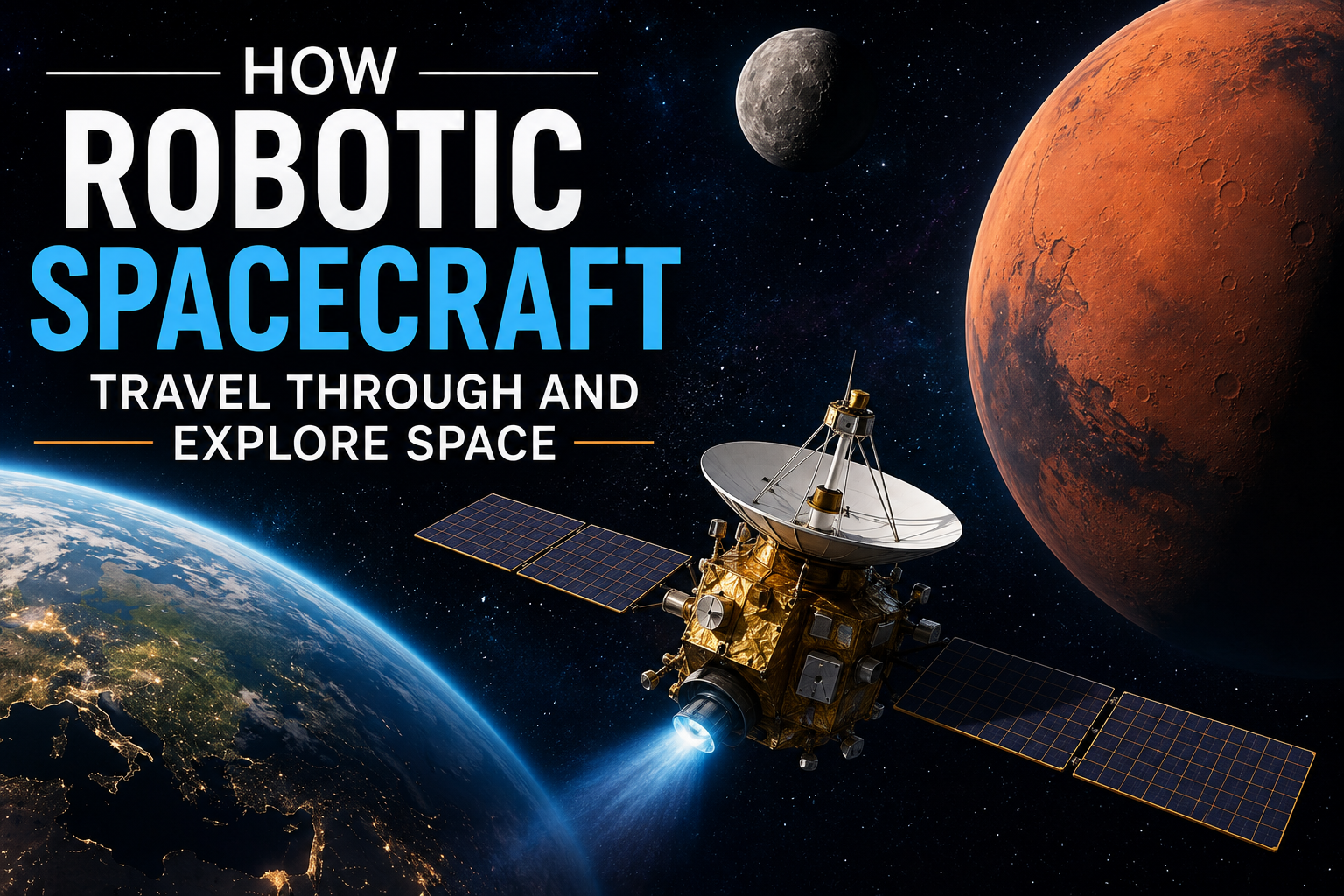
How Robotic Spacecraft Travel Through and Explore Space
Robotic spacecraft have transformed humanity’s ability to explore places that are too distant, dangerous, or difficult for people to reach.
From orbiting Earth and studying the Moon to traveling across the solar system and sending data back from the outer planets, these machines allow scientists to investigate environments that would otherwise remain inaccessible. They can operate for years or even decades, carrying cameras, scientific instruments, antennas, computers, and propulsion systems through an environment where there is no air and almost no possibility of repair.
But how does a spacecraft actually travel through space? How does it know where it is going? And how can a machine millions or billions of kilometers away send useful information back to Earth?
The answers involve a combination of orbital mechanics, propulsion, navigation, communications, robotics, and carefully engineered scientific instruments.
What Is a Robotic Spacecraft?
A robotic spacecraft is an uncrewed vehicle designed to travel beyond Earth’s atmosphere or operate in space.
Unlike crewed spacecraft, robotic missions do not need life-support systems, living quarters, food, or other equipment required to keep astronauts alive. This allows engineers to devote more of the spacecraft’s mass and power to scientific instruments, communications, propulsion, and other mission systems.
Robotic spacecraft can take several forms, including:
- Orbiters, which travel around planets, moons, or other objects.
- Landers, which descend to the surface of another world.
- Rovers, which move across a planetary surface.
- Flyby spacecraft, which pass an object without entering orbit.
- Sample-return spacecraft, which collect material and bring it back to Earth.
- Space telescopes, which observe distant objects from space.
- Solar-system probes, which travel vast distances to study environments far from Earth.
Each type is designed around a particular mission.
An orbiter may spend years mapping a planet, while a flyby probe might gather observations during a brief encounter. A rover needs wheels and surface-navigation systems, whereas a deep-space probe may need highly reliable communications and a power system capable of operating far from the Sun.
Spacecraft Begin Their Journey on Rockets
A spacecraft normally begins its mission attached to a launch vehicle.
Rockets provide the enormous amount of energy needed to overcome Earth’s gravity and place a spacecraft on its intended trajectory. During launch, the rocket accelerates rapidly through the atmosphere and eventually releases the spacecraft after reaching the appropriate flight path.
Getting into space, however, is only the beginning.
A spacecraft traveling to another planet usually needs a carefully calculated trajectory. Engineers must consider the positions and movements of planets, the spacecraft’s required speed, the amount of fuel available, and the scientific objectives of the mission.
A small difference in speed or direction at the beginning of a mission can eventually produce a very large difference in location after millions of kilometers of travel.
Spacecraft Do Not Simply Fly in a Straight Line
One of the most important ideas in space exploration is that spacecraft generally do not travel through space like airplanes flying from one city to another.
Their paths are governed primarily by gravity.
The Sun’s gravity dominates the motion of objects throughout much of the solar system. Planets, moons, asteroids, spacecraft, and other objects are constantly moving through gravitational fields.
Mission planners use these gravitational forces to design trajectories.
A spacecraft traveling from Earth to another planet is essentially placed onto an orbit around the Sun that intersects with the destination at the right time.
This requires precise calculations because the destination is moving while the spacecraft is traveling.
Orbital Mechanics Guides the Journey
Orbital mechanics is the science of understanding how objects move under gravity.
It is central to nearly every robotic space mission.
Instead of simply asking, “How do we point the spacecraft toward Mars?” engineers ask questions such as:
- What orbit should the spacecraft enter?
- How much velocity does it need?
- When should it leave Earth?
- Where will the destination be when the spacecraft arrives?
- How much fuel is required for course corrections?
- How can the spacecraft slow down when it reaches its destination?
These calculations allow spacecraft to follow trajectories that conserve fuel while reaching their targets.
For some missions, the most efficient route can take months or years.
Gravity Assists Can Provide Extra Speed
Robotic spacecraft can sometimes use planets and moons as natural sources of gravitational assistance.
This technique is known as a gravity assist or gravitational slingshot.
A spacecraft approaches a moving planet and passes through its gravitational field. The spacecraft’s trajectory changes, and depending on the geometry of the encounter, it can gain or lose energy relative to the Sun.
The planet itself changes its motion by an extremely tiny amount, but the effect on the spacecraft can be significant.
Gravity assists have made it possible for some spacecraft to reach destinations that would otherwise require much larger quantities of fuel.
They are particularly valuable for missions traveling through the outer solar system.
How Spacecraft Change Direction
Although gravity determines much of a spacecraft’s trajectory, robotic spacecraft still need propulsion systems to make adjustments.
Small thrusters can perform course corrections, change orientation, adjust orbital paths, or control a spacecraft’s position.
Some spacecraft use chemical propulsion, while others can use electric propulsion systems.
Chemical rockets generate relatively large amounts of thrust for short periods. They are useful when spacecraft need major changes in velocity, such as entering orbit or performing important trajectory maneuvers.
Electric propulsion systems typically produce much lower thrust but can operate for much longer periods. Over time, this can produce substantial changes in spacecraft velocity while using relatively little propellant.
Solar Electric Propulsion
Some robotic spacecraft use electricity generated by solar panels to accelerate ions or other charged particles.
Ion and other forms of electric propulsion can be highly efficient in terms of propellant consumption.
The trade-off is thrust.
An electric propulsion system may accelerate a spacecraft very slowly compared with a conventional chemical rocket. But because it can operate continuously or for extended periods, the spacecraft can gradually build up significant velocity.
This approach can be particularly useful for missions where travel time and trajectory requirements allow gradual acceleration.
How Spacecraft Get Their Power
A spacecraft needs energy for almost everything it does.
Power systems operate:
- Computers
- Cameras
- Scientific instruments
- Heaters
- Radios
- Navigation equipment
- Sensors
- Motors
- Data-processing systems
For missions relatively close to the Sun, solar panels are one of the most common power sources.
Solar panels convert sunlight into electricity, which can then be stored in batteries and distributed to spacecraft systems.
However, sunlight becomes much weaker as distance from the Sun increases.
A spacecraft traveling into the outer solar system therefore faces a different power challenge from one orbiting Earth.
Radioisotope Power for Deep-Space Missions
Some spacecraft traveling far from the Sun use radioisotope power systems.
These systems generate electricity from the heat produced by the natural radioactive decay of certain isotopes.
Unlike solar panels, radioisotope systems do not depend on sunlight.
That makes them particularly useful for missions operating far from the Sun or in environments where sunlight is limited.
They can also provide heat that helps keep spacecraft components within acceptable temperature ranges.
Long-duration missions require power systems designed to remain dependable for many years, sometimes decades.
How Spacecraft Know Where They Are
Navigation is one of the most challenging parts of robotic exploration.
A spacecraft cannot simply look at a road sign and determine its position.
Instead, mission controllers use observations and measurements to determine the spacecraft’s trajectory.
Tracking stations on Earth can monitor radio signals sent between the spacecraft and ground antennas. By measuring characteristics such as signal timing and frequency, engineers can determine information about the spacecraft’s distance and velocity.
Spacecraft can also use onboard sensors to determine their orientation.
These can include:
- Star trackers
- Sun sensors
- Gyroscopes
- Accelerometers
- Cameras
- Inertial measurement systems
Together, these systems allow spacecraft to maintain an understanding of their orientation and trajectory.
Star Trackers Help Spacecraft Find Their Orientation
A spacecraft needs to know which direction it is pointing.
This matters because antennas, solar panels, cameras, and scientific instruments often need to face specific directions.
Star trackers use cameras to identify patterns of stars and compare them with an onboard catalog.
Because stars appear in predictable positions relative to one another, the spacecraft can determine its orientation in space.
This is particularly useful for deep-space missions where there are no obvious external reference points.
How Spacecraft Communicate With Earth
A robotic spacecraft can collect enormous amounts of scientific information, but that information is only useful to scientists if it can reach Earth.
Spacecraft use radio communication systems to transmit data across space.
Large antennas on Earth receive these extremely weak signals.
Networks of ground stations positioned in different parts of the world can maintain communication with spacecraft as Earth rotates.
The farther away a spacecraft travels, the weaker its signal becomes. Communication therefore requires highly sensitive receiving equipment, accurate pointing, powerful transmitters, and carefully designed data systems.
Why Deep-Space Communication Takes Time
Radio signals travel at the speed of light, but space is enormous.
This means communication with distant spacecraft is not instantaneous.
Signals traveling between Earth and the Moon take a little over a second each way. Signals traveling to Mars can take several minutes each way depending on the positions of Earth and Mars.
For spacecraft much farther away, the delay can become hours.
This makes real-time control impossible for many deep-space missions.
If a spacecraft encounters an unexpected obstacle, engineers on Earth may not be able to respond immediately. The spacecraft therefore needs a degree of autonomy.
Robotic Spacecraft Need Onboard Computers
Computers allow spacecraft to process commands, monitor equipment, manage power, collect scientific data, and respond to certain situations without waiting for instructions from Earth.
Onboard software can perform tasks such as:
- Controlling spacecraft orientation
- Managing scientific instruments
- Monitoring temperatures
- Detecting system problems
- Managing power consumption
- Storing scientific data
- Executing scheduled commands
- Entering protective modes when necessary
Reliability is particularly important because spacecraft computers cannot easily be repaired after launch.
Engineers therefore design systems with redundancy, fault detection, and protective procedures.
Spacecraft Can Put Themselves Into Safe Mode
If a spacecraft detects a serious problem, it may automatically enter a protective state known as safe mode.
In safe mode, nonessential systems can be switched off while the spacecraft focuses on maintaining basic functions.
The spacecraft may point its communications antenna toward Earth or orient itself toward the Sun so that it can maintain communication or generate power.
Safe mode is an important part of mission survival because it provides spacecraft with a way to respond to unexpected problems even when communication delays prevent immediate intervention.
How Robotic Spacecraft Explore Other Worlds
Traveling to another world is only part of the mission.
Once a spacecraft arrives, it must perform scientific observations.
An orbiter may use cameras, radar, spectrometers, magnetometers, and other instruments to study a planet from above.
A lander can examine the surface directly.
A rover can travel across terrain, selecting targets for detailed investigation and collecting measurements from multiple locations.
Each approach provides different information.
Orbiters offer broad coverage, while landers and rovers can perform detailed investigations of specific environments.
Cameras Are Scientific Instruments
Spacecraft cameras are not simply used to take photographs.
They can provide information about geology, atmospheric conditions, surface features, clouds, dust, ice, and changes over time.
Different cameras can be designed to detect different wavelengths of light.
Some instruments observe visible light, while others can detect infrared, ultraviolet, or other portions of the electromagnetic spectrum.
These observations can reveal characteristics that cannot be seen by the human eye.
Spectrometers Reveal What Things Are Made Of
Spectrometers help scientists determine the chemical composition of materials.
When light interacts with matter, it can produce distinctive patterns related to the substances involved.
By measuring these patterns, spacecraft instruments can help identify minerals, gases, ice, and other materials.
This is particularly important when studying planets, moons, asteroids, and comets.
A spacecraft may never physically touch a distant object, yet its instruments can provide evidence about what that object is made of.
Radar Can See Through Certain Surfaces
Radar instruments send radio waves toward a target and measure the returning signals.
They can provide information about surface structure and, under suitable conditions, features beneath the surface.
Radar has been particularly useful for studying planetary surfaces, clouds, ice deposits, and geological structures.
Because radio waves can behave differently from visible light, radar can reveal features that ordinary cameras cannot.
Rovers Turn Spacecraft Into Mobile Laboratories
Rovers are among the most recognizable robotic explorers.
Instead of remaining at one location, a rover can travel across a planetary surface and examine multiple sites.
A rover may carry instruments capable of analyzing rocks, soil, atmospheric conditions, radiation, temperature, and other properties.
Its ability to move provides a major scientific advantage.
Scientists can select new targets as the mission develops, allowing exploration teams to investigate locations that appear particularly interesting.
Driving on Another Planet Is Not Like Driving on Earth
A rover operating on another world faces challenges that would be unusual on Earth.
Its operators may have to deal with communication delays, unfamiliar terrain, limited energy, extreme temperatures, dust, steep slopes, and obstacles.
Because commands can take time to reach the rover, driving often involves carefully planned sequences rather than continuous remote control.
Cameras and other sensors help mission teams understand the terrain before issuing movement commands.
Some rovers also have autonomous navigation capabilities that allow them to identify obstacles and select safer paths.
Landing Is One of the Hardest Parts
Reaching another planet does not guarantee a successful mission.
A spacecraft may have to slow down dramatically before reaching the surface.
Landing systems can involve heat shields, parachutes, engines, airbags, landing legs, radar, or other technologies depending on the destination and spacecraft design.
Mars presents a particularly difficult challenge because its atmosphere is thick enough to produce aerodynamic effects but too thin to slow a spacecraft as effectively as Earth’s atmosphere.
A landing sequence may therefore require several carefully coordinated systems.
A failure lasting only a few seconds can end an entire mission.
Robots Can Explore Places Humans Cannot Easily Reach
One of the greatest advantages of robotic exploration is that robots do not need breathable air, food, or comfortable temperatures.
They can operate in environments where sending people would be extremely difficult.
Robotic spacecraft have explored:
- The surfaces of planets and moons
- Asteroids
- Comets
- The outer solar system
- Solar wind
- Planetary atmospheres
- Magnetic fields
- Interplanetary space
They can also remain in operation for long periods without requiring human crews.
This makes robotics one of the most important tools for expanding humanity’s understanding of the solar system.
The Limits of Robotic Exploration
Robotic spacecraft are powerful, but they are not unlimited.
They operate with finite amounts of power and propellant. Their instruments have limited capabilities. Communications can be interrupted. Computers can fail. Components can degrade after years of exposure to radiation and extreme temperatures.
Distance is another major limitation.
The farther a spacecraft travels, the more difficult communication becomes and the longer it takes for commands and scientific data to cross the gap.
These limitations force mission designers to make difficult decisions about what a spacecraft should observe, how much data it should collect, and which scientific objectives should receive priority.
Why Long-Distance Exploration Takes Years
Space is vast, and spacecraft generally cannot travel at anything close to the speed of light.
Even powerful rockets can only provide limited changes in velocity.
Mission planners therefore often balance several competing goals:
- Minimize fuel consumption
- Reach the destination within a practical timeframe
- Carry enough scientific equipment
- Maintain communication
- Protect the spacecraft
- Achieve the desired scientific objectives
A slower trajectory may save fuel but require a longer mission. A faster trajectory may require substantially more energy.
There is rarely a single perfect solution.
What Robotic Exploration Teaches Humanity
Robotic spacecraft have fundamentally changed our understanding of the solar system.
They have revealed worlds with unexpected geological activity, complex atmospheres, unusual landscapes, vast ice deposits, powerful magnetic environments, and diverse chemical compositions.
They have also shown that planets and moons can be far more dynamic than scientists once assumed.
Each mission builds on earlier discoveries.
Data from one spacecraft can influence the design of another, creating a gradual expansion of scientific knowledge.
The Future of Robotic Space Exploration
Future robotic missions are likely to become increasingly capable.
Advances in artificial intelligence, autonomous navigation, miniaturized electronics, communications, propulsion, and scientific instruments could allow spacecraft to make more decisions independently and explore more challenging environments.
Small spacecraft may also become increasingly important. Because they can be cheaper and faster to develop than large traditional missions, constellations of small spacecraft could eventually investigate multiple targets or perform coordinated observations.
Robotic missions could also play an important role in preparing for future human exploration by mapping resources, studying hazards, testing technologies, and examining environments before astronauts arrive.
Machines That Extend Human Reach
Robotic spacecraft are essentially extensions of human curiosity.
They cannot replace scientists, engineers, or human exploration, but they allow people to investigate environments that are separated from Earth by millions or billions of kilometers.
Their journeys depend on gravity, mathematics, carefully planned propulsion, autonomous computers, sensitive instruments, and communications systems capable of bridging enormous distances.
From a launchpad on Earth to a distant planet, moon, asteroid, or the edge of the solar system, every robotic mission represents an extraordinary engineering challenge.
And each successful spacecraft expands the range of places humanity can observe, measure, and understand—turning distant worlds from points of light into scientifically accessible destinations.


2 Comments
Micle harison
June 7, 2019Lorem ipsum dolor sit amet, usu ut perfecto postulant deterruisset, libris causae volutpat at est, ius id modus laoreet urbanitas. Mel ei delenit dolores.
John Doe
June 7, 2019Some consultants are employed indirectly by the client via a consultancy staffing company.