
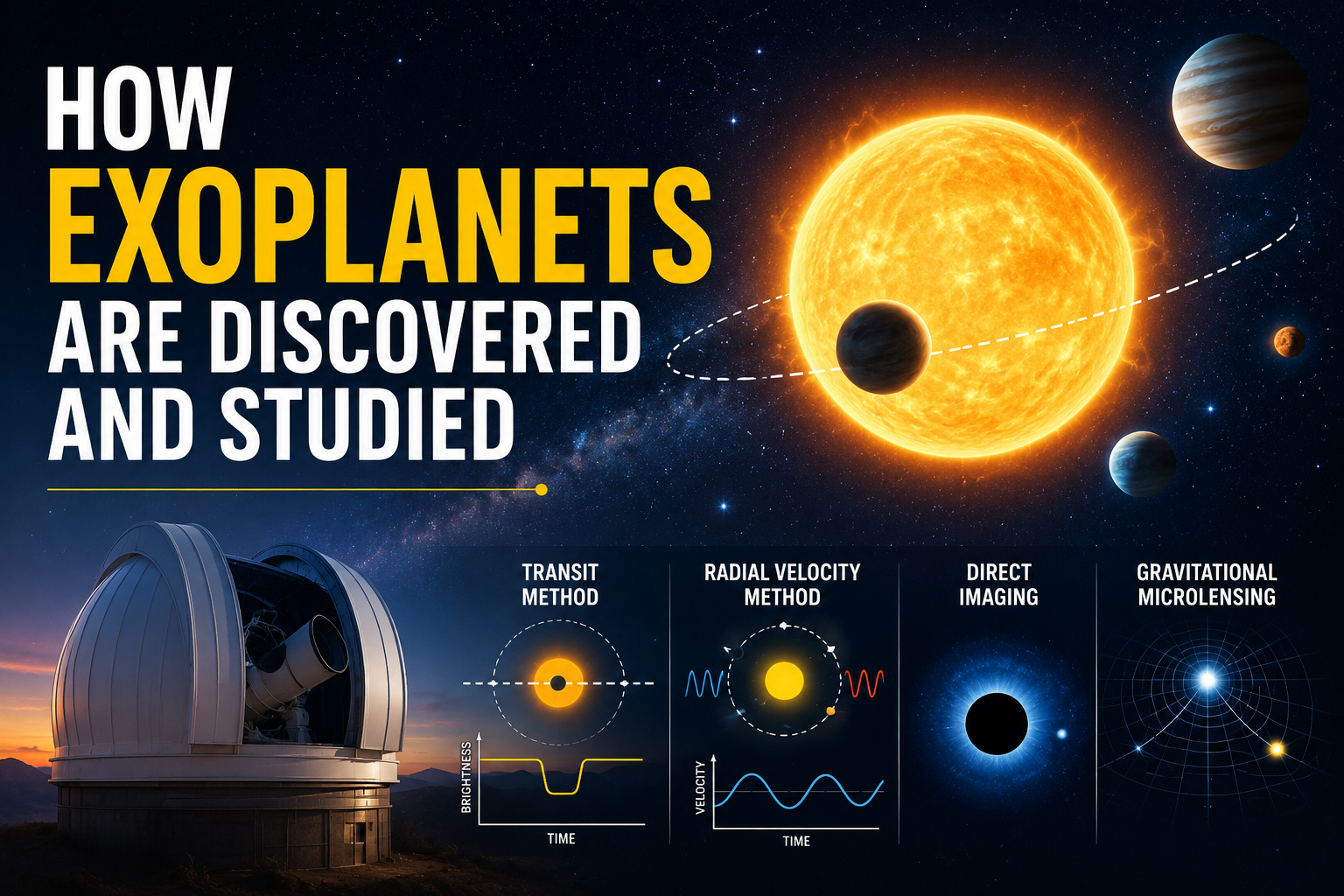
How Exoplanets Are Discovered and Studied
For thousands of years, humans could see stars scattered across the night sky but had no way of knowing whether those distant suns had planets of their own.
Today, astronomers have confirmed thousands of exoplanets—planets that orbit stars beyond our solar system. Some are giant worlds larger than Jupiter, while others are rocky planets that may resemble Earth in size. They orbit stars at distances ranging from extremely close to surprisingly far away.
Yet discovering an exoplanet is not as simple as taking a picture of it.
Stars are enormously bright, while planets are comparatively faint. At the distances involved, the light from a planet can be overwhelmed by the glare of its host star. Astronomers therefore often detect exoplanets indirectly by observing the subtle effects their gravity or movement has on their stars.
These techniques have transformed our understanding of planetary systems and opened one of astronomy’s biggest questions: How common are worlds that could potentially support life?
What Is an Exoplanet?
An exoplanet is a planet that exists outside our solar system.
Our solar system contains eight recognized planets orbiting the Sun, but there is no reason to assume that planetary systems elsewhere look the same.
Exoplanets can differ dramatically in size, composition, temperature and orbital distance. Astronomers have discovered:
- Gas giants larger than Jupiter
- Rocky planets roughly comparable in size to Earth
- Worlds orbiting extremely close to their stars
- Planets orbiting two stars
- Super-Earths larger than Earth but smaller than Neptune
- Mini-Neptunes with thick atmospheres
- Planets in systems containing several known worlds
Some exoplanets orbit their stars in only a few days, while others take years or much longer to complete an orbit.
The enormous variety of these worlds has shown scientists that planetary systems can develop in ways that are far more diverse than the architecture of our own solar system might suggest.
Why Exoplanets Are So Difficult to See
The fundamental problem is one of contrast.
A planet does not usually produce enough visible light to compete with its star. Instead, it primarily reflects some of the star’s light and may emit infrared radiation because of its temperature.
Imagine trying to spot a tiny candle next to a powerful searchlight from thousands of kilometers away. The candle might be there, but the searchlight makes it extremely difficult to see.
The same basic problem confronts astronomers when searching for planets around distant stars.
Fortunately, planets affect their host stars in measurable ways.
A planet’s gravity can cause a star to move slightly. A planet passing between its star and Earth can block a tiny fraction of the star’s light.
Those small changes provide clues that can reveal the presence of an otherwise invisible world.
The Transit Method
One of the most successful techniques for finding exoplanets is called the transit method.
A transit occurs when a planet passes between its host star and an observer.
As the planet crosses the face of the star from our perspective, it blocks a small amount of starlight. Astronomers can detect this temporary dip in brightness by repeatedly measuring the star’s light.
If the dip occurs at regular intervals, it can provide strong evidence that a planet is repeatedly orbiting the star.
The amount of light blocked can also reveal information about the planet’s size.
A larger planet blocks more of the star’s light, producing a deeper transit signal. A smaller planet produces a shallower dip.
This makes the transit method especially useful for estimating an exoplanet’s radius.
What Transit Timing Reveals
The time between repeated transits tells astronomers how long the planet takes to orbit its star.
For example, if a star’s brightness decreases once every 10 days because of a transiting planet, astronomers can infer that the planet’s orbital period is approximately 10 days.
Combined with information about the star, the orbital period can help researchers estimate the planet’s distance from its host star.
Repeated observations can also reveal additional planets.
If the gravitational influence of another planet slightly changes the timing of known transits, astronomers may detect those variations and infer the presence of an additional world.
The Radial Velocity Method
Another major technique is the radial velocity method, sometimes called the Doppler method.
Planets do not simply orbit their stars while the stars remain perfectly stationary.
Because a planet has gravity, it pulls on its star as the two bodies orbit their shared center of mass. The star therefore moves back and forth slightly.
That movement can be detected by studying changes in the star’s spectrum.
As the star moves toward and away from Earth, the wavelengths of certain spectral features shift because of the Doppler effect.
By measuring those shifts with extremely sensitive instruments, astronomers can identify the star’s motion and determine whether an orbiting planet may be responsible.
The radial velocity method can provide information about the planet’s orbit and an estimate of its minimum mass.
Why Combining Methods Is So Powerful
Transit and radial velocity observations become particularly valuable when used together.
The transit method can reveal a planet’s radius, while radial velocity measurements can provide information about its mass.
With both measurements, scientists can calculate the planet’s approximate density.
Density can help researchers determine whether a world is likely to be primarily rocky, gaseous or something in between.
For example, a planet with a relatively small radius and high density is more likely to have a substantial rocky or metallic composition than a much larger planet with a low density.
This combination turns a simple detection into a much more detailed investigation.
The Direct Imaging Method
Sometimes astronomers can detect an exoplanet more directly by blocking or suppressing the light from its host star.
This technique is known as direct imaging.
Specialized instruments can use devices called coronagraphs to block much of a star’s light, making it easier to detect nearby objects.
Direct imaging is extremely challenging because the planet can be billions of times fainter than its star at some wavelengths.
It is therefore generally more effective for certain large, young planets that are relatively far from their host stars.
Young giant planets can still retain considerable heat from their formation, causing them to emit detectable infrared radiation.
Direct images can provide valuable information about a planet’s brightness, temperature and atmosphere.
Gravitational Microlensing
Another method takes advantage of one of the most remarkable predictions of Einstein’s theory of general relativity.
When light from a distant star passes near a massive foreground star, the foreground star’s gravity bends the light. From Earth, this can cause the background star to appear temporarily brighter.
This phenomenon is called gravitational microlensing.
If the foreground star has a planet, the planet can create an additional brief distortion in the light curve.
Microlensing is particularly useful because it can detect planets at distances and orbital separations that are difficult to study with other techniques.
However, microlensing events generally happen only once because the alignment between the foreground and background stars changes as the objects move through space.
That makes follow-up observations challenging.
Astrometry: Measuring a Star’s Position
Astronomers can also search for the tiny movement of a star across the sky caused by orbiting planets.
This technique is known as astrometry.
Instead of measuring how quickly a star moves toward or away from Earth, astrometry attempts to measure small changes in the star’s position against more distant background stars.
The motion can be extremely small, requiring highly precise measurements.
As astronomical instruments improve, astrometry could become increasingly useful for studying planetary systems and measuring the masses and orbits of their planets.
How Astronomers Confirm an Exoplanet
A possible planet detected by one method is not automatically accepted as a confirmed exoplanet.
Astronomers must consider alternative explanations.
For example, a dip in a star’s brightness might be caused by something other than a planet. Another star could be involved, or the signal could result from an eclipsing stellar system.
Researchers therefore analyze the signal carefully and use additional observations where possible.
Confirmation may involve:
- Detecting a repeated transit.
- Measuring the star’s motion.
- Checking whether the signal could have another explanation.
- Comparing observations from different instruments.
- Modeling the system’s physical properties.
- Searching for additional evidence supporting the planetary interpretation.
The process helps distinguish genuine planets from false positives.
Studying an Exoplanet’s Atmosphere
Finding an exoplanet is only the beginning.
Astronomers increasingly want to know what these worlds are made of.
One of the most exciting techniques involves studying the planet’s atmosphere as it passes in front of its star.
During a transit, some starlight travels through the planet’s atmosphere before reaching Earth.
Different molecules absorb different wavelengths of light.
By analyzing how the star’s spectrum changes during the transit, scientists can sometimes identify chemical signatures associated with gases in the planet’s atmosphere.
This technique is known as transmission spectroscopy.
Possible atmospheric constituents include water vapor, carbon dioxide, methane, sodium and other molecules, depending on the planet and the sensitivity of the observations.
Space Telescopes Have Changed the Search
Ground-based observatories have played an important role in discovering and studying exoplanets, but space telescopes have several advantages.
Earth’s atmosphere can distort incoming light and absorb certain wavelengths. Observatories above the atmosphere can make extremely precise measurements without dealing with many of these effects.
Space missions such as Kepler and TESS have dramatically expanded the number of known exoplanet candidates and confirmed planets.
Kepler demonstrated that planets are common throughout the galaxy by monitoring large numbers of stars and looking for repeated changes in brightness.
TESS was designed to survey much of the sky and identify planets around relatively nearby stars, many of which are suitable for detailed follow-up observations.
The James Webb Space Telescope and Exoplanet Atmospheres
The James Webb Space Telescope (JWST) has added another powerful capability to exoplanet research.
Because JWST is particularly sensitive to infrared light, it can analyze the atmospheres of selected exoplanets in considerable detail.
Astronomers can use spectroscopy to investigate the chemical composition of an atmosphere and study how the planet’s environment changes with temperature and location.
The goal is not simply to find planets but to characterize them.
Scientists want to understand how planets form, how their atmospheres develop and why some worlds become habitable while others become hostile.
What Makes a Planet Potentially Habitable?
Finding an Earth-sized planet does not automatically mean that it is capable of supporting life.
Astronomers often begin by considering whether a planet lies within its star’s habitable zone.
The habitable zone is the range of orbital distances where conditions could potentially allow liquid water to exist on a planet’s surface, assuming an appropriate atmosphere.
But the concept is only a starting point.
A planet’s atmosphere, pressure, composition, geological activity, magnetic environment and relationship with its star can all influence its habitability.
Two planets at similar distances from their stars could therefore have dramatically different environments.
A planet may also be tidally locked, causing one side to permanently face its star while the other remains in darkness.
Understanding habitability requires studying the entire planetary system rather than relying on orbital distance alone.
Scientists Are Looking for Signs of Life Carefully
The search for potentially habitable exoplanets naturally raises the possibility of finding life beyond Earth.
But detecting a particular molecule in an atmosphere would not automatically prove that life exists there.
Some gases can be produced through non-biological chemical and geological processes.
Scientists therefore look for combinations of atmospheric characteristics that are difficult to explain through known non-biological mechanisms.
This requires extremely careful analysis.
A potential biosignature must be considered alongside the planet’s temperature, atmospheric chemistry, stellar environment and geological possibilities.
The scientific standard for claiming evidence of extraterrestrial life is consequently much higher than simply detecting one interesting molecule.
Why Exoplanet Research Matters
Exoplanet research is helping answer fundamental questions about our place in the universe.
For decades, Earth was the only known planet with life. Today, astronomers know that planets are widespread and that planetary systems come in an extraordinary range of forms.
The next challenge is understanding how common Earth-like environments actually are.
Scientists are investigating whether rocky planets are common, how frequently they retain atmospheres and how often those atmospheres contain the ingredients associated with habitability.
Each newly characterized world provides another piece of the puzzle.
From Tiny Signals to Distant Worlds
The remarkable thing about exoplanet astronomy is that many discoveries begin with signals that are almost unimaginably small.
A distant planet may reveal itself by causing a barely detectable dip in starlight or by making its host star wobble slightly.
From those tiny measurements, astronomers can reconstruct an extraordinary amount of information: a planet’s size, mass, orbit, temperature and sometimes even the composition of its atmosphere.
As telescopes and instruments become more sensitive, the field is moving from simply asking “Are there planets around other stars?” to much more ambitious questions about what those worlds are actually like.
The ultimate goal is not merely to build a catalog of distant planets. It is to understand how planetary systems form, why they evolve differently and whether Earth-like conditions—and perhaps life itself—exist elsewhere among the stars.


2 Comments
Micle harison
June 7, 2019Lorem ipsum dolor sit amet, usu ut perfecto postulant deterruisset, libris causae volutpat at est, ius id modus laoreet urbanitas. Mel ei delenit dolores.
John Doe
June 7, 2019Some consultants are employed indirectly by the client via a consultancy staffing company.