
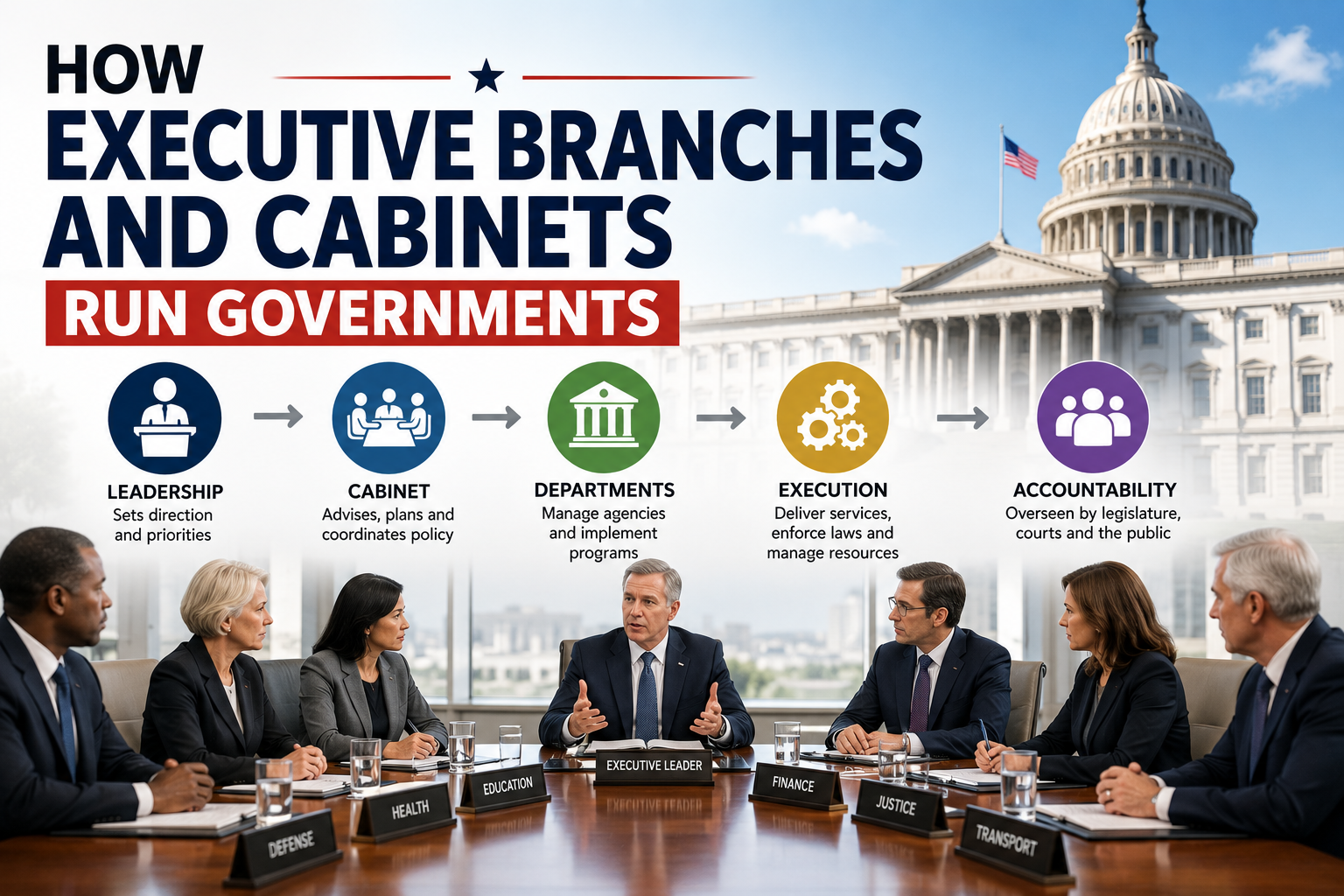
How Executive Branches and Cabinets Run Governments
When people think about government, they often picture presidents, prime ministers, parliaments and courts. But knowing who holds political office is only part of understanding how a government actually works.
Behind every major government decision is an executive system responsible for turning laws and political priorities into action. The executive branch manages public administration, implements legislation, oversees government agencies and responds to national challenges. At the center of many executive systems is a cabinet, a group of senior officials who help coordinate the government’s major policy areas.
Although executive branches vary considerably from one country to another, they generally share the same fundamental responsibility: turning political authority into practical government.
What Is the Executive Branch?
The executive branch is the part of government responsible for carrying out and enforcing laws.
In a democratic system, government is often divided into three broad branches:
- The executive implements and administers laws.
- The legislature makes and changes laws.
- The judiciary interprets laws and resolves legal disputes.
The exact boundaries differ between political systems, but the separation is designed to prevent too much power from being concentrated in one institution.
The executive may include a president or prime minister, cabinet ministers, government departments, civil servants, regulatory agencies and other public institutions.
While elected leaders determine broad political priorities, thousands or even millions of public employees may be involved in carrying out government programs.
Who Leads the Executive?
The person at the top of the executive depends on the country’s political system.
In a presidential system, the president is generally both the head of state and the head of government, although the precise powers vary between countries.
In a parliamentary system, the prime minister usually serves as the head of government, while a president or monarch may separately serve as head of state.
There are also semi-presidential systems, in which executive authority is divided in different ways between a president and a prime minister.
These differences matter because they influence how governments are formed, how ministers are appointed and how political accountability works.
The President or Prime Minister
The head of government typically establishes the administration’s broad political direction.
Depending on the country’s constitution and political system, this leader may:
- Propose major policy initiatives
- Appoint ministers
- Direct government departments
- Present a legislative agenda
- Negotiate with other political leaders
- Represent the country internationally
- Respond to national emergencies
- Oversee implementation of government priorities
However, executive leaders rarely make every decision themselves.
Modern governments are far too large and complicated for one person to manage directly.
This is where the cabinet and wider executive administration become essential.
What Is a Cabinet?
A cabinet is a group of senior government officials responsible for major areas of public policy.
Cabinet members are commonly known as ministers or secretaries, depending on the country.
A cabinet might include officials responsible for areas such as:
- Finance or treasury
- Foreign affairs
- Defense
- Health
- Education
- Agriculture
- Transport
- Energy
- Justice
- Labor
- Environment
- Interior or public security
Each minister typically oversees a government department or ministry.
The names and responsibilities of these departments differ between countries, and governments may create, merge or reorganize ministries as priorities change.
Why Governments Need Cabinets
A modern government deals with thousands of interconnected issues.
A finance ministry may focus on taxation and public spending, while a health ministry manages hospitals and public-health policy. A foreign ministry handles international relations, while an education ministry oversees schools and education policy.
These responsibilities require specialized knowledge.
A cabinet allows senior political leaders to divide responsibility while maintaining coordination.
The cabinet also gives the head of government a forum for discussing major decisions before they are implemented.
Instead of every ministry pursuing its own priorities independently, cabinet discussions can help establish a common government position.
Ministers Have Two Major Roles
Government ministers often perform two different but closely connected jobs.
First, they are political leaders.
They help develop and defend the government’s policies, communicate with the public and participate in political decision-making.
Second, they are administrative leaders.
They oversee a ministry responsible for implementing laws and government programs.
This creates an important relationship between politics and administration.
A minister may decide that the government wants to expand access to education, for example. Officials within the education ministry then have to work out how that objective can actually be achieved.
That process may involve budgets, regulations, staffing, infrastructure, procurement and coordination with regional or local governments.
Political Leaders and Civil Servants
One of the most important distinctions within an executive branch is the difference between political leadership and the permanent public service.
Ministers are usually political appointees or elected political figures whose positions may change when governments change.
Civil servants, by contrast, generally provide professional and administrative continuity.
They can help develop policies, analyze evidence, manage public programs, prepare budgets and implement decisions made by the political leadership.
This distinction allows government institutions to continue functioning even when elections produce a new administration.
A minister may leave office after an election, but the ministry’s professional staff can remain.
How a Government Turns an Idea Into Policy
A government’s policy process can involve many stages.
Suppose an administration wants to reduce unemployment.
The political leadership may identify employment as a priority. The relevant ministry could then research the problem, consult stakeholders and develop possible solutions.
Officials may estimate the cost of different programs and assess their likely effects.
The cabinet may discuss the proposals and determine whether they fit the government’s broader priorities.
If legislation is required, the government may introduce a bill to the legislature.
Once approved according to the country’s legal process, the executive administration is responsible for implementing the resulting law.
The process can therefore look something like:
Political priority → policy development → cabinet discussion → legislative or regulatory action → implementation → monitoring
Not every government decision follows exactly this sequence, but it illustrates how political ideas become administrative programs.
Cabinet Decisions Require Coordination
Government policies rarely affect only one ministry.
Consider climate policy.
An environmental ministry may be responsible for environmental regulations, but climate policy can also affect energy, transport, agriculture, industry, finance and foreign affairs.
If ministries act independently, their policies can conflict.
A finance ministry might prioritize lower taxes, while another ministry seeks increased spending. An energy ministry might want to expand infrastructure while an environmental ministry seeks stricter emissions controls.
Cabinet discussions provide a mechanism for resolving these competing priorities.
The cabinet can consider the government’s objectives as a whole rather than looking at each issue in isolation.
Collective Responsibility
In many parliamentary systems, cabinet government operates according to the principle of collective responsibility.
Under this principle, ministers are generally expected to support agreed government decisions publicly, even if there was disagreement during private cabinet discussions.
The idea is to present a coherent government position.
A minister who fundamentally disagrees with a major government decision may sometimes resign rather than publicly oppose the administration they serve.
The precise rules surrounding collective responsibility differ between countries.
The principle nevertheless reflects a basic feature of cabinet government: major executive decisions are often treated as decisions of the government as a whole rather than individual ministers acting independently.
How Cabinets Make Decisions
Cabinet decision-making can take several forms.
Ministers may meet regularly to discuss major policy proposals. Specialized cabinet committees may examine complex issues before they reach the full cabinet.
Senior officials can prepare briefing documents explaining the evidence, financial implications and legal considerations surrounding a proposal.
The head of government then has to balance competing interests.
A cabinet decision may involve questions such as:
- Is the policy legally possible?
- How much will it cost?
- Can the government afford it?
- What are the expected benefits?
- Which groups will be affected?
- Will another ministry be affected?
- Does the proposal fit existing laws?
- Can the government implement it effectively?
- What political consequences could follow?
Good executive government therefore involves much more than announcing policies.
Implementation can be just as important as the original decision.
Government Departments Turn Decisions Into Action
Ministries and departments are the machinery through which executive decisions are implemented.
A health ministry, for example, may oversee national health programs, establish standards, allocate resources and coordinate with hospitals or regional authorities.
A transport department may regulate infrastructure, transportation systems and related safety standards.
These institutions usually contain specialized divisions and agencies with specific responsibilities.
The larger the government, the more complicated this administrative structure becomes.
Executive Agencies Have Specialized Responsibilities
Governments often establish agencies that operate within or alongside ministries.
These agencies may regulate industries, collect taxes, manage borders, protect the environment, oversee elections or provide public services.
Specialization allows agencies to develop expertise in particular fields.
However, agencies still operate within a broader legal and political framework.
Their authority usually comes from laws, regulations or constitutional arrangements that define what they can and cannot do.
The Executive Needs a Budget
Government promises require money.
A cabinet cannot simply announce a new nationwide program without considering how it will be financed.
The executive therefore plays a central role in preparing and proposing the government budget.
The budget typically estimates government revenue and sets out proposed spending.
Revenue can come from sources such as:
- Income taxes
- Corporate taxes
- Consumption taxes
- Customs duties
- Natural-resource revenues
- Government fees
- Borrowing
The government then has to decide how available resources should be allocated.
This creates difficult choices.
Increasing spending in one area may require reducing spending elsewhere, raising revenue or borrowing more money.
The Legislature Usually Controls the Purse
Although the executive often prepares the budget, democratic systems generally give the legislature an important role in approving taxation and public spending.
This is one of the major checks on executive power.
A government may propose a spending plan, but legislators can debate, amend or reject elements of it according to the country’s constitutional system.
This relationship demonstrates why the executive cannot always govern independently.
Government power is divided among institutions that are expected to check one another.
Executive Orders and Administrative Powers
Some executive systems give leaders authority to issue directives without passing a new law through the legislature.
In the United States, for example, presidents can issue executive orders directing federal officials within the limits of existing constitutional and statutory authority.
Other countries use different forms of executive or administrative instruments.
These powers can allow governments to act relatively quickly, particularly when existing laws already provide the necessary authority.
However, executive directives are not unlimited.
They can be challenged in courts, restricted by legislation or overturned by later administrations depending on the legal system.
Emergency Powers
Executives often receive additional authority during emergencies.
Governments may need to respond rapidly to events such as natural disasters, wars, public-health emergencies or major security threats.
Emergency powers can allow governments to make decisions faster than normal procedures permit.
But these powers can also create risks.
If emergency authority is too broad or remains in place for too long, it can weaken democratic oversight and individual rights.
For that reason, many constitutional systems place legal limits on emergency powers, including time limits, legislative oversight or judicial review.
The Executive and Foreign Policy
The executive branch often plays a particularly important role in international affairs.
Heads of government and foreign ministers may negotiate treaties, meet foreign leaders, participate in international organizations and establish diplomatic priorities.
Foreign policy can involve security, trade, immigration, environmental agreements and international development.
Although the executive frequently takes the lead, legislatures may have powers over treaties, budgets, military action or other aspects of foreign policy.
The precise division of authority varies considerably between political systems.
The Executive Is Subject to Checks and Balances
Executive power is not supposed to be unlimited in a constitutional democracy.
Different institutions can constrain executive decisions.
The legislature may investigate government actions, control spending or reject proposed legislation.
Courts can determine whether executive actions comply with the constitution or other laws.
Independent oversight bodies can investigate corruption, government spending or administrative misconduct.
The media and civil society can scrutinize government decisions and bring public attention to controversial policies.
Elections provide another major mechanism of accountability.
If citizens are dissatisfied with the government’s performance, they can potentially replace the political leadership through the electoral process.
Courts Can Review Executive Actions
Judicial review is an important part of many constitutional systems.
If an executive authority takes an action that appears to violate the constitution or existing law, affected parties may challenge that action in court.
A court can then determine whether the executive acted within its legal authority.
This creates an important boundary between political power and legal authority.
A government may have the political support to pursue a policy, but it still has to operate within the legal framework established by the country’s constitution and laws.
Cabinets Can Change After Elections
Executive leadership often changes when political power changes.
In a presidential system, an election may produce a new president who appoints a new administration.
In a parliamentary system, a new government may be formed when a different party or coalition gains enough legislative support to command a majority.
Cabinet ministers may therefore change even when the permanent government administration remains largely intact.
This allows democratic governments to combine political change with institutional continuity.
Coalition Governments Make Cabinet Management More Complex
In some parliamentary systems, no single political party wins enough seats to govern alone.
Several parties may therefore form a coalition government.
Cabinet positions may be distributed among coalition partners, with different parties responsible for different ministries.
Coalition governments can bring together a wider range of political interests, but they can also make decision-making more complicated.
Major policies may require negotiation among coalition partners.
A disagreement within the coalition can sometimes threaten the government’s stability.
Local Governments Add Another Layer
National executives are not always responsible for every public service.
Many countries divide government responsibilities among national, regional, state, provincial or local authorities.
A national government might establish broad education policy, while regional governments administer schools.
A national government may establish health standards while local authorities manage particular facilities or services.
The exact arrangement depends on whether a country is centralized, federal or somewhere between the two.
Understanding executive government therefore requires looking beyond the national cabinet.
Why Government Administration Matters
Political debates often focus on leaders and elections, but effective government ultimately depends on administration.
A government can announce ambitious policies, but those policies have little practical value if institutions cannot implement them.
Implementation requires trained personnel, reliable budgets, effective systems, accurate information and accountability.
This is why public administration is such an important part of executive government.
The quality of institutions can determine whether political promises become functioning public services.
What Happens When Executive Power Becomes Too Strong?
Strong executive leadership can help governments respond quickly, especially during crises.
But excessive concentration of power can create serious problems.
If executives weaken legislatures, interfere with courts, suppress oversight or remove meaningful limits on their authority, democratic institutions can become less effective.
The danger is not simply that one leader becomes powerful.
The deeper concern is that the institutional checks designed to prevent abuse may gradually stop functioning.
Healthy democratic systems therefore depend not only on elections but also on independent institutions capable of holding executive power accountable.
Why Cabinets and Executive Branches Matter to Everyday Life
Most people encounter government through practical services rather than political theory.
A passport, school, hospital, road, tax system, public benefit, business regulation or emergency response may all involve executive institutions.
When those institutions work effectively, government can become almost invisible in everyday life.
When they fail, citizens notice quickly.
This is why understanding the executive branch matters. It helps explain how decisions made by political leaders eventually affect household finances, businesses, schools, infrastructure and public services.
From Political Promises to Public Action
Executive government is ultimately the bridge between political decisions and practical administration.
Presidents and prime ministers establish broad priorities. Cabinets coordinate those priorities across different policy areas. Ministers lead departments, while civil servants and public agencies turn decisions into programs, regulations and services.
At the same time, legislatures, courts, oversight institutions, the media and citizens provide checks on executive authority.
The system is therefore much more than a single leader issuing orders.
Effective government depends on a network of institutions working together—and sometimes disagreeing with one another—within a legal and constitutional framework.
That balance is what allows executive branches to act while still being held accountable. When political leadership, professional administration and institutional oversight function together, governments are better positioned to turn public priorities into meaningful results without allowing executive power to become unchecked.


2 Comments
Micle harison
June 7, 2019Lorem ipsum dolor sit amet, usu ut perfecto postulant deterruisset, libris causae volutpat at est, ius id modus laoreet urbanitas. Mel ei delenit dolores.
John Doe
June 7, 2019Some consultants are employed indirectly by the client via a consultancy staffing company.