
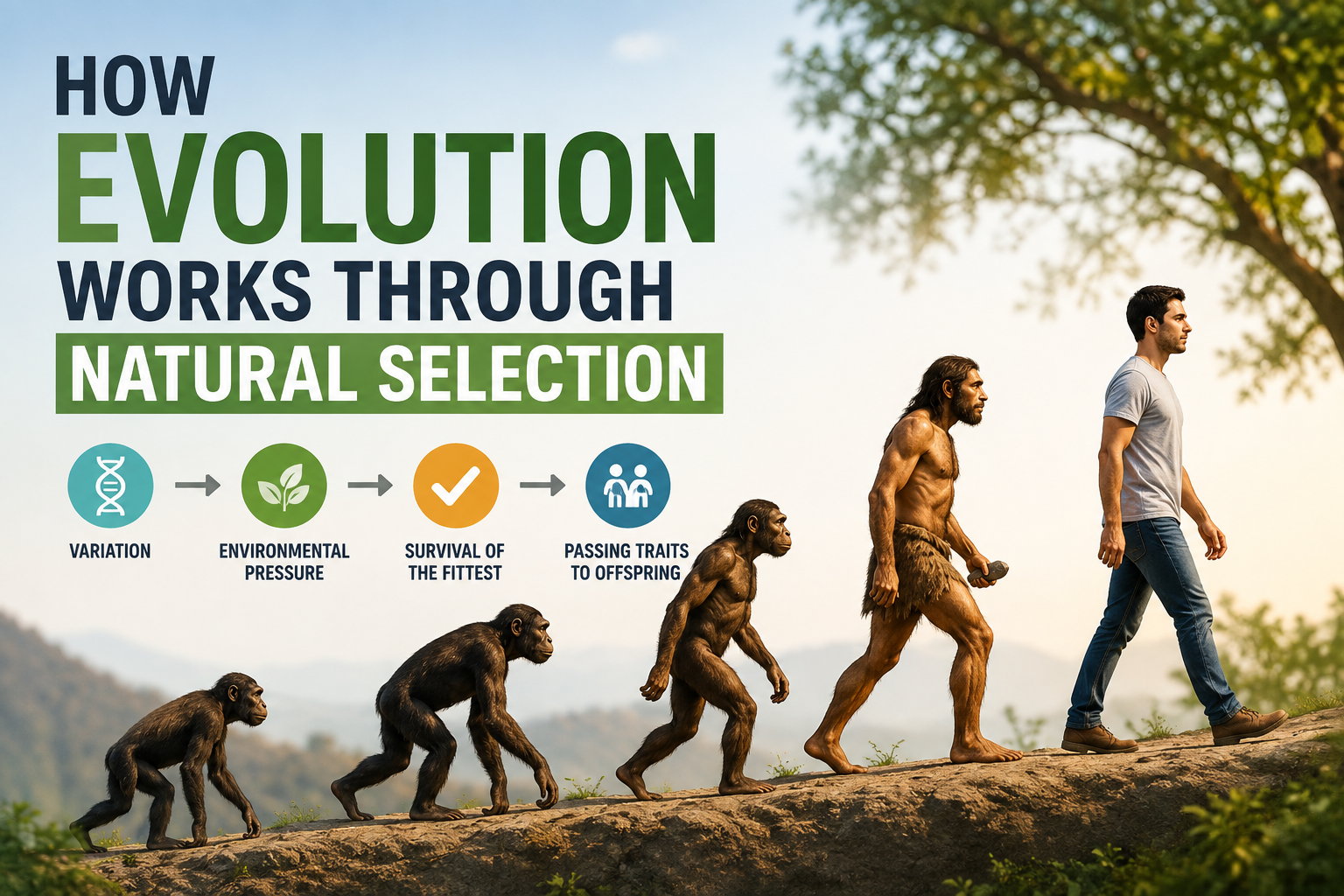
How Evolution Works Through Natural Selection
Evolution is one of the central ideas in modern biology, but it is often misunderstood as a process in which individual animals deliberately adapt to their surroundings. In reality, evolution happens across generations as inherited characteristics become more or less common within populations.
At the heart of this process is natural selection.
Natural selection explains how environmental pressures can favor some inherited traits over others. When individuals with certain characteristics survive and reproduce more successfully, those traits can become increasingly common in later generations.
Over long periods, this simple process can produce remarkable changes—from bacteria developing resistance to antibiotics to populations of animals becoming better suited to particular environments.
What Is Evolution?
Evolution is the change in the inherited characteristics of a population over generations.
A population is not genetically identical. Individuals carry different versions of genes, known as alleles, and those genetic differences can influence characteristics such as body size, coloration, metabolism, behavior and resistance to disease.
When the frequency of particular inherited variants changes from one generation to the next, evolution has occurred.
This distinction is important: individual organisms do not evolve during their lifetimes in the biological sense. Populations evolve across generations.
For example, an individual bird cannot decide to grow a longer beak because its food source has changed. But if birds with slightly longer beaks are better at obtaining the available food and consequently produce more offspring, the genes associated with that characteristic may become more common in the population.
Over many generations, the population could develop a noticeably different average beak shape.
Charles Darwin and the Idea of Natural Selection
The mechanism of natural selection was famously developed by Charles Darwin and independently conceived by Alfred Russel Wallace in the 19th century.
Darwin recognized that populations produce more offspring than can survive and that individuals differ in their characteristics. He also observed that some variations can provide advantages in particular environments.
From these observations came the basic idea of natural selection.
Individuals with advantageous inherited traits are more likely, on average, to survive and reproduce. Their offspring may inherit those traits, increasing their representation in future generations.
Darwin did not know about genes or DNA because genetics had not yet been incorporated into evolutionary biology. Later discoveries in genetics provided the mechanism for understanding how inherited variation is produced and passed between generations.
The Four Key Ingredients of Natural Selection
Natural selection can be understood through several basic conditions.
1. Variation Exists Within Populations
Individuals within a species are not identical.
Two members of the same population can differ in characteristics such as size, coloration, behavior or tolerance to environmental conditions.
Some of these differences are influenced by genetics.
Without variation, natural selection would have little material to work with. If every individual had exactly the same inherited characteristics, environmental pressures could not favor one inherited variant over another.
2. Some Variation Is Heritable
For natural selection to change a population genetically, differences must be capable of being passed from parents to offspring.
Genes provide the biological information that can be inherited.
Genetic variation can arise through processes such as mutation and genetic recombination. Mutations can introduce new genetic variants, while recombination reshuffles existing variants during reproduction.
Not every mutation is beneficial. Many have little effect, some are harmful, and a small proportion may provide an advantage in a particular environment.
3. More Offspring Are Produced Than Can Survive
Most organisms have the potential to produce more offspring than the environment can support.
Food, water, shelter, nesting sites and other resources are limited. Individuals may also face predators, parasites, disease, competition and environmental hazards.
As a result, not every offspring survives long enough to reproduce.
This creates competition and differences in reproductive success.
4. Individuals Leave Different Numbers of Offspring
The most important part of natural selection is differential reproductive success.
If a particular inherited characteristic helps an organism survive and reproduce, individuals carrying that characteristic may leave more offspring on average.
Those offspring can inherit the relevant genetic variants.
Over generations, the frequency of those variants can increase within the population.
A Simple Example of Natural Selection
Imagine a population of insects living on dark tree bark.
Some insects have lighter coloration while others are darker. Birds that hunt the insects can more easily spot the lighter individuals against the dark background.
If darker insects are less likely to be eaten, they may survive longer and reproduce more frequently.
Their offspring inherit genetic variants associated with darker coloration.
After many generations, darker insects could make up a much larger proportion of the population.
The insects did not become darker because they consciously needed camouflage. Instead, individuals already carrying advantageous variation had greater reproductive success.
That is natural selection in action.
Where Does Genetic Variation Come From?
Natural selection does not create genetic variation according to an organism’s needs. Instead, it acts on variation that already exists or arises through genetic processes.
Mutation
A mutation is a change in DNA.
Mutations can occur naturally as DNA is copied and maintained. Environmental factors can also increase mutation rates in some circumstances.
A mutation may alter a gene, but its effect can vary enormously.
It might have no noticeable effect, interfere with biological function, or occasionally provide an advantage under particular conditions.
For example, a mutation that helps a bacterium survive exposure to an antibiotic can become highly advantageous when that antibiotic is present.
Genetic Recombination
Sexual reproduction also generates new combinations of existing genetic variants.
During the production of eggs and sperm, genetic material is rearranged and chromosomes are distributed into reproductive cells in different combinations.
This means siblings can inherit different combinations of genes from the same parents.
Recombination therefore provides natural selection with additional variation on which it can act.
Natural Selection Does Not Always Mean “Survival of the Fittest”
The phrase “survival of the fittest” can be misleading if “fitness” is interpreted as physical strength.
In evolutionary biology, fitness generally refers to an organism’s ability to survive and reproduce successfully in a particular environment.
A physically powerful animal is not necessarily evolutionarily fitter than a smaller one.
Consider an environment where food is scarce. An animal that requires less energy to survive might have a reproductive advantage over a stronger animal with higher energy requirements.
Fitness is therefore relative to the environment.
A trait that is advantageous in one setting can become disadvantageous when conditions change.
The Environment Shapes Which Traits Are Favored
Natural selection is closely connected to environmental conditions.
A characteristic that helps an organism survive in one environment may provide little benefit—or even become harmful—in another.
Consider coloration in animals.
A white coat may provide excellent camouflage in a snowy environment but make an animal highly visible in a dark forest.
If the environment changes, the selective pressures acting on a population can change as well.
This is one reason evolution does not have a predetermined destination.
There is no universal biological definition of a “more evolved” organism.
Evolution Has No Goal
One of the most common misconceptions about evolution is that species evolve toward greater complexity or perfection.
Natural selection does not plan ahead.
There is no evolutionary blueprint telling a species what it should become.
Instead, populations respond to changing circumstances through differences in reproductive success.
A trait can become common because it provides an advantage under particular conditions—not because it represents progress toward some predetermined endpoint.
This also explains why evolution can produce compromises.
A characteristic may improve one aspect of survival while creating a disadvantage elsewhere. Evolution works with existing biological structures and available genetic variation rather than designing organisms from scratch.
Natural Selection Can Produce New Species
Given enough time and genetic divergence, natural selection can contribute to the formation of new species.
One important pathway begins when populations of the same species become separated.
Geographic barriers such as mountains, rivers or islands can prevent groups from regularly breeding with one another.
Once separated, the populations can accumulate different mutations and experience different environmental pressures.
Natural selection may favor different traits in each population.
Over many generations, the genetic differences can become substantial enough that the groups can no longer successfully interbreed.
This process is known as speciation.
Natural selection is not the only mechanism involved in evolution, but it is a major force that can drive populations apart when they experience different environments and selective pressures.
Natural Selection Is Still Happening Today
Evolution is not simply something that happened in the distant past.
Natural selection continues whenever inherited differences affect survival or reproductive success.
One of the clearest modern examples is antibiotic resistance.
When antibiotics are used against bacteria, susceptible bacteria may be killed while bacteria carrying resistance mechanisms survive.
Those surviving bacteria reproduce, potentially increasing the proportion of resistant bacteria in the population.
The result is not that bacteria “learn” how to resist antibiotics. Instead, antibiotic exposure creates a strong selective environment in which resistant variants can have a major advantage.
Similar evolutionary processes can be observed in agriculture, wildlife populations and disease-causing organisms.
Humans Are Part of Evolution Too
Humans are not separate from evolutionary processes.
Our species evolved through the same fundamental biological mechanisms that affect other organisms.
Human populations have experienced natural selection in response to environmental pressures, infectious diseases, diet and other factors.
Some inherited characteristics that are common in human populations reflect adaptations to particular environments.
However, human evolution is complicated by culture and technology.
Clothing, agriculture, medicine, housing and other technologies can change the environments in which humans live. These cultural developments can alter the selective pressures acting on populations.
Human evolution therefore demonstrates that biology and environment are closely interconnected.
Natural Selection Is Only One Part of Evolution
Natural selection is central to evolutionary theory, but it is not the only process that changes populations.
Genetic drift, for example, can change allele frequencies simply because some individuals reproduce while others do not by chance. This effect can be particularly important in small populations.
Gene flow occurs when individuals or genetic material move between populations, introducing genetic variants into new groups.
Mutation creates new genetic variation.
Together with natural selection, these mechanisms help explain how populations change genetically over time.
Evolutionary biology therefore involves more than a simple story of organisms adapting to their surroundings.
Why Evolution Matters Today
Understanding natural selection has practical consequences far beyond the study of fossils and ancient species.
It helps scientists understand how pathogens change, why antibiotic resistance develops, how agricultural pests respond to pesticides and how wildlife populations respond to environmental changes.
It also provides a framework for understanding biodiversity.
Every species alive today represents a population with an evolutionary history shaped by genetic variation, environmental pressures, chance events and interactions with other organisms.
Evolution helps explain both the similarities shared by living things and the extraordinary diversity found across the planet.
The Process That Keeps Changing Life
Natural selection can appear simple at first: individuals vary, some of those differences are inherited, resources are limited, and individuals leave different numbers of offspring.
But repeated across thousands or millions of generations, those small differences can produce profound biological change.
The process does not require organisms to consciously adapt, and it does not work toward a predetermined goal. Instead, environmental conditions continually influence which inherited characteristics are more likely to persist.
That makes evolution through natural selection one of the most powerful explanations in science for how life changes, adapts and diversifies over time.


2 Comments
Micle harison
June 7, 2019Lorem ipsum dolor sit amet, usu ut perfecto postulant deterruisset, libris causae volutpat at est, ius id modus laoreet urbanitas. Mel ei delenit dolores.
John Doe
June 7, 2019Some consultants are employed indirectly by the client via a consultancy staffing company.