
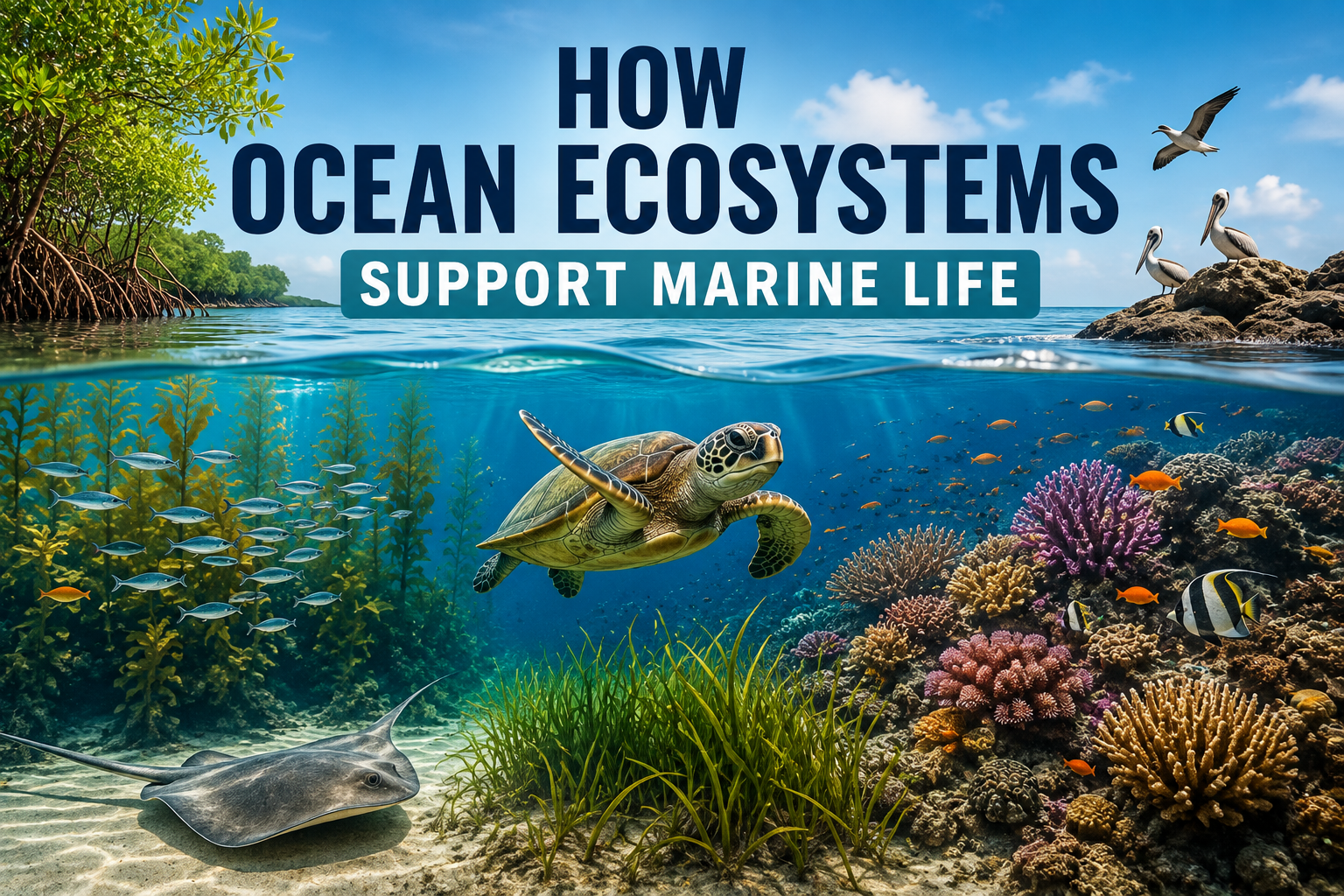
How Ocean Ecosystems Support Marine Life
The ocean is far more than a vast body of salt water. It is a network of interconnected ecosystems that provides food, shelter, breeding grounds and pathways for countless species.
From microscopic phytoplankton drifting near the surface to whales moving through the open ocean, marine organisms depend on relationships between habitats, nutrients, predators and physical conditions. Coral reefs, kelp forests, seagrass meadows, mangroves, estuaries and deep-sea environments each perform different ecological roles, yet they are closely connected.
Understanding how these systems work helps explain why healthy ocean ecosystems are essential not only for marine species, but also for coastal communities and the wider planet.
What Is an Ocean Ecosystem?
An ocean ecosystem is a community of living organisms interacting with one another and with their physical environment.
Marine ecosystems include both biotic factors, such as fish, algae, corals, bacteria and marine mammals, and abiotic factors, including:
- Water temperature
- Salinity
- Sunlight
- Ocean currents
- Depth
- Pressure
- Nutrient availability
- Oxygen levels
- Seafloor characteristics
These factors vary dramatically across the ocean. As a result, marine life has evolved to occupy highly specialized environments.
NOAA describes ocean, coastal and estuarine environments as home to organisms ranging from single-celled plankton to blue whales, with their survival influenced by habitats, ecological relationships and changing environmental conditions. (NOAA)
How Marine Food Webs Support Life
One of the most important functions of an ocean ecosystem is moving energy through food webs.
At the foundation are primary producers, including phytoplankton, algae and marine plants. These organisms capture energy from sunlight through photosynthesis and convert it into organic matter.
Small organisms consume these producers. Larger animals then consume those organisms, creating interconnected feeding relationships.
A simplified marine food chain might look like this:
Phytoplankton → Zooplankton → Small Fish → Larger Fish → Marine Predators
Real ecosystems are considerably more complicated because individual species can have multiple predators and food sources. NOAA notes that aquatic food webs show how energy moves among producers and consumers and that changes affecting one species can produce direct or indirect effects throughout the network. (NOAA)
This interconnectedness is one reason biodiversity matters. Removing or reducing an important species can influence many other organisms.
Phytoplankton Form the Base of Many Marine Food Webs
Although they are often overlooked because they are microscopic, phytoplankton play an enormous role in ocean ecosystems.
These tiny organisms live primarily in sunlit waters, where they use sunlight, carbon dioxide and nutrients to produce organic matter.
They are then consumed by organisms such as zooplankton and krill, which become food for fish and other marine animals.
The result is a flow of energy from microscopic organisms to increasingly large consumers.
Much of the ocean’s biological productivity is concentrated in the upper, sunlit portion of the water column, where photosynthesis can occur. (NOAA National Marine Sanctuaries)
Coral Reefs Create Complex Marine Habitats
Coral reefs are among the most recognizable ocean ecosystems and are exceptionally important habitats for marine biodiversity.
Reef-building corals create physical structures filled with cracks, crevices and sheltered spaces. These structures provide places where fish, crustaceans, mollusks, sea turtles and many other organisms can feed, hide and reproduce.
NOAA describes coral reefs as among the most diverse ecosystems on Earth. Although they occupy a relatively small area, they provide habitat and food for large numbers of marine species. (NOAA)
The reef itself is therefore more than a collection of corals. It functions as a three-dimensional habitat supporting an interconnected community.
Coral and Algae Have an Important Partnership
Many shallow-water reef-building corals have a mutualistic relationship with microscopic photosynthetic algae living within their tissues.
The algae produce energy-rich compounds through photosynthesis, while the coral provides a protected environment and materials needed by the algae.
This relationship helps support the productivity of shallow coral reef ecosystems. (NOAA)
When environmental conditions disrupt this relationship, corals can become stressed and lose their associated algae, a phenomenon commonly known as coral bleaching.
Seagrass Meadows Provide Underwater Nurseries
Seagrasses are flowering plants that live underwater in shallow coastal environments.
Their importance can be easy to underestimate because they resemble ordinary grass. In reality, seagrass meadows provide essential habitat for many marine organisms.
Their leaves and roots:
- Provide shelter
- Stabilize sediments
- Create feeding grounds
- Support young fish and invertebrates
- Help maintain water quality
- Provide spawning and nursery habitat
NOAA notes that submerged aquatic vegetation provides food, oxygen and shelter and can support spawning, nursery, refuge and feeding areas for many species. (National Ocean Service)
This makes seagrass ecosystems particularly important for species that spend different stages of their lives in different habitats.
Mangrove Forests Connect Land and Sea
Mangroves occupy tropical and subtropical coastal areas where land meets the sea.
Their tangled root systems create sheltered environments where young fish, crustaceans and other organisms can find food and protection from predators.
Mangrove roots also slow water movement, allowing sediments to settle. This helps stabilize shorelines and can reduce the amount of sediment reaching nearby marine habitats. (National Ocean Service)
Mangroves are therefore important not only because they provide habitat themselves, but also because they influence the conditions of surrounding ecosystems.
Estuaries Are Highly Productive Ecosystems
Estuaries occur where freshwater from rivers and streams meets seawater.
The mixing of fresh and salt water creates changing conditions in salinity, water depth and nutrient availability. These variations support a wide range of habitats, including marshes, mangroves, seagrass beds and oyster reefs.
NOAA Fisheries describes estuaries as among the most productive ecosystems on Earth and notes that they provide feeding, growing and reproductive habitat for numerous species. (NOAA Fisheries)
Many fish and shellfish use estuaries during important stages of their life cycles.
That makes estuaries a critical connection between freshwater environments and the marine ecosystem.
Kelp Forests Create Underwater Communities
Kelp forests are another important marine habitat, particularly along temperate coastlines.
Large kelp plants can form underwater canopies with multiple layers of habitat beneath them. Fish, invertebrates and other organisms can use these structures for shelter, feeding and reproduction.
NOAA describes kelp forests as ecosystems with a layered structure resembling a terrestrial rainforest, with canopy-forming kelp creating habitat throughout the water column. (NOAA National Marine Sanctuaries)
The complexity of these habitats allows many species to coexist in relatively small areas.
The Open Ocean Supports Vast Food Webs
Not all marine ecosystems are attached to reefs, coastlines or the seafloor.
The pelagic ecosystem, or open ocean, occupies the water column away from the immediate seafloor and shoreline.
It includes organisms ranging from microscopic plankton to large predators such as tuna, sharks and marine mammals.
Because sunlight penetrates only relatively shallow waters, much of the ocean’s primary production occurs near the surface. Organisms in these upper waters become food for larger animals, while organic matter can eventually sink into deeper parts of the ocean. (NOAA)
This creates connections between surface ecosystems and the deep ocean.
The Deep Sea Has Its Own Ecosystems
Far below the sunlit surface, conditions become dramatically different.
There is little or no sunlight, temperatures can be low, pressure is immense and food availability can be limited.
Yet the deep ocean supports diverse communities of organisms.
Some deep-sea ecosystems depend largely on organic material that sinks from productive surface waters. Others, such as communities associated with hydrothermal vents, can rely on chemical energy rather than sunlight.
These environments demonstrate that marine life does not depend on a single type of ecosystem or energy pathway.
Ocean Currents Help Connect Marine Ecosystems
Ocean currents transport water, nutrients, heat and organisms across enormous distances.
They can influence where nutrients become available for primary producers and can also affect the movement of larvae and other organisms.
Currents help connect habitats that may appear geographically separated.
A young fish, for example, may begin life in a coastal nursery environment before moving toward offshore habitats as it matures.
This movement creates ecological connectivity, meaning that the health of one ecosystem can influence another.
Research and NOAA resources emphasize connections among habitats such as mangroves, seagrass beds, coral reefs and offshore environments through the movement of organisms, nutrients and organic material. (NOAA Institutional Repository)
Why Marine Biodiversity Matters
Biodiversity refers to the variety of living organisms within an ecosystem.
A biologically diverse ocean contains many different species performing different ecological roles.
Some species are predators. Others consume algae or plankton. Some break down organic matter, while others create habitat or recycle nutrients.
This diversity can make ecosystems more complex and resilient.
For example, a coral reef is not supported by coral alone. It depends on relationships involving fish, algae, microorganisms, invertebrates and surrounding habitats.
The same principle applies across marine environments.
What Happens When Ocean Ecosystems Are Damaged?
Marine ecosystems can be affected by many human activities and environmental pressures.
Important threats include:
- Overfishing
- Pollution
- Marine debris
- Habitat destruction
- Coastal development
- Rising ocean temperatures
- Oxygen-depleted waters
- Destructive fishing practices
- Chemical contamination
- Physical damage to habitats
NOAA identifies toxic spills, marine debris, oxygen-depleted areas, warming waters, overfishing and shoreline development among threats to marine life and its habitats. (NOAA)
Because ecosystems are interconnected, damage to one habitat can sometimes create consequences elsewhere.
For example, degradation of mangroves can reduce nursery habitat for young marine animals, while loss of seagrass can affect sediment stability and food availability.
Healthy Habitats Can Support Coastal Communities
The importance of ocean ecosystems extends beyond wildlife.
Healthy marine habitats provide services that benefit people, including food production, recreation, tourism and coastal protection.
Coral reefs can reduce wave energy reaching shorelines. Mangroves can help stabilize coastlines and reduce erosion. Seagrasses can stabilize sediments and contribute to water-quality processes. Estuaries can provide important habitat for fish and shellfish. (NOAA National Marine Sanctuaries)
These ecological functions demonstrate why protecting marine habitats can also support coastal economies and communities.
Why Connected Ecosystems Matter More Than Isolated Habitats
One of the most important ideas in marine ecology is that ecosystems should not be viewed as isolated islands.
A fish may use one habitat when it is young, another when it feeds and another when it reproduces.
Similarly, nutrients and organic material can move between coastal and offshore ecosystems.
Coral reefs, seagrass meadows and mangrove forests can therefore operate as parts of a broader coastal system rather than completely independent environments. Research summarized through NOAA has found that these habitats can complement one another in providing ecological and coastal-protection benefits. (NOAA Institutional Repository)
Protecting only one habitat while allowing connected ecosystems to deteriorate can limit the effectiveness of conservation efforts.
Protecting the Systems That Keep Marine Life Thriving
Supporting ocean ecosystems requires protecting both individual species and the habitats they depend on.
Effective conservation can include sustainable fisheries management, habitat restoration, marine protected areas, pollution reduction and responsible coastal development.
Restoring seagrass meadows, protecting mangrove forests and reducing damage to coral reefs can help preserve the physical structures and ecological relationships that marine species depend on.
The goal is not simply to protect individual animals. It is to maintain the networks of habitats, food webs and environmental processes that allow marine life to survive and reproduce.
The Ocean Works as One Connected System
Ocean ecosystems support marine life through an intricate combination of food, shelter, reproduction, nutrient cycling and ecological relationships.
Phytoplankton provide the foundation for many food webs. Coral reefs create complex habitats. Seagrass meadows provide nursery grounds. Mangroves protect coastlines and shelter young marine animals. Estuaries connect rivers with the sea, while kelp forests and open-ocean ecosystems support their own diverse communities.
These environments may look very different, but they are connected through currents, migrating animals, nutrients and energy.
That interconnectedness is ultimately what makes the ocean such a productive and resilient environment—and why maintaining healthy marine ecosystems is essential for the extraordinary diversity of life beneath the waves.


2 Comments
Micle harison
June 7, 2019Lorem ipsum dolor sit amet, usu ut perfecto postulant deterruisset, libris causae volutpat at est, ius id modus laoreet urbanitas. Mel ei delenit dolores.
John Doe
June 7, 2019Some consultants are employed indirectly by the client via a consultancy staffing company.