
How Earth Formed and How Its Planetary Systems Work
Earth is the only world currently known to support life, but its existence is the result of a long and complex history. Our planet formed billions of years ago from material left over from the birth of the Sun, gradually developing into a layered rocky world with an atmosphere, oceans and conditions capable of supporting living organisms.
Earth also exists within a much larger system. Its orbit around the Sun, interaction with the Moon, rotation, magnetic field and relationships with other planets all influence how the planet behaves.
Understanding how Earth formed and how its planetary systems work provides a foundation for understanding everything from day and night to seasons, tides, climate and the long-term evolution of our planet.
How Did Earth Form?
Earth formed approximately 4.5 billion years ago from a rotating cloud of gas and dust that surrounded the young Sun.
This material was part of the solar nebula, a vast disk of particles created as the early solar system developed.
As gravity pulled material together, dust grains collided and stuck to one another. Over time, these small particles became larger objects called planetesimals.
Repeated collisions and gravitational attraction eventually produced increasingly large bodies.
One of these growing worlds became the early Earth.
NASA describes the planets as having formed from material in the disk of gas and dust surrounding the young Sun, with rocky planets developing closer to the Sun and gas and ice giants forming farther away.
From Dust to a Young Planet
The formation of Earth was not a single event.
It was a gradual process involving countless collisions.
Small particles first accumulated into larger bodies. Those bodies then collided with one another, producing objects large enough for their gravity to attract even more material.
As the young Earth grew, collisions released enormous amounts of heat.
Radioactive elements inside the planet also generated heat as they decayed.
The result was a young Earth that was substantially hotter and more geologically active than the planet we know today.
Over time, heavier materials moved toward the center while lighter materials remained closer to the surface.
This process helped create Earth’s internal structure.
Earth’s Major Internal Layers
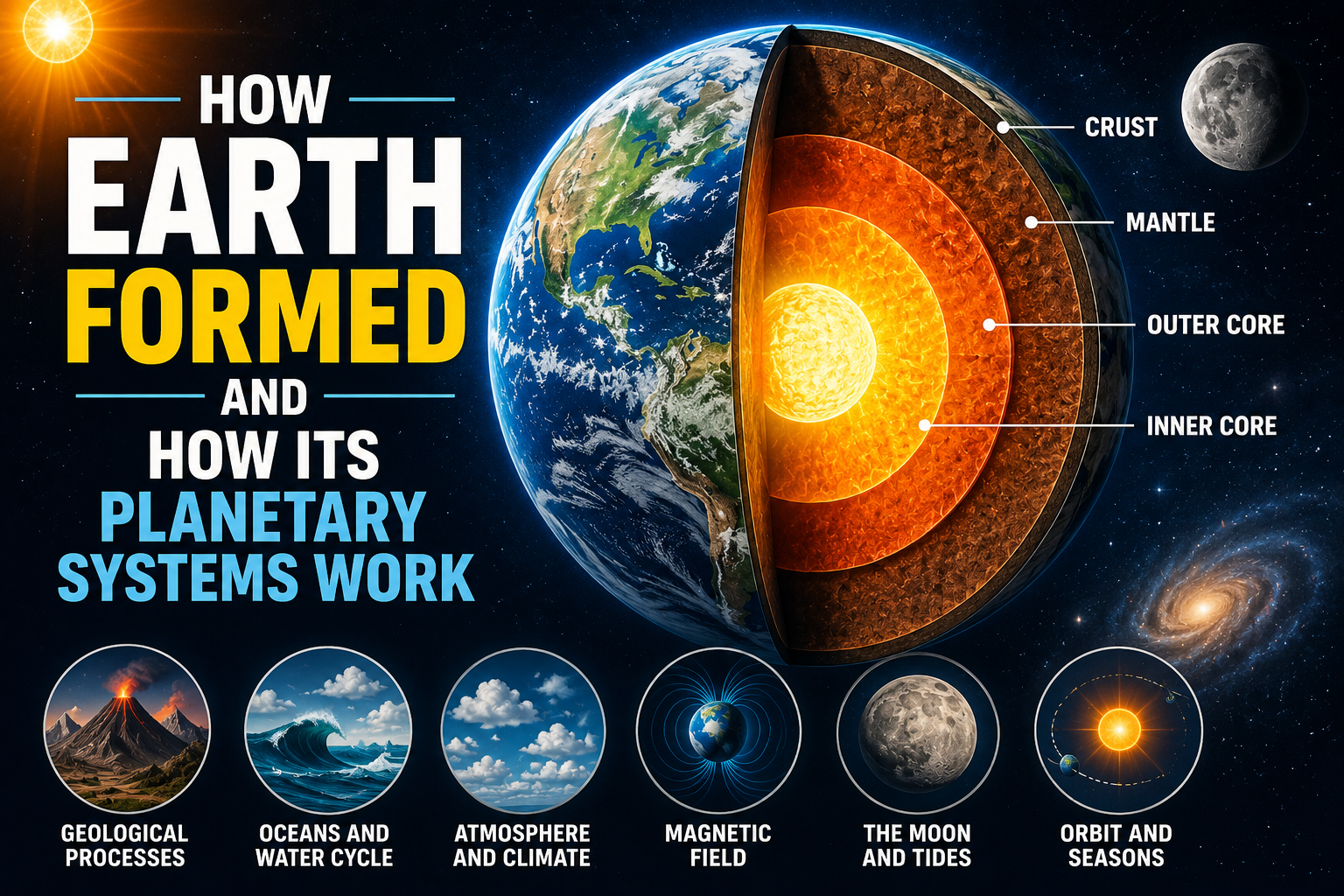
Earth is commonly divided into four major structural layers:
- Inner core
- Outer core
- Mantle
- Crust
The inner core is a solid region dominated by iron and nickel.
Surrounding it is the outer core, which is liquid. Movement of electrically conductive material within the outer core plays an important role in generating Earth’s magnetic field.
Above the core is the mantle, a thick layer of hot rock that behaves differently depending on depth and timescale.
At the surface is the relatively thin crust, which forms the solid outer part of the planet.
Together, these layers form a dynamic system rather than a static ball of rock.
How Earth’s Magnetic Field Works
Earth’s magnetic field is one of the planet’s most important protective systems.
It is generated primarily by movement of electrically conducting molten material in the outer core. This process produces a large magnetic field surrounding the planet.
The magnetic field extends far into space and forms the magnetosphere.
One of its important functions is helping shield Earth from charged particles associated with the solar wind.
Without the magnetic field and atmosphere, Earth’s surface environment would be exposed to a much harsher space environment.
The magnetic field is also responsible for the basic directional behavior of magnetic compasses.
How the Moon Became Part of Earth’s System
The Moon is an important component of the Earth system.
The leading scientific explanation is that the Moon formed after a massive collision involving the young Earth and another planetary body. Debris from the collision eventually gathered in orbit around Earth and formed the Moon.
The Moon’s gravitational influence affects Earth in several ways.
The most obvious effect is the production of ocean tides.
The Moon’s gravity pulls on Earth’s oceans, creating tidal bulges. The Sun also contributes to tides, although the Moon is the dominant influence because it is much closer to Earth.
The Earth-Moon relationship also affects the long-term stability and evolution of Earth’s rotation.
Why Earth Orbits the Sun
Earth does not remain stationary in space.
It travels around the Sun along an approximately elliptical orbit.
This movement is governed primarily by gravity.
The Sun contains most of the mass in the solar system, creating an enormous gravitational field. Earth moves forward through space while the Sun’s gravity continually changes its trajectory.
The result is an orbit rather than Earth simply flying away in a straight line.
Earth takes approximately 365.25 days to complete one orbit around the Sun.
That additional fraction of a day is one reason the calendar requires leap years to remain aligned with Earth’s orbit.
Why Earth Rotates
Earth also spins around its own axis.
One complete rotation takes approximately 24 hours relative to the Sun.
This rotation produces the cycle of day and night.
As Earth turns, different parts of the planet face toward the Sun and then away from it.
The side facing the Sun experiences daylight, while the opposite side experiences nighttime.
Earth’s rotation also influences atmospheric and oceanic circulation through the Coriolis effect, which affects the movement of large-scale weather systems and ocean currents.
What Causes Earth’s Seasons?
Earth’s seasons are primarily caused by the planet’s axial tilt, not by large changes in Earth’s distance from the Sun.
Earth’s rotational axis is tilted by approximately 23.5 degrees relative to the plane of its orbit.
As Earth travels around the Sun, this tilt causes different hemispheres to receive different amounts of direct sunlight during different parts of the year.
When the Northern Hemisphere is tilted toward the Sun, it experiences summer while the Southern Hemisphere experiences winter.
About six months later, the situation reverses.
This explains why the seasons are opposite in the two hemispheres.
Earth’s Atmosphere Makes the Surface Habitable
Earth’s atmosphere is another major part of the planetary system.
It contains a mixture of gases dominated by nitrogen and oxygen, along with smaller amounts of other gases.
The atmosphere performs several important functions.
It:
- Provides gases required by many living organisms
- Helps regulate surface temperatures
- Protects the surface from much of the Sun’s harmful ultraviolet radiation
- Supports weather and the water cycle
- Burns up many small meteoroids before they reach the surface
The atmosphere is not a fixed layer. It constantly interacts with oceans, land, ice and living organisms.
This creates a complex Earth system in which changes in one component can affect others.
How Earth’s Water System Works
Water is continuously moving between different parts of Earth’s environment.
This is known as the water cycle.
Solar energy drives evaporation from oceans, lakes, rivers and land surfaces. Water vapor rises into the atmosphere, where it can cool and condense into clouds.
Eventually, water returns to Earth’s surface as precipitation.
It may then:
- Flow into rivers
- Enter lakes
- Soak into soil
- Become groundwater
- Freeze as snow or ice
- Return directly to the atmosphere through evaporation
Most of Earth’s water is found in the oceans, which act as enormous reservoirs within the planetary system.
The water cycle connects the atmosphere, oceans, land and living organisms.
How Earth’s Climate System Works
Earth’s climate system is powered primarily by energy from the Sun.
Solar radiation reaches Earth, where some energy is reflected back into space and some is absorbed by the atmosphere, oceans and land.
Earth then releases energy back toward space as infrared radiation.
The balance between incoming and outgoing energy plays a major role in determining global temperatures.
The atmosphere also contains greenhouse gases that absorb and re-emit some outgoing infrared radiation.
This natural greenhouse effect helps keep Earth warm enough to support life.
Without the natural greenhouse effect, Earth’s average surface temperature would be substantially colder.
How Plate Tectonics Shape Earth
Earth’s surface is not one continuous, immovable shell.
The crust and uppermost mantle form the lithosphere, which is divided into large tectonic plates.
These plates move slowly over geological timescales.
Where plates interact, they can:
- Build mountains
- Create earthquakes
- Produce volcanoes
- Form ocean trenches
- Create new crust
- Recycle old oceanic crust
Plate tectonics has played a major role in shaping Earth’s continents and ocean basins.
It also influences the long-term carbon cycle and therefore interacts with Earth’s climate system.
Why Volcanoes Matter
Volcanoes are another expression of Earth’s internal energy.
When molten rock from inside the planet reaches the surface, it can erupt as lava, ash and gases.
Volcanic activity has influenced Earth’s surface throughout its history.
Volcanoes can create new land, alter landscapes and release gases into the atmosphere.
They also contribute to the long-term cycling of elements between Earth’s interior, surface and atmosphere.
Although major eruptions can have significant short-term environmental effects, volcanic activity is also part of the natural geological processes that have shaped the planet.
How Earth Interacts With the Solar System
Earth is one component of a larger planetary system.
The solar system includes:
- The Sun
- Eight planets
- Dwarf planets
- Moons
- Asteroids
- Comets
- Meteoroids
- Dust and other small bodies
The Sun dominates the system gravitationally and provides most of its energy.
The planets follow different orbits and have dramatically different compositions and environments.
The inner planets—Mercury, Venus, Earth and Mars—are primarily rocky worlds.
Farther from the Sun are the giant planets, including Jupiter, Saturn, Uranus and Neptune.
Each planet formed from the same broad solar-nebula environment, but differences in location, composition and evolutionary history produced very different worlds.
Earth’s Place in the Habitable Zone
Earth orbits within a region around the Sun commonly described as the habitable zone.
This is the range of orbital distances where conditions could potentially allow liquid water to exist on a planet’s surface, assuming an appropriate atmosphere and other conditions.
Being in the habitable zone does not automatically make a planet habitable.
Venus and Mars demonstrate why.
A planet’s atmosphere, geological history, water availability, chemistry and other factors all influence whether life-supporting conditions can exist.
Earth happens to have a combination of characteristics that has allowed stable surface environments and liquid water to persist for extremely long periods.
How Earth’s Systems Work Together
Perhaps the most important feature of Earth is that its major systems are interconnected.
Scientists often describe several major components of the Earth system:
- Atmosphere — the gases surrounding the planet
- Hydrosphere — Earth’s water
- Geosphere — rocks, minerals and Earth’s solid structure
- Cryosphere — frozen water, including glaciers and ice sheets
- Biosphere — living organisms
These systems constantly exchange energy and matter.
For example, plants absorb carbon dioxide from the atmosphere.
Oceans absorb and release gases.
Rocks can undergo weathering that moves minerals and carbon into soils and waterways.
Volcanic activity can transfer material from Earth’s interior into the atmosphere.
Water moves between oceans, atmosphere, land and living organisms.
The Earth system therefore operates as a network of connected processes.
How Life Changed the Planet
Life has not simply adapted to Earth’s environment.
Over geological time, living organisms have also transformed it.
One of the most important examples is oxygen.
Early Earth’s atmosphere contained very little free oxygen compared with today. Photosynthetic organisms eventually began producing oxygen, contributing to major changes in atmospheric chemistry.
The rise of oxygen transformed ecosystems and made aerobic forms of life possible.
Plants and microorganisms also influence carbon cycling, soil development and atmospheric composition.
This means Earth’s biological system is an active component of planetary evolution.
Why Earth’s Systems Are Always Changing
Earth may appear stable on a human timescale, but its systems are constantly changing.
Continents move.
Mountains rise and erode.
Oceans circulate.
Ice expands and retreats.
The atmosphere changes composition.
Species evolve.
The Sun itself slowly changes over astronomical timescales.
Some changes happen in seconds, such as earthquakes and volcanic eruptions. Others take centuries, millions of years or even billions of years.
Understanding these different timescales is essential when studying Earth’s history.
Earth’s Planetary System Is a Network
Earth’s formation was the beginning of a much longer story.
The planet developed from material surrounding the young Sun and gradually differentiated into its core, mantle and crust. Its atmosphere and oceans evolved alongside geological and biological processes.
Today, Earth operates as a remarkably interconnected planetary system.
Its rotation creates day and night. Its tilted axis produces the seasons. Its orbit around the Sun determines the length of the year. The Moon drives much of the planet’s tides. Earth’s magnetic field interacts with the solar wind. Its atmosphere regulates energy and supports the water cycle, while plate tectonics continually reshapes the surface.
These processes do not operate independently.
They interact to create the dynamic world we experience today.
Earth is therefore best understood not as an isolated planet, but as a living system of interconnected geological, atmospheric, oceanic, biological and astronomical processes—one that has been evolving for roughly 4.5 billion years.


2 Comments
Micle harison
June 7, 2019Lorem ipsum dolor sit amet, usu ut perfecto postulant deterruisset, libris causae volutpat at est, ius id modus laoreet urbanitas. Mel ei delenit dolores.
John Doe
June 7, 2019Some consultants are employed indirectly by the client via a consultancy staffing company.