
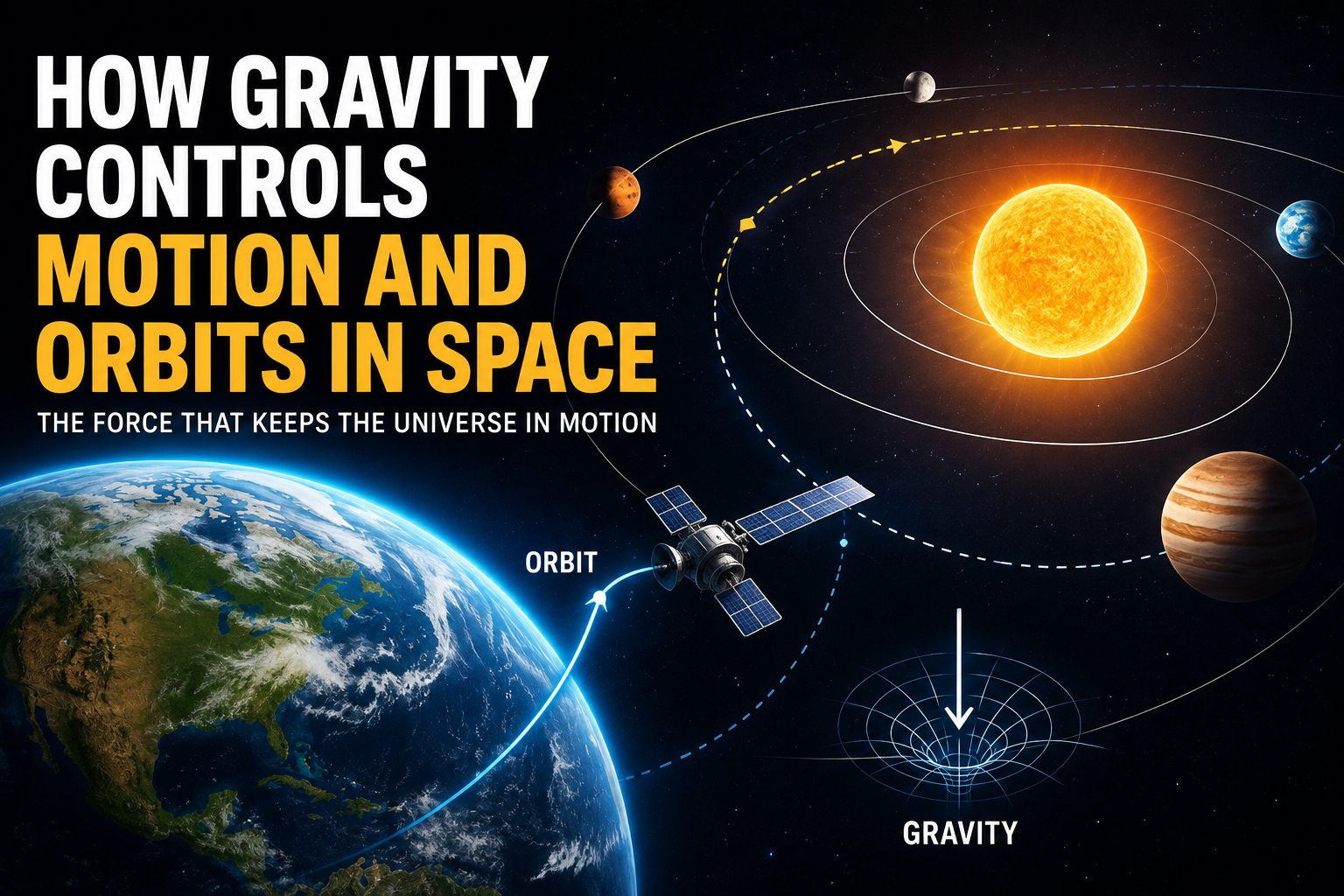
How Gravity Controls Motion and Orbits in Space
Gravity is one of the most important forces in the universe. It keeps planets moving around stars, holds moons in orbit around planets, shapes galaxies, and allows spacecraft to travel between worlds.
Although gravity is often described simply as the force that pulls objects toward one another, its role in space is more subtle. Gravity can change an object’s speed and direction, create stable orbits, and even determine whether an object remains bound to a planetary system or escapes into space.
Understanding gravity and orbital motion provides the foundation for explaining everything from the Moon’s path around Earth to the journeys of robotic spacecraft exploring the Solar System.
What Is Gravity?
Gravity is the attraction between objects that have mass.
Every object with mass produces a gravitational influence. The greater an object’s mass, the stronger its gravitational pull. Gravity also becomes weaker as the distance between objects increases.
On Earth, gravity pulls objects toward the planet’s center. It is what gives us weight and keeps the atmosphere and oceans from drifting away into space.
In space, gravity works in exactly the same fundamental way. The difference is that objects are often moving fast enough that gravity continuously changes their paths rather than simply pulling them straight downward.
Why Objects Orbit Instead of Falling Straight Down
An orbit can seem mysterious because an object such as the Moon is constantly being pulled toward Earth but does not crash into it.
The key is sideways motion.
Imagine throwing a ball horizontally from a very high mountain. It would move forward while gravity pulls it downward. If it were thrown fast enough, Earth’s curved surface would fall away beneath it at roughly the same rate that the ball falls.
The object would effectively keep falling around Earth.
That is the basic idea behind an orbit.
An orbiting object is continuously falling toward the body it is orbiting, but its forward motion carries it around that body.
Speed Is Essential to an Orbit
Gravity alone does not create an orbit.
The object’s velocity matters just as much.
Consider a spacecraft near Earth:
- If it is moving too slowly, gravity can pull it back toward Earth.
- If it has the right combination of speed and direction, it can enter orbit.
- If it moves fast enough, it can escape Earth’s gravitational influence.
This is why launching a spacecraft is not simply a matter of pointing it upward. Engineers must give it sufficient horizontal velocity as well.
For a low Earth orbit, spacecraft typically travel at roughly 7.8 kilometers per second, or about 28,000 kilometers per hour.
At that speed, a spacecraft can circle Earth approximately every 90 minutes, depending on its altitude.
Gravity Changes the Direction of Motion
Gravity does more than accelerate an object toward another body.
It continually changes the object’s velocity vector, meaning its speed and direction.
Suppose a spacecraft is moving past a planet. The planet’s gravity pulls the spacecraft toward it as the spacecraft approaches. As the spacecraft moves away, the gravitational pull changes its trajectory again.
The result can be a curved path rather than a straight line.
This principle explains why planets follow curved paths around the Sun and why spacecraft can change trajectories by passing near planets.
What Keeps Planets in Orbit Around the Sun?
The planets of our Solar System orbit the Sun because of the Sun’s enormous gravitational influence and the planets’ existing motion through space.
The Sun contains most of the Solar System’s mass, giving it a powerful gravitational field.
At the same time, the planets have substantial sideways velocities.
The result is a continuing balance between:
Forward motion + gravitational acceleration = orbital motion
The planets are not being held in place by an invisible track. Their paths emerge naturally from gravity and motion.
Planetary Orbits Are Usually Elliptical
A common misconception is that planets travel around the Sun in perfect circles.
In reality, planetary orbits are generally ellipses.
An ellipse is a stretched circle with two focal points. In the Solar System, the Sun lies at one of those focal points of each planet’s elliptical orbit.
Some planetary orbits are close to circular, while others are more elongated.
Earth’s orbit, for example, is relatively close to circular, while some comets travel along highly elongated paths.
Why Planets Speed Up and Slow Down
An object’s orbital speed does not necessarily remain constant.
When a planet moves closer to the Sun, the Sun’s gravitational influence becomes stronger and the planet moves faster.
When the planet moves farther away, it moves more slowly.
This relationship is described by Kepler’s laws of planetary motion.
For an orbiting body, the important principle is that gravitational potential energy and kinetic energy are continuously exchanged as the object moves through its orbit.
A planet moving closer to the Sun gains kinetic energy and speeds up. As it moves farther away, it slows down.
The Moon’s Orbit Around Earth
The Moon provides one of the clearest examples of orbital motion.
Earth’s gravity keeps the Moon gravitationally bound to our planet, while the Moon’s velocity prevents it from simply falling into Earth.
The Moon’s orbit is slightly elliptical rather than perfectly circular.
The Moon also affects Earth through gravity. Its gravitational pull contributes significantly to ocean tides and produces subtle effects on Earth’s rotation.
The Earth-Moon system therefore provides an example of how gravity operates between two relatively close astronomical bodies.
Earth’s Gravity Also Controls Artificial Satellites
Thousands of satellites orbit Earth for communication, navigation, weather monitoring, scientific research and other purposes.
Each satellite has a particular orbit determined by its:
- Altitude
- Speed
- Direction
- Earth’s gravitational field
Different jobs require different orbital characteristics.
Low Earth Orbit
Low Earth orbit is useful for Earth observation, scientific missions and many communications applications.
Satellites in these orbits travel rapidly around Earth.
Geostationary Orbit
A geostationary satellite orbits Earth at a specific altitude above the equator and takes approximately one day to complete an orbit.
Because its orbital period matches Earth’s rotation, it can appear almost stationary over one location on Earth’s surface.
This makes geostationary orbits particularly useful for communications and weather observation.
What Happens When an Object Escapes Gravity?
Gravity never completely disappears.
Even far from Earth, Earth’s gravitational influence still exists, although it becomes weaker with distance.
When scientists talk about a spacecraft escaping Earth’s gravity, they generally mean that the spacecraft has enough energy to leave Earth’s gravitationally bound orbit and continue outward without requiring continuous propulsion to prevent it from falling back.
The escape speed from Earth’s surface is approximately 11.2 kilometers per second in an idealized calculation that ignores atmospheric drag and other complications.
A spacecraft does not necessarily have to accelerate straight upward to achieve escape. Mission designers can use orbital mechanics to build up the required energy efficiently.
Gravity Assist: Using a Planet to Change a Spacecraft’s Path
One of the most useful applications of gravity in space exploration is the gravity assist, sometimes called a gravitational slingshot.
A spacecraft passing near a moving planet can exchange a small amount of energy and momentum with the planet.
From the spacecraft’s perspective, its trajectory can change dramatically.
Depending on the geometry of the encounter, a spacecraft can:
- Increase its speed relative to the Sun
- Decrease its speed relative to the Sun
- Change direction
- Alter its orbital path
- Reach destinations that would otherwise require much more fuel
The planet does not lose a noticeable amount of its orbital energy because the spacecraft is tiny compared with the planet. Nevertheless, the technique can make a major difference to a spacecraft mission.
Why Spacecraft Do Not Simply Fly in Straight Lines
A spacecraft traveling between planets is constantly being affected by gravity.
The spacecraft feels the gravitational influence of:
- The Sun
- The planet it leaves
- The planet it approaches
- Other planets
- Moons
- Occasionally smaller bodies
Mission planners therefore calculate trajectories using orbital mechanics rather than simply drawing a straight line between two planets.
A spacecraft may follow a long curved path that takes advantage of gravitational fields along the way.
This approach can save enormous amounts of fuel.
The Sun Controls Most of the Solar System’s Large-Scale Motion
Although planets have their own gravitational influence, the Sun dominates the overall structure of the Solar System because of its enormous mass.
Planets, asteroids and comets generally orbit the Sun because they are gravitationally bound to it.
The Sun also moves.
It is not perfectly stationary at the center of every planetary orbit. Instead, the Sun and planets technically orbit their shared center of mass, known as the barycenter.
For the Sun and Jupiter, for example, the barycenter can lie outside the Sun’s center because Jupiter is so massive compared with the other planets.
Gravity Shapes Moons and Planetary Systems
Gravity is also responsible for the formation and organization of planetary systems.
Moons orbit planets because of gravitational attraction. Some planets have dozens of moons, while others have none that are currently known.
Gravity also influences the shapes and structures of rings around planets.
Saturn’s rings, for example, consist of enormous numbers of particles whose motions are controlled by Saturn’s gravity and interactions with nearby moons.
These gravitational interactions can create gaps, waves and other structures within planetary rings.
Gravity and Tidal Forces
Gravity can produce different effects across an extended object.
The side of an object closer to a massive body experiences a slightly stronger gravitational pull than the side farther away.
This difference is known as a tidal force.
Tidal forces are responsible for Earth’s ocean tides, but their effects can be much more dramatic elsewhere.
They can:
- Stretch moons
- Heat planetary interiors
- Influence rotation
- Drive geological activity
- Break objects apart when they pass too close to massive bodies
Jupiter’s moon Io is an extreme example. Gravitational interactions involving Jupiter and other moons generate powerful tidal heating inside Io, contributing to its intense volcanic activity.
What Happens When Gravity Becomes Extremely Strong?
Gravity becomes especially dramatic around extremely dense objects.
Black holes are the most famous example.
A black hole forms when matter becomes compressed into an extraordinarily dense region, creating a gravitational environment from which nothing that crosses the event horizon can escape—not even light.
Objects can orbit black holes before potentially falling inward.
The same fundamental principles of orbital motion still apply, although the extreme gravitational environment requires Einstein’s theory of general relativity rather than simple Newtonian calculations to describe it accurately.
Newton’s View of Gravity
Isaac Newton developed a mathematical description of gravity that remains extremely useful.
Newton’s law of universal gravitation states that the gravitational force between two masses depends on their masses and the distance separating them.
In simplified form:
F = G(m₁m₂ / r²)
This means that:
- Increasing either mass increases gravitational force.
- Increasing the distance decreases gravitational force.
- The force decreases according to the square of the distance.
Newton’s equations are accurate enough for many practical applications, including much of spacecraft trajectory planning.
Einstein Added a Deeper Explanation
Albert Einstein’s theory of general relativity provides a more complete description of gravity.
Instead of treating gravity simply as a force between masses, general relativity describes massive objects as changing the geometry of spacetime.
Objects then move through this curved spacetime.
For ordinary planetary orbits, Newton’s equations provide an excellent approximation. But for extreme environments—such as close to black holes or for extremely precise measurements—general relativity becomes essential.
One famous consequence is that Mercury’s orbit contains a small shift that cannot be fully explained using Newtonian gravity alone.
Gravity Is Not the Same Everywhere
The strength of gravity depends heavily on the mass and size of an object.
The Moon has much less mass than Earth, so its surface gravity is much weaker.
Mars also has lower surface gravity than Earth.
This means a person would weigh considerably less on the Moon or Mars, even though their mass would remain the same.
In orbit, however, the situation is different.
Astronauts aboard an orbiting spacecraft experience apparent weightlessness not because Earth’s gravity has disappeared, but because both they and the spacecraft are continuously falling around Earth together.
Why Astronauts Experience Weightlessness
The International Space Station, for example, remains within Earth’s gravitational field.
Gravity at its altitude is still substantial.
Astronauts float because they are in continuous free fall along with the station.
The station is moving forward fast enough that, as gravity pulls it toward Earth, the Earth’s surface curves away beneath it.
The astronauts and station therefore keep falling around Earth rather than crashing into it.
This is why microgravity is a more accurate term than saying there is “no gravity” in orbit.
Gravity Can Create Stable and Unstable Orbits
Not every orbital path is equally stable.
Small changes in velocity can alter an orbit significantly.
A spacecraft can transition between:
- Circular orbits
- Elliptical orbits
- Transfer orbits
- Escape trajectories
- Capture trajectories
Gravitational interactions with other bodies can also gradually change an orbit.
Mission planners must account for these effects when designing long-duration spacecraft missions.
Why Orbital Mechanics Matters for Space Exploration
Nearly every spacecraft mission depends on orbital mechanics.
Engineers use gravitational principles to determine:
- When to launch
- Which direction to travel
- How much fuel is required
- Where a spacecraft will be months or years later
- How to enter another planet’s orbit
- How to land safely
- How to return to Earth
A small error in trajectory calculations can eventually produce a large difference in position.
For missions traveling millions or billions of kilometers, precision is essential.
Gravity Creates a Dynamic Solar System
The Solar System is not a collection of objects moving along fixed tracks.
Every planet, moon, asteroid and spacecraft is participating in a constantly changing gravitational environment.
Planets pull on one another. Moons affect their planets and each other. The Sun dominates the system but also responds to the gravitational influence of its planets.
Over long periods, these interactions can subtly alter orbital paths.
This dynamic behavior is one reason celestial mechanics remains an important field of scientific research.
Gravity Is the Invisible Architecture of Space
Gravity provides much of the structure we observe across the universe.
It keeps moons around planets, planets around stars and stars within galaxies. It allows spacecraft to enter orbit, travel between worlds and use planets as gravitational assists. It also governs the dramatic environments around neutron stars and black holes.
The key to understanding orbital motion is recognizing that gravity and motion work together. An orbiting object is not escaping gravity; it is continuously responding to it while moving forward. The resulting curved path can remain stable for enormous periods of time.
From a satellite circling Earth to a planet completing another journey around the Sun, the same fundamental principles connect everyday space technology with some of the largest structures in the cosmos.


2 Comments
Micle harison
June 7, 2019Lorem ipsum dolor sit amet, usu ut perfecto postulant deterruisset, libris causae volutpat at est, ius id modus laoreet urbanitas. Mel ei delenit dolores.
John Doe
June 7, 2019Some consultants are employed indirectly by the client via a consultancy staffing company.