
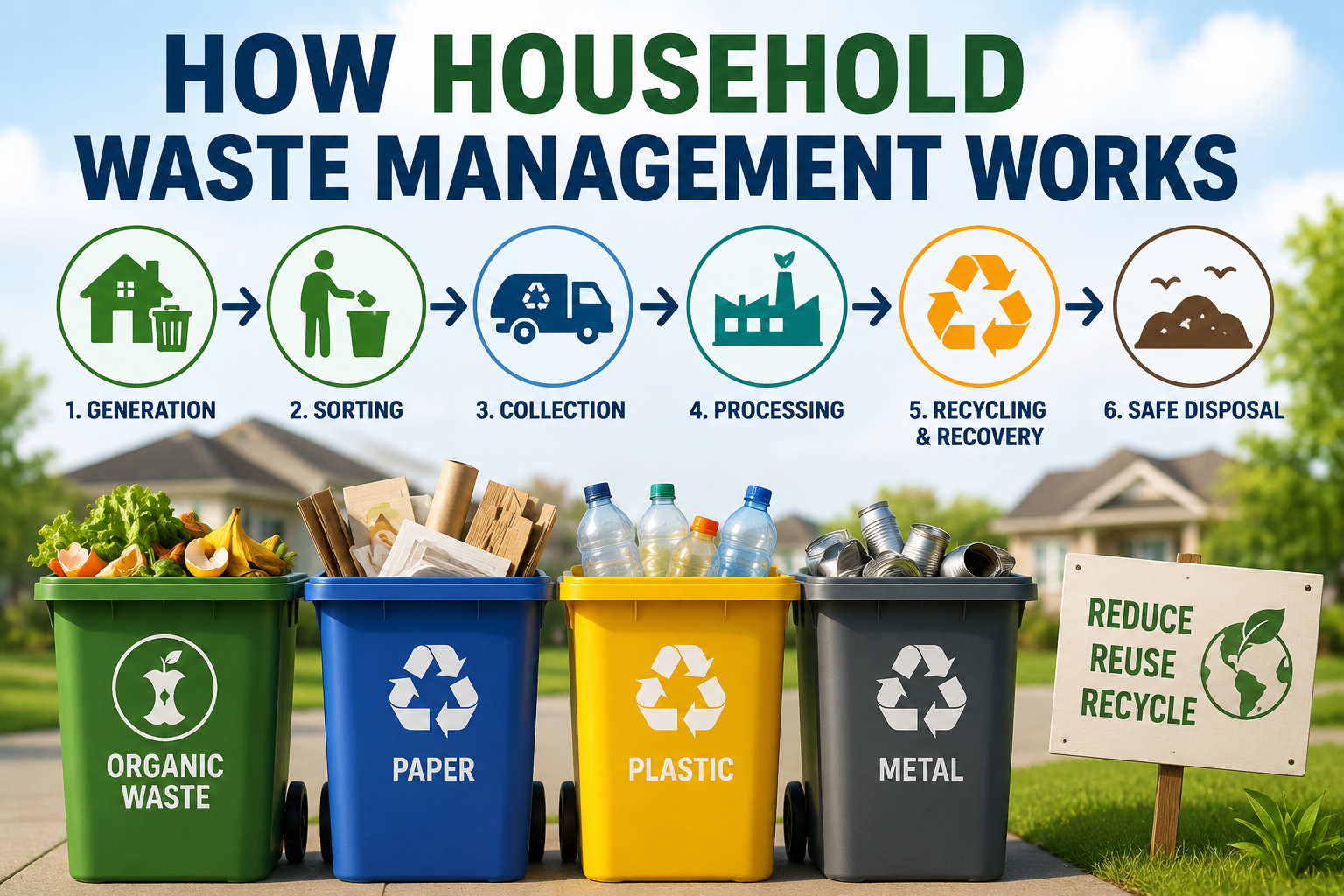
How Household Waste Management Works
Every household produces waste. Food scraps, packaging, old clothing, broken appliances, paper, plastic and other discarded materials are part of everyday life. What happens to those materials after they leave a home, however, depends on how waste is separated, collected, transported, treated and disposed of.
Effective household waste management is not simply about taking out the trash. It is a system designed to reduce unnecessary waste, recover useful materials, safely handle hazardous substances and minimize the environmental and health problems associated with disposal.
Understanding how that system works can help households make better decisions about what they buy, what they throw away and what can be reused or recycled.
What Is Household Waste Management?
Household waste management is the process of handling discarded materials generated by homes.
It can include:
- Waste prevention
- Reuse
- Sorting and separation
- Recycling
- Composting
- Collection
- Transportation
- Treatment
- Recovery of useful materials
- Final disposal
The goal is to manage waste safely while reducing the amount that ultimately requires disposal.
Different communities use different systems. Some provide separate bins for recyclables and organic waste, while others collect mixed household waste and sort it at specialized facilities.
Where Household Waste Comes From
Waste is generated in almost every part of daily home life.
Common sources include:
Kitchens
Kitchens often produce large quantities of waste, including food scraps, packaging, bottles, cans and cardboard.
Bathrooms
Bathroom waste can include paper products, empty containers, personal-care packaging and certain products that require special handling.
Bedrooms and Living Areas
Clothing, newspapers, electronics, furniture, packaging and miscellaneous household items can eventually become waste.
Garages and Outdoor Areas
Garages and gardens can generate batteries, paint containers, chemicals, grass clippings, branches and other materials that may need specialized disposal.
Because household waste comes from so many sources, effective management starts with understanding what is actually being thrown away.
The Waste Hierarchy
Waste-management systems generally prioritize some actions over others.
A useful way to think about the hierarchy is:
- Prevent waste
- Reduce consumption
- Reuse items
- Repair where practical
- Recycle materials
- Recover useful resources or energy
- Dispose of remaining waste
The most desirable outcome is usually to avoid creating unnecessary waste in the first place.
For example, buying a durable product that lasts for years can prevent more waste than purchasing a disposable version repeatedly and recycling the packaging afterward.
Waste Reduction Starts Before the Trash Can
Household waste management begins when people decide what to purchase.
Consumers can reduce waste by:
- Buying only what they need
- Choosing durable products
- Avoiding unnecessary packaging
- Purchasing products in appropriate quantities
- Repairing items instead of immediately replacing them
- Reusing containers where appropriate
- Choosing refillable products
- Planning meals to reduce food waste
This approach is sometimes called source reduction because it prevents waste from being created at the source.
It can also save money.
A household that avoids unnecessary purchases is simultaneously reducing its waste and reducing its spending.
Reusing Items Keeps Materials in Circulation
Reuse means using an item again rather than immediately throwing it away.
Examples include:
- Donating clothing
- Reusing storage containers
- Giving furniture to another household
- Repairing appliances
- Reusing cardboard boxes
- Repurposing certain household materials
Reuse can be more resource-efficient than recycling because the original product remains intact and does not necessarily need to be processed into another material.
However, reuse should always take safety and hygiene into account. Some items are unsuitable for repeated use, particularly when they are damaged or designed for single use.
Sorting Waste at Home
One of the simplest ways households can improve waste management is by separating different types of waste.
Depending on the local system, categories might include:
- General waste
- Paper and cardboard
- Glass
- Metal
- Plastics
- Organic waste
- Electronic waste
- Hazardous household waste
Correct sorting matters because contaminated or incorrectly placed materials can interfere with recycling and composting processes.
A household should always follow the rules provided by its local waste-management service because accepted materials differ between communities.
What Happens to General Household Waste?
General household waste is typically collected and transported to a waste-management facility.
Depending on the local infrastructure, it may undergo sorting, treatment, energy recovery or disposal.
Some waste eventually reaches a landfill.
A modern landfill is more than simply a hole in the ground. Properly designed facilities use engineering systems intended to isolate waste from surrounding soil and water.
These can include:
- Liner systems
- Drainage systems
- Leachate collection
- Landfill-gas management
- Monitoring systems
- Controlled placement of waste
The objective is to reduce environmental risks while safely containing materials that cannot be economically or practically recovered.
How Recycling Works
Recycling involves collecting discarded materials and processing them into materials that can be used again.
The process generally involves several stages.
Collection
Recyclable materials are collected from households or drop-off locations.
Sorting
Materials are separated by type.
Sorting may involve workers, conveyor systems, magnets, optical scanners and other technologies.
Processing
Materials are cleaned, shredded, crushed, melted or otherwise processed depending on the material.
Manufacturing
Processed materials are turned into new products or packaging.
Purchase and Use
Recycled material eventually returns to the economy as part of another product.
This creates a cycle in which some materials remain in use rather than being discarded after a single use.
Not Everything With a Recycling Symbol Is Recyclable Everywhere
A common misconception is that a recycling symbol automatically means an item belongs in a household recycling bin.
In reality, recycling systems vary.
A particular community may accept certain types of plastic while rejecting others. Some materials may technically be recyclable but lack a local facility capable of processing them economically.
Contamination is another problem.
Food residue, liquids and non-recyclable materials can contaminate recyclable materials and complicate processing.
For this reason, households should check local recycling guidelines rather than relying solely on symbols printed on packaging.
How Food Waste Is Managed
Food waste is a major component of household waste.
It can include:
- Vegetable scraps
- Fruit peels
- Leftovers
- Expired food
- Coffee grounds
- Tea leaves
- Bones and other food remnants
The best approach is generally to prevent edible food from becoming waste.
Households can do this by:
- Planning meals
- Storing food properly
- Understanding date labels
- Freezing food before it spoils
- Using leftovers creatively
- Buying realistic quantities
Some unavoidable food scraps can be composted where suitable facilities or home systems are available.
What Is Composting?
Composting is the controlled decomposition of organic materials into a nutrient-rich material that can be used to improve soil.
Common compostable materials include:
- Fruit and vegetable scraps
- Coffee grounds
- Some paper products
- Leaves
- Grass clippings
- Other suitable plant materials
A successful composting system needs the right balance of organic materials, moisture and air.
Microorganisms break down the material over time, producing compost.
Composting can reduce the amount of organic waste sent to landfills while producing a useful soil amendment.
However, not every food or material should automatically be placed in a home compost system. Households should follow the requirements of their particular composting method.
Why Organic Waste Matters in Landfills
Organic material behaves differently from many other forms of household waste.
When food and other biodegradable material decomposes under oxygen-limited conditions inside a landfill, it can generate methane, a greenhouse gas.
Landfills can capture some of this gas and use it for energy or otherwise manage it to reduce emissions.
Keeping suitable organic material out of landfills through composting or other recovery methods can therefore contribute to more efficient waste management.
Electronic Waste Requires Special Attention
Electronic waste, or e-waste, includes discarded electrical and electronic equipment.
Examples include:
- Phones
- Computers
- Televisions
- Printers
- Chargers
- Small appliances
- Batteries
- Cables
Electronic products can contain valuable materials that can be recovered, but some also contain substances that require careful handling.
Throwing electronics into ordinary household waste can therefore create environmental and safety concerns.
Many communities have specialized collection programs for electronics and batteries.
Household Hazardous Waste
Some common household products should not simply be poured down drains or placed in ordinary garbage.
These can include:
- Certain paints
- Solvents
- Pesticides
- Strong cleaning chemicals
- Automotive fluids
- Some batteries
- Certain fluorescent lamps
Improper disposal can contaminate water, soil or other waste streams.
Local authorities may provide special collection points or designated disposal days for hazardous household materials.
The safest approach is to follow the product label and local disposal instructions.
Why Batteries Need Careful Disposal
Batteries deserve particular attention because they can contain reactive chemicals and valuable materials.
Damaged or improperly discarded batteries can also create fire risks, especially when they come into contact with other metal objects or are processed incorrectly.
Rechargeable batteries and lithium-ion batteries are increasingly common in:
- Phones
- Laptops
- Electric tools
- Cameras
- Toys
- E-bikes
- Electric vehicles
Households should use designated battery-recycling or collection programs where available rather than placing batteries in general waste unless local authorities specifically instruct them to do so.
Waste Collection and Transportation
Once waste has been separated, it needs to move from households to processing or disposal facilities.
Collection services may use:
- Garbage trucks
- Recycling vehicles
- Organic-waste collection trucks
- Community drop-off systems
- Specialized hazardous-waste transport
Collection schedules and methods vary widely.
Transportation itself has environmental costs because collection vehicles consume fuel or electricity and travel throughout communities.
Efficient collection routes can reduce those costs.
Waste Sorting Facilities
Modern waste-management facilities can use sophisticated equipment to separate materials.
Depending on the facility, sorting technologies may include:
- Conveyor belts
- Magnets for ferrous metals
- Eddy-current systems for some non-ferrous metals
- Optical scanners
- Air separators
- Screens
- Manual sorting
The purpose is to recover materials that have enough value and quality to be processed into new products.
Technology can improve sorting efficiency, but human workers remain important in many systems.
Waste-to-Energy Systems
Some waste that cannot be practically recycled may be processed in facilities that recover energy.
In certain systems, waste is burned under controlled conditions to produce heat or electricity.
Modern waste-to-energy facilities use pollution-control technologies to manage emissions.
However, waste-to-energy does not eliminate the need for waste reduction and recycling. Materials that can be economically reused or recycled may provide greater resource benefits when kept in circulation.
Why Landfills Still Matter
Even advanced waste-management systems produce some materials that cannot currently be reused, recycled or economically recovered.
Those materials require a final disposal method.
Landfills therefore remain an important part of waste infrastructure in many countries.
The challenge is to minimize the amount sent to landfill while ensuring that the remaining waste is managed safely.
This is why the waste hierarchy emphasizes prevention, reuse and recovery before disposal.
The Environmental Effects of Poor Waste Management
Poorly managed waste can create several environmental problems.
Water Pollution
Waste and contaminated runoff can introduce harmful substances into rivers, lakes and groundwater.
Air Pollution
Open burning of waste can release harmful pollutants.
Soil Contamination
Chemicals and other substances can accumulate in soil when waste is improperly disposed of.
Greenhouse Gas Emissions
Decomposing organic waste in landfills can produce methane, while transporting and processing waste can consume energy.
Wildlife Impacts
Animals can become trapped in waste or ingest materials they mistake for food.
Resource Loss
Throwing away recyclable materials means the resources used to produce them may need to be extracted again.
Household Waste Can Affect Public Health
Waste management is also a public-health issue.
Accumulated waste can attract insects and rodents, create unpleasant odors and contribute to the spread of contaminants.
Improperly discarded sharp objects or hazardous chemicals can also injure people.
Reliable collection, safe storage, proper treatment and responsible disposal therefore protect communities as well as the environment.
The Importance of Waste Storage at Home
Waste management does not begin when the collection truck arrives.
Households need to store waste safely until collection.
Good practices include:
- Keeping garbage containers covered
- Separating hazardous materials
- Preventing food waste from attracting pests
- Keeping sharp objects contained
- Avoiding overflowing bins
- Following local collection requirements
- Keeping recyclable materials reasonably clean and dry when required
Proper storage makes collection safer and reduces problems around the home.
How Households Can Reduce Waste
Small changes can make a meaningful difference when practiced consistently.
Plan Before Shopping
Make shopping lists and avoid buying more food than the household can use.
Choose Durable Products
Long-lasting products generally need to be replaced less frequently.
Repair Before Replacing
A broken item may only need a small repair.
Reuse Containers and Materials
Where safe and appropriate, reuse household items instead of immediately discarding them.
Donate Usable Items
Clothing, furniture, books and appliances that are no longer needed may still be useful to someone else.
Compost Suitable Organic Waste
If a suitable composting system is available, food scraps and yard waste can sometimes be diverted from general waste.
Learn Local Recycling Rules
Correct sorting is more useful than simply putting everything with a recycling symbol into the recycling bin.
Waste Management Is Also a Resource Management Problem
A discarded product is not simply “trash.”
It may contain:
- Metals
- Plastics
- Glass
- Paper fibers
- Organic nutrients
- Energy
- Water
- Labor
- Manufacturing resources
When an item is thrown away, much of the value invested in producing it can be lost.
Recycling and reuse therefore serve a broader purpose than reducing the amount of garbage sent to landfills. They can help recover materials that would otherwise require new extraction and processing.
Why Individual Actions Still Matter
It is easy to assume that household behavior makes little difference compared with industrial waste.
Large-scale systems certainly play a major role, but households collectively generate enormous amounts of waste.
Small decisions multiplied across millions of homes can have significant effects.
Choosing reusable products, reducing food waste, separating recyclable materials and properly disposing of hazardous products can all contribute to better waste-management outcomes.
At the same time, households cannot solve every waste problem alone. Product design, collection infrastructure, recycling markets, government policies and business practices all influence how effectively materials are managed.
The Future of Household Waste Management
Waste management is increasingly moving toward systems that treat discarded materials as potential resources.
Future approaches may place greater emphasis on:
- Circular economy principles
- Reusable packaging
- Advanced recycling technologies
- Improved food-waste recovery
- Automated sorting
- Better product design
- Extended producer responsibility
- Local composting
- Electronic-waste recovery
- Waste prevention
A circular economy aims to keep materials and products in use for as long as possible rather than following a simple pattern of producing, using and discarding.
This approach requires changes throughout the supply chain, not just at the household level.
Making Waste a Smaller Part of Everyday Life
Effective household waste management ultimately depends on a series of decisions made throughout a product’s life—from purchasing and use to reuse, recycling and final disposal.
The simplest principle is also one of the most powerful: the best waste is waste that never has to be created.
When households buy thoughtfully, use products efficiently, repair what they can, separate materials correctly and dispose of hazardous items responsibly, they become an important part of a larger waste-management system.
The challenge ahead is to make those choices easier by building systems in which durable products, reuse, recycling and responsible disposal are convenient and accessible. A cleaner approach to household waste is not just about having a tidier home; it is about using resources more efficiently and reducing the environmental burden created by everyday life.




2 Comments
Micle harison
June 7, 2019Lorem ipsum dolor sit amet, usu ut perfecto postulant deterruisset, libris causae volutpat at est, ius id modus laoreet urbanitas. Mel ei delenit dolores.
John Doe
June 7, 2019Some consultants are employed indirectly by the client via a consultancy staffing company.