
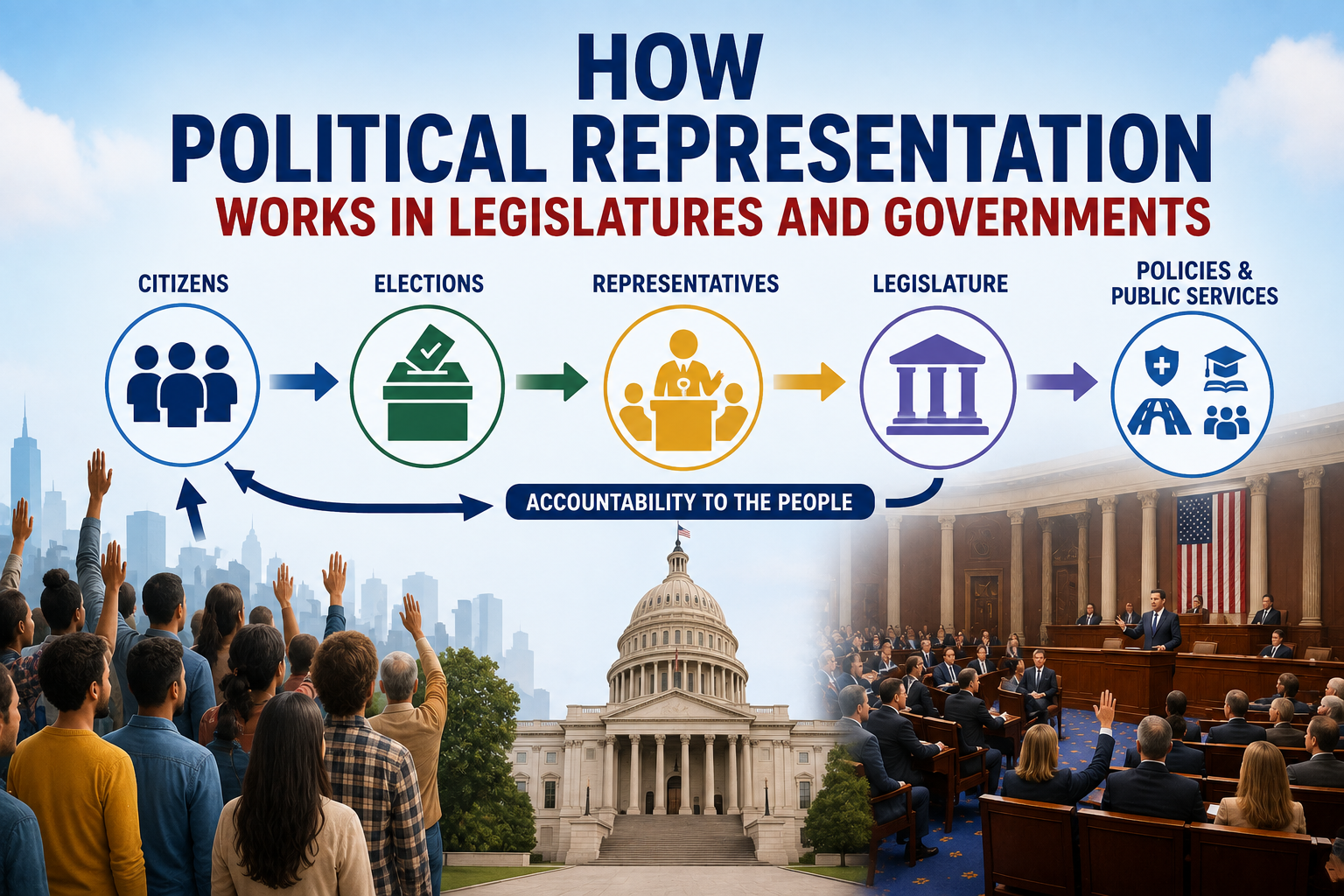
How Political Representation Works in Legislatures and Governments
Political representation is one of the central ideas behind modern government. In a representative democracy, citizens generally do not make every public decision themselves. Instead, they choose people to represent their interests in legislatures and, in some systems, in executive offices and local governments.
Those representatives debate laws, approve budgets, oversee government institutions and make decisions that affect millions of people. But representation is more complicated than simply winning an election. It involves elections, constituencies, political parties, accountability, public participation and institutions designed to balance competing interests.
Understanding how political representation works helps explain how governments turn citizens’ preferences into public policy—and why disagreements between voters, representatives and political institutions are a normal part of democratic politics.
What Is Political Representation?
Political representation occurs when an individual or group acts on behalf of other people in a political institution.
In a representative system, citizens delegate some decision-making authority to elected officials.
A representative may be expected to:
- Speak for constituents
- Introduce or support legislation
- Vote on laws
- Approve or scrutinize government spending
- Raise local concerns
- Monitor government agencies
- Participate in national debates
- Defend constitutional principles
- Respond to the interests of voters
Representation can take different forms depending on the country’s constitution and political system.
A national legislature might represent geographic constituencies, political parties, population groups or a combination of these.
Why Do Countries Use Representatives?
Large modern societies contain millions of people with different interests and priorities.
It would be difficult for every citizen to participate directly in every legislative decision.
Representative government provides a practical alternative.
Instead of having every citizen vote on every bill, citizens select representatives who participate in the day-to-day work of government.
This allows legislatures to operate continuously while giving citizens a mechanism for influencing who holds political power.
How Elections Create Representation
Elections are one of the primary mechanisms through which representation is established.
Voters choose among candidates, political parties or lists according to the country’s electoral system.
The candidates who receive enough support become representatives or, in some systems, gain seats according to the proportion of votes received.
Elections therefore perform several functions:
- They select political leaders.
- They give citizens a voice in government.
- They provide a mechanism for removing unpopular officials.
- They create political legitimacy.
- They encourage candidates to respond to public concerns.
However, elections alone do not guarantee effective representation. The rules governing elections can significantly influence which groups gain political power.
What Is a Legislature?
A legislature is an institution responsible primarily for making laws.
Depending on the country, it may be called:
- Parliament
- Congress
- National Assembly
- House of Representatives
- Legislative Assembly
- Diet
- Chamber of Deputies
A legislature may have one chamber or two.
A unicameral legislature has one chamber.
A bicameral legislature has two chambers, often known as an upper house and lower house.
The structure differs from country to country.
What Does a Legislature Do?
Legislatures generally perform several major functions.
Making Laws
Members introduce, debate, amend and vote on proposed laws.
Approving Public Spending
In many systems, legislatures have authority over government budgets and taxation.
Representing Constituents
Members raise issues affecting the people or areas they represent.
Oversight
Legislatures can investigate government activities, question ministers and examine how public institutions operate.
Debating National Issues
Legislatures provide a formal arena for political disagreement and discussion.
Ratifying or Approving Certain Decisions
Depending on the constitution, legislatures may have roles in approving treaties, appointments or other major government decisions.
Geographic Representation
One common model divides a country into electoral districts or constituencies.
Each constituency elects one or more representatives.
A representative is then expected to serve the people within that geographic area.
This can create a direct connection between voters and elected officials.
For example, constituents may contact their representative about:
- Infrastructure
- Public services
- Education
- Healthcare
- Employment
- Local development
- Government administration
The representative can raise these issues within the legislature.
Constituencies and Districts
A constituency is a geographic area whose residents participate in electing a representative or representatives.
The size and boundaries of constituencies can have significant political consequences.
Ideally, districts should provide relatively balanced representation according to the principles established by the country’s electoral laws.
Population changes can create pressure to redraw boundaries.
This process is often called redistricting or boundary delimitation.
Why Electoral Boundaries Matter
The boundaries of electoral districts can influence which political parties are competitive.
If district boundaries are manipulated for partisan advantage, the practice may be described as gerrymandering.
Gerrymandering can involve drawing boundaries in ways that concentrate or disperse particular groups of voters to influence electoral outcomes.
Different countries have different safeguards against this practice, including independent electoral commissions and constitutional requirements.
Political Parties and Representation
Political parties play a major role in modern legislatures.
A political party is an organized group that seeks political power and promotes particular policies, values or priorities.
Parties help voters understand candidates and policy choices.
They also organize representatives once elections are over.
A party may establish positions on issues such as:
- Taxation
- Public spending
- Education
- Healthcare
- Foreign policy
- Environmental regulation
- Economic policy
- National security
Members of the same party often coordinate their positions and voting strategies.
Party Representation Versus Constituency Representation
A representative can have multiple responsibilities.
They may feel obligated to represent:
- Their constituents
- Their political party
- Their personal principles
- The broader national interest
These interests do not always align.
A representative might believe a particular policy is good for the country while knowing that many voters in their constituency oppose it.
This creates an important question:
Should representatives vote according to their constituents’ preferences or according to their own judgment?
Political systems and democratic theories offer different answers.
The Delegate Model
Under the delegate model, representatives are expected to act according to the preferences of the people who elected them.
The representative essentially acts as an extension of the voters.
If constituents strongly oppose a proposed policy, a delegate-style representative may be expected to oppose it as well.
This approach emphasizes responsiveness.
The Trustee Model
Under the trustee model, representatives are expected to use their own judgment.
Voters elect them because they trust them to make informed decisions.
A trustee might therefore support a policy even if it is temporarily unpopular among constituents.
The argument is that complex legislation often involves technical issues that cannot be reduced to simple public preferences.
Many Representatives Use a Combination
In practice, representatives often combine elements of both models.
They may closely follow public opinion on highly visible issues while relying on their own judgment on complex or technical matters.
They may also change their position when public opinion shifts.
Representation is therefore rarely a simple matter of following instructions.
Proportional Representation
Not all electoral systems use geographic districts with one representative.
Proportional representation, or PR, attempts to distribute legislative seats more closely according to the proportion of votes received by political parties.
For example, if a party receives approximately 30% of the relevant vote, a proportional system may give it roughly 30% of the available seats, subject to the system’s specific rules.
This can allow smaller political parties to gain representation that might be difficult to achieve under a winner-take-all system.
Party Lists
One common form of proportional representation uses party lists.
Political parties present lists of candidates, and voters may vote primarily for a party.
Seats are then allocated according to the party’s share of the vote.
There are different forms of list systems.
Some allow voters to influence which candidates from a party list are elected, while others give parties greater control over candidate order.
Mixed Electoral Systems
Some countries combine geographic representation with proportional representation.
These are often described as mixed electoral systems.
A voter may have:
- One vote for a constituency representative
- Another vote for a political party
The system then uses different mechanisms to fill different types of seats.
Mixed systems attempt to combine the direct local connection of district representation with the broader proportionality of party-based representation.
Why Electoral Systems Matter
Electoral systems influence political representation in several ways.
They can affect:
- Number of political parties
- Size of governing majorities
- Representation of smaller parties
- Geographic representation
- Coalition formation
- Voter incentives
- Campaign strategies
- Relationship between representatives and constituents
There is no single electoral system that is perfect for every country.
Each involves trade-offs.
Majority and Plurality Systems
In a plurality system, the candidate receiving the most votes wins, even if that candidate does not receive more than half of all votes.
This is sometimes called a first-past-the-post system.
For example, if three candidates receive:
- Candidate A: 40%
- Candidate B: 35%
- Candidate C: 25%
Candidate A wins under a simple plurality system.
A majority system, by contrast, generally requires a candidate to receive more than 50% of the relevant vote.
If nobody reaches that threshold in the first round, a second round or another mechanism may be used.
How Legislatures Form Governments
Winning legislative seats does not always mean a political party can govern alone.
In parliamentary systems, the party or coalition capable of commanding legislative confidence generally forms the government.
This can happen in several ways.
Single-Party Majority
One party wins enough seats to govern independently.
Coalition Government
Two or more parties agree to govern together.
Minority Government
A party or coalition governs without holding a legislative majority, relying on support from other parties on important votes.
The precise rules vary by country.
What Is a Coalition?
A coalition is an agreement between political parties to cooperate in government.
Coalition partners may negotiate over:
- Cabinet positions
- Budget priorities
- Legislation
- Policy programs
- Parliamentary procedures
Coalitions can provide broader political representation, but disagreements between partners can also make governing more difficult.
Presidential Systems Work Differently
In a presidential system, the president is generally elected separately from the legislature.
The president leads the executive branch, while the legislature performs its lawmaking and oversight functions.
This creates a separation between executive and legislative authority.
A president may therefore belong to one political party while the legislature is controlled partly or entirely by another.
This situation can lead to political bargaining, divided government or legislative gridlock.
Representation in Upper and Lower Chambers
In bicameral legislatures, the two chambers may represent citizens differently.
A lower chamber may be based primarily on population.
An upper chamber may give greater representation to geographic regions, states, provinces or other political units.
This creates an additional layer of representation.
The purpose is often to balance population-based representation with territorial or regional interests.
Why Bicameral Legislatures Exist
An upper chamber can provide:
- Additional legislative review
- Regional representation
- Checks on the lower chamber
- A second perspective on legislation
- Greater institutional stability
However, bicameralism can also make legislation slower and create conflicts between chambers.
Representation of Minority Interests
Democratic representation is not only about the largest group.
Political institutions can use various mechanisms to ensure that minority interests have opportunities to participate.
These can include:
- Proportional representation
- Reserved seats
- Constitutional protections
- Anti-discrimination laws
- Decentralized government
- Parliamentary committees
- Independent institutions
The exact mechanisms vary significantly across countries.
Women and Political Representation
The composition of a legislature can affect which perspectives are present in political decision-making.
Countries use different approaches to increase women’s representation, including:
- Party recruitment
- Candidate quotas
- Reserved seats
- Proportional electoral systems
- Campaign-support programs
Women’s representation has increased substantially in many countries, although participation remains uneven globally.
Representation Is More Than Demographics
Having representatives who share characteristics with particular groups can improve descriptive representation.
But representation also involves substantive representation—whether elected officials actually advocate policies affecting those groups.
A representative does not necessarily support every policy favored by people who share their background.
Similarly, a representative from one group can advocate effectively for people from many other groups.
Representation therefore involves both who holds office and what those officials do.
Constituency Services
Representatives often help constituents navigate government systems.
Depending on the country and office, this can include helping people understand administrative procedures or directing them toward appropriate public services.
These activities are sometimes described as constituency services.
They create a direct connection between elected officials and the people they represent.
How Citizens Hold Representatives Accountable
Representation only works effectively when citizens have mechanisms for holding officials accountable.
These mechanisms include:
- Elections
- Public hearings
- Parliamentary debates
- Media scrutiny
- Civil society organizations
- Courts
- Freedom-of-information systems
- Public consultations
- Political parties
- Peaceful protest
Elections are particularly important because voters can remove representatives who fail to meet their expectations.
However, accountability between elections also matters.
The Role of Parliamentary Committees
Much of a legislature’s detailed work happens in committees rather than on the main chamber floor.
Committees may focus on areas such as:
- Finance
- Defense
- Health
- Education
- Agriculture
- Foreign affairs
- Environment
- Justice
Committees can examine proposed legislation, question officials, conduct investigations and review government programs.
This allows legislators to examine complex issues in greater detail.
How Legislation Moves Through a Legislature
Although procedures vary, a bill often follows a sequence such as:
Proposal → Introduction → Debate → Committee Review → Amendments → Further Debate → Vote → Approval by Other Chamber → Executive Approval → Law
Not every bill follows exactly this path.
Some proposals may fail early. Others may be substantially changed during committee review.
In bicameral systems, both chambers may need to approve the same version of legislation.
Separation of Powers
Political representation is closely connected to the principle of separation of powers.
In many constitutional systems, government authority is divided among:
- Legislature
- Executive
- Judiciary
The legislature makes laws, the executive implements and administers them, and the judiciary interprets laws and resolves legal disputes.
The precise arrangement differs among political systems.
The purpose of separating powers is generally to prevent excessive concentration of authority.
Checks and Balances
Institutions can also place limits on one another.
For example:
- Legislatures can oversee executive agencies.
- Executives may veto legislation in some systems.
- Courts may review government actions.
- Legislatures may approve or reject certain appointments.
- Independent institutions may investigate public officials.
These mechanisms create additional accountability.
Local Government and Political Representation
Representation does not stop at the national level.
Local governments may have elected:
- Mayors
- Councillors
- County officials
- Municipal representatives
- Regional officials
Local representatives often deal with issues that directly affect daily life, including:
- Roads
- Waste management
- Local planning
- Public transportation
- Parks
- Local economic development
- Community services
The structure varies considerably between countries.
Direct Democracy and Representation
Representative democracy can coexist with elements of direct democracy.
Some systems allow citizens to vote directly on particular questions through:
- Referendums
- Citizens’ initiatives
- Recall elections
- Local ballot measures
These mechanisms give citizens a more direct role in specific decisions.
However, most modern democracies still rely heavily on representative institutions for routine governance.
The Challenges of Political Representation
Representation is rarely perfect.
Several challenges can affect how accurately political institutions reflect public preferences.
Unequal Political Participation
Some groups vote or participate more than others.
Campaign Financing
Access to political funding can influence elections and political competition.
Partisan Polarization
Strong party divisions can make compromise difficult.
Gerrymandering
Manipulated electoral boundaries can distort representation.
Low Voter Turnout
When turnout is low, elected officials may be chosen by a relatively small portion of eligible voters.
Misinformation
False or misleading information can influence public debate and voter decisions.
Political Disillusionment
Citizens may become less willing to participate when they believe institutions do not respond to their concerns.
Why Political Representation Requires Public Participation
Elected representatives cannot know everything their constituents want.
Citizens therefore communicate their preferences through many channels.
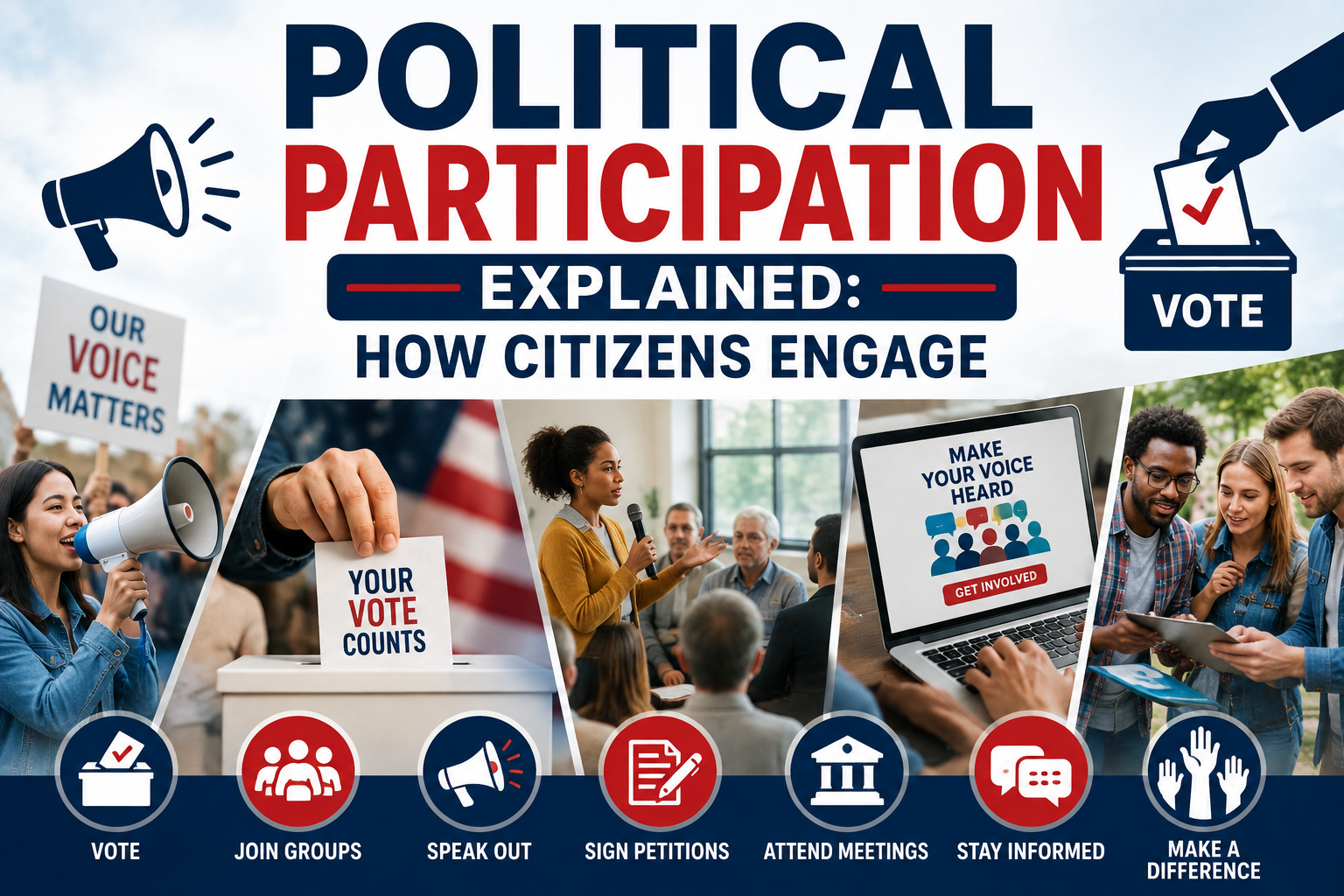
These include:
- Voting
- Contacting representatives
- Joining political parties
- Participating in civil society
- Attending public meetings
- Signing petitions
- Providing testimony
- Peaceful demonstrations
- Engaging in public debate
Representation works best when there is a continuing exchange between citizens and political institutions rather than communication only during elections.
The Role of Independent Media
Independent journalism can help citizens understand what representatives are doing.
News organizations can investigate:
- Government spending
- Legislative decisions
- Political promises
- Conflicts of interest
- Public policy
- Official conduct
This information can help voters make more informed decisions.
A free press can therefore function as an important part of democratic accountability.
Political Representation Is a Continuing Relationship
Winning an election is only the beginning of representation.
Once elected, officials have to make decisions, negotiate with other politicians, respond to constituents and operate within constitutional and legal limits.
Citizens, meanwhile, continue to evaluate those decisions.
This creates a continuing relationship:
Citizens → Elections → Representatives → Policies → Public response → Accountability → Future elections
The cycle is repeated over time.
Why Representation Shapes Government
Political representation is ultimately about connecting citizens with the institutions that exercise public authority.
Electoral systems determine how votes become seats. Legislatures transform those seats into debates, laws, budgets and oversight. Political parties organize competing ideas, while committees and other institutions provide mechanisms for detailed scrutiny.
No representative can satisfy every constituent on every issue. Democratic government instead depends on systems that allow different interests to compete, negotiate and influence public decisions while preserving accountability.
The strength of political representation therefore depends not only on who wins elections, but also on how fairly elections are conducted, how effectively institutions constrain power, how openly representatives communicate with citizens and whether people have meaningful opportunities to participate between elections.



2 Comments
Micle harison
June 7, 2019Lorem ipsum dolor sit amet, usu ut perfecto postulant deterruisset, libris causae volutpat at est, ius id modus laoreet urbanitas. Mel ei delenit dolores.
John Doe
June 7, 2019Some consultants are employed indirectly by the client via a consultancy staffing company.