
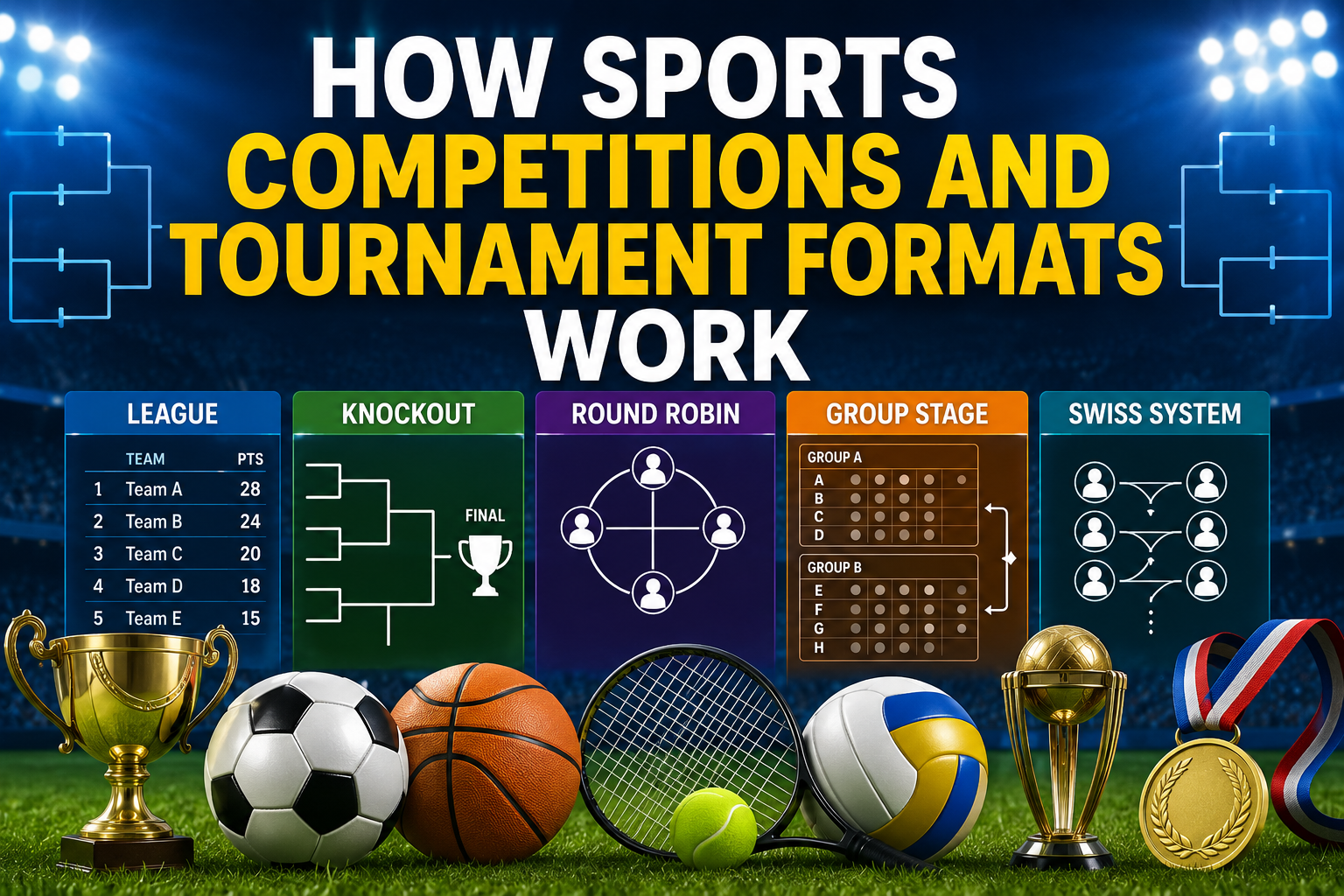
How Sports Competitions and Tournament Formats Work
Sports competitions can look very different depending on the game, the number of participants and the goals of the organizers. A soccer league may involve teams playing dozens of matches over several months, while a tennis tournament can eliminate players after a single defeat. Some competitions use group stages, others rely on rankings, and many combine several formats.
Despite these differences, most sports competitions are built around the same basic ideas: determining who participates, organizing matches or events, establishing rules for progression, ranking performance and ultimately identifying a winner.
Understanding these structures makes it easier to follow everything from local tournaments to major international sporting events.
What Is a Sports Competition?
A sports competition is an organized contest in which individuals or teams perform against one another according to established rules.
Competitions can range from a single event to an entire season.
Examples include:
- A single boxing match
- A marathon
- A tennis tournament
- A soccer league
- A basketball championship
- A swimming meet
- A track-and-field competition
- A multi-sport event
The format determines how participants progress and how performances are compared.
Why Competition Formats Matter
The format of a competition can influence almost everything about the sporting experience.
It determines:
- How many games participants play
- How mistakes affect progression
- How long the event lasts
- How teams or athletes qualify
- How rankings are calculated
- How champions are determined
- How much room exists for recovery after a poor performance
A knockout tournament, for example, places enormous importance on individual matches because one defeat may end a participant’s run.
A league provides more opportunities to recover because teams typically play many matches.
The Main Types of Sports Competition
Although organizers can create countless variations, several major formats appear repeatedly.
The most common include:
- League competitions
- Knockout tournaments
- Round-robin tournaments
- Group-stage competitions
- Swiss-system tournaments
- Multi-stage competitions
- Individual timed or scored events
Each format has different advantages and challenges.
How League Competitions Work
A league generally involves participants competing over an extended schedule.
Instead of being eliminated after one defeat, teams or athletes accumulate results throughout the competition.
In a typical league, participants receive points or rankings based on their performances.
For example, a soccer league might award:
- Three points for a win
- One point for a draw
- Zero points for a loss
At the end of the season, the participant with the highest number of points may become champion.
Other sports use different scoring systems.
Single Round-Robin Leagues
In a single round-robin competition, each participant plays every other participant once.
If there are 10 teams, each team plays nine matches.
The total number of matches is:
n(n − 1) ÷ 2
where n represents the number of participants.
With 10 teams:
10 × 9 ÷ 2 = 45 matches
Double Round-Robin Leagues
In a double round-robin system, participants play each opponent twice.
In many soccer leagues, this means playing one match at home and another away.
The number of matches doubles compared with a single round-robin format.
This approach provides a larger sample of performance and reduces the chance that one unusual result determines the entire competition.
Advantages of League Formats
League competitions reward consistency.
A team can lose several matches and still recover later.
This can make a league useful when organizers want to determine which participant performs best over a long period rather than simply identifying who succeeds on one particular day.
The disadvantage is time.
A league involving many participants can require hundreds of matches and several months of scheduling.
How Knockout Tournaments Work
A knockout tournament is one of the simplest formats to understand.
Participants compete in elimination rounds.
The winner advances while the loser is eliminated.
A basic structure might look like:
Round of 16 → Quarterfinals → Semifinals → Final
The winner of the final becomes champion.
Single-Elimination Tournaments
In a single-elimination tournament, one loss can end a participant’s competition.
This creates enormous pressure because every match matters.
Single-elimination formats are common in:
- Tennis
- Basketball tournaments
- Soccer cup competitions
- Volleyball
- Esports
- Combat sports
They are also popular with audiences because the consequences of each match are immediately clear.
Double-Elimination Tournaments
Double-elimination formats give participants a second chance.
A participant generally has to lose twice before being eliminated.
After the first loss, the participant moves into a lower or “losers” bracket.
This system can reduce the possibility that one bad performance immediately eliminates a strong participant.
It also creates a more complicated tournament structure.
How Seeding Works
Large tournaments often use seeding to determine where participants appear in the bracket.
Seeds are typically assigned according to rankings, previous performance, qualifying results or other criteria.
The purpose can be to prevent the strongest participants from meeting each other in the earliest rounds.
For example, in a 16-player tournament, the highest-ranked player might be placed in a position designed to avoid the second-highest-ranked player until a later stage.
Seeding can therefore influence the path a participant must take to reach the final.
Why Upsets Are So Important
A tournament upset occurs when a lower-ranked participant defeats a higher-ranked opponent.
Upsets are one of the defining features of knockout sports.
Because elimination tournaments provide limited opportunities to recover, an underdog may only need one outstanding performance to defeat a heavily favored opponent.
This is one reason knockout tournaments can produce dramatic results that would be less likely in a long league season.
How Round-Robin Tournaments Work
A round-robin tournament requires participants to compete against each other according to a predetermined schedule.
Unlike single-elimination competitions, losing a match does not necessarily eliminate a participant.
Results accumulate over multiple rounds.
At the end, rankings are calculated using criteria such as:
- Wins
- Points
- Draws
- Losses
- Score differential
- Head-to-head results
- Sets won
- Goals scored
- Other sport-specific statistics
Round-robin formats can provide a more comprehensive assessment of performance because participants compete multiple times.
How Group Stages Work
Many major tournaments combine group play with knockout rounds.
Participants are divided into groups, often containing four or more teams.
Each team plays other teams within its group.
The best-performing teams then advance to the knockout stage.
A simplified structure might look like:
Group Stage → Round of 16 → Quarterfinals → Semifinals → Final
This format combines two different ideas.
The group stage rewards consistency, while the knockout stage creates high-stakes elimination matches.
How Teams Advance From Groups
Advancement rules vary.
A competition might send:
- The top team from each group
- The top two teams
- The top two plus the best third-place teams
- A predetermined number of participants
Tiebreakers become important when teams finish with identical records.
Understanding Tiebreakers
Tiebreakers are rules used to separate participants who have the same number of points or an identical record.
Depending on the sport, tiebreakers might include:
- Head-to-head results
- Score difference
- Goals scored
- Sets won
- Point differential
- Strength of schedule
- Number of wins
- Disciplinary records
The order matters.
If the rules say head-to-head performance comes before score difference, organizers must apply the criteria in that sequence.
Tiebreakers can become extremely important near the end of a competition when several participants are fighting for qualification.
How the Swiss System Works
The Swiss system is another tournament format designed to allow many participants to compete over several rounds without requiring everyone to play everyone else.
Participants are generally paired with others who have similar records.
For example, after the first round:
- Winners are paired with other winners.
- Participants with one loss are paired with others with similar records.
- The process continues across subsequent rounds.
Participants do not normally play the same opponent repeatedly.
The Swiss system is particularly common in chess and has also become popular in other competitive environments.
It can handle large fields more efficiently than a full round-robin tournament.
How Individual Sports Determine Winners
Not every competition involves direct head-to-head matches.
In track and field, swimming, cycling and other sports, athletes may compete against the clock, distance or a scoring system.
For example:
- The fastest runner wins a sprint.
- The swimmer with the fastest time wins the race.
- The longest legal jump wins a long-jump competition.
- A gymnast may receive scores from judges.
These competitions often involve qualification rounds followed by finals.
Qualification Rounds
Qualification rounds reduce a large field to a manageable number of finalists.
For example, dozens of athletes may compete in preliminary heats.
The best performers then advance.
Qualification can be based on:
- Finishing position
- Time
- Distance
- Score
- Ranking
- Qualification standards
This structure allows large numbers of participants to compete without requiring every athlete to face every other athlete directly.
How Finals Work
The final is usually the stage that determines the champion.
However, “final” does not always mean a single contest.
Some sports use:
- Best-of-three series
- Best-of-five series
- Best-of-seven series
- Two-leg finals
- Aggregate scoring
- Multiple-event championships
The objective is to create a fair and practical method of determining the winner.
What Is a Best-of-Series Format?
A best-of-series competition requires one participant to win a predetermined number of games.
In a best-of-seven series, for example, the first team to win four games becomes champion.
The series can end after four, five, six or seven games.
This format is common in professional basketball, baseball and ice hockey playoffs.
The major advantage is that one unusually good or bad performance has less influence than it would in a single-elimination game.
Home Advantage and Scheduling
Some series alternate home venues.
A common arrangement gives one team more home games based on regular-season performance or seeding.
Home advantage can influence:
- Crowd support
- Familiarity with the venue
- Travel demands
- Rest
- Matchups
- Environmental conditions
Organizers therefore carefully design schedules to balance competitive and logistical considerations.
How Aggregate Scoring Works
In some competitions, two teams play multiple matches and their scores are combined.
This is known as aggregate scoring.
For example:
- First match: Team A 2–1 Team B
- Second match: Team B 1–1 Team A
Team A wins the tie 3–2 on aggregate.
This format can reward performance across multiple games rather than a single result.
Some competitions also use extra criteria when aggregate scores are level.
How Qualification for Major Tournaments Works
Large sporting events often require participants to qualify before reaching the main competition.
Qualification can occur through:
- Regional tournaments
- Ranking systems
- Qualifying matches
- Time standards
- Automatic qualification
- Previous championships
- National selection
Qualification systems vary significantly between sports.
For individual athletes, rankings or qualifying times may determine eligibility.
For teams, qualification can involve an extended series of matches.
Ranking Systems in Sports
Rankings provide another way of comparing competitors.
A ranking system may consider:
- Recent results
- Tournament performance
- Strength of opponents
- Championships won
- Points earned
- Consistency
Different sports use different ranking formulas.
Rankings can influence tournament seeding, qualification and invitations.
However, a ranking is not always identical to a tournament result.
A player may be ranked number one going into a competition but still lose in an early round.
Points Systems Can Shape Competition Strategy
Points systems affect how participants approach matches.
If a win is worth substantially more than a draw, teams may have greater incentive to pursue victory.
If preserving a lead is particularly valuable, competitors may become more defensive.
The scoring system therefore does more than determine the winner after the fact.
It can influence strategic decisions during the competition itself.
Why Competition Formats Are Designed Carefully
Tournament organizers have to balance several competing goals.
A good format should ideally:
- Produce credible results
- Give participants meaningful opportunities
- Fit within scheduling constraints
- Maintain audience interest
- Minimize unnecessary travel
- Protect athlete welfare
- Provide clear qualification rules
- Create a fair path to the championship
There is rarely a perfect format.
A tournament with many games may be fairer but take longer. A short knockout tournament may be exciting but more vulnerable to one-off upsets.
Fairness Versus Entertainment
Sports organizers often have to balance competitive fairness with entertainment.
A pure round-robin competition may provide a strong measure of consistency but lack the sudden drama of elimination matches.
A knockout tournament creates immediate stakes but can eliminate a strong participant after one poor performance.
Hybrid formats attempt to combine both benefits.
That is why many major competitions use group stages followed by knockout rounds.
How Overtime and Extra Time Work
When two participants finish level, competition rules determine what happens next.
Depending on the sport, possibilities include:
- Extra time
- Overtime periods
- Sudden-death formats
- Penalty shootouts
- Tiebreak games
- Extra innings
- Additional rounds
The exact rules are sport-specific.
The goal is generally to produce a winner while maintaining the competitive principles of the sport.
What Happens When a Participant Withdraws?
Competitions also need rules for withdrawals.
A participant may withdraw because of:
- Injury
- Illness
- Scheduling problems
- Disqualification
- Eligibility issues
- Other circumstances
Depending on when the withdrawal occurs, organizers may award a walkover, replace the participant, alter the bracket or remove previous results.
Clear withdrawal rules help prevent confusion and protect the integrity of the competition.
The Role of Officials
Officials are essential to organized sports competitions.
Their responsibilities can include:
- Enforcing rules
- Recording scores
- Managing time
- Reviewing disputed plays
- Issuing penalties
- Confirming results
- Maintaining safety
Modern sports increasingly use technology to assist officials.
Examples include:
- Video review
- Goal-line technology
- Electronic timing
- Hawk-Eye systems
- Photo finishes
- Automated scoring systems
Technology can improve accuracy, although it also introduces debates about delays, interpretation and the limits of automated decision-making.
Why Competition Formats Can Change
Sports organizations sometimes modify tournament structures.
Changes may be made because of:
- Expansion of the number of participants
- Scheduling problems
- Travel concerns
- Commercial considerations
- Athlete workload
- Changes in qualification systems
- Audience preferences
- Competitive balance
A format that works well for 16 teams may not work as effectively for 32 or 48.
Organizers must therefore continually evaluate whether a competition remains practical and credible.
How Weather and Other Conditions Can Affect Competitions
Outdoor sports can be affected by environmental conditions.
Rain, extreme heat, wind, snow or poor visibility can lead to:
- Delays
- Postponements
- Schedule changes
- Venue changes
- Shortened competitions
Some sports have specific rules for handling these circumstances.
Weather management is particularly important for events that involve large numbers of participants and spectators.
Why Tournaments Create So Much Drama
Tournament structures naturally create narratives.
A competitor may:
- Recover from an early defeat
- Defeat a heavily favored opponent
- Advance through multiple rounds
- Set a record
- Reach a first final
- Defend a championship
- Win after a dramatic tiebreak
The structure gives every stage a clear purpose.
As the field becomes smaller, the significance of each match generally increases.
That is one reason championship tournaments attract such large audiences.
Choosing the Right Format
There is no universally superior competition format.
A league works well when organizers want to reward consistency over an extended period.
A knockout tournament is effective when organizers want high-stakes elimination and a relatively quick path to a champion.
A group stage can provide participants with multiple opportunities before the pressure of elimination begins.
A Swiss system can accommodate large fields without requiring enormous numbers of matches.
The best choice depends on the sport, number of participants, available time, competitive objectives and resources.
Why Tournament Structure Shapes the Sporting Story
Sports competitions are ultimately systems for turning performance into meaningful outcomes.
Every rule about qualification, scheduling, points, rankings, seeding and elimination affects how participants approach the competition and how audiences experience it.
A league asks a fundamental question: Who can perform consistently over time?
A knockout tournament asks: Who can survive when every match matters?
A group-and-knockout format asks both.
Understanding these structures makes sports easier to follow because the results become more than individual wins and losses. They become part of a carefully designed pathway that determines who advances, who is eliminated and, eventually, who earns the right to be called champion.





2 Comments
Micle harison
June 7, 2019Lorem ipsum dolor sit amet, usu ut perfecto postulant deterruisset, libris causae volutpat at est, ius id modus laoreet urbanitas. Mel ei delenit dolores.
John Doe
June 7, 2019Some consultants are employed indirectly by the client via a consultancy staffing company.