
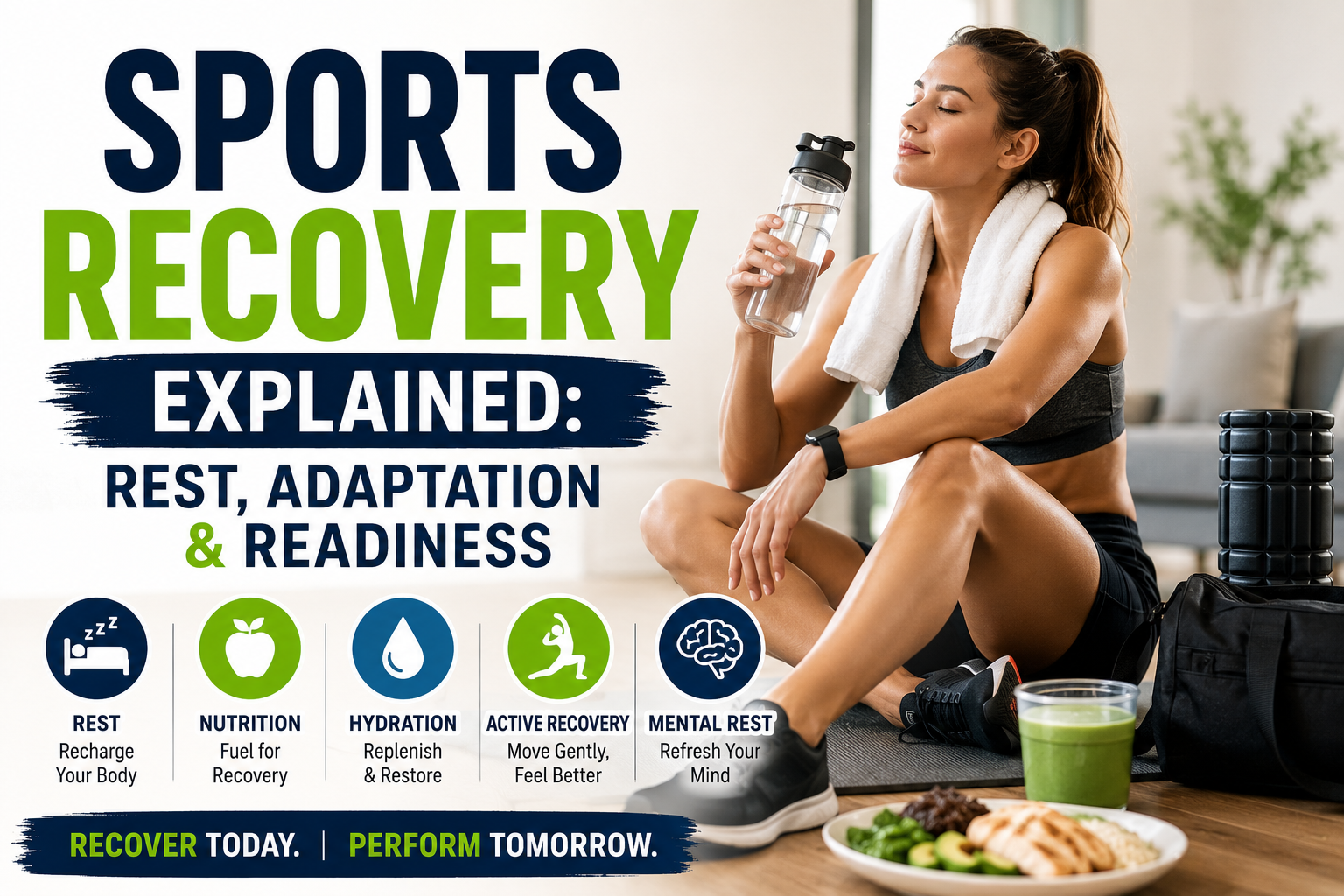
Sports Recovery Explained: Rest, Adaptation & Readiness
Training is only one part of athletic development. What happens between workouts, practices and competitions can be just as important for improving performance.
Sports recovery is the collection of processes that help the body and mind return toward readiness after physical activity. It includes sleep, nutrition, hydration, rest, active recovery and sensible management of training intensity.
Recovery is not simply about taking time off. The goal is to give the body enough opportunity to repair itself and adapt to training while maintaining the fitness and skills that athletes are trying to develop.
Understanding how recovery works can help athletes train more consistently, recognize excessive fatigue and make better decisions about when to push and when to ease back.
What Is Sports Recovery?
Sports recovery refers to the physical and psychological processes that occur after exercise or competition.
During demanding activity, the body experiences temporary stress. Muscles use stored energy, connective tissues are loaded, fluids are lost through sweat and the nervous system is challenged.
Recovery gives these systems time to restore their resources and respond to the training stimulus.
Depending on the activity, recovery may involve:
- Sleep
- Rest days
- Light movement
- Hydration
- Eating enough food
- Replenishing carbohydrate stores
- Consuming adequate protein
- Mobility work
- Managing training volume
- Reducing psychological stress
Recovery needs vary considerably between individuals and sports.
A professional endurance athlete, a recreational runner and a strength-training beginner may all require different approaches.
Why Recovery Matters for Athletes
Training creates a stimulus for adaptation, but adaptation does not happen simply because a workout was completed.
The body needs time and resources to respond to that stimulus.
With appropriate recovery, an athlete can potentially return to training with better readiness and gradually build capacity over time.
Poor recovery can have the opposite effect.
When demanding training repeatedly occurs without sufficient recovery, fatigue can accumulate. Performance may decline, motivation can fall and the risk of poor movement quality or injury may increase.
Recovery therefore supports consistency.
An athlete who can train productively week after week often has a greater opportunity to improve than someone who repeatedly alternates between extremely hard training and prolonged periods of exhaustion.
The Difference Between Rest and Recovery
Rest and recovery are related, but they are not exactly the same thing.
Rest generally means reducing or stopping physical activity.
Recovery is broader. It includes everything that helps the body and mind return toward a state in which productive activity is possible.
An athlete can be resting physically while still recovering poorly because of inadequate sleep, insufficient food, dehydration or high psychological stress.
Conversely, recovery can sometimes include gentle movement rather than complete inactivity.
The important question is not simply, “Did I rest?”
It is whether the athlete has recovered sufficiently for the next appropriate training demand.
How the Body Responds to Training
Exercise places stress on multiple body systems.
Resistance training, for example, challenges muscles and connective tissues. Endurance exercise places substantial demands on cardiovascular and metabolic systems. High-intensity sports can challenge the nervous system while requiring rapid changes of direction, acceleration and deceleration.
After training, the body works to restore balance.
Energy stores are replenished, damaged or stressed tissues undergo repair and physiological systems gradually return toward baseline.
Over repeated training cycles, the body can adapt to these demands.
This is one reason progressive training works: the athlete provides a manageable stimulus, recovers and gradually becomes capable of handling more.
Understanding Adaptation
Adaptation is one of the central concepts in sports performance.
When the body is exposed to an appropriate training stimulus and given sufficient recovery, it can become better equipped to handle similar demands in the future.
Adaptations can include:
- Increased muscular strength
- Improved aerobic capacity
- Better movement efficiency
- Greater muscular endurance
- Improved coordination
- Increased tolerance for training volume
- Better sport-specific skills
However, adaptation is not unlimited.
Increasing training demands too quickly can overwhelm an athlete’s ability to recover.
Effective programming therefore balances training stress with recovery capacity.
What Happens During Sleep?
Sleep is one of the most important components of recovery.
During sleep, the body carries out numerous processes involved in physical restoration, memory and regulation of physiological systems.
For athletes, sleep also matters because learning and skill development do not stop when practice ends.
Sleep supports processes involved in memory consolidation, which can be particularly relevant for sports requiring technique, decision-making and complex movement.
Insufficient sleep can also affect alertness, mood, reaction time and perceived effort.
For these reasons, sleep should generally be considered a core part of an athlete’s training program rather than an optional extra.
Why Nutrition Supports Recovery
Training uses energy and nutrients.
Food provides the materials needed to replenish energy stores and support normal physiological processes.
Three nutritional components are particularly relevant to many athletes:
Carbohydrates
Carbohydrates provide an important source of energy during many forms of exercise.
After demanding training, consuming adequate carbohydrate can help replenish muscle glycogen stores.
This can become especially important when an athlete has another demanding session or competition relatively soon.
Protein
Protein supplies amino acids required for maintaining and repairing body tissues.
Athletes regularly exposed to resistance training or other demanding physical activity need adequate dietary protein as part of an overall balanced diet.
Protein does not work in isolation, however. Total energy intake, overall diet quality and training load also matter.
Dietary Fats
Fats provide energy and perform important structural and physiological functions.
A balanced diet generally includes appropriate sources of unsaturated fats alongside other essential nutrients.
Hydration Is Part of Recovery
Sweating causes the loss of water and electrolytes.
The extent of these losses depends on factors such as:
- Exercise intensity
- Exercise duration
- Environmental temperature
- Humidity
- Individual sweat rate
- Clothing
- Access to fluids
Replacing fluids after exercise helps support normal physiological function.
For shorter, less intense activities, ordinary food and fluids may often be sufficient. Longer or particularly demanding sessions can create greater hydration and electrolyte requirements.
There is no universal amount of fluid that every athlete should consume.
Individual needs matter.
Active Recovery Explained
Active recovery involves performing low-intensity movement rather than remaining completely inactive.
Examples include:
- Easy walking
- Gentle cycling
- Light swimming
- Low-intensity mobility work
- Easy recreational movement
The purpose is not to create another demanding workout.
Active recovery should generally be easy enough that it does not add significant training stress.
For some athletes, gentle movement can also help them feel less stiff after demanding exercise.
Do Recovery Tools Actually Matter?
The sports industry offers a large range of recovery products and techniques, including massage devices, compression garments, cold-water immersion and other methods.
Some techniques may help with short-term perceptions of soreness or recovery, but they should not replace the fundamentals.
A useful hierarchy is:
- Adequate sleep
- Appropriate nutrition
- Sufficient hydration
- Sensible training progression
- Planned rest
- Stress management
- Additional recovery techniques when appropriate
The basics generally have a much stronger foundation than relying on a single recovery gadget or treatment.
Managing Muscle Soreness
Delayed-onset muscle soreness, commonly called DOMS, can develop after unfamiliar or particularly demanding exercise.
It often becomes noticeable several hours after exercise and can persist for a few days.
Soreness does not automatically mean that a workout was more effective.
An athlete can make significant progress without experiencing severe soreness after every training session.
Likewise, some soreness does not necessarily mean an athlete should stop all activity.
The appropriate response depends on the severity of symptoms and whether normal movement is affected.
Sharp, persistent or unusual pain should not simply be dismissed as ordinary training soreness.
How Training Load Affects Recovery
Recovery needs are closely connected to training load.
Training load can increase through several variables, including:
- Duration
- Intensity
- Frequency
- Volume
- Exercise complexity
- Competition demands
A sudden increase in one or several of these factors can make recovery more difficult.
For example, a runner who suddenly doubles weekly mileage may experience substantially greater fatigue even if each individual run feels manageable.
Gradual progression gives the body more opportunity to adapt.
Why Rest Days Can Improve Training
Rest days are not wasted training days.
They provide opportunities for fatigue to decrease and allow athletes to prepare for subsequent sessions.
The ideal frequency of rest depends on the athlete and training program.
Some athletes may benefit from complete rest, while others may use low-intensity recovery sessions.
A well-designed training schedule considers the entire week rather than treating every workout independently.
A hard session followed by another hard session may produce a very different result from a hard session followed by an appropriately easy day.
Recognizing Signs of Inadequate Recovery
Athletes should pay attention to patterns rather than relying on a single symptom.
Possible signs that recovery is inadequate can include:
- Persistent fatigue
- Declining performance
- Unusually high perceived effort
- Poor sleep
- Reduced motivation
- Irritability or mood changes
- Persistent muscle soreness
- Repeated minor illnesses
- Loss of enthusiasm for training
- Difficulty completing normal workouts
These signs can have many possible causes, so they should not automatically be interpreted as evidence of a particular medical condition.
If symptoms are persistent, severe or concerning, professional medical advice is appropriate.
Recovery and Mental Readiness
Physical recovery is only one side of athletic readiness.
Competition and demanding training can create psychological stress as well.
An athlete may be physically capable of exercising but mentally exhausted from competition pressure, travel, work, school or other responsibilities.
Mental recovery can involve:
- Adequate sleep
- Time away from sport
- Relaxation
- Social connection
- Enjoyable non-sport activities
- Managing competition expectations
- Appropriate workload planning
A sustainable training program needs to account for the athlete as a whole person.
How Athletes Can Track Recovery
Recovery can be monitored using both objective and subjective information.
Useful indicators may include:
- Training performance
- Resting heart rate trends
- Sleep duration and quality
- Muscle soreness
- Mood
- Energy levels
- Motivation
- Perceived exertion
- Training volume
Wearable devices can provide useful information, but their measurements should not be treated as perfect representations of recovery.
A person’s own experience remains important.
For example, an athlete might have acceptable wearable data but still feel unusually fatigued because of poor sleep, psychological stress or other factors.
Recovery Is Different for Every Sport
Different sports place different demands on the body.
A marathon runner may focus heavily on aerobic recovery and replenishing energy stores.
A power athlete may place greater emphasis on nervous-system fatigue, muscular recovery and adequate nutrition.
A football or basketball player may need to recover from repeated sprinting, jumping, contact and changes of direction while also preparing for another practice or match.
Gymnasts and other technical athletes may need to balance physical recovery with frequent skill practice.
There is therefore no universal recovery formula.
Age and Experience Can Change Recovery Needs
Recovery requirements can change throughout an athlete’s life and career.
Training history, age, fitness level, injury history, sleep, nutrition and overall lifestyle can all influence how someone responds to exercise.
Beginners may need additional recovery when adapting to unfamiliar training.
Experienced athletes may tolerate higher workloads because they have developed greater capacity, but that does not make them immune to excessive fatigue.
Older athletes may also need to adjust training and recovery strategies as physiological characteristics change.
Individualization is more useful than applying the same schedule to everyone.
The Role of Professional Support
Coaches, sports scientists, physiotherapists, dietitians, physicians and other qualified professionals can help athletes make more informed recovery decisions.
Professional support can be particularly valuable when an athlete is dealing with:
- Persistent pain
- Recurrent injuries
- Major changes in performance
- Unexplained fatigue
- Nutritional difficulties
- Disordered eating concerns
- Returning to sport after injury
- High training loads
Recovery should complement appropriate medical care rather than replace it.
Common Recovery Mistakes
Several mistakes can undermine otherwise well-designed training programs.
Training Hard Every Day
More training is not automatically better. Adaptation requires a manageable balance between stress and recovery.
Treating Sleep as Optional
Consistently sacrificing sleep for additional training can undermine performance and general well-being.
Underfueling
Not consuming enough energy can make it harder to support training, recovery and normal physiological function.
Ignoring Hydration
Fluid needs can increase significantly during prolonged or intense exercise, especially in hot environments.
Chasing Recovery Gadgets
Recovery tools may have a role, but they cannot compensate for inadequate sleep, nutrition or training management.
Confusing Pain With Progress
Soreness and discomfort are not reliable measures of training quality. Persistent or sharp pain deserves appropriate attention.
How to Build a Better Recovery Routine
A practical recovery routine does not have to be complicated.
Start with the fundamentals:
Sleep consistently. Establish regular sleep habits and allow sufficient time for rest.
Eat adequately. Match food intake to training demands and maintain a balanced diet.
Stay hydrated. Replace fluids according to activity level, environment and individual needs.
Plan easier periods. Include lighter sessions and rest within the overall training schedule.
Increase workload gradually. Give the body time to adapt when training volume or intensity changes.
Monitor how you feel. Combine performance information with subjective measures such as energy, mood and soreness.
Adjust when necessary. A training plan should be flexible enough to respond to unusual fatigue, illness, travel or other stresses.
Readiness Matters More Than Simply Feeling Rested
Sports recovery is ultimately about creating the conditions for productive training and competition.
Rest allows fatigue to decrease. Nutrition and hydration provide resources. Sleep supports physical and mental restoration. Appropriate training progression creates the stimulus for adaptation.
When these pieces work together, athletes can gradually develop greater capacity without constantly pushing beyond what they can recover from.
The most effective recovery strategy is rarely the most complicated one. It is the one that consistently supports the next quality training session, protects long-term health and allows the athlete to keep progressing when the demands of sport inevitably increase.





2 Comments
Micle harison
June 7, 2019Lorem ipsum dolor sit amet, usu ut perfecto postulant deterruisset, libris causae volutpat at est, ius id modus laoreet urbanitas. Mel ei delenit dolores.
John Doe
June 7, 2019Some consultants are employed indirectly by the client via a consultancy staffing company.