
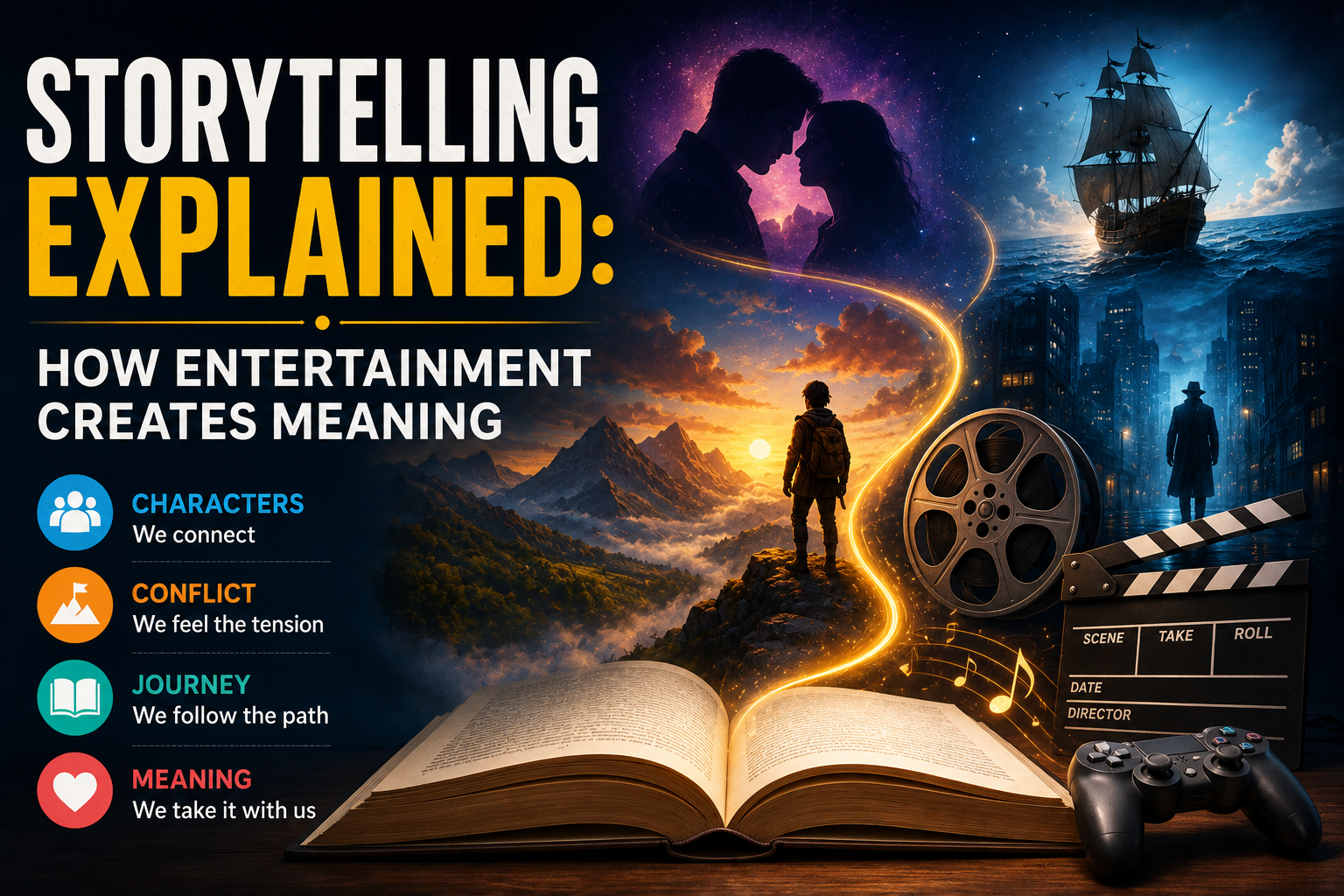
Storytelling Explained: How Entertainment Creates Meaning
Entertainment is often described as a way to pass the time, but the stories people watch, read, hear and play can do much more than provide distraction.
A movie can change how someone thinks about courage. A television series can make audiences question their assumptions about family or friendship. A novel can introduce readers to a completely unfamiliar perspective. A video game can make players experience the consequences of decisions rather than simply watching them happen.
At the center of all these experiences is storytelling.
Storytelling gives entertainment structure, emotion and meaning. It turns characters into people audiences care about, events into experiences worth remembering and individual moments into ideas that can remain with people long after the entertainment itself has ended.
What Is Storytelling?
Storytelling is the art of communicating ideas, experiences or emotions through a sequence of events involving characters, circumstances and change.
Stories can be fictional or based on real events. They can be delivered through:
- Movies
- Television shows
- Books
- Music
- Theater
- Podcasts
- Video games
- Comics
- Animation
- Documentaries
- Online entertainment
The medium may change, but many storytelling principles remain surprisingly consistent.
A story usually gives audiences a reason to care about what happens next.
That reason might be curiosity, emotional attachment, suspense, humor, fear, hope or the desire to understand a character.
Why Stories Matter in Entertainment
Facts can communicate information, but stories can give that information emotional context.
Consider the difference between saying that someone experienced hardship and watching a character struggle through that hardship over the course of a film.
The first statement communicates an idea.
The second allows audiences to experience the idea indirectly.
This is one reason stories are so powerful.
They give abstract concepts a human face.
Themes such as:
- Love
- Loss
- Ambition
- Betrayal
- Freedom
- Identity
- Friendship
- Justice
- Family
- Sacrifice
- Belonging
can become easier to understand when audiences encounter them through characters and events.
Characters Create Emotional Connection
Characters are often the emotional foundation of entertainment.
Audiences do not necessarily need to agree with a character to become interested in that character. They simply need to understand what the character wants, fears or values.
A compelling character usually has some combination of:
- Goals
- Motivations
- Strengths
- Weaknesses
- Conflicts
- Relationships
- Fears
- Contradictions
- Personal history
These characteristics create opportunities for development.
A character who begins a story afraid of failure may gradually become more confident. Another might begin with strong beliefs and discover that those beliefs are incomplete.
The change gives the audience something to follow.
Character Development Gives Stories Meaning
Character development is the process through which a character changes, reveals new qualities or gains a deeper understanding of themselves or their circumstances.
The change does not always have to be positive.
A character can become more courageous, more compassionate or more mature.
But a character can also become corrupted, isolated or consumed by ambition.
What matters is that the audience can see a meaningful relationship between the character’s experiences and who they eventually become.
This makes the story feel consequential.
If events happen but nothing changes, audiences may struggle to understand why those events mattered.
Conflict Drives Stories Forward
Without conflict, many stories would have little reason to continue.
Conflict occurs when characters encounter obstacles between themselves and what they want.
It can take many forms.
Internal conflict
A character struggles with their own emotions, beliefs or decisions.
Interpersonal conflict
Two or more characters have competing goals, values or interests.
Social conflict
A character struggles against institutions, communities or social expectations.
Environmental conflict
Characters must overcome physical conditions such as extreme weather, dangerous terrain or limited resources.
Moral conflict
A character must choose between competing values or principles.
A strong story can contain several types simultaneously.
A character might want to achieve a particular goal while simultaneously questioning whether achieving it is morally acceptable.
That creates both external and internal tension.
Story Structure Creates Expectations
Stories generally have some form of structure.
The exact structure can vary considerably, but many narratives include:
- An introduction to the characters and situation
- A problem or disruption
- Rising complications
- A turning point
- A climax or major confrontation
- Some form of resolution
This structure gives audiences a sense of progression.
The beginning establishes the world.
The middle creates complications.
The climax forces important decisions or consequences.
The ending provides some degree of resolution.
Not every story follows this pattern exactly. Experimental films, literary fiction and other forms of entertainment can deliberately challenge conventional structure.
Even then, audiences often look for patterns that help them interpret what they are experiencing.
Suspense Keeps Audiences Watching
Suspense is created when audiences want to know what will happen next.
It can come from uncertainty, danger, incomplete information or competing possibilities.
A thriller might create suspense by making audiences wonder whether a character will escape.
A mystery might make them ask who committed a crime.
A romantic story might create uncertainty about whether two characters will remain together.
The important element is not necessarily danger.
It is anticipation.
The audience understands that something important is unresolved and wants to discover the outcome.
Curiosity Is Another Powerful Storytelling Tool
Not every story needs dramatic suspense.
Curiosity can be just as effective.
A story may introduce a question without immediately answering it:
- Why did the character disappear?
- What happened in the past?
- Who can be trusted?
- What is really happening?
- Why does the character behave this way?
The audience continues because it wants the answer.
This technique is particularly useful in mysteries, science fiction, fantasy and complex dramas.
Stories Create Meaning Through Themes
A theme is an underlying idea explored through a story.
The plot tells audiences what happens.
The theme helps audiences think about what those events mean.
For example, a story about a wealthy person losing everything might explore:
- The difference between wealth and happiness
- The dangers of greed
- The importance of relationships
- Social inequality
- Personal identity
A story does not necessarily need to state its theme directly.
In fact, audiences often respond more strongly when they are allowed to interpret the meaning themselves.
Symbolism Adds Another Layer
Storytellers frequently use objects, places, colors, actions or recurring images to represent larger ideas.
A locked door might represent isolation.
A journey might represent personal transformation.
A broken object might symbolize a damaged relationship.
A recurring song might connect different moments in a character’s life.
Symbolism allows creators to communicate ideas without explaining everything through dialogue.
It also gives audiences opportunities to discover additional meaning during repeated viewings or readings.
Setting Can Become Part of the Story
The world surrounding a story is not merely background.
Setting can influence characters, conflict and themes.
A story set in a crowded city may explore anonymity, ambition or social pressure.
A story set in an isolated rural community may focus on tradition, belonging or limited opportunities.
A futuristic setting might allow creators to explore questions about technology and society.
Even fictional worlds can feel meaningful when their environments reflect the concerns of their characters.
Dialogue Reveals More Than Information
Dialogue serves several purposes beyond moving the plot forward.
It can reveal:
- Personality
- Relationships
- Social background
- Conflict
- Humor
- Motivation
- Emotional tension
Strong dialogue often contains information that characters do not say directly.
A character might claim everything is fine while their word choice, tone or behavior suggests otherwise.
This creates a gap between what is said and what is meant.
Audiences naturally try to interpret that gap.
Humor Can Communicate Serious Ideas
Comedy is sometimes treated as the opposite of meaningful storytelling, but humor can address serious subjects in powerful ways.
Comedy can expose:
- Hypocrisy
- Social expectations
- Political behavior
- Workplace culture
- Family dynamics
- Cultural differences
By making audiences laugh, a story can sometimes encourage them to examine uncomfortable subjects without becoming overwhelmed by them.
Satire is particularly effective because it uses humor to criticize people, institutions or ideas.
Music Changes How Stories Feel
Music can transform the emotional meaning of a scene.
The same visual sequence can feel completely different depending on its soundtrack.
A quiet melody can make a scene feel reflective.
A dramatic score can increase tension.
An energetic song can create excitement.
Silence can sometimes be even more powerful.
Music also helps audiences associate particular sounds with characters, locations or emotional states.
Over time, those associations can become part of the identity of a story.
Visual Storytelling Communicates Without Words
Film, television, animation and games have an advantage that written stories do not always possess: they can communicate through images.
A character standing alone in a large empty room can suggest isolation without anyone saying the character feels lonely.
A crowded frame can communicate social pressure.
Changes in lighting can alter the emotional atmosphere.
Camera angles can influence how audiences perceive power and vulnerability.
Visual storytelling allows meaning to exist beneath the dialogue.
Video Games Make Audiences Participants
Interactive entertainment adds another dimension to storytelling.
In a traditional film, audiences watch characters make decisions.
In many video games, players make decisions themselves.
This can create a stronger sense of participation.
A game may ask players to:
- Choose between competing goals
- Decide whom to trust
- Manage limited resources
- Accept consequences
- Explore a world
- Solve problems
- Determine a character’s fate
Because players participate in the process, the meaning of an event can become more personal.
A difficult decision in a game may feel different from watching an actor make the same decision on screen.
Stories Reflect Society
Entertainment often reflects the culture in which it is created.
Stories can reveal attitudes toward:
- Family
- Gender
- Work
- Wealth
- Authority
- Religion
- Technology
- Education
- Race and culture
- Relationships
This does not mean every story accurately represents society.
Sometimes entertainment reinforces stereotypes. At other times, it challenges them.
Either way, stories can become a record of what creators and audiences considered important at a particular time.
Entertainment Can Challenge Assumptions
One of storytelling’s most powerful functions is allowing audiences to see situations from perspectives different from their own.
A story might place audiences inside the experiences of someone with a different:
- Background
- Profession
- Culture
- Age
- Social position
- Personal belief
- Life experience
This does not automatically create understanding, but it can encourage audiences to consider questions they might not otherwise encounter.
That is one reason stories can influence conversations far beyond the entertainment industry.
Why Audiences Interpret Stories Differently
A story does not have one guaranteed meaning.
Different audiences can watch the same film, read the same novel or play the same game and come away with different interpretations.
Personal experiences influence how people understand stories.
Someone who has experienced loss may interpret a character’s grief differently from someone who has not.
Someone who has struggled with ambition may respond differently to a story about success.
Cultural background can also influence interpretation.
This is not necessarily a weakness of storytelling.
Ambiguity can make entertainment more engaging because audiences continue thinking about the story after it ends.
The Importance of Emotional Payoff
A story can contain an excellent premise and still feel unsatisfying if its emotional journey does not lead anywhere meaningful.
Emotional payoff occurs when the story gives significance to the feelings, conflicts or questions it has developed.
For example, if a story spends considerable time establishing a friendship, the eventual separation of those characters should feel meaningful.
If a character spends the entire narrative seeking redemption, the audience expects the ending to address that journey.
Good storytelling creates emotional expectations and then gives audiences a reason to believe those expectations mattered.
Why Some Stories Stay With Us
Certain stories become memorable because they combine several elements effectively.
They may contain:
- Relatable characters
- Strong emotional conflicts
- Memorable imagery
- Meaningful themes
- Unexpected developments
- Powerful music
- Thought-provoking questions
- Satisfying or deliberately challenging endings
But memorability does not always depend on complexity.
A simple story told honestly can be more powerful than an elaborate story filled with unnecessary twists.
What matters is whether the audience has a reason to care.
Entertainment Does Not Always Need a Message
There is also an important distinction between meaningful entertainment and entertainment that is explicitly trying to teach a lesson.
Not every movie, song, game or television show needs a profound message.
Comedy can simply make people laugh.
A sports movie can provide excitement.
A fantasy adventure can offer an escape from everyday life.
A musical can create an emotional experience.
Entertainment has value even when its primary purpose is enjoyment.
Sometimes meaning emerges naturally from the experience rather than being deliberately inserted by the creator.
Escapism Can Also Have Value
Stories allow people to temporarily step outside their ordinary circumstances.
A fantasy world can provide an escape.
A comedy can offer relief after a difficult day.
A dramatic series can give audiences an emotional experience that differs from their everyday lives.
This does not make escapism meaningless.
Rest, imagination and emotional release are legitimate reasons people seek entertainment.
Stories can provide a temporary distance from reality while still allowing audiences to return to real life with new ideas or emotions.
The Role of the Audience
Storytelling is not a one-way process.
Creators produce a story, but audiences complete part of the experience through interpretation.
Viewers decide which characters they sympathize with.
Readers decide which details seem important.
Players determine how they approach challenges.
Audiences discuss theories, debate endings and create interpretations that creators may never have anticipated.
In this sense, entertainment becomes a conversation between creators and audiences.
How Technology Is Changing Storytelling
Technology continues to expand the ways stories can be created and experienced.
Streaming has changed how audiences consume television and film.
Digital platforms have lowered barriers to publishing and distribution.
Video games have become increasingly sophisticated interactive storytelling environments.
Virtual and augmented reality can place audiences inside simulated environments.
Artificial intelligence is also creating new possibilities for content creation and interactive experiences.
Yet technological innovation does not eliminate the fundamental principles of storytelling.
Even the most advanced entertainment still needs characters, conflict, emotion, curiosity or some other reason for audiences to care.
Storytelling Across Different Entertainment Formats
Different forms of entertainment emphasize different storytelling strengths.
Movies
Movies combine acting, cinematography, editing, sound and music to tell stories within a relatively limited period.
Television
Television can develop characters and relationships over many episodes or seasons.
Books
Books allow creators to explore thoughts, memories and internal experiences in considerable depth.
Theater
Theater creates a direct relationship between performers and audiences in a shared physical space.
Video games
Games allow audiences to interact with characters, environments and narrative decisions.
Podcasts
Podcasts can use voice, sound design and conversation to create intimate storytelling experiences.
Music
Songs can communicate stories and emotions through lyrics, melody, rhythm and performance.
Each medium offers different ways of creating meaning.
What Makes Storytelling Effective?
There is no single formula for great storytelling, but several principles consistently matter.
Give characters meaningful goals
Audiences need reasons to care about what characters are trying to achieve.
Create genuine obstacles
Challenges give the story momentum.
Make consequences matter
Choices should have meaningful effects.
Build emotional connections
Relationships help audiences become invested in outcomes.
Use details purposefully
Small details can create atmosphere, symbolism or character depth.
Respect the audience
Stories do not always need to explain every idea directly.
Give the ending significance
The resolution should address the central emotional or narrative journey.
Why Stories Matter Beyond Entertainment
Storytelling remains one of the most powerful tools humans use to understand experiences.
Entertainment gives those stories a form that can be shared across generations, cultures and technologies.
A well-told story can make an unfamiliar experience feel understandable. It can turn an abstract idea into something emotional. It can preserve memories, challenge assumptions and create conversations between people who might otherwise have little in common.
Most importantly, storytelling gives audiences the opportunity to feel something and then ask why they felt it.
That is where much of entertainment’s deeper value comes from.
A story may begin as a simple attempt to entertain, but its characters, conflicts, choices and consequences can leave audiences thinking about their own lives, relationships and beliefs.
And that is why storytelling remains at the heart of entertainment: people may come for the experience, but they often remember the meaning.




2 Comments
Micle harison
June 7, 2019Lorem ipsum dolor sit amet, usu ut perfecto postulant deterruisset, libris causae volutpat at est, ius id modus laoreet urbanitas. Mel ei delenit dolores.
John Doe
June 7, 2019Some consultants are employed indirectly by the client via a consultancy staffing company.