
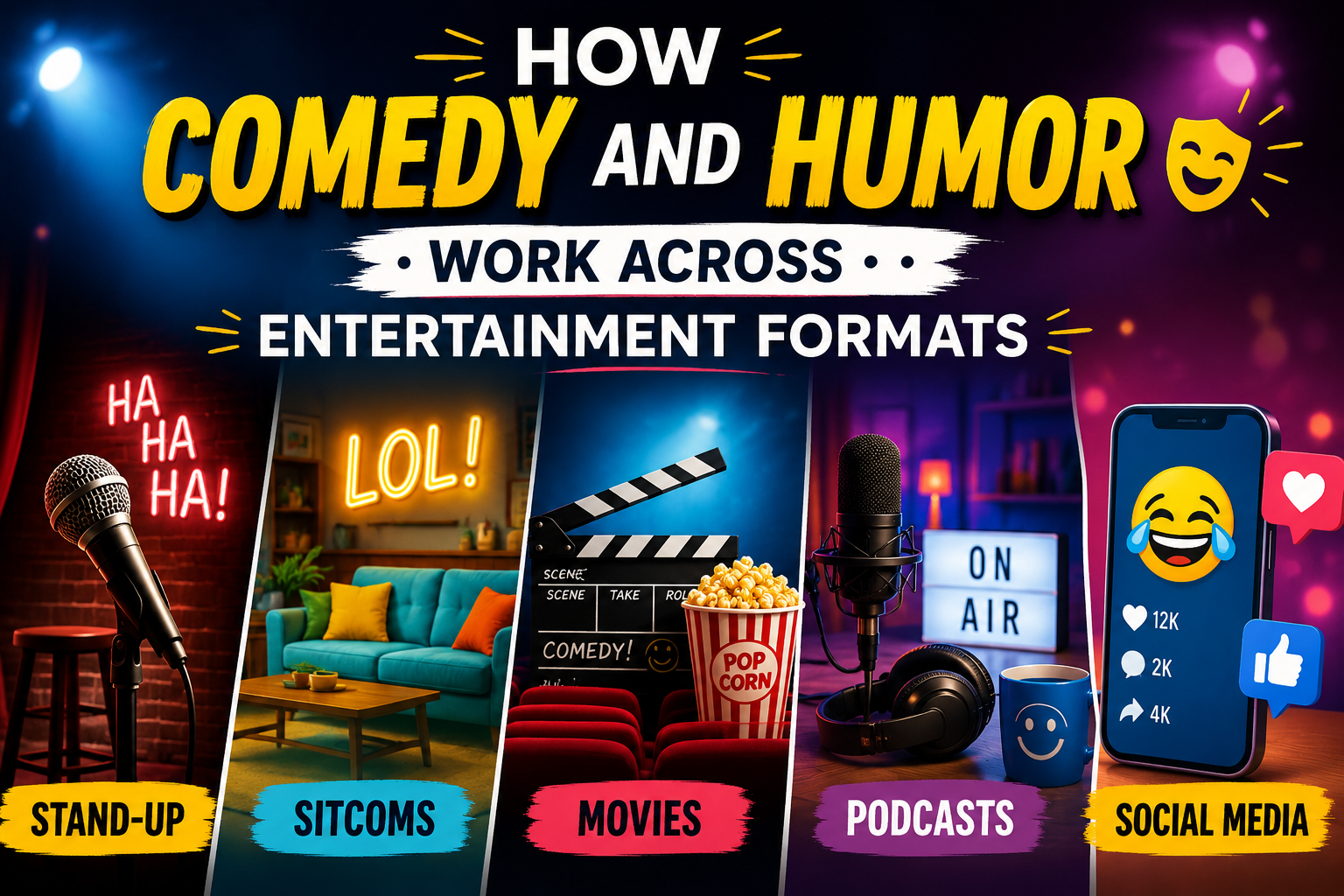
How Comedy and Humor Work Across Entertainment Formats
Comedy is one of the most adaptable forms of entertainment.
A joke can make an audience laugh in a crowded theater, a television living room, a movie theater, a podcast, a comedy club, a social media feed, or a live stage show. Yet the techniques that work in one format do not always work in another.
The basic purpose of comedy may appear straightforward: make people laugh. In practice, successful humor depends on timing, expectations, characters, language, performance, context, audience participation, editing, sound, visuals, and the unique characteristics of each entertainment medium.
A joke delivered by a stand-up comedian relies heavily on the performer’s timing and relationship with the audience. A sitcom can use recurring characters and storylines to create humor over multiple episodes. A movie can use visual comedy, editing, music, and elaborate physical situations. A podcast can build humor through conversation and personality, while online comedy can rely on extremely short setups designed for viewers scrolling through a feed.
Understanding these differences helps explain why comedy remains successful across generations while continually changing its form.
What Makes Something Funny?
There is no single formula that explains every successful joke.
Humor can emerge from surprise, exaggeration, contradiction, misunderstanding, awkwardness, recognition, wordplay, physical behavior, satire, absurdity, or the reversal of expectations.
One of the most common mechanisms is incongruity.
People generally form expectations about what should happen next. Comedy can create a gap between that expectation and what actually happens.
For example, someone might begin a sentence in a serious tone and end it with an unexpected interpretation. The humor comes partly from the audience recognizing the original expectation and then experiencing the sudden change.
Other forms of humor rely on recognition.
A comedian might describe an ordinary experience that many people have encountered but rarely discuss. The audience laughs because the situation feels familiar.
Comedy therefore often combines two seemingly opposite ingredients:
surprise and recognition.
The audience needs to understand what is happening, but something unexpected must happen within that familiar framework.
Timing Is at the Heart of Comedy
Timing can determine whether a joke succeeds or fails.
A punchline delivered too early may not have enough buildup.
A punchline delivered too late may lose momentum.
A pause before the punchline can increase anticipation. A pause after the punchline can give the audience time to react.
Different entertainment formats provide different levels of control over timing.
A live comedian must respond to the audience in real time.
A filmmaker can manipulate timing through editing.
A television writer can build a joke across several scenes.
A social media creator may have only a few seconds to establish the premise.
The technology changes, but timing remains fundamental.
Stand-Up Comedy Depends on the Performer
Stand-up is one of the most direct forms of comedy.
A comedian typically stands in front of an audience and delivers material without the extensive visual and production infrastructure found in film or television.
That places enormous importance on:
- Delivery
- Facial expressions
- Voice
- Pauses
- Body language
- Audience interaction
- Storytelling
- Stage presence
A written joke can look ordinary on paper and become hilarious when performed by the right comedian.
The reverse can also happen.
A clever line may fail when delivered without the rhythm, expression, or context that makes it work.
Stand-up therefore demonstrates that comedy is not simply about words. Performance is part of the joke.
Audience Interaction Changes Live Comedy
Live comedy has something recorded entertainment cannot fully reproduce: immediate feedback.
Comedians can hear laughter, silence, applause, groans, or heckling.
They can adjust their performance accordingly.
A comedian may extend a joke because the audience is responding strongly or abandon a line that is not working.
Improvisation can also create moments that exist only during a particular performance.
This makes live comedy unpredictable.
The audience is not merely receiving the entertainment. It can become part of the performance itself.
Sitcoms Build Humor Through Characters
Situation comedies, or sitcoms, use recurring characters and environments to create humor over time.
This gives writers an important advantage.
Audiences already understand the characters.
They know who is overly confident, who is anxious, who is impulsive, who is overly serious, and who consistently makes bad decisions.
Writers can then create jokes based on those established personalities.
A character’s predictable behavior can become funny because the audience knows what is likely to happen.
At the same time, writers can create humor by placing characters in situations that conflict with their personalities.
A highly organized character forced into chaos, for example, can create a natural source of comedy.
Recurring Characters Create Comedic Expectations
Long-running entertainment formats can develop what might be called a comedic vocabulary.
Audiences become familiar with recurring:
- Characters
- Catchphrases
- Relationships
- Locations
- Conflicts
- Personality traits
- Running jokes
Once those patterns are established, writers can either repeat them or deliberately break them.
The repetition creates familiarity.
The variation creates surprise.
That combination helps explain why audiences can continue enjoying the same characters across dozens or even hundreds of episodes.
Movies Can Combine Multiple Types of Humor
Comedy films have access to a much larger storytelling canvas than stand-up performances.
A movie can combine:
- Dialogue
- Physical comedy
- Visual jokes
- Character humor
- Satire
- Music
- Editing
- Special effects
- Dramatic situations
- Action sequences
A filmmaker can also control exactly what the audience sees and when they see it.
This allows visual jokes that would be impossible to reproduce on a simple stage.
For example, a character may confidently walk into a situation without realizing something obvious is happening behind them. The audience can see the information that the character does not know.
This creates dramatic irony, which can become a powerful comedic device.
Physical Comedy Works Without Much Dialogue
Physical comedy is among the most universally recognizable forms of humor.
Slapstick, exaggerated movement, awkward behavior, falls, accidents, and visual misunderstandings can often communicate humor without relying heavily on language.
This makes physical comedy particularly useful in international entertainment.
A viewer may not understand every line of dialogue but can still understand what is happening visually.
Physical comedy also allows filmmakers and performers to create exaggerated versions of everyday problems.
A simple task can become increasingly complicated until the situation becomes absurd.
Animation Expands the Possibilities of Comedy
Animation provides unusual freedom because creators are not limited by physical reality.
Characters can transform, stretch, fly, disappear, change environments, or interact with impossible objects.
This makes animation particularly well suited to exaggerated humor and visual absurdity.
Animated comedy can also operate at multiple levels.
Children may enjoy the physical action, while adults recognize references, wordplay, satire, or cultural commentary beneath the surface.
That layered structure allows the same piece of entertainment to appeal to different audiences simultaneously.
Satire Uses Humor to Examine Society
Comedy is not always designed simply to entertain.
Satire uses humor to criticize or examine people, institutions, behaviors, and social ideas.
Satirical entertainment may exaggerate real-world situations to expose contradictions.
It can use:
- Irony
- Parody
- Exaggeration
- Caricature
- Absurdity
- Understatement
The humor encourages audiences to recognize something about the subject being mocked.
Satire can therefore entertain while also encouraging audiences to think critically.
Its effectiveness often depends on context. The audience needs enough knowledge to understand what is being referenced or criticized.
Parody Depends on Recognition
Parody imitates an existing style, character, genre, or cultural phenomenon for comedic effect.
The audience’s familiarity with the original material is important.
If viewers recognize the source being imitated, they can appreciate the differences between the original and the parody.
For example, a parody might exaggerate the dramatic conventions of action movies, reality television, advertisements, or romantic films.
The humor comes partly from seeing familiar conventions pushed beyond their normal boundaries.
Improvisational Comedy Creates Uncertainty
Improvisation introduces another important element into entertainment: unpredictability.
In improvisational comedy, performers create dialogue or situations without following a completely predetermined script.
This can produce surprising interactions because performers must respond to one another in real time.
Improvisation relies heavily on listening.
One performer provides an idea, another builds on it, and the scene develops through collaboration.
The audience also becomes aware that the performance is unfolding in the moment.
That sense of uncertainty can make even a simple interaction exciting.
Podcasts Make Personality Central to Comedy
Podcasts have created a different environment for humor.
Because many podcasts rely heavily on conversation, comedy can emerge naturally from relationships between hosts and guests.
The humor may come from:
- Storytelling
- Arguments
- Observations
- Recurring topics
- Personal experiences
- Unexpected reactions
- Inside jokes
Unlike television, podcasts do not always need elaborate visuals or sets.
This allows personality to become the primary entertainment asset.
Listeners can develop a strong sense of familiarity with hosts over time, making recurring jokes and conversational patterns increasingly effective.
Radio Comedy Relies on Sound
Radio demonstrates how much comedy can be created without visual information.
Because listeners cannot see the performers, sound becomes especially important.
Radio comedy can use:
- Dialogue
- Voice acting
- Sound effects
- Music
- Silence
- Character voices
- Audio editing
Listeners create their own mental images of what is happening.
That can actually strengthen certain forms of comedy because the imagination fills in the missing visual information.
Social Media Has Changed the Length of a Joke
Digital platforms have dramatically changed how comedy is produced and consumed.
Many online audiences encounter humor while scrolling through rapidly changing streams of content.
This creates intense competition for attention.
Creators often need to establish a premise quickly.
A traditional comedy routine might spend several minutes developing a story.
A short online video may have only a few seconds to capture attention before the viewer moves on.
This has encouraged shorter setups, faster punchlines, visual hooks, captions, reaction formats, memes, and highly recognizable situations.
Memes Are a Form of Shared Humor
Memes demonstrate how internet culture can turn humor into a participatory format.
A meme often begins with a recognizable image, phrase, video, or concept that people adapt to different situations.
The format becomes more important than the original joke.
Users can create their own versions, changing the text or context while retaining the recognizable structure.
This creates a collaborative form of comedy.
Instead of a professional writer creating every joke, thousands or millions of people can participate in modifying the same comedic template.
Editing Has Become Part of Digital Comedy
Video editing can dramatically change how a joke works.
Creators can use:
- Cuts
- Zooms
- Captions
- Sound effects
- Reactions
- Repetition
- Slow motion
- Visual overlays
A facial expression that might be mildly funny in real life can become much more comedic when a video suddenly cuts to it at exactly the right moment.
Editing effectively becomes another performer.
The editor controls what the audience sees, when they see it, and how long they see it.
Comedy in Video Games Is Interactive
Video games introduce an element that most other entertainment formats cannot: the audience can influence what happens.
Players may accidentally create funny situations through their actions.
Games can also deliberately use:
- Humorous dialogue
- Character personalities
- Unexpected events
- Visual gags
- Parody
- Absurd missions
- Interactive choices
A scripted joke in a movie always happens in essentially the same way.
A comedic moment in a game may happen differently for every player.
That unpredictability creates a unique form of interactive humor.
Comedy in Theater Depends on Shared Space
Live theater creates a different relationship between performers and audiences.
Everyone occupies the same physical environment.
Actors can hear audience reactions and adjust their energy accordingly, even when the script itself remains fixed.
Theater comedy can use exaggerated movement, dialogue, physical staging, misunderstandings, costumes, props, and timing.
Because the performance happens live, mistakes can sometimes become unexpectedly funny.
A small accident or forgotten line can create laughter precisely because the audience knows it was not planned.
Music Can Be Used for Comedy
Music is another flexible comedic tool.
A song can be funny because of its lyrics, performance, subject matter, arrangement, or contrast with the surrounding situation.
Music can also create humor through unexpected contrast.
A dramatic soundtrack accompanying a completely ordinary activity can make the situation seem absurd.
Comedy creators frequently exploit this gap between what the audience hears and what it sees.
Why Different Cultures Laugh at Different Things
Humor is influenced by culture.
Language, history, social norms, traditions, politics, religion, relationships, and everyday experiences can all influence what audiences find funny.
Wordplay provides a particularly clear example.
A pun that works perfectly in one language may become meaningless when translated into another.
Cultural references can create similar problems.
An audience needs to understand the reference before it can appreciate the joke.
This is one reason international comedy often requires adaptation rather than literal translation.
Universal Humor Still Exists
Despite cultural differences, certain comedic ideas appear across many societies.
Physical humor, surprise, exaggerated reactions, misunderstandings, playful behavior, and recognizable everyday frustrations can often cross language barriers.
Children’s entertainment frequently relies on this principle.
A character slipping, making an exaggerated expression, or becoming confused can be understood without much dialogue.
Universal humor provides creators with a way to communicate across cultural boundaries.
Why Comedy Changes Over Time
Comedy reflects the society in which it is created.
As social norms change, the subjects considered acceptable, interesting, controversial, or humorous can change as well.
Technology also influences comedy.
The arrival of television created new comedic formats.
The internet introduced memes and viral video culture.
Smartphones made short-form video ubiquitous.
Artificial intelligence is now creating new possibilities for comedic writing, character generation, voice performance, animation, and interactive entertainment.
Comedy therefore evolves alongside both culture and technology.
The Importance of Audience Expectations
A comedy audience brings expectations to every entertainment format.
Someone watching a stand-up special expects jokes.
Someone watching a comedy film may expect characters, story development, and visual humor.
Someone listening to a comedy podcast may expect spontaneous conversation.
Someone scrolling through short-form videos may expect immediate entertainment.
Creators who understand those expectations can use them strategically.
They can satisfy expectations, surprise the audience, or deliberately break the conventions of the format.
Breaking expectations can itself become a source of comedy.
Why Some Jokes Fail
Not every joke works.
A joke can fail because:
- The audience does not understand the reference.
- The setup is too long.
- The punchline is predictable.
- The timing is wrong.
- The delivery lacks energy.
- The context is inappropriate.
- The joke depends too heavily on language.
- The audience has different cultural expectations.
- The format does not suit the joke.
A joke that succeeds in one environment can therefore fail completely in another.
This is why comedy creators must think about not only what they are saying but also where, when, and how the audience will experience it.
Comedy Is Both Writing and Performance
One of the most important characteristics of entertainment comedy is the relationship between the idea and its execution.
A writer may create an excellent premise, but the actor’s performance can determine whether it becomes funny.
A comedian may have strong material but poor timing.
A filmmaker may write a clever scene but discover that editing makes the humor even stronger.
A social media creator may transform an ordinary observation into a successful joke through delivery and visual editing.
Comedy therefore exists at the intersection of concept, performance, timing, and audience response.
Technology Is Expanding the Comedy Toolkit
Modern creators have more tools than ever before.
A single person can now write, record, edit, publish, and distribute comedy using consumer technology.
Artificial intelligence can assist with brainstorming, character development, visual generation, voice synthesis, editing, and other creative processes.
At the same time, the abundance of content makes originality increasingly valuable.
When audiences encounter thousands of jokes every day, simply producing more content is not necessarily enough.
Distinctive perspectives, memorable characters, strong storytelling, and authentic personality can help comedy stand out.
The Enduring Appeal of Making People Laugh
Comedy survives because it can adapt.
It can fit into a two-hour movie or a ten-second video. It can exist in a carefully scripted television series or an improvised conversation. It can rely on language, visuals, music, physical movement, character relationships, or audience participation.
The technology may change, but the basic human mechanisms remain familiar: surprise, recognition, exaggeration, tension, release, contradiction, and shared experience.
That adaptability explains why comedy continues to move comfortably between stage, screen, radio, podcasts, games, and digital platforms.
The future of comedy will likely involve even more experimentation as creators combine traditional storytelling with interactive media, artificial intelligence, immersive technology, and rapidly changing online communities.
But whatever the format, the central challenge will remain remarkably simple:
Give audiences a reason to expect one thing—and then find a clever, surprising, and entertaining way to give them something else.





2 Comments
Micle harison
June 7, 2019Lorem ipsum dolor sit amet, usu ut perfecto postulant deterruisset, libris causae volutpat at est, ius id modus laoreet urbanitas. Mel ei delenit dolores.
John Doe
June 7, 2019Some consultants are employed indirectly by the client via a consultancy staffing company.