
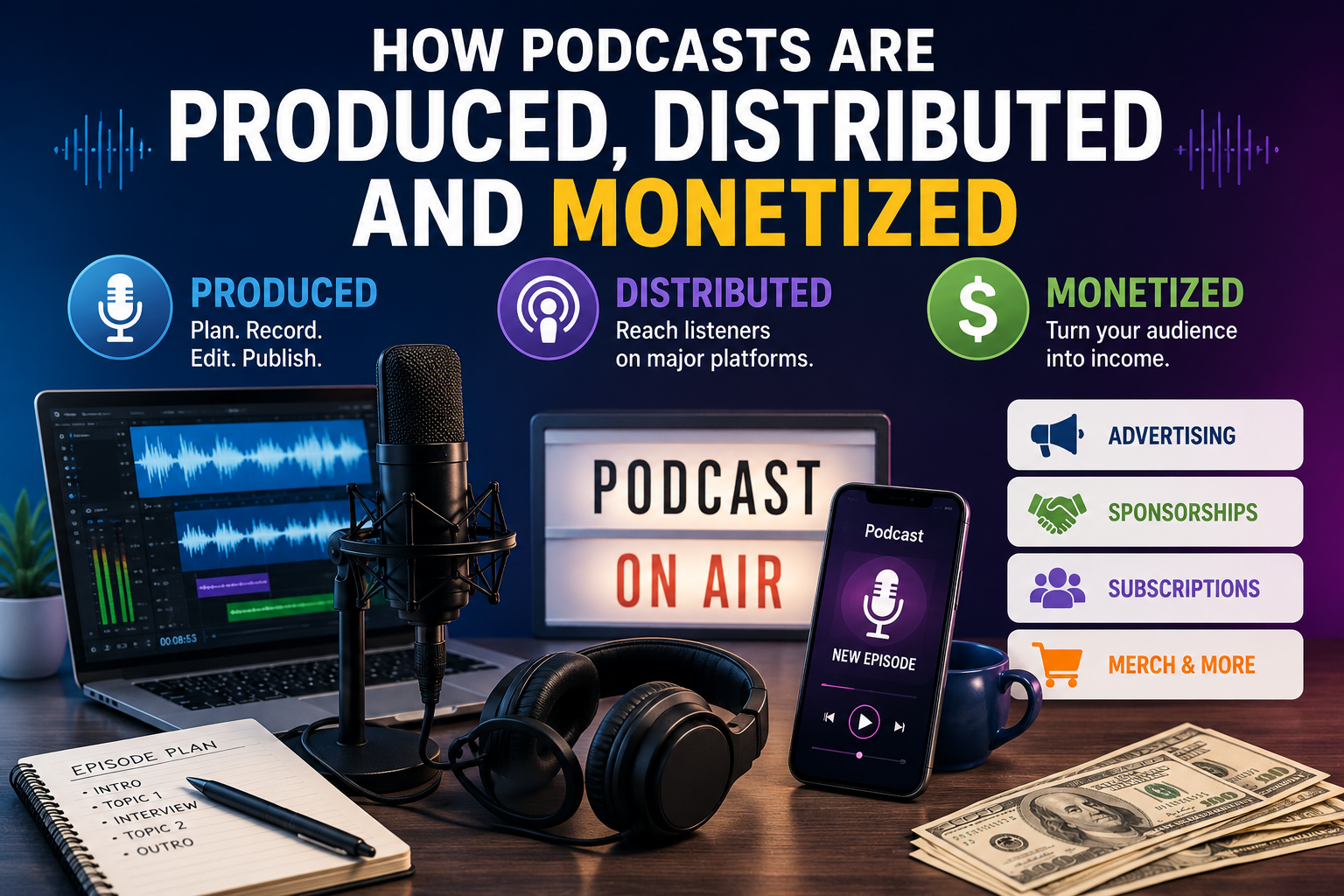
How Podcasts Are Produced, Distributed and Monetized
Podcasts have evolved from a niche form of online audio into a major part of the global entertainment industry.
What began largely as independent creators publishing downloadable audio programs has developed into a sophisticated media business. Today, podcasts range from informal conversations recorded at home to professionally produced shows involving hosts, producers, editors, researchers, sound engineers and marketing teams.
Behind every successful podcast is a production process that begins with an idea and continues through recording, editing, distribution, audience development and, eventually, monetization.
Understanding how that process works reveals why producing a podcast is both a creative exercise and a business operation.
It All Starts With a Strong Podcast Concept
Before microphones are switched on, a podcast needs a clear idea.
A successful concept usually answers several basic questions:
- What is the podcast about?
- Who is it for?
- Why would someone listen?
- What makes it different from other shows?
- How frequently will new episodes be released?
- Who will host or present it?
The concept can be broad, such as news, entertainment, technology or personal stories, or highly specialized around a particular interest.
A focused audience can actually be an advantage.
A podcast designed specifically for independent business owners, for example, has a clearer identity than one that attempts to cover every possible business topic.
The more clearly a show understands its audience, the easier it becomes to make decisions about its format, guests, tone and promotional strategy.
Choosing the Right Format
Podcasts can take many forms.
Some are built around conversations between two or more hosts. Others rely on interviews, storytelling, documentaries or solo commentary.
Common formats include:
- Interview podcasts, where hosts speak with guests.
- Conversational shows, built around discussions between regular hosts.
- Solo podcasts, where one presenter delivers commentary or analysis.
- Narrative podcasts, which use storytelling techniques to build a structured episode.
- Documentary podcasts, which combine interviews, narration, archival material and sound design.
- News podcasts, which summarize or analyze current events.
- Fiction podcasts, which use actors, scripts and sound effects to tell stories.
The format affects almost every part of production.
A simple interview show may require only a host, guest and recording setup. A narrative documentary can require extensive research, multiple interviews, location recordings, music, sound effects and significant editing.
Research Happens Before Recording
Good podcast episodes are rarely created entirely in front of a microphone.
Research can be one of the most important stages of production.
For an interview program, producers may research a guest’s background, previous work and areas of expertise before preparing questions.
For a documentary, research can involve reviewing reports, books, interviews, public records and other source material.
Even entertainment podcasts benefit from preparation.
Hosts may create an outline containing discussion topics, key questions and important points they do not want to overlook.
Preparation helps keep an episode focused while still leaving room for natural conversation.
Recording the Episode
Once the concept and preparation are complete, the actual recording begins.
At its simplest, podcast recording requires a microphone, headphones, a computer or recording device and audio-recording software.
However, professional production can involve considerably more equipment.
Microphone selection matters because different microphones capture voices differently. Room acoustics also have a major effect on sound quality. A high-quality microphone cannot completely compensate for a room filled with echoes, background noise or unwanted sounds.
For remote interviews, creators may use specialized online recording platforms designed to capture each participant’s audio separately.
This can produce better results than simply recording a video call, because separate high-quality audio tracks give editors more control during post-production.
Why Headphones Matter
Headphones allow hosts and producers to hear problems while recording.
Background noise, microphone distortion, electrical interference and other issues can sometimes be difficult to notice without monitoring the audio.
Catching a problem during recording is generally easier than trying to repair it later.
That is why professional recording environments typically use headphones and monitoring equipment.
Editing Turns Raw Audio Into a Program
Recording is only part of the production process.
Raw podcast audio often contains pauses, mistakes, repeated sentences, background noise and sections that do not contribute to the episode.
Editors shape that material into a coherent program.
Editing can include:
- Removing mistakes and unnecessary pauses
- Improving the flow of conversations
- Reducing background noise
- Balancing audio levels
- Adjusting volume differences between speakers
- Adding music
- Adding sound effects
- Creating transitions
- Removing unwanted sections
- Improving the overall pacing
For narrative programs, editing can be particularly complex.
A producer may record hours of interviews but use only a few minutes of material in the finished episode.
The goal is not simply to make the recording shorter.
It is to make the story clearer and more engaging.
Sound Design Adds Personality
Music and sound effects can give a podcast a recognizable identity.
A short opening sequence can establish the show’s tone. Background music can create atmosphere during storytelling. Carefully selected sound effects can make certain moments more immersive.
But sound design works best when it supports the content rather than distracting from it.
Too much music or excessive effects can make an episode feel cluttered.
Professional production therefore involves knowing when to add sound and when to let a voice stand on its own.
Mixing and Mastering Prepare the Episode for Listeners
After editing, the audio typically goes through mixing and mastering.
Mixing involves balancing different audio elements so that voices, music and effects work together.
For a multi-person podcast, the editor may need to ensure that every speaker is at a consistent volume.
Mastering is the final stage of audio preparation. It can help achieve appropriate loudness and consistency while reducing technical problems that might become noticeable during playback.
This matters because listeners consume podcasts through many different devices.
An episode may be played through headphones, a smartphone speaker, a car audio system or a home speaker.
Consistent audio helps create a better experience across those environments.
Creating the Episode File
Once production is complete, the finished audio is exported into an appropriate digital format.
The episode also needs supporting information.
This typically includes:
- Episode title
- Description
- Artwork
- Publication date
- Show notes
- Episode number, where applicable
- Links or references
- Credits
- Explicit-content information where relevant
The cover artwork is especially important for discovery because it often becomes the first visual representation of a podcast that potential listeners see.
How Podcasts Are Distributed
Podcast distribution works differently from traditional radio.
Creators generally upload their audio to a podcast hosting platform. The host stores the audio file and provides an RSS feed containing information about the show and its episodes.
Podcast directories and listening applications can use that feed to retrieve new episodes.
This means creators do not necessarily need to upload the same audio file manually to every listening service.
Instead, they publish an episode through their hosting system, which updates the feed and allows supported platforms to retrieve the new content.
What Is a Podcast RSS Feed?
An RSS feed is one of the fundamental technologies behind podcast distribution.
It contains structured information about a podcast, including its title, description, artwork and episodes.
When a new episode is published, the feed is updated.
Podcast applications can then detect the new episode and make it available to subscribers.
This system helped make podcasting relatively open compared with traditional broadcasting because individual creators can publish programs without owning a radio station or television network.
Podcast Platforms Help Listeners Discover Shows
Listeners can access podcasts through a wide range of services and applications.
Major podcast platforms provide search and discovery features that allow people to find shows by topic, host, category or keyword.
Creators therefore have two separate challenges:
Publishing the episode and getting people to discover it.
Distribution solves the first problem.
Marketing and audience development help solve the second.
Building an Audience Takes More Than Publishing Episodes
A podcast can be technically excellent and still struggle to attract listeners.
Audience development often requires consistent promotion.
Creators may use:
- Social media
- Short video clips
- Email newsletters
- YouTube
- Websites
- Guest appearances
- Cross-promotion
- Search optimization
- Online communities
- Partnerships with other creators
Short clips can be particularly useful because they give potential listeners a quick sample of the show’s personality.
A compelling 30-second segment can sometimes generate more interest than a generic advertisement saying that a new episode is available.
Consistency Builds Listener Habits
Podcast audiences often develop routines around their favorite shows.
Some listeners expect an episode every Monday morning. Others may prefer weekly, biweekly or seasonal releases.
There is no universal publishing schedule that guarantees success.
The more important factor is consistency.
A creator who promises a weekly show but regularly misses episodes may make it harder for listeners to develop a habit.
At the same time, publishing more frequently is not automatically better.
A well-produced weekly episode can be more valuable than several rushed episodes that provide little useful or entertaining content.
How Podcasts Make Money
Once a podcast develops an audience, creators have several potential ways to generate revenue.
The most common include:
- Advertising
- Sponsorships
- Listener subscriptions
- Premium content
- Membership programs
- Merchandise
- Affiliate marketing
- Events
- Donations
- Brand partnerships
- Selling products or services
Different models work better for different types of shows.
A business podcast, for example, might attract valuable sponsors even with a relatively small audience because its listeners represent a specific professional demographic.
An entertainment show may depend more heavily on large listener numbers, subscriptions or merchandise.
Podcast Advertising
Advertising is one of the most recognizable podcast monetization methods.
A company pays to have its product or service promoted during an episode.
Podcast advertising can take several forms.
A host might read an advertisement directly to listeners, while another show may use a professionally produced audio advertisement inserted into the episode.
Host-read advertising is particularly attractive to some brands because the host’s relationship with the audience can make the promotion feel more personal.
However, advertisers increasingly care about more than raw download numbers.
They may consider audience demographics, engagement, geographic distribution and whether listeners are likely to be interested in the product.
Sponsorships Can Become Long-Term Partnerships
A sponsorship arrangement can extend beyond a single advertisement.
A company may sponsor an entire podcast season or establish an ongoing relationship with the show.
This can provide creators with more predictable revenue while giving brands repeated exposure to the same audience.
Successful sponsorships generally work best when there is a logical connection between the sponsor and the podcast’s listeners.
An audience interested in personal finance may be relevant to financial services companies. A technology audience may be attractive to software and hardware brands.
The closer the relationship between the product and the audience, the more natural the sponsorship can feel.
Subscriptions and Premium Content
Some podcasts generate revenue directly from listeners.
Creators can offer paid subscriptions that provide benefits such as:
- Ad-free episodes
- Early access
- Bonus episodes
- Extended interviews
- Exclusive series
- Private communities
- Behind-the-scenes content
This model changes the relationship between creator and audience.
Instead of relying entirely on advertisers, the podcast can generate revenue from the people who value the content most.
The challenge is convincing enough listeners that the additional benefits are worth paying for.
Merchandise Can Extend the Brand
Popular podcasts sometimes become brands beyond their audio content.
Creators may sell clothing, mugs, books, posters or other products featuring the podcast’s name, artwork or recurring themes.
Merchandise is generally more effective when listeners have developed a strong emotional connection with the show.
A product with a memorable inside joke or recognizable phrase can become part of the community surrounding a podcast.
Podcasts Can Promote Other Businesses
Not every podcast needs to make money directly from its episodes.
For some creators, the podcast functions as a marketing channel for another business.
A consultant might use a podcast to demonstrate expertise and attract clients.
A fitness professional could use episodes to build an audience for training programs.
A company executive might use a podcast to strengthen relationships with customers and industry professionals.
In these cases, the value of the podcast comes from what it helps sell or achieve outside the show itself.
Analytics Help Creators Understand Their Audience
Podcast analytics can reveal important information about audience behavior.
Depending on the hosting platform and available measurement tools, creators may be able to see information such as downloads, listening trends, geographic distribution and episode performance.
These metrics can help answer questions such as:
- Which episodes attract the most listeners?
- Are audiences returning?
- Which topics perform particularly well?
- Where are listeners discovering the show?
- Is the audience growing?
- Which episodes generate the strongest engagement?
Analytics should not dictate every creative decision, but they can provide useful evidence.
A creator might discover that a particular recurring segment consistently attracts listeners, for example, or that certain episode topics generate unusually strong interest.
The Business Side Becomes More Complex as Podcasts Grow
A small podcast may be operated by one person.
As the audience grows, however, additional roles may become necessary.
A larger production can involve:
- Hosts
- Executive producers
- Producers
- Researchers
- Audio editors
- Sound designers
- Social media managers
- Marketing specialists
- Sales teams
- Booking coordinators
- Graphic designers
- Business managers
This creates a transition from a personal creative project to a media business.
The larger the production becomes, the more important workflows, deadlines, budgets and quality-control processes become.
Why Some Podcasts Become Sustainable Businesses
Successful podcasts rarely depend on a single factor.
Strong content helps attract listeners. Consistent publishing helps retain them. Distribution makes the show accessible. Marketing expands its reach. Community creates loyalty. Monetization converts that audience into revenue.
The relationship can be thought of as a cycle:
Good content attracts an audience → the audience creates value → revenue funds production → better resources improve the show → stronger content attracts more listeners.
The cycle does not always work perfectly, but it explains why audience trust is one of the most valuable assets a podcast can build.
Podcasting Is Both Media and Business
The rise of podcasting has lowered the barriers to entering the media industry.
A creator no longer needs a traditional broadcasting studio or large production company to reach an international audience. With the right equipment, a clear concept and access to distribution tools, an individual can produce and publish a show from almost anywhere.
But accessibility does not make success automatic.
The strongest podcasts combine creativity with discipline.
They understand their audience, prepare carefully, produce consistently, distribute effectively and build relationships with listeners. As those audiences grow, creators can explore advertising, sponsorships, subscriptions, products and other revenue streams.
Ultimately, podcasting works because it combines the intimacy of conversation with the reach of digital media.
A microphone may be enough to start a show, but building a lasting podcast requires much more: a compelling idea, a committed production process, a loyal audience and a business model capable of supporting the work over time.




2 Comments
Micle harison
June 7, 2019Lorem ipsum dolor sit amet, usu ut perfecto postulant deterruisset, libris causae volutpat at est, ius id modus laoreet urbanitas. Mel ei delenit dolores.
John Doe
June 7, 2019Some consultants are employed indirectly by the client via a consultancy staffing company.