
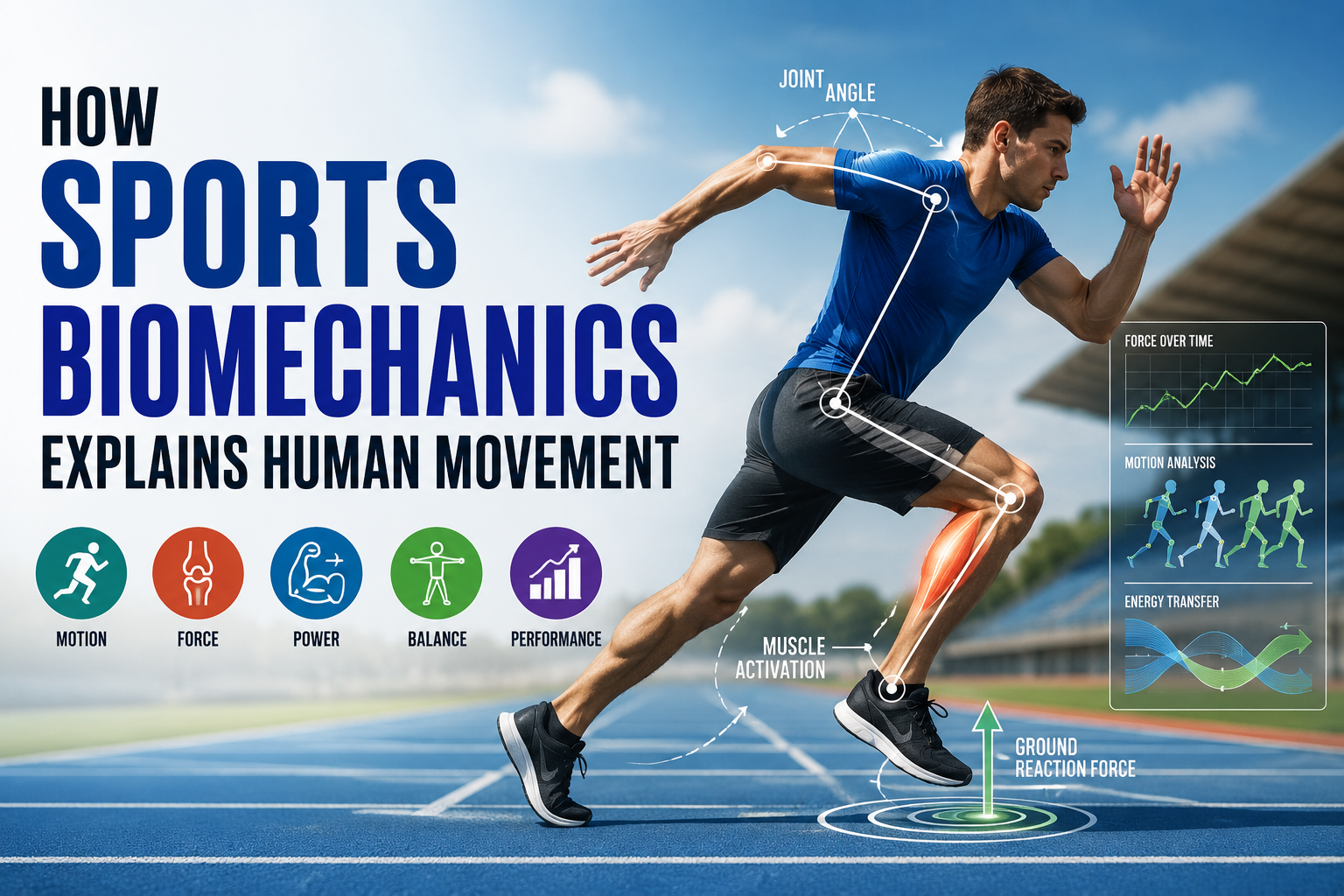
How Sports Biomechanics Explains Human Movement
Every sprint, jump, throw, swing and change of direction involves a complex interaction between muscles, bones, joints and forces.
To the casual observer, an elite athlete may appear to move effortlessly. A sprinter explodes from the starting blocks, a basketball player rises for a jump shot, or a tennis player generates enormous racket speed with a seemingly simple swing.
Behind those movements is a field of science called sports biomechanics.
Biomechanics examines how the human body moves and how forces affect that movement. In sports, it helps researchers, coaches and athletes understand why particular techniques work, how movement can become more efficient and how certain mechanical factors may contribute to injury.
It combines principles from anatomy, physics, physiology and engineering to turn athletic movement into something that can be measured and analyzed.
What Is Sports Biomechanics?
Biomechanics is the study of movement and the forces that produce or influence it.
In sports, researchers can examine almost any physical action. They might study how a runner places their foot on the ground, how a swimmer moves through water or how a baseball pitcher transfers energy through the body.
The analysis can involve questions such as:
- How quickly is a body segment moving?
- What forces are acting on the athlete?
- Where is the athlete’s center of mass?
- How much force does the athlete produce?
- How efficiently is energy transferred?
- What happens to the joints during a movement?
- How does technique affect performance?
- Which mechanical factors may increase physical stress?
The answers can help athletes refine their technique rather than simply relying on repetition.
The Role of Physics in Athletic Movement
Many of the principles used in biomechanics come directly from physics.
An athlete cannot move without interacting with forces.
When a runner pushes backward against the ground, the ground exerts an opposing force that helps propel the runner forward. When a jumper bends their legs before taking off, they are preparing the body and muscles to generate force against the ground.
This relationship between an athlete and the environment is fundamental to movement.
Several physical concepts are particularly important in sports biomechanics, including force, acceleration, momentum, impulse, torque and power.
Force: The Foundation of Movement
Force can be thought of as a push or pull.
Muscles generate forces that move bones around joints, while external forces come from sources such as gravity, the ground, water, equipment and contact with other athletes.
Consider a sprinter leaving the starting blocks.
The athlete pushes against the blocks, producing force that accelerates the body forward. Once the athlete is running, each foot strike involves another interaction with the ground.
The ability to produce and apply force in the right direction is therefore crucial.
But producing large amounts of force is not enough by itself.
An athlete must be able to apply force at the right time and in the right direction.
Acceleration Determines How Quickly Movement Changes
Acceleration describes how quickly velocity changes.
In sprinting, acceleration is particularly important during the first part of a race. A powerful athlete who can rapidly increase their velocity may gain an advantage before reaching maximum running speed.
Acceleration also matters in sports such as football, basketball and tennis, where athletes frequently start, stop and change direction.
A player may need to accelerate toward a ball, decelerate before changing direction and then accelerate again.
These actions require precise control of forces.
Momentum Helps Explain Powerful Movement
Momentum is related to an object’s mass and velocity.
A heavier or faster-moving object has more momentum, which means changing its motion requires more force or more time.
This helps explain why body mass and speed can influence collisions and athletic performance.
A rugby player running at high speed, for example, carries considerable momentum into a tackle.
The same principle applies to equipment.
A fast-moving tennis racket or baseball bat can transfer substantial momentum to a ball, contributing to its speed after impact.
Impulse Explains How Force Changes Motion
Impulse describes the effect of applying force over a period of time.
This is particularly useful for understanding jumping, landing and collisions.
Suppose an athlete lands from a jump. Their body must reduce its downward momentum before coming to rest.
Bending the knees and hips can increase the time over which the body decelerates. This can alter how forces are distributed through the body.
The exact movement strategy depends on the sport and situation, but the underlying principle is that changing the duration and magnitude of forces can affect movement.
Torque and the Mechanics of Rotation
Many sports movements involve rotation.
A golfer rotates the torso during a swing. A figure skater spins around an axis. A swimmer rotates the shoulders. A baseball pitcher rotates the trunk and arm during a throw.
Biomechanics uses the concept of torque to understand rotational effects.
Torque describes the turning effect produced by a force around an axis.
The position and direction of a force relative to a joint or rotational axis matter.
This is why changing the angle of a limb can dramatically affect how much rotational effect a muscle or external force produces.
Why the Human Body Works Like a Linked System
The human body is not a collection of isolated moving parts.
Bones, joints and muscles form interconnected kinetic chains.
A movement that begins in one part of the body can influence another part further along the chain.
This concept is sometimes described as the kinetic chain.
Consider an overhead throw.
The movement may involve the legs, hips, trunk, shoulder, elbow and wrist in a coordinated sequence. Energy generated by the lower body can contribute to movement of the upper body.
If the sequence is poorly coordinated, the athlete may lose efficiency or place additional stress on certain body structures.
The Kinetic Chain in Sports
Efficient athletic movement often involves transferring energy through multiple body segments.
A golfer does not generate club-head speed using the arms alone. The movement involves the legs, hips, torso and shoulders before the arms and club accelerate toward the ball.
Similarly, a volleyball player jumping to spike a ball coordinates movement from the lower body through the trunk and upper limbs.
This sequential transfer of movement is one reason sports biomechanics looks at the entire body rather than focusing only on the part that appears to perform the final action.
The Center of Mass Affects Balance
The center of mass is the point at which an object’s mass can be considered concentrated for analyzing its overall movement.
In humans, the center of mass changes as the body moves.
Athletes constantly adjust their body position to control balance.
A gymnast performing on a narrow beam must keep their center of mass within a manageable position relative to their support base.
A basketball defender lowering their stance can improve stability while preparing to move laterally.
A skier shifts body position to maintain control while traveling over changing terrain.
Understanding the relationship between the center of mass and the body’s base of support is therefore essential to athletic balance.
Stability and Mobility Are Often in Tension
Sports frequently require athletes to balance stability with mobility.
A highly stable position can make it difficult to move quickly. A highly mobile position can reduce immediate stability.
Athletes constantly adjust between the two.
A tennis player preparing to return a serve needs enough stability to control the incoming force but also enough freedom of movement to react quickly.
A weightlifter needs a stable base during a heavy lift, while a soccer player may prioritize mobility when chasing an opponent.
The ideal balance depends on the movement and sporting situation.
Ground Reaction Force Is Critical
Whenever an athlete interacts with the ground, the ground exerts a force back on the athlete.
This is known as ground reaction force.
It is one of the most important measurements in sports biomechanics.
Force plates can measure how much force an athlete applies to the ground and how that force changes over time.
Researchers can use this information to study running, jumping, landing, lifting and changes of direction.
Ground reaction forces can reveal differences between techniques that may look almost identical to the naked eye.
How Biomechanics Measures Movement
Modern sports biomechanics relies heavily on technology.
High-speed cameras can record movements that happen too quickly for normal observation.
Motion-capture systems can track markers placed on an athlete’s body and reconstruct movement in three dimensions.
Force plates measure forces beneath an athlete’s feet.
Inertial sensors can record acceleration, rotation and orientation during movement.
Other systems can measure muscle activity, joint angles, pressure distribution and equipment motion.
Together, these technologies allow researchers to turn athletic movement into measurable data.
Motion Capture Makes Invisible Details Visible
A movement that takes less than a second can contain hundreds of important details.
A high-speed camera can break that movement into individual frames, allowing researchers to examine body position throughout the action.
For example, a sprint analysis might examine:
- Foot placement.
- Knee position.
- Hip movement.
- Trunk angle.
- Arm motion.
- Ground contact time.
- Stride length.
- Stride frequency.
Coaches can then identify technical characteristics that might be difficult to recognize during normal training.
Measuring Joint Angles
Joint angles provide another useful way to describe movement.
During a squat, researchers can measure the angles of the knees, hips and ankles at different stages.
During a throwing motion, they can analyze the movement of the shoulder and elbow.
These measurements help researchers compare techniques between athletes or evaluate how an athlete’s movement changes over time.
Importantly, there is rarely one universally perfect joint angle for every athlete.
Body proportions, strength, flexibility, sport-specific requirements and individual technique all matter.
Biomechanics and Running
Running is one of the most extensively studied forms of human movement.
Every stride involves a repeated sequence of contact with and movement away from the ground.
Researchers can examine variables such as:
- Ground contact time
- Stride length
- Stride frequency
- Vertical movement
- Joint angles
- Ground reaction forces
- Running speed
- Leg stiffness
- Energy expenditure
The goal is not necessarily to make every runner use the same technique.
Instead, biomechanics can help identify movement patterns that are efficient and appropriate for a particular athlete.
Why Elite Athletes Still Have Different Techniques
Watching professional athletes can reveal an important lesson: excellence does not always look identical.
Two successful sprinters may have different stride characteristics. Two elite swimmers may use slightly different stroke mechanics. Two basketball players may have different shooting motions.
Biomechanics therefore does not necessarily seek to create one universal technique.
Instead, it helps identify the underlying principles that allow different athletes to perform effectively.
Individual anatomy and physical characteristics matter.
A technique that works exceptionally well for one athlete may not be equally effective for another.
Biomechanics and Jumping
Jumping provides a straightforward example of how force and movement interact.
Before takeoff, athletes typically lower their bodies and rapidly extend the hips, knees and ankles.
The objective is to generate sufficient upward impulse to overcome gravity and propel the body into the air.
Researchers can use force plates and motion-capture systems to analyze how force is produced throughout the movement.
They can examine how quickly the athlete produces force, how much force is generated and how different body segments contribute to the jump.
This information can be useful in sports ranging from basketball and volleyball to track and field.
Biomechanics and Throwing
Throwing involves a complex sequence of rotational and linear movements.
A powerful throw can begin with the lower body and progress through the hips, trunk, shoulder, elbow and wrist.
Timing is crucial.
If one segment accelerates too early or too late, the transfer of energy may become less efficient.
Biomechanical analysis can therefore help researchers understand how athletes generate speed while controlling the forces placed on their joints.
This is especially relevant in sports involving repeated overhead movements.
Biomechanics Can Help With Equipment Design
Biomechanics does not focus exclusively on athletes.
It can also influence the design of sporting equipment.
Manufacturers can study how shoes interact with the ground, how bicycle components affect pedaling mechanics or how racket characteristics influence ball movement.
Running shoes, for example, can be tested for properties such as cushioning, stiffness and energy return.
Equipment can then be designed to interact with the athlete’s movement in particular ways.
However, equipment that performs well in a laboratory is not automatically better for every athlete. Comfort, fit, individual movement patterns and sport-specific requirements remain important.
The Connection Between Biomechanics and Injury
One of the most valuable applications of biomechanics is understanding mechanical factors associated with injury.
Sports injuries are complex and rarely have a single cause.
Training load, previous injuries, fatigue, anatomy, technique, recovery and environmental conditions can all contribute.
Biomechanics can nevertheless help identify movements that place unusual or excessive loads on particular tissues.
For example, researchers can examine how forces are distributed across joints during landing or cutting movements.
The information can contribute to training strategies designed to improve movement control and physical resilience.
Fatigue Can Change Movement
An athlete’s technique is not necessarily identical at the beginning and end of a competition.
Fatigue can change muscle function, coordination, reaction time and movement patterns.
A runner may alter their stride as fatigue develops. A basketball player may land differently late in a game. A swimmer may change stroke mechanics during a long race.
Biomechanical monitoring can help researchers understand these changes.
This is important because a technique that looks efficient when an athlete is fresh may become less controlled under fatigue.
Technology Is Making Biomechanics More Accessible
Biomechanical analysis was once largely confined to specialized laboratories.
Today, cameras, wearable sensors and computer-based analysis are making movement assessment more accessible.
Some systems can analyze an athlete using video captured by relatively ordinary cameras.
Wearable devices can record acceleration, rotation and other movement characteristics during training.
Artificial intelligence and machine-learning techniques are also increasingly being explored for movement analysis.
These technologies could allow athletes and coaches to collect useful information without requiring every training session to take place in a laboratory.
Data Still Needs Human Interpretation
More data does not automatically produce better coaching.
A sensor can report thousands of measurements, but athletes and coaches still need to understand what those measurements mean.
A change in one variable may be beneficial in one context and problematic in another.
For example, increasing stride length is not automatically a way to make every runner faster. Altering movement without understanding the athlete’s mechanics could produce unintended consequences.
The value of biomechanics comes from combining measurements with knowledge of anatomy, physiology, training and the specific demands of the sport.
Biomechanics Is About More Than Perfect Technique
The ultimate purpose of sports biomechanics is not to make human movement look identical.
Human bodies differ, sports differ and competitive situations change.
Instead, biomechanics provides a framework for understanding movement scientifically.
It explains how forces create motion, how body segments work together, why balance matters and how technique influences the transfer of energy.
For athletes, that understanding can support more informed training and technical development.
For coaches, it provides another way to evaluate performance.
For researchers, it offers a way to study one of the most complicated systems in nature: the moving human body.
Turning Movement Into Measurable Science
Every athletic performance is a physical event governed by forces and motion, even when those principles are invisible to the athlete.
A sprinter’s acceleration, a gymnast’s balance, a swimmer’s stroke and a footballer’s change of direction can all be analyzed through the same fundamental concepts.
Sports biomechanics makes those hidden mechanics measurable.
By combining physics with human anatomy, technology and sports science, it helps explain not only how athletes move, but why certain movements are efficient, powerful or difficult to control.
As measurement technology continues to improve, the field is likely to reveal even more about the mechanics of human performance—giving athletes better information about how to move, train and compete while respecting the remarkable individuality of the human body.





2 Comments
Micle harison
June 7, 2019Lorem ipsum dolor sit amet, usu ut perfecto postulant deterruisset, libris causae volutpat at est, ius id modus laoreet urbanitas. Mel ei delenit dolores.
John Doe
June 7, 2019Some consultants are employed indirectly by the client via a consultancy staffing company.