
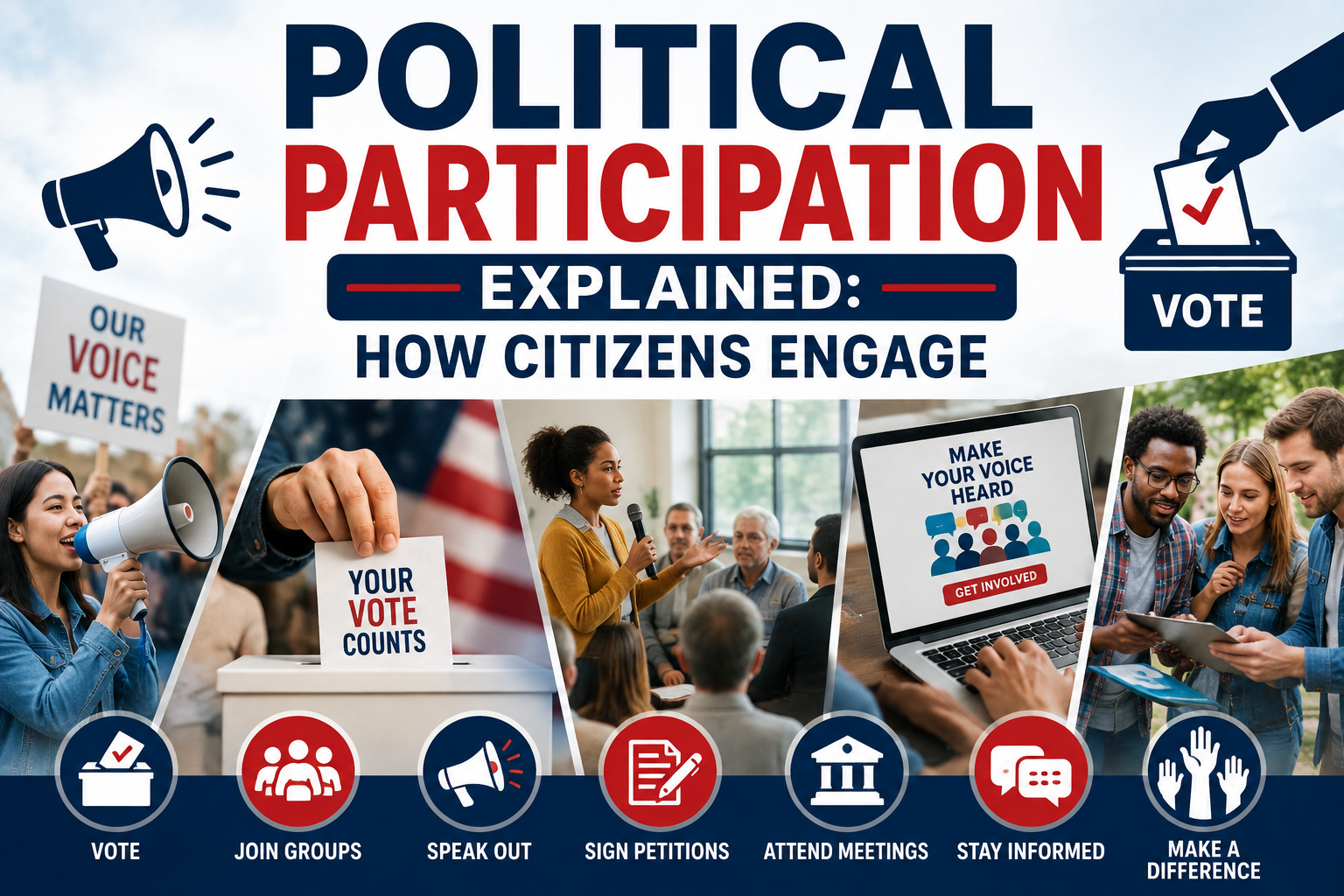
Political Participation Explained: How Citizens Engage
Political participation is often associated with voting, but citizens can influence political life in many other ways. People participate when they vote in elections, contact elected representatives, join political organizations, attend public meetings, campaign for causes, sign petitions, participate in peaceful demonstrations or contribute to discussions about public policy.
These activities help connect citizens with the institutions that make and implement political decisions. They can also provide governments with information about public priorities, concerns and expectations.
Understanding political participation is therefore essential to understanding how democratic systems function and how individuals can influence decisions that affect their communities.
What Is Political Participation?
Political participation refers to the ways individuals and groups attempt to influence government, public policy or political decision-making.
Some forms are formal and directly connected to government institutions. Others take place outside official political structures.
Common examples include:
- Voting in elections
- Registering to vote
- Joining a political party
- Contacting elected officials
- Campaigning for candidates
- Participating in public consultations
- Signing petitions
- Joining civic organizations
- Supporting advocacy campaigns
- Attending political meetings
- Peacefully demonstrating
- Discussing political issues
- Participating in community organizations
Political participation can therefore occur at the local, regional and national levels.
Why Does Political Participation Matter?
Participation gives citizens opportunities to communicate their preferences and influence public decisions.
In representative democracies, elected officials make many decisions on behalf of the public. Elections provide one important mechanism for citizens to select those representatives and hold them accountable.
Participation between elections also matters.
Citizens can raise concerns about proposed policies, provide feedback on government services and organize around issues they believe require attention.
When people participate constructively, political institutions can gain a better understanding of the needs and priorities of the communities they serve.
Voting Is One Form of Participation
Voting is one of the most recognizable forms of political participation.
During an election, eligible voters choose among candidates, parties or proposals depending on the electoral system.
Voting allows citizens to influence who holds political office and, in some systems, directly decide particular policy questions through referendums or similar mechanisms.
However, voting is only one part of political participation.
A person can vote regularly while remaining uninvolved in political activities between elections. Another person may rarely participate in elections but actively work with a community organization, campaign for a policy change or communicate with elected officials.
Both forms of engagement can have political significance.
Political Parties Create Organized Participation
Political parties provide another way for citizens to participate.
Parties generally organize around shared political ideas, policy priorities or approaches to government.
Citizens may participate by:
- Becoming party members
- Attending meetings
- Volunteering during campaigns
- Helping develop policy proposals
- Supporting candidates
- Organizing local activities
- Communicating with other members
Political parties can also connect citizens with candidates and government institutions.
For some people, party involvement provides a structured way to participate beyond simply voting.
Campaigning Allows Citizens to Support Candidates
Election campaigns create additional opportunities for political engagement.
Volunteers may help candidates communicate with voters, distribute information, organize events or encourage people to participate in elections.
Campaigning can also involve activities such as fundraising, voter education and community outreach, subject to applicable laws and regulations.
Digital platforms have expanded the ways campaigns communicate with the public, but traditional activities such as community meetings and direct conversations remain important.
Contacting Elected Representatives
Citizens do not have to wait for an election to communicate with government officials.
People may contact representatives to:
- Express support for a policy
- Raise concerns about proposed legislation
- Request assistance with a public issue
- Share experiences with government services
- Ask questions about political decisions
- Advocate for changes in policy
When many constituents communicate about the same issue, representatives may receive a clearer indication that a concern has broad community relevance.
Effective communication is generally specific, respectful and focused on the issue being raised.
Public Meetings Encourage Civic Engagement
Public meetings provide opportunities for citizens to engage directly with officials and other community members.
Depending on the political system, these may include:
- Town halls
- Local council meetings
- Public hearings
- Community consultations
- Parliamentary committee sessions
- Neighborhood meetings
Such settings can allow citizens to ask questions, present concerns and hear explanations from decision-makers.
Public meetings can also make government processes more visible to the communities affected by them.
Petitions Provide Collective Advocacy
Petitions allow people to express support for a particular request or policy change.
A petition can demonstrate that multiple individuals care about an issue.
Petitions may be organized by community groups, advocacy organizations or individuals. Some governments have formal systems through which petitions can be submitted to public institutions.
Their effectiveness depends on the political context, the issue involved and how decision-makers respond.
A petition does not automatically change policy, but it can contribute to public discussion and demonstrate organized support for a cause.
Peaceful Demonstrations Are Another Form of Participation
Peaceful demonstrations provide a public way for people to express political views or draw attention to particular issues.
Marches, rallies and public gatherings have historically been used by citizens and organizations to advocate for policy changes, raise awareness and demonstrate the level of public concern surrounding an issue.
The right to peaceful assembly and expression is recognized in many democratic legal systems, although specific rules governing demonstrations vary between countries.
Responsible civic participation also requires respect for the rights and safety of others.
Civic Organizations Expand Political Engagement
People can participate politically without joining a political party.
Civic organizations, professional associations, community groups, charities and advocacy organizations may all engage with public policy.
Such organizations can:
- Research public issues
- Educate communities
- Represent particular interests
- Provide information to policymakers
- Organize campaigns
- Monitor government activity
- Encourage public participation
These groups can help individuals combine their voices around issues that affect them.
Political Discussion Can Influence Public Opinion
Political participation also happens through communication.
Conversations with family members, friends, colleagues and community members can influence how people understand political issues.
Public discussion can occur through:
- Community forums
- Newspapers
- Radio
- Television
- Online publications
- Social media
- Podcasts
- Educational institutions
- Public debates
Political discussion can help citizens exchange information and consider different perspectives.
However, responsible participation requires distinguishing between evidence-based information, personal opinion and unsupported claims.
Social Media Has Changed Political Participation
Digital technology has created additional channels for civic engagement.
Citizens can now communicate with public officials, share political information, organize events and promote campaigns without relying entirely on traditional organizations.
Social media can make political participation faster and more accessible.
At the same time, digital participation creates challenges.
False information can spread quickly. Political discussions can become highly polarized, and users may encounter content designed primarily to provoke emotional reactions.
Digital participation is therefore most useful when people evaluate information carefully and consider multiple credible sources.
Political Participation Begins Before Election Day
Political engagement can start long before an election.
Citizens may research candidates, examine policy proposals, attend debates, discuss issues and learn how the electoral system works.
Voter education is particularly important because elections can involve complicated questions about candidates, parties, electoral rules and public policy.
Being informed allows citizens to make decisions based on more than slogans or isolated political claims.
What Is Civic Engagement?
Political participation and civic engagement are closely related but not identical.
Political participation generally focuses on influencing government, politics or public policy.
Civic engagement is broader and can include activities that strengthen communities without directly targeting government decisions.
For example, volunteering at a community organization may be civic engagement. If that organization then campaigns for a change in local policy, the activity can also become a form of political participation.
The two concepts frequently overlap.
Why Some People Participate More Than Others
Political participation varies significantly between individuals and communities.
Several factors can influence whether someone becomes politically active, including:
- Political knowledge
- Education
- Time availability
- Income and resources
- Trust in institutions
- Social networks
- Community involvement
- Perceived effectiveness
- Access to political institutions
- Personal interest in public affairs
People are more likely to participate when they believe their actions can make a difference.
Barriers to participation can have the opposite effect.
Political Participation and Representation
Participation is closely connected to political representation.
Elected officials need information about the people they represent. Elections provide one source of that information, but communication and organized civic activity can provide additional insight between elections.
However, participation is not always evenly distributed.
People with greater financial resources, stronger networks or more available time may have more opportunities to engage.
This creates an important question for democratic systems: Who gets heard, and whose concerns receive political attention?
Encouraging broad participation can help reduce the gap between politically active groups and citizens who face greater barriers to engagement.
Peaceful Political Participation and Democratic Stability
Healthy political systems require citizens to be able to disagree.
Political participation does not mean everyone must support the same policies or political leaders.
In a functioning democratic environment, people can advocate for different positions while recognizing the right of others to do the same.
Peaceful participation, open debate and respect for political rights can help societies manage disagreements without relying on political violence.
This makes participation important not only for influencing policy but also for maintaining a culture in which political disagreement can be managed constructively.
How Citizens Can Participate More Effectively
Political participation does not necessarily require joining a major organization or becoming deeply involved in electoral politics.
Individuals can begin with relatively simple actions.
Learn How Government Works
Understanding which institution is responsible for a particular issue helps citizens direct their concerns to the appropriate decision-maker.
Research Before Taking a Position
Look beyond headlines and social media posts. Compare credible sources and distinguish evidence from opinion.
Communicate Clearly
When contacting representatives or organizations, explain the issue, why it matters and what action you would like to see.
Participate Locally
Local government often makes decisions that directly affect everyday life, including infrastructure, public services, planning and community development.
Join Organizations
Community groups and civic organizations can provide opportunities to work collectively on issues.
Vote When Eligible
Elections remain one of the most direct ways citizens can influence political representation.
Respect Political Differences
Effective participation does not require agreement with everyone. Listening to opposing arguments can improve understanding and produce more informed political decisions.
Common Barriers to Political Participation
Not everyone has the same ability or opportunity to participate.
Barriers can include:
- Lack of political information
- Limited access to voting
- Transportation difficulties
- Work schedules
- Disability-related barriers
- Financial constraints
- Language barriers
- Distrust of political institutions
- Fear of political consequences
- Feeling that participation will not matter
Removing unnecessary barriers can make political systems more inclusive.
Accessible voter information, transparent government processes and opportunities for public input can all help broaden participation.
Political Participation Is More Than Casting a Ballot
Political participation is a continuous process rather than an activity that happens only on election day.
Citizens can influence political life through voting, campaigning, public meetings, advocacy, political discussion, community organizations, petitions and direct communication with government officials.
Some forms of participation are highly visible, while others happen quietly within communities and organizations.
What connects them is the effort to contribute to public decision-making or influence the direction of society.
Citizens Shape Politics Through Everyday Engagement
A political system is not shaped solely by politicians, parties or government institutions. Citizens also play an important role in determining which issues receive attention, which leaders gain support and which policies become politically possible.
The most effective participation does not necessarily involve the loudest voice. It involves informed citizens understanding how decisions are made, identifying where they can have influence and engaging through lawful and constructive channels.
Whether through a ballot, a community meeting, a conversation, an advocacy campaign or a direct message to a representative, political participation gives citizens a practical way to turn individual concerns into a collective voice.


2 Comments
Micle harison
June 7, 2019Lorem ipsum dolor sit amet, usu ut perfecto postulant deterruisset, libris causae volutpat at est, ius id modus laoreet urbanitas. Mel ei delenit dolores.
John Doe
June 7, 2019Some consultants are employed indirectly by the client via a consultancy staffing company.