
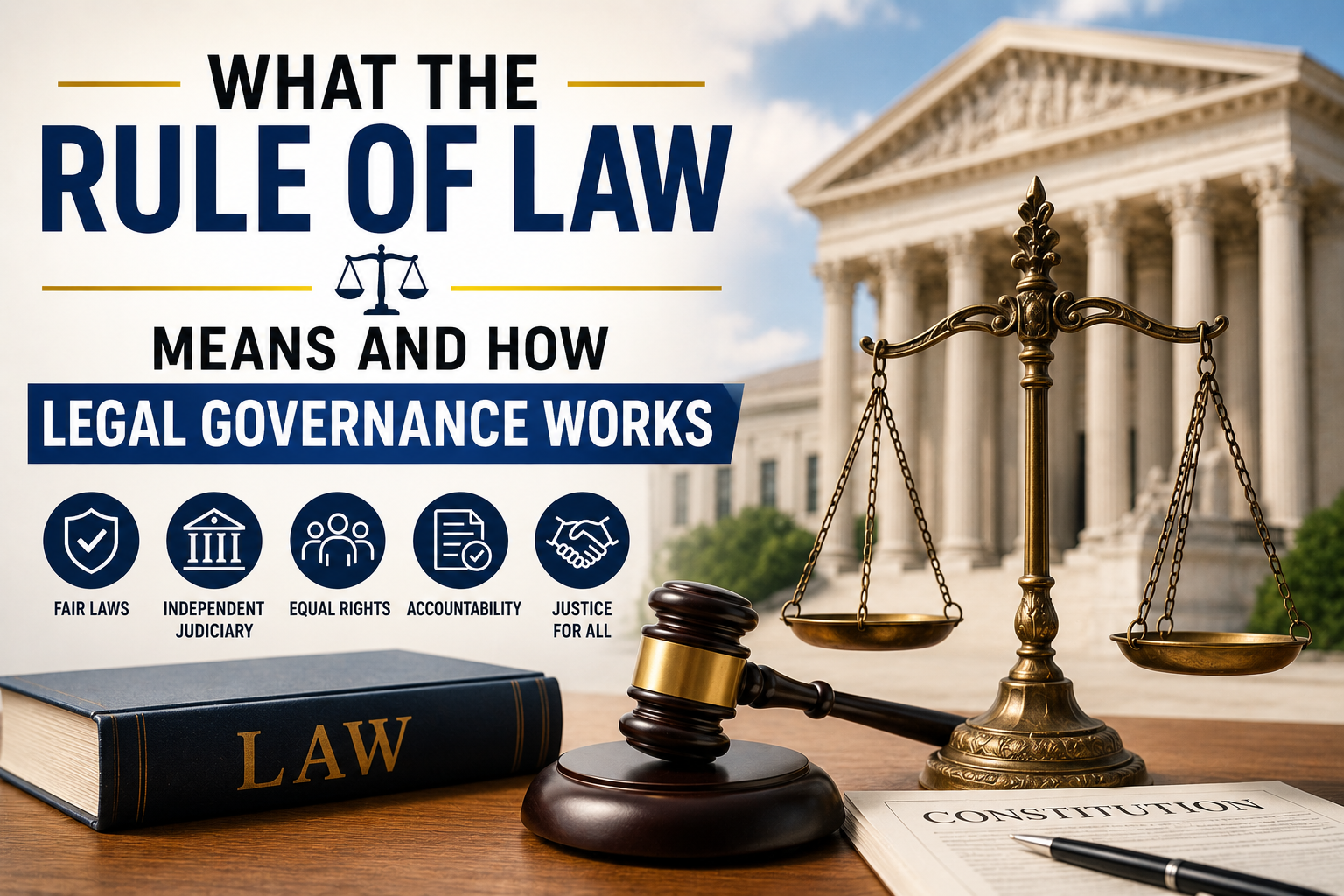
What the Rule of Law Means and How Legal Governance Works
The rule of law is one of the foundational ideas behind modern government. It establishes a basic principle: laws, rather than the personal preferences of individuals, should govern society.
In a functioning system of legal governance, government officials, institutions, businesses, and ordinary citizens are expected to operate within an established legal framework. Courts interpret and apply laws, legislatures create them, and government agencies implement them.
The rule of law is therefore about much more than having laws on the books. It is about how those laws are created, enforced, interpreted, and challenged.
When the principle is strong, people can understand their rights and responsibilities, challenge government decisions, enter contracts with greater confidence, and seek legal remedies when their rights are violated.
What Is the Rule of Law?
The rule of law is the principle that everyone is subject to the law and that government authority must be exercised according to established legal rules.
This includes political leaders and government officials.
A president, prime minister, minister, mayor, police officer, civil servant, or judge does not ordinarily have unlimited authority simply because they hold public office. Their powers are defined and restricted by law.
The rule of law generally involves several connected principles:
- Laws should be publicly known and reasonably understandable.
- Laws should apply consistently.
- Government officials should exercise power within legal limits.
- People should have access to independent courts.
- Legal procedures should be fair.
- Individuals should be able to challenge unlawful government action.
- Basic rights should receive legal protection.
- Courts should be able to make decisions without improper political interference.
Different countries organize their legal systems in different ways, but these principles form an important foundation for accountable government.
Why the Rule of Law Matters
Without predictable legal rules, political and economic life can become highly uncertain.
If government officials can punish people arbitrarily, seize property without legal justification, ignore court decisions, or change rules without following established procedures, citizens and businesses have difficulty planning for the future.
The rule of law creates a degree of predictability.
A person should generally be able to know what conduct is prohibited, what rights they have, what government agencies are allowed to do, and where they can seek help when something goes wrong.
That predictability supports social stability as well as economic activity.
Laws Apply to Government Too
A central feature of the rule of law is that government itself is subject to legal limits.
Governments have significant powers. They can collect taxes, regulate businesses, enforce criminal laws, control public spending, issue licenses, manage public property, and in some circumstances restrict individual conduct.
The rule of law requires these powers to have a legal foundation.
For example, a government agency generally cannot simply invent a new legal power because an official believes it would be useful. The authority must come from the constitution, legislation, regulations, or another recognized source of law.
This principle helps prevent public power from becoming arbitrary.
The Constitution Provides the Basic Framework
In many countries, the constitution is the highest source of domestic law.
A constitution can establish:
- The structure of government
- The powers of different institutions
- The relationship between national and local government
- Individual rights and freedoms
- The authority of courts
- Procedures for creating laws
- Limits on government power
- Procedures for changing constitutional rules
Constitutions vary considerably.
Some are relatively detailed, while others establish broad principles that are developed through legislation and judicial interpretation.
Regardless of their design, constitutional systems generally attempt to establish rules governing the exercise of public authority.
The Legislature Makes Laws
In a representative system, legislatures are usually responsible for creating and changing statutes.
Depending on the country, the legislature may be called a parliament, congress, national assembly, or another name.
The legislative process commonly involves several stages.
A proposal may be introduced as a bill, examined by committees, debated, amended, voted on, and eventually sent through additional constitutional procedures before becoming law.
The exact process varies from one legal system to another.
The important point is that laws are not supposed to appear simply because an individual government official wants them. They are produced through recognized legal and political procedures.
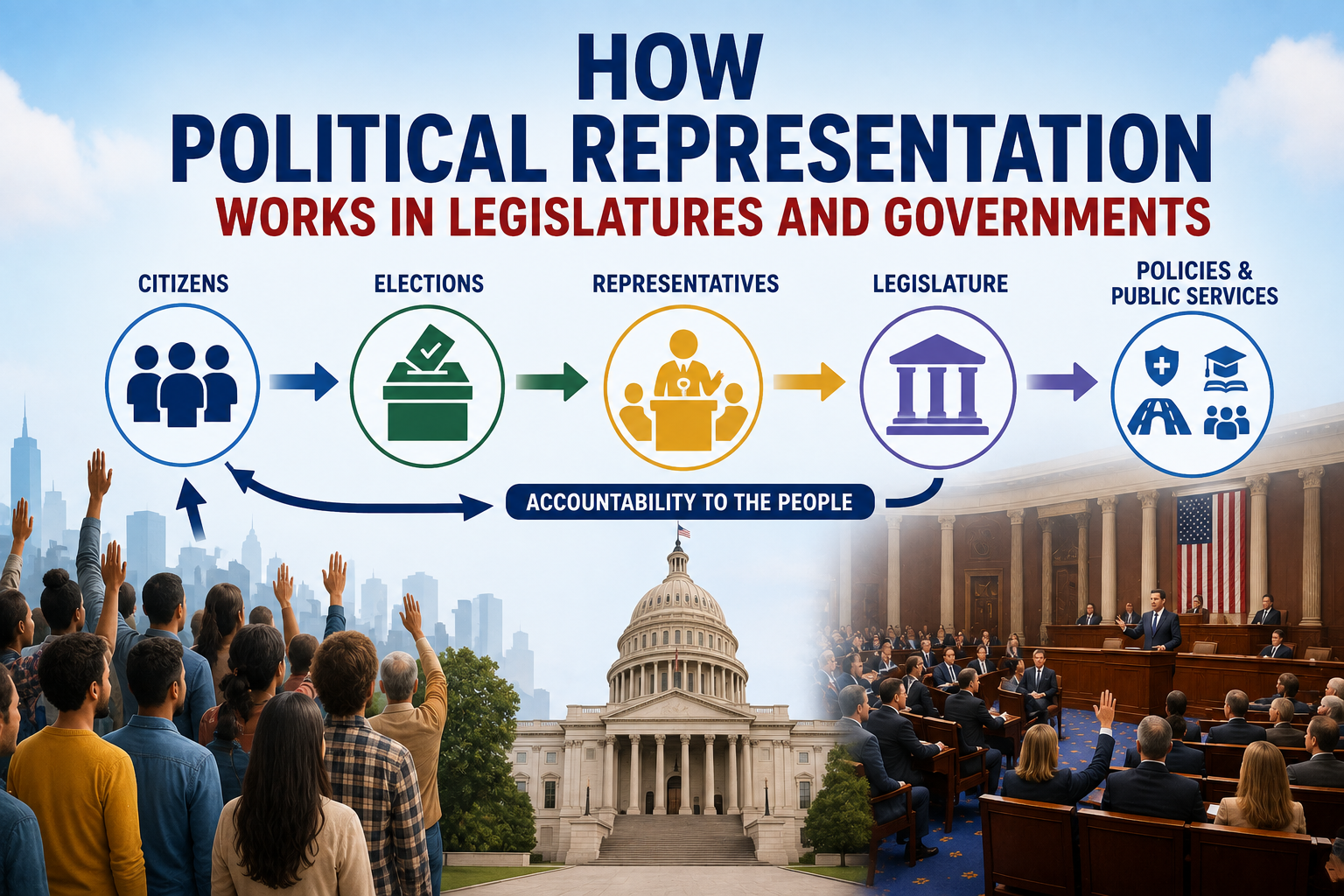
Elections Connect Citizens With Lawmaking
In democratic systems, elections provide one of the principal ways citizens influence the people responsible for making laws.
Voters choose representatives or, in some systems, directly participate in certain decisions.
Elections therefore provide a political mechanism through which citizens can influence public policy.
However, the rule of law goes beyond elections.
Winning an election does not normally give a government unlimited authority. Elected officials must still operate within constitutional and legal boundaries.
This distinction is important because democracy and the rule of law are closely related but are not identical concepts.
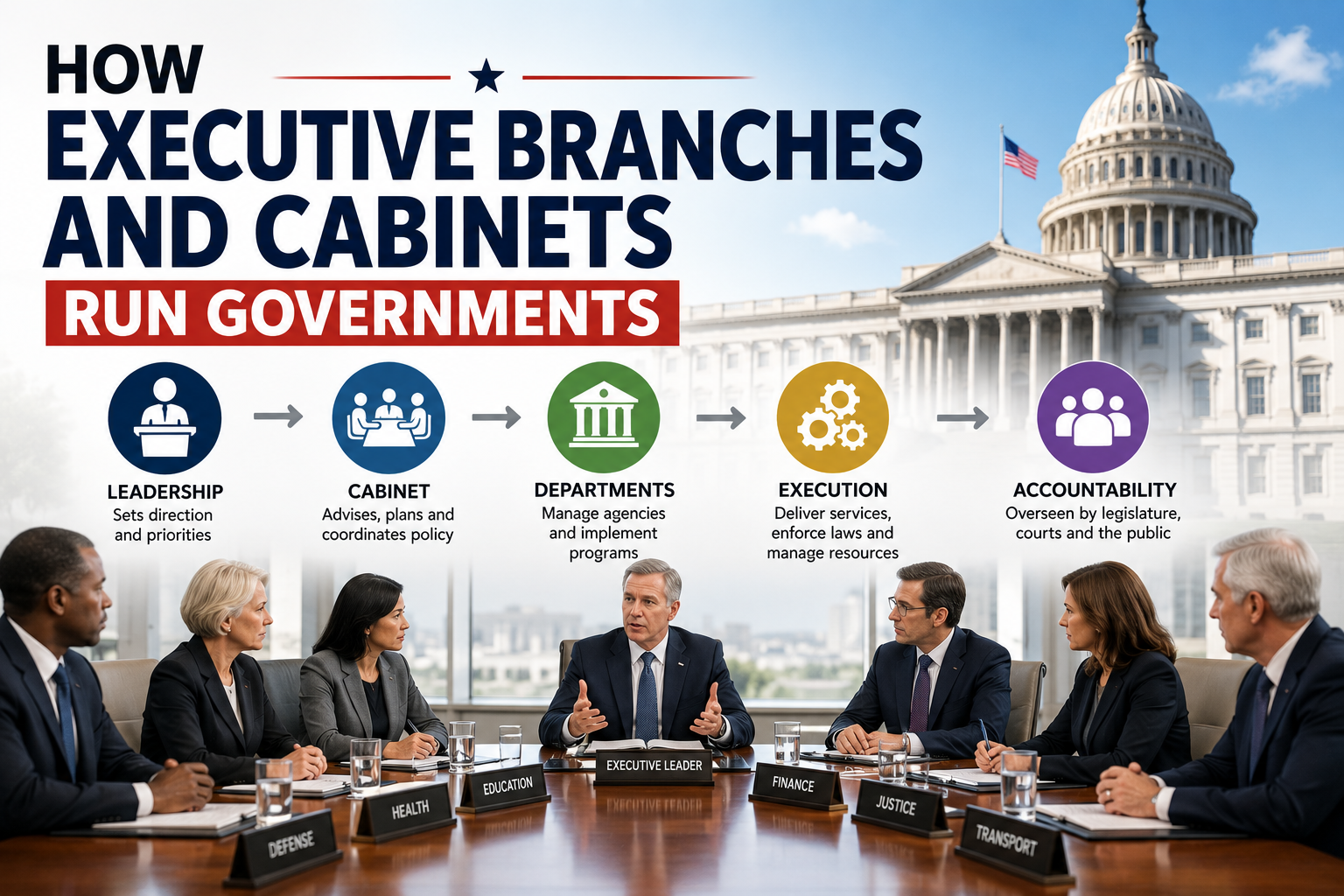
The Executive Implements Laws
The executive branch is generally responsible for implementing and administering laws.
Depending on the political system, the executive may include a president, prime minister, cabinet ministers, government departments, regulators, law-enforcement agencies, and other public institutions.
Executive agencies can perform many functions, including:
- Collecting taxes
- Managing public programs
- Enforcing regulations
- Administering public services
- Issuing licenses and permits
- Investigating violations
- Managing government employees
- Implementing legislation
But executive authority is also subject to legal limits.
An agency may have considerable discretion in carrying out its responsibilities, but that discretion generally must remain within the authority granted to it by law.
Courts Interpret and Apply the Law
Courts play a different role.
When disputes arise, courts interpret legal rules and apply them to particular circumstances.
A court may be asked to determine whether a person violated a law, whether a contract was breached, whether a government decision was lawful, or whether one party owes another compensation.
Judges examine relevant legal sources and evidence before reaching decisions.
In constitutional systems with judicial review, courts may also examine whether government actions or legislation comply with constitutional requirements.
Judicial Independence Is Essential
Courts cannot effectively protect the rule of law if judges are controlled by political authorities.
Judicial independence means judges should be able to decide cases according to law and evidence without improper pressure from politicians, government agencies, powerful individuals, or other outside interests.
This does not mean judges should have unlimited power.
Judicial independence operates within a broader legal framework that includes professional standards, appeal procedures, disciplinary systems, and constitutional rules.
The objective is to protect impartial decision-making while maintaining judicial accountability.
Separation of Powers Creates Checks
Many constitutional systems distribute government authority among different institutions.
This is commonly described as the separation of powers.
The legislature makes laws, the executive implements them, and the judiciary interprets and applies them. The exact arrangement varies between countries, particularly in parliamentary and presidential systems.
The purpose is to prevent too much authority from becoming concentrated in one institution.
Different branches can also provide checks on one another.
For example, a legislature may oversee executive agencies, courts may review government decisions, and executives may have certain constitutional powers relating to legislation.
The specific mechanisms depend on the country’s constitutional structure.
Checks and Balances Limit Government Power
Checks and balances are mechanisms designed to prevent government institutions from exercising unchecked authority.
They can include:
- Legislative oversight
- Judicial review
- Independent auditing
- Constitutional limitations
- Parliamentary investigations
- Public transparency requirements
- Election mechanisms
- Administrative review
- Ombudsman institutions
- Independent regulatory bodies
These mechanisms do not eliminate political disagreements.
Instead, they create formal processes through which disputes over government power can be examined and resolved.
Due Process Protects Legal Rights
Due process refers broadly to the requirement that legal procedures be fair and properly followed.
The exact meaning varies by legal system, but due-process protections can include notice of legal proceedings, an opportunity to respond, access to a court or hearing, impartial decision-making, and the right to challenge certain decisions.
In criminal cases, procedural protections can be particularly important because the consequences of government action may include imprisonment, fines, or other serious penalties.
Due process helps ensure that punishment does not depend simply on an official’s accusation.
Equality Before the Law
The rule of law also involves the principle that people should be treated according to the same legal standards.
This does not necessarily mean that every person receives identical treatment in every circumstance. Different legal categories and circumstances can justify different rules.
However, government officials should not arbitrarily exempt favored individuals from laws that apply to others.
Equality before the law is particularly important when dealing with powerful individuals, political opponents, wealthy organizations, or unpopular groups.
A legal system loses credibility when people believe that the law is strict for some and optional for others.
Legal Certainty Makes Rules More Predictable
People need to understand what the law requires.
If legal rules are impossibly vague, constantly changing, or hidden from the public, individuals cannot reliably determine how to comply.
Legal certainty therefore encourages governments to publish laws and regulations, establish recognizable procedures, and avoid arbitrary enforcement.
This principle is especially important for businesses.
Companies make long-term decisions based on expectations about taxes, regulations, property rights, contracts, employment rules, and other legal obligations.
Predictable laws can therefore support investment and economic planning.
The Role of Police and Law Enforcement
Law enforcement agencies are responsible for enforcing many laws.
Police officers may investigate crimes, respond to emergencies, protect public safety, arrest suspects where legally authorized, and gather evidence.
But law enforcement powers are not unlimited.
Police generally must operate within legal rules governing searches, arrests, detention, use of force, evidence collection, and other activities.
The precise standards differ across jurisdictions.
The broader rule-of-law principle is that enforcement authorities must also obey the law.
Prosecutors Have Legal Responsibilities
Prosecutors represent the public interest in criminal proceedings in systems where public prosecution is used.
Their responsibilities can include deciding whether sufficient evidence exists to bring charges, presenting cases in court, and complying with procedural and ethical requirements.
A prosecutor’s role is not simply to secure convictions at any cost.
The legitimacy of the criminal justice system depends on lawful procedures, reliable evidence, and fair treatment of defendants.
Access to Justice Matters
Having rights on paper is not enough if people cannot realistically enforce them.
Access to justice means people should have meaningful ways to resolve legal disputes and challenge unlawful treatment.
Barriers can include:
- Excessive legal costs
- Long delays
- Lack of legal assistance
- Geographic distance from courts
- Complex procedures
- Lack of information
- Fear of retaliation
- Language barriers
Legal systems therefore often develop mechanisms intended to make justice more accessible.
These can include legal aid, simplified procedures, alternative dispute resolution, public legal information, and specialized courts or tribunals.
Administrative Law Controls Government Agencies
A large portion of modern governance happens through administrative agencies rather than legislatures or courts.
Government agencies may issue regulations, grant permits, collect taxes, enforce standards, distribute benefits, and make thousands of individual decisions.
Administrative law establishes rules governing how these agencies exercise their authority.
It can address questions such as:
- Did the agency have legal authority?
- Did it follow the required procedure?
- Did it consider relevant evidence?
- Was the decision reasonable under the applicable legal standard?
- Can the affected person appeal?
- Can a court review the decision?
Administrative law is therefore an important part of everyday legal governance.
Regulations Turn Laws Into Practical Rules
Legislatures often establish broad legal requirements while government agencies develop more detailed regulations.
For example, legislation might establish a general environmental protection requirement, while an authorized agency develops technical standards explaining how businesses must comply.
Regulations can cover areas such as:
- Environmental protection
- Public health
- Workplace safety
- Financial services
- Transportation
- Telecommunications
- Consumer protection
- Food safety
Because regulations can significantly affect individuals and businesses, legal systems commonly establish procedures for creating, reviewing, and challenging them.
Contracts Depend on Legal Enforcement
The rule of law is also essential to private relationships.
Contracts allow people and organizations to make agreements with some expectation that those agreements will be legally enforceable.
A business may agree to deliver goods in exchange for payment. A landlord may agree to provide housing in exchange for rent. An employer and employee may enter an employment agreement.
If one party fails to meet its obligations, the legal system can provide mechanisms for resolving the dispute.
Contract law therefore allows strangers and organizations to cooperate with greater confidence.
Property Rights Support Economic Activity
Property rights establish legal relationships between people and assets.
They can govern ownership, transfer, inheritance, leasing, and use of property.
Secure property rights can encourage individuals and businesses to invest because they have greater confidence that legally recognized interests will be protected.
At the same time, property rights are not always absolute. Governments can impose regulations relating to land use, taxation, environmental protection, public safety, and other legitimate objectives.
The rule of law requires those restrictions to have a lawful basis and follow applicable procedures.
Transparency Strengthens Legal Governance
People cannot effectively hold government accountable if they cannot see what government is doing.
Transparency can involve publishing laws, budgets, government decisions, procurement information, regulatory proposals, and other public records.
Freedom-of-information laws in many jurisdictions provide mechanisms through which members of the public can request government information, subject to legally recognized exceptions.
Transparency can discourage misconduct and help journalists, civil-society organizations, researchers, and citizens scrutinize public institutions.
Accountability Gives the Rule of Law Practical Meaning
Accountability means officials and institutions can be required to explain or justify their actions and face consequences when they violate legal or professional standards.
Different systems use different accountability mechanisms.
Officials may be subject to:
- Courts
- Legislative oversight
- Auditors
- Ethics bodies
- Ombudsman investigations
- Administrative reviews
- Disciplinary procedures
- Elections
Accountability is particularly important because laws are only effective when violations have meaningful consequences.
What Happens When the Rule of Law Weakens?
The consequences of weakened legal governance can be significant.
If officials routinely ignore legal limits, courts cannot operate independently, corruption becomes widespread, or laws are selectively enforced, public confidence can decline.
People may become less willing to cooperate with institutions they consider unfair.
Businesses may become more cautious about investing. Citizens may have less confidence that disputes will be resolved impartially. Political competition can become increasingly confrontational when participants believe that legal protections cannot be trusted.
Over time, these problems can weaken both institutions and social stability.
Rule of Law Is Different From Rule by Law
These concepts can sound similar but have an important distinction.
Rule by law can describe a system in which authorities use laws as instruments of government.
Rule of law, by contrast, emphasizes that government itself is constrained by legal principles.
A government can have thousands of laws and still fall short of strong rule-of-law standards if those laws are arbitrarily enforced, courts lack independence, or officials are effectively above the law.
The question is therefore not simply whether a country has laws.
It is whether those laws meaningfully constrain the exercise of power.
Can the Rule of Law Exist Without Democracy?
Democracy and the rule of law often reinforce one another, but they are conceptually distinct.
Democracy concerns how political authority is obtained and exercised, particularly through popular participation and elections.
The rule of law concerns the legal limits and procedures governing that authority.
A democratic government can violate rule-of-law principles if it disregards constitutional limits or uses state power arbitrarily.
Conversely, some legal institutions may exist in systems with limited democratic participation.
A strong system of governance generally requires attention to both legitimate political participation and meaningful legal constraints.
Why Independent Institutions Matter
The rule of law depends on institutions that can perform their responsibilities effectively.
Courts need sufficient independence and resources. Legislatures need the capacity to scrutinize government. Auditors need to examine public finances. Law-enforcement agencies need professional standards. Regulatory bodies need legal authority and appropriate oversight.
Institutions also need public legitimacy.
Even technically well-designed laws may have limited impact if people do not trust the institutions responsible for enforcing them.
Trust develops partly through consistent performance, transparency, fairness, and accountability.
Citizens Also Have Responsibilities
The rule of law is not solely a responsibility of government.
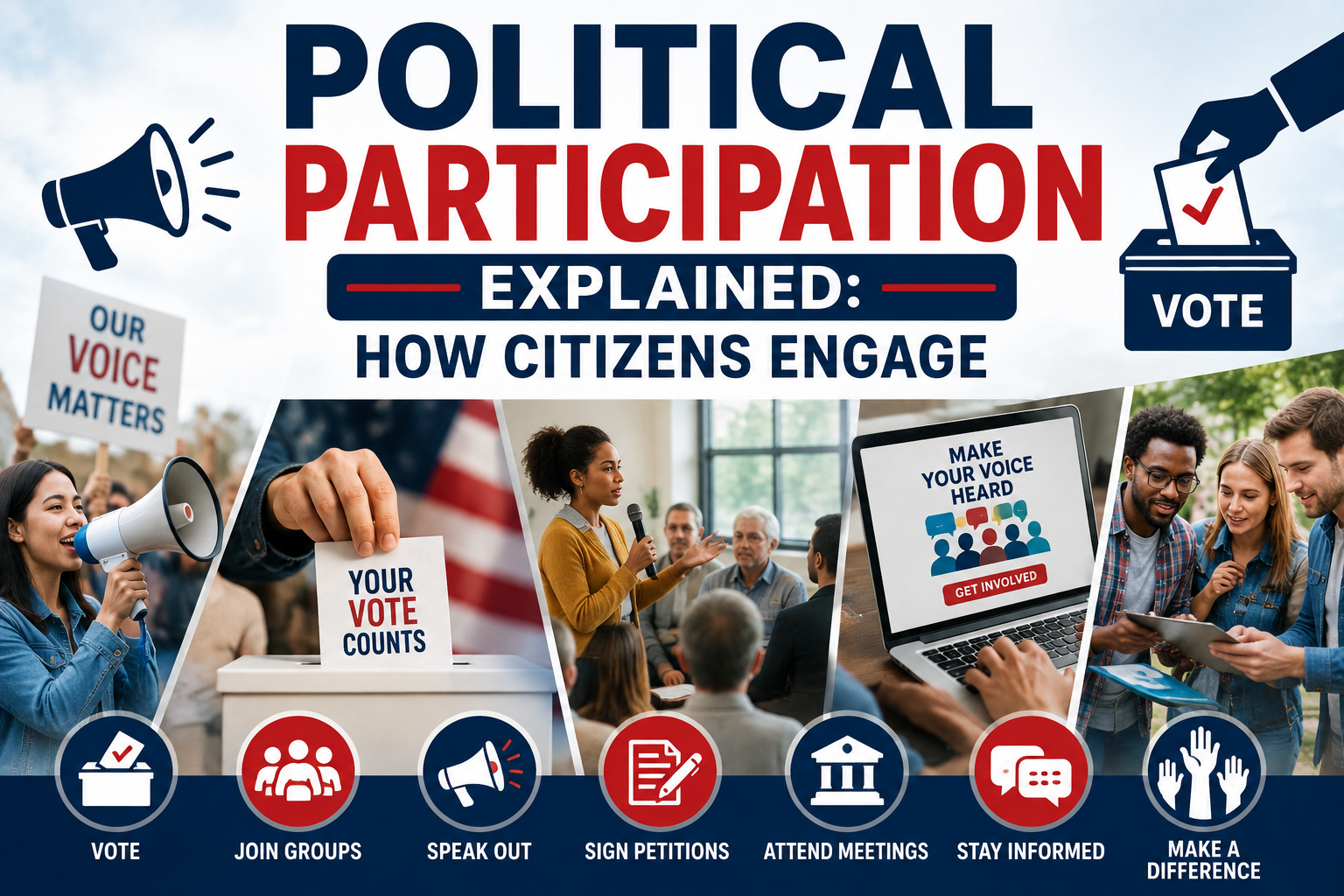
Citizens contribute to legal governance by respecting lawful decisions, participating in civic institutions, reporting misconduct, serving on juries where applicable, paying legally required taxes, and using lawful channels to challenge decisions they believe are wrong.
People also have a role in understanding their rights and responsibilities.
A society in which citizens know how legal institutions work is better positioned to identify abuses and demand accountability.
How Legal Governance Works as a System
The different parts of legal governance are interconnected.
A simplified model looks like this:
- Constitutions establish fundamental rules and government structures.
- Legislatures create laws within those constitutional boundaries.
- Executives and agencies implement and administer those laws.
- Law-enforcement institutions enforce applicable legal rules.
- Courts resolve disputes and interpret the law.
- Review and oversight mechanisms hold institutions accountable.
- Citizens participate through elections, legal proceedings, public debate, and other civic processes.
No single institution creates the entire system.
Legal governance works through relationships between institutions.
Keeping Public Power Within Legal Boundaries
The rule of law is ultimately about limiting arbitrary power.
Governments need enough authority to maintain public services, protect communities, enforce laws, regulate economic activity, and respond to national challenges. But that authority needs boundaries.
Those boundaries come from constitutions, legislation, courts, administrative procedures, institutional checks, elections, transparency, and public accountability.
A healthy legal system does not promise that every dispute will disappear or that government decisions will always be popular. Instead, it provides recognized rules for handling disagreement.
That is the practical value of the rule of law: power is exercised through established legal institutions rather than personal will, and people have lawful ways to challenge decisions when those boundaries are crossed.
When courts can operate independently, laws are applied consistently, officials remain accountable, and citizens can meaningfully enforce their rights, legal governance becomes more than a collection of statutes. It becomes a framework that allows a society to manage disagreement, protect rights, organize public authority, and maintain confidence in the institutions responsible for governing it.


2 Comments
Micle harison
June 7, 2019Lorem ipsum dolor sit amet, usu ut perfecto postulant deterruisset, libris causae volutpat at est, ius id modus laoreet urbanitas. Mel ei delenit dolores.
John Doe
June 7, 2019Some consultants are employed indirectly by the client via a consultancy staffing company.