
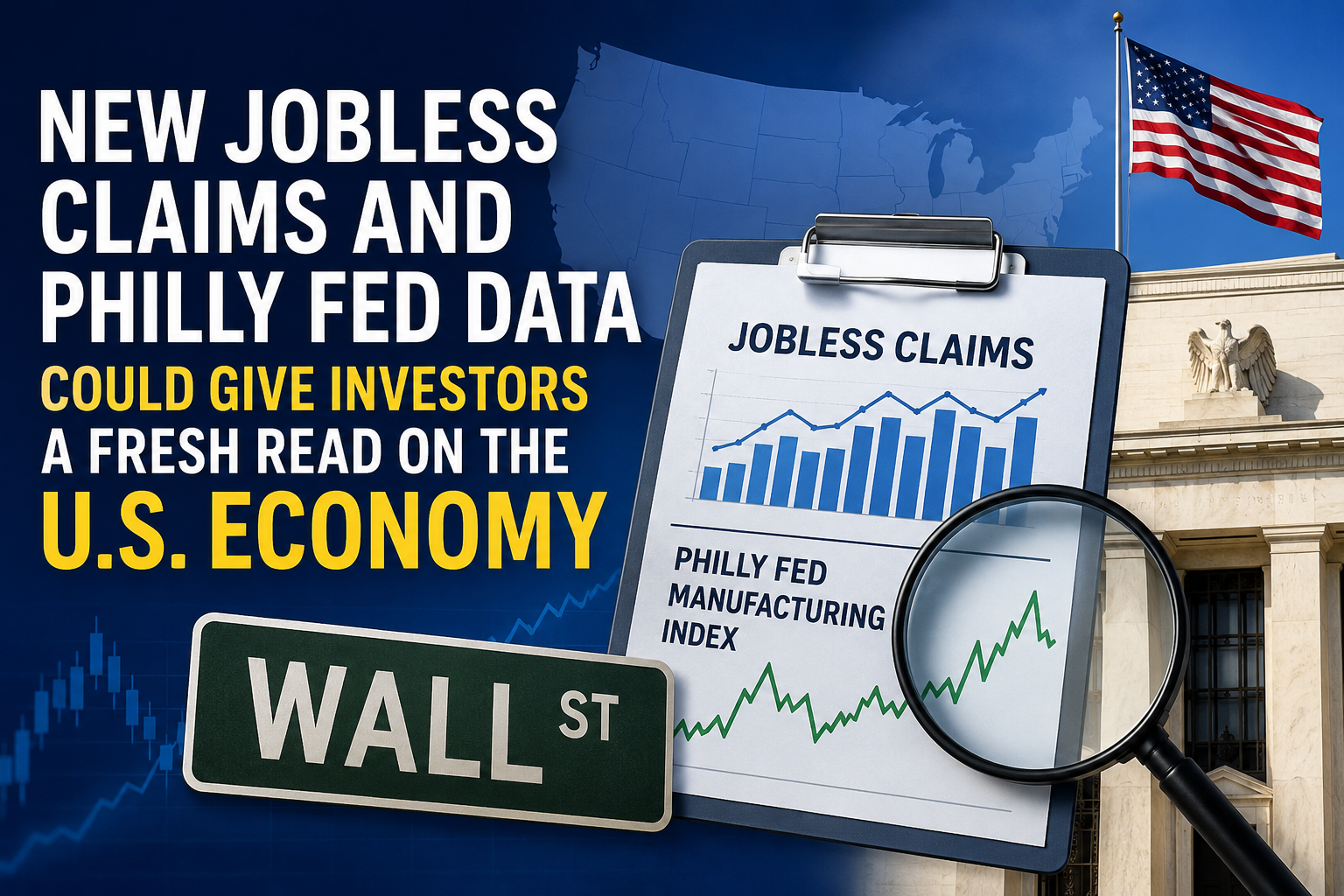
New Jobless Claims and Philly Fed Data Could Give Investors a Fresh Read on the U.S. Economy
Investors will get another important look at the health of the U.S. economy on Thursday, August 20, when two closely watched indicators are released: weekly initial jobless claims and the Philadelphia Federal Reserve’s manufacturing survey.
The reports arrive at a particularly important moment for financial markets. Recent economic data have painted a mixed picture, with signs of cooling in parts of the labor market and consumer economy alongside pockets of continued business strength. Meanwhile, investors remain focused on what the latest numbers could mean for Federal Reserve interest-rate policy.
The Philadelphia Fed manufacturing survey is currently expected to show a reading of 41.4 for August, while the Labor Department will release the latest weekly unemployment-claims figures. (Markets.News)
Together, the reports could help investors determine whether the U.S. economy is maintaining solid momentum or beginning to lose more steam.
Why Jobless Claims Matter to Investors
Initial jobless claims measure the number of people filing new applications for unemployment benefits. Because the data are released weekly, they can provide a relatively timely indication of changes in labor-market conditions.
The latest reading showed 209,000 initial claims for the week ending August 8, up from a revised 200,000 the previous week and above economists’ expectations. The four-week moving average, however, remained around 199,000, while continuing claims declined to about 1.78 million. (The Wall Street Journal)
That combination is important.
A modest increase in weekly claims does not necessarily mean the labor market is deteriorating sharply. Claims remain historically low, suggesting that widespread layoffs have not emerged. At the same time, a sustained upward trend could indicate that employers are becoming more cautious about maintaining their workforces.
For investors, the distinction between a stable labor market and a rapidly weakening one could have significant implications.
The Labor Market Is Showing Signs of Cooling
The U.S. labor market has increasingly looked less overheated than it did during the post-pandemic hiring boom.
Recent reporting has pointed to a low-hiring, low-layoff environment. Companies have generally avoided large-scale layoffs, but employers have also become more hesitant to add workers. That can create a labor market in which existing employees remain relatively secure while job seekers find it harder to land new positions. (AP News)
This matters because the Federal Reserve is balancing two broad concerns: inflation and employment.
If jobless claims begin rising consistently, investors could interpret that as evidence that restrictive monetary policy is placing greater pressure on businesses and consumers. That could strengthen expectations for future interest-rate cuts.
But if claims remain low, policymakers may have more room to focus on inflation risks rather than rushing to support employment.
What the Philly Fed Manufacturing Survey Can Tell Us
The Philadelphia Fed Manufacturing Business Outlook Survey offers a different perspective on economic conditions.
Rather than measuring unemployment, the survey captures business sentiment and activity among manufacturers in the Third Federal Reserve District. Investors watch indicators such as new orders, shipments, employment, prices and expectations for future activity.
The July survey was particularly encouraging. Manufacturing activity continued to expand, while general activity and new orders climbed to nearly five-year highs. The employment index was also positive for a second consecutive month. (Federal Reserve Bank of Philadelphia)
The August report will therefore provide an important test of whether that momentum is continuing.
A strong reading would suggest that businesses remain willing to produce, invest and hire despite elevated borrowing costs and broader economic uncertainty. A sharp decline, on the other hand, could reinforce concerns that industrial activity is losing momentum.
Investors Are Looking for the Bigger Economic Picture
Neither jobless claims nor the Philly Fed survey should be viewed in isolation.
Economic data released during August have produced a complicated picture of the U.S. economy. Retail sales recently came in weaker than expected, while inflation pressures have shown signs of easing in some areas. At the same time, manufacturing activity in New York strengthened considerably in August, with the Empire State general business conditions index reaching 20.6, its highest level in four years. (Reuters)
That makes Thursday’s reports particularly useful.
If jobless claims remain contained and manufacturing activity stays strong, investors could see evidence of an economy that is slowing gradually rather than approaching a sharp downturn.
If claims rise significantly while the Philly Fed index weakens, however, the combination could provide a stronger signal that economic momentum is deteriorating.
The most interesting scenario may be one in which the two reports move in different directions. A strong manufacturing reading combined with rising jobless claims, for example, could indicate that businesses remain productive while becoming more cautious about hiring.
What the Data Could Mean for Interest Rates
The Federal Reserve’s policy outlook remains one of the biggest factors connecting economic data to financial markets.
The latest economic calendar places the jobless-claims and Philadelphia Fed releases on Thursday, following publication of the minutes from the Federal Reserve’s July meeting. Other important economic reports, including preliminary August purchasing managers’ indexes, are scheduled for Friday. (Kiplinger)
Investors will therefore be looking at Thursday’s numbers as part of a broader sequence of evidence.
A weakening labor market could increase expectations that the Fed will eventually have to reduce interest rates to support economic activity. Lower rates can potentially benefit interest-rate-sensitive areas such as housing and certain consumer sectors while also influencing bond yields and equity valuations.
A stronger-than-expected economy could have the opposite effect. If growth remains resilient and inflation pressures fail to fall sufficiently, investors may anticipate that policymakers will keep rates higher for longer.
That is why even seemingly modest weekly economic reports can trigger meaningful market reactions.
What It Could Mean for Everyday Investors
For households and long-term investors, the immediate market reaction may be less important than the broader trend.
A single week of higher jobless claims does not establish a recession. Likewise, one strong manufacturing survey does not guarantee that economic growth will remain robust.
Instead, investors should watch whether the data are developing into a consistent pattern.
Three questions are particularly useful:
- Are jobless claims consistently rising? A sustained increase would be more concerning than a one-week jump.
- Is business activity continuing to expand? Manufacturing surveys can provide an early indication of changes in demand and production.
- Are inflation pressures easing at the same time? Falling inflation combined with weaker employment could create a very different policy environment from strong growth accompanied by persistent inflation.
This broader approach can help prevent investors from making major decisions based on one headline.
Why the Next Few Data Releases Matter
The U.S. economy is currently sending mixed signals. The labor market remains relatively resilient, but hiring has slowed. Manufacturing has shown areas of strength, while consumer activity and some leading indicators have raised questions about future momentum.
The Conference Board’s latest data also showed that its U.S. Leading Economic Index fell 0.2% in June, although the decline over the first half of 2026 was considerably smaller than the contraction recorded during the second half of 2025. The organization said strong business investment, particularly related to artificial intelligence, could continue supporting economic activity even as consumer spending weakens. (The Conference Board)
That context makes the upcoming releases more valuable.
Investors are not simply trying to determine whether the economy is growing or shrinking. They are trying to understand how quickly conditions are changing and whether the Federal Reserve may need to adjust its policy stance.
The Signal Investors Will Be Watching
Thursday’s jobless claims and Philly Fed manufacturing data could provide two complementary views of the U.S. economy: one from the labor market and another from businesses.
If claims remain low while manufacturing activity stays strong, the message would be relatively reassuring. The economy could be slowing without entering a significant downturn.
If unemployment claims continue climbing and manufacturing sentiment deteriorates, concerns about weaker growth could become more prominent in financial markets.
And if the reports send mixed signals, investors will likely turn to the wider collection of employment, inflation, consumer-spending and business surveys for confirmation.
For personal-finance decisions, that broader trend matters more than any single day’s market movement. The evolving combination of employment, inflation and economic growth will ultimately influence borrowing costs, savings returns, investment valuations and the Federal Reserve’s next moves.




2 Comments
Micle harison
June 7, 2019Lorem ipsum dolor sit amet, usu ut perfecto postulant deterruisset, libris causae volutpat at est, ius id modus laoreet urbanitas. Mel ei delenit dolores.
John Doe
June 7, 2019Some consultants are employed indirectly by the client via a consultancy staffing company.