
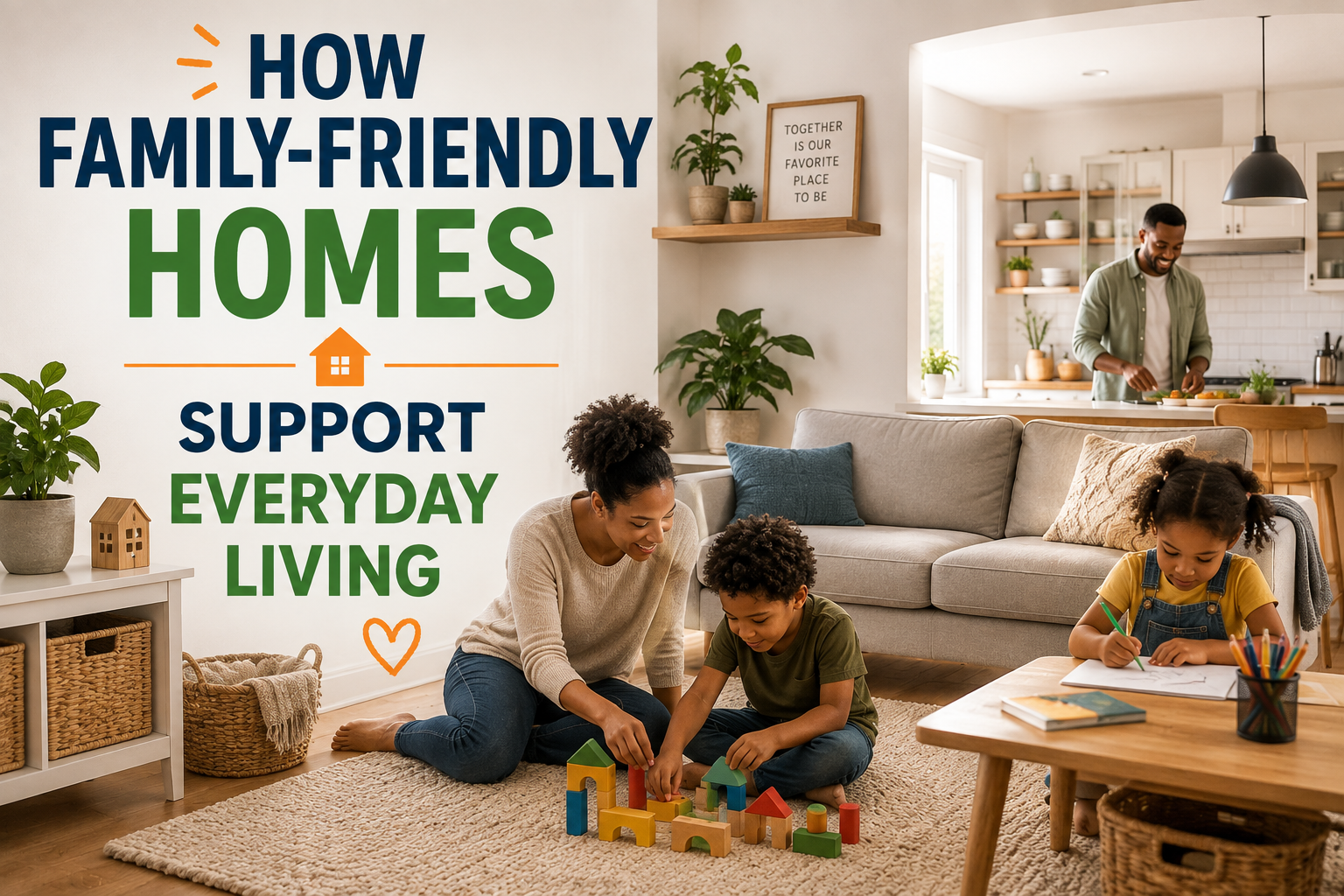
How Family-Friendly Homes Support Everyday Living
A family-friendly home is not necessarily the biggest house, the most expensive property or the one filled with the latest smart-home technology. It is a home designed around the way people actually live.
Families need spaces that can handle busy mornings, homework, meals, playtime, relaxation, unexpected messes and quiet moments. A well-designed home makes these everyday activities easier by combining practical layouts, durable materials, useful storage and comfortable shared spaces.
Whether a family lives in a detached house, townhouse, apartment or smaller urban home, thoughtful design can make a significant difference to daily life.
What Makes a Home Family-Friendly?
A family-friendly home generally supports several needs at the same time.
It should provide enough space for people to spend time together while also allowing household members to find privacy when they need it. It should be reasonably easy to clean, safe for children and practical enough to accommodate changing family routines.
Some of the most important characteristics include:
- Functional room layouts
- Plenty of accessible storage
- Durable and easy-to-clean surfaces
- Safe movement through the home
- Comfortable shared spaces
- Flexible rooms that can serve multiple purposes
- Convenient laundry and cleaning areas
- Adequate lighting and ventilation
- Outdoor or recreational space where available
The most successful family homes are often those where practical details have been considered alongside appearance.
Flexible Spaces Make Changing Routines Easier
Family needs rarely remain the same for long.
A nursery may eventually become a child’s bedroom. A playroom might later become a study area. A guest bedroom could double as a home office.
Designing rooms with flexibility in mind allows a home to adapt without requiring major renovations every few years.
Furniture can also make spaces more adaptable. A dining table can become a homework station in the afternoon, while storage benches can provide seating and a place to keep toys, shoes or blankets.
Instead of assigning every room to one narrowly defined purpose, families can benefit from creating spaces that can change with their circumstances.
The Kitchen Often Becomes the Heart of the Home
For many families, the kitchen is much more than a place to prepare food.
It can become a gathering point for breakfast, conversations, homework, meal preparation and family activities.
A family-friendly kitchen should therefore prioritize functionality.
Enough counter space can make food preparation easier. Well-organized cabinets reduce clutter. Frequently used items should be accessible without requiring someone to search through several cupboards.
Where space allows, an island or breakfast counter can create an informal gathering area without interfering with the main cooking zone.
Safety is equally important, particularly in homes with young children. Sharp objects, cleaning products and hot appliances should be stored or positioned appropriately.
Storage Can Reduce Everyday Stress
Clutter is one of the simplest ways for a home to feel smaller and more difficult to manage.
Families accumulate a remarkable number of belongings: clothing, school supplies, toys, sports equipment, books, shoes, cleaning products and seasonal items.
Good storage helps keep these belongings organized without requiring every surface to become a storage area.
Useful solutions can include:
- Built-in wardrobes
- Under-bed storage
- Shelving systems
- Entryway cabinets
- Storage benches
- Baskets for frequently used items
- Kitchen organizers
- Garage or utility-room storage
- Wall-mounted shelves
Storage works best when it is located where items are actually used.
For example, a designated place for shoes and bags near the entrance can prevent those items from spreading throughout the house.
An Organized Entryway Can Improve the Whole House
The entrance is often the first place where household clutter appears.
Children arrive home with backpacks, shoes and sports equipment. Adults may bring in work bags, groceries and other belongings.
A practical entryway can create a transition between the outside world and the rest of the home.
Hooks at accessible heights, shoe storage, a small bench and a designated place for keys can make daily departures and arrivals much smoother.
Even in a small apartment, a compact wall-mounted organizer can perform many of the same functions without taking up much floor space.
Durable Materials Make Maintenance Easier
Family homes experience considerable wear.
Floors collect dirt and spills. Walls may develop marks. Furniture gets used repeatedly. Kitchen and bathroom surfaces are exposed to moisture and cleaning products.
Choosing durable materials can therefore save time and money over the long term.
Easy-to-clean flooring can be particularly useful in high-traffic areas. Washable paint can make it easier to remove everyday marks from walls.
Furniture fabrics also deserve consideration. Materials that are resistant to stains or easy to clean can be more practical than delicate finishes in heavily used areas.
This does not mean a family home needs to look utilitarian. Durable materials are available in many styles, colors and textures.
Safety Should Be Built Into the Design
A family-friendly home should make safe movement and everyday activities as straightforward as possible.
For households with young children, this can involve securing furniture that could tip, keeping hazardous substances out of reach and using appropriate safety devices around stairs, windows and electrical outlets.
Stairways should be well lit and free from unnecessary obstacles.
Bathrooms require particular attention because water can create slippery surfaces. Non-slip flooring and appropriate storage can reduce common household risks.
As children grow, their needs change. A home that is safe for a toddler may need different considerations once children become more independent.
Lighting Can Affect How a Home Feels
Natural and artificial lighting both contribute to a home’s comfort.
Large windows can bring daylight into living areas, while appropriately positioned artificial lighting makes rooms easier to use after dark.
Different areas require different lighting approaches.
A kitchen may benefit from bright task lighting over preparation areas. Bedrooms can use softer lighting for relaxation. Study areas require sufficient illumination for reading and writing.
Night lighting can also be useful in hallways, bathrooms and stairways, especially for children and older family members.
Good lighting is therefore not simply a decorative feature. It supports how a household moves through the home.
Ventilation and Indoor Comfort Matter
Families spend substantial amounts of time indoors, making air quality and temperature important parts of a comfortable home.
Good ventilation can help reduce indoor humidity, odors and the concentration of certain pollutants.
Opening windows when conditions permit can improve air circulation, while exhaust fans are particularly useful in kitchens and bathrooms.
Temperature control also matters. A home that becomes excessively hot or cold can affect sleep, concentration and general comfort.
Simple measures such as window coverings, shading, insulation and appropriate ventilation can contribute to a more comfortable indoor environment.
Bedrooms Should Balance Privacy and Connection
Bedrooms provide an opportunity for family members to have personal space.
Children may benefit from having areas where they can read, play or study independently. Teenagers often place an even greater value on privacy.
At the same time, bedrooms should remain connected to the overall household through sensible circulation and access to shared areas.
For younger children, keeping bedrooms relatively close to parents or caregivers can make nighttime routines easier.
As children grow older, flexible bedroom layouts can accommodate desks, bookshelves and other features that support changing needs.
Bathrooms Need Practical Design
Bathrooms can become surprisingly busy in family homes.
Several people may need to use the same space during the morning rush, while children may require additional assistance or supervision.
Where possible, a family bathroom should provide adequate storage and easy-to-clean surfaces.
Separate storage areas for toiletries can reduce countertop clutter. Hooks and towel rails should be positioned conveniently for the people using them.
A second bathroom or powder room can significantly reduce congestion in larger households, although thoughtful scheduling and organization can also make a single bathroom work effectively.
Laundry Areas Can Save Time
Laundry is an unavoidable part of family life, so the design of the laundry area can have a surprisingly large impact on household routines.
A useful laundry space should provide enough room for sorting, washing, drying and storing supplies.
Where possible, placing the laundry area near bedrooms or frequently used circulation routes can reduce the amount of time spent carrying clothes around the house.
Shelving, baskets and designated spaces for clean and dirty clothing can also simplify the process.
For smaller homes, a laundry area may need to share space with a bathroom, kitchen or utility closet. Even then, organization can make the area considerably more efficient.
Shared Spaces Encourage Family Connection
Family-friendly design should not focus exclusively on individual rooms.
Shared spaces give households opportunities to eat together, talk, relax and participate in activities.
A comfortable living room does not necessarily require expensive furniture. The key is creating enough seating and open space for the household’s typical activities.
A dining area can similarly become an important gathering place.
The arrangement of furniture matters. Seating that faces toward one another can encourage conversation more effectively than a layout in which everyone faces a screen.
Outdoor Areas Can Extend the Living Space
Where a property has access to a garden, balcony, courtyard or other outdoor area, that space can become an important extension of the home.
Outdoor areas provide opportunities for children to play, adults to relax and families to spend time together away from screens.
A small balcony can accommodate plants and compact seating. A courtyard can become a play or entertaining area. A garden can provide room for recreation and gardening.
The goal is not necessarily to create a large outdoor space but to make whatever space exists useful.
A Home Should Support Homework and Work
Modern households often need spaces for studying and working.
Children may need somewhere quiet to complete assignments, while adults may work remotely for part or all of the week.
A dedicated office is useful but not essential.
A well-positioned desk in a bedroom, hallway nook or living area can provide a functional workspace.
Good lighting, comfortable seating, sufficient electrical outlets and a relatively quiet environment can make a significant difference.
As much as possible, work areas should be separated from distractions while remaining practical enough to use regularly.
Technology Should Serve the Household
Smart-home technology can make certain household tasks more convenient, but technology works best when it solves a real problem.
Programmable lighting, smart thermostats, security systems and connected appliances can help families manage their homes more efficiently.
However, technology should not replace basic functionality.
A complicated smart-home system that requires constant troubleshooting may create more work than it saves.
Simple, reliable solutions are often more valuable than adding technology simply because it is available.
Family-Friendly Design Does Not Have to Be Expensive
Creating a practical home does not necessarily require a major renovation.
Small changes can produce noticeable improvements.
Adding storage near the entrance, rearranging furniture, improving lighting or creating a dedicated homework station can make an existing home more functional.
Decluttering can also reveal unused space.
Families can prioritize improvements based on the problems they experience most often rather than trying to redesign the entire property at once.
For example, if mornings are chaotic, improving the entryway and bathroom organization may be more useful than investing in decorative upgrades.
If cleaning takes too much time, durable surfaces and better storage may provide greater value.
Designing for Different Stages of Family Life
A truly adaptable home should be capable of changing as the people living in it change.
The needs of a family with a newborn are different from those of a household with teenagers. Eventually, children may leave home, creating opportunities to repurpose bedrooms and other spaces.
Thinking about these transitions can prevent families from making expensive decisions based only on their current circumstances.
Movable furniture, flexible rooms and adaptable storage can help a home remain useful for many years.
Accessibility can also become increasingly important as family members age. Features such as fewer unnecessary steps, wider pathways, good lighting and easily accessible storage can benefit people of different ages and abilities.
The Most Useful Home Is the One That Fits Real Life
Family-friendly homes are ultimately about reducing friction in everyday routines.
A good home makes it easier to prepare meals, keep belongings organized, get children ready for school, complete homework, relax after work and spend time together.
That does not require a huge floor plan or an unlimited renovation budget.
It requires paying attention to how the household actually functions.
The best design decisions are often the simplest: storage where clutter collects, durable surfaces where messes happen, comfortable spaces where people gather and flexible rooms that can change as the family grows.
When a home is designed around real routines rather than appearances alone, ordinary activities become easier—and that practical comfort is what makes a house truly feel like a family home.



2 Comments
Micle harison
June 7, 2019Lorem ipsum dolor sit amet, usu ut perfecto postulant deterruisset, libris causae volutpat at est, ius id modus laoreet urbanitas. Mel ei delenit dolores.
John Doe
June 7, 2019Some consultants are employed indirectly by the client via a consultancy staffing company.