
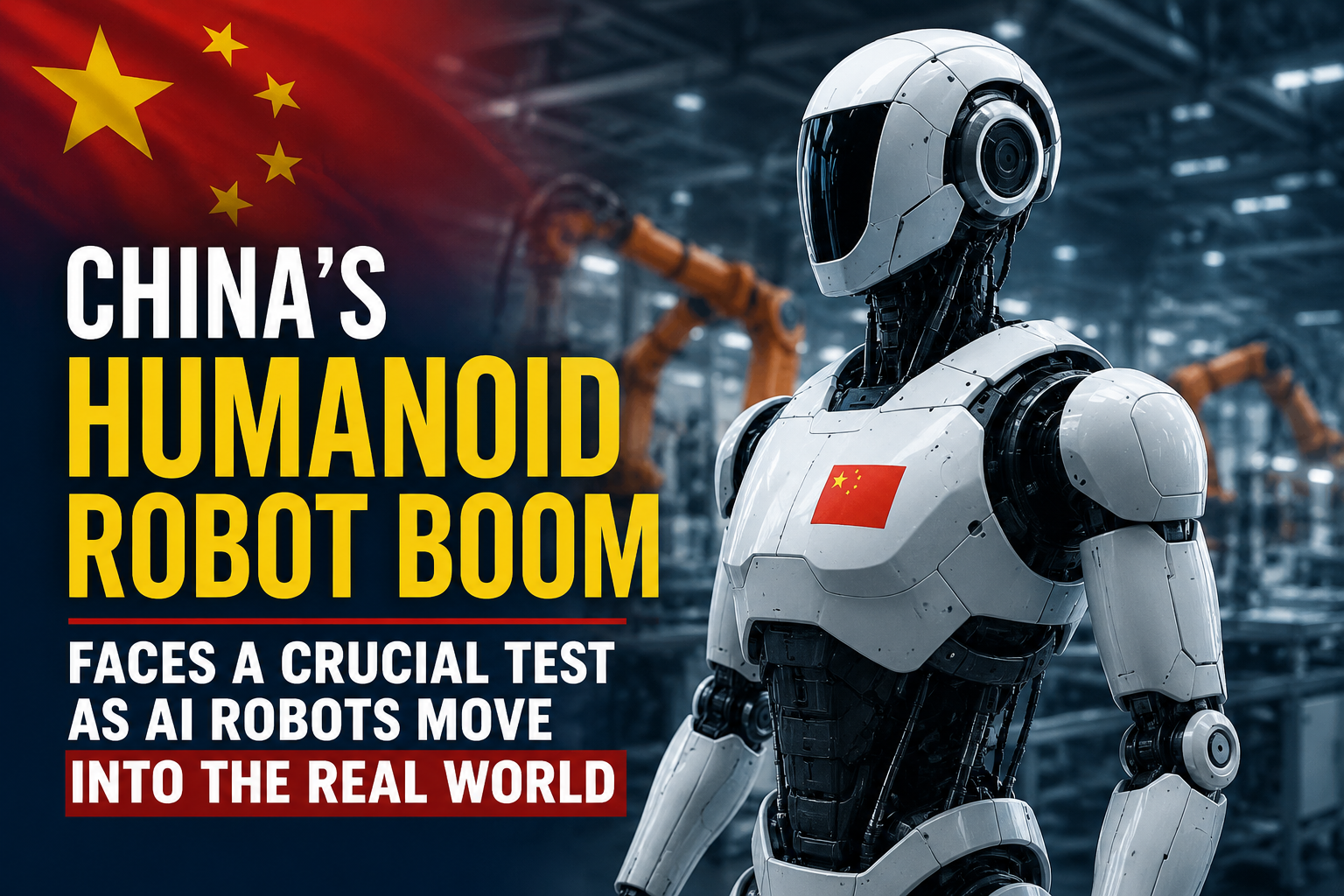
China’s Humanoid Robot Boom Faces a Crucial Test as AI Robots Move Into the Real World
China’s humanoid robot industry has reached a point where impressive demonstrations are no longer enough.
For years, humanoid robots have captivated audiences with backflips, dancing, boxing, walking demonstrations and increasingly sophisticated interactions with people. But the industry’s next challenge is much less glamorous: can these machines perform useful work reliably, repeatedly and economically in the real world?
That question is becoming particularly important in China, where manufacturers have moved faster than many international competitors in producing and deploying humanoid robots.
Chinese companies accounted for more than 97% of global humanoid robot shipments during the first half of 2026, according to research cited by China Daily. AgiBot alone reportedly shipped about 8,400 units, while Unitree delivered roughly 5,900. Global shipments reached approximately 19,100 units during the period. (China Daily)
The numbers are remarkable. But they also raise a more important question: how many of those robots are actually doing economically valuable work?
China Has Built a Huge Lead in Humanoid Robots
China’s advantage is not simply the number of robotics companies it has created. It is the combination of manufacturing capacity, component supply chains, government support, industrial demand and increasingly sophisticated AI systems.
Companies including AgiBot, Unitree, UBTECH, Leju Robotics and EngineAI have emerged as major players.
In 2025, AgiBot shipped more than 5,100 humanoid robots, according to Omdia data reported by Xinhua, giving it roughly 39% of global shipments. Unitree followed with about 4,200 units, while UBTECH shipped around 1,000. (China.org.cn)
That momentum has continued into 2026.
Industry researcher TrendForce expects China’s humanoid robot output to rise sharply this year as manufacturers move toward larger-scale commercialization. The firm has identified Unitree and AgiBot as particularly important companies in China’s production race. (TrendForce)
But shipment numbers only tell part of the story.
A robot sitting in a showroom, research laboratory or training center is fundamentally different from one that works an eight-hour shift, performs a repetitive industrial task and generates enough economic value to justify its purchase.
That distinction is now becoming central to the industry.
The Factory Floor Is the Real Test
One of the clearest signs of the industry’s transition is the increasing number of humanoid robots being tested in actual factories.
In April, AgiBot humanoid robots reportedly completed an eight-hour shift on an electronics manufacturing line in Jiangxi, performing thousands of pick-and-place operations. A Shanghai government report said the robots completed 2,283 operations without errors or malfunctions during one deployment. (Pudong)
Other deployments are similarly focused on narrow, measurable industrial tasks.
In Zhejiang garment factories, for example, robots developed by Aitu have been tested on the difficult task of separating pieces of fabric before sewing. The company reported a 97% success rate for separating fabric pieces for a specific product category and estimated that the robot could potentially pay for itself in roughly 18 months at its current performance level. (State Council Information Office)
That example illustrates how the economics of humanoid robotics are likely to develop.
The first successful applications may not involve robots replacing an entire worker.
Instead, they may involve machines taking over one repetitive task at a time.
A robot might load components, move materials, inspect products, position parts or perform another narrowly defined operation. If it can do that reliably enough, for long enough and at a competitive cost, the business case begins to emerge.
Why Humanoid Robots Are So Difficult
The basic concept sounds straightforward: build a machine with a human-like body and give it artificial intelligence.
The engineering reality is considerably harder.
Factories are full of objects that vary in shape, weight, texture and position. Humans compensate almost automatically. We can pick up a soft piece of fabric, recognize when it is slipping, adjust our grip and continue the task without consciously calculating every movement.
Robots have to learn those behaviors through sensors, control systems, training data and AI models.
Walking and navigation are becoming increasingly mature. Manipulation remains one of the harder problems.
A robot that can walk across a stage is impressive. A robot that can pick up hundreds of slightly different objects without dropping or damaging them is much more valuable to a manufacturer.
China’s robotics industry is therefore increasingly investing in facilities designed to generate real-world training data.
A training facility in Cixi, Zhejiang, for example, has deployed dozens of embodied-AI robots in simulated industrial environments covering sectors such as automobiles, appliances and textiles. The facility is intended to provide extensive robot-training time and help machines learn from physical environments rather than purely digital simulations. (State Council Information Office)
The Importance of Embodied AI
The broader technology shift is often described as embodied AI.
Traditional AI primarily operates inside computers. It processes text, images, audio or other digital information.
Embodied AI attempts to connect intelligence to physical action.
A robot needs to see an environment, understand what is happening, make a decision and physically manipulate objects. That creates a continuous loop:
Perception → reasoning → action → feedback → learning.
The quality of that loop could determine whether humanoid robots remain expensive demonstrations or become a major new category of automation.
China is increasingly treating the problem as an ecosystem rather than simply a hardware challenge.
Training centers, manufacturing facilities, AI developers, component suppliers and industrial customers are becoming interconnected parts of the same system.
That could give Chinese companies an important advantage: more robots in real environments can produce more operational data, which can potentially improve the software controlling future robots.
The Data Advantage Could Become Critical
Robot intelligence requires data.
A language model can learn from enormous quantities of text available online. Robots do not have an equivalent unlimited supply of physical-world data.
A machine needs information about how objects move, how much force is required to grasp something, what happens when an object slips and how actions change when environmental conditions vary.
That makes real-world deployment particularly valuable.
A robot working in a factory can generate information that a robot sitting in a laboratory cannot.
This creates a potentially powerful feedback loop:
More robots → more real-world data → better AI models → better robots → more deployments.
Chinese robotics researchers and companies are increasingly emphasizing this relationship.
AgiBot’s chief scientist said earlier this year that deploying more robots creates more valuable real-world data that can be used to train better models. (China.org.cn)
If that cycle works, China’s manufacturing advantage could reinforce its AI robotics advantage.
But Shipment Numbers May Not Tell the Whole Story
There is an important caveat.
A growing number of robots being produced does not necessarily mean the same number are generating commercial returns.
The Financial Times reported that China’s humanoid robotics ecosystem has been supported by more than 90 government-backed training centers, with concerns emerging over whether some demand reflects genuine commercial adoption or a policy-driven ecosystem. The report also noted that nearly 370 robotics startups have been launched in China over roughly two years. (Financial Times)
That creates a difficult question for investors and manufacturers:
Who is actually buying the robots, and why?
Government support can accelerate an emerging technology by helping companies build factories, train machines and develop supply chains.
But eventually, commercial customers must demonstrate that the technology creates enough value to justify continued spending.
The transition from government-supported experimentation to sustainable commercial demand may therefore be one of the industry’s most important tests.
Unitree’s Stock Market Debut Highlights the Stakes
The financial market is already showing enormous enthusiasm for Chinese robotics.
Unitree, one of China’s best-known robotics companies, made its Shanghai STAR Market debut this week. Its shares surged as much as 629% during trading before closing substantially higher. The company raised approximately 6.1 billion yuan, or about $900 million, in the IPO. (Business Insider)
The market reaction demonstrates how strongly investors believe robotics could become China’s next major technology industry.
But a spectacular stock-market debut also increases pressure on the industry.
Higher valuations create expectations for:
- larger production volumes;
- improving robot capabilities;
- growing commercial revenue;
- stronger margins;
- international expansion;
- and eventually sustainable profitability.
Those expectations will become harder to satisfy if robots remain primarily demonstration machines.
The Economics Matter More Than the Spectacle
The most important metric for humanoid robots may ultimately be surprisingly simple:
How much does a robot cost, and how much productive work can it perform?
Manufacturers have to consider much more than the initial purchase price.
Businesses will need to account for:
- maintenance;
- batteries and charging;
- software;
- integration;
- downtime;
- human supervision;
- training;
- repairs;
- safety systems;
- and the cost of replacing or upgrading the machine.
A robot that costs less than a human worker but spends significant amounts of time inactive may not actually be cheaper.
Likewise, a highly capable robot may still struggle commercially if it requires extensive human supervision.
The winning systems will therefore likely be those that combine reasonable hardware costs with dependable autonomy.
Why Narrow Tasks Could Win First
The industry’s path to general-purpose robots may not begin with general-purpose jobs.
Instead, companies are likely to target tasks where the environment is predictable and the economic benefit is easy to measure.
That could include:
- moving components;
- loading machines;
- sorting objects;
- quality inspection;
- packaging;
- basic assembly;
- warehouse handling;
- material transfer.
These applications have an important advantage.
The robot does not need to understand everything.
It only needs to become very good at a specific task.
A robot that performs one factory operation thousands of times with high reliability may already have commercial value, even if it cannot cook dinner, clean a house or carry on a sophisticated conversation.
The Real Breakthrough May Not Look Like Science Fiction
This is perhaps the biggest misconception surrounding humanoid robotics.
The breakthrough may not be a robot that suddenly becomes indistinguishable from a human.
It may instead be a machine that quietly works alongside humans in a factory, warehouse, laboratory or logistics facility and performs a limited set of tasks reliably enough that businesses continue buying more of them.
China’s recent factory deployments suggest that this process is already beginning.
At one electronics manufacturing trial, an AgiBot robot reportedly completed thousands of operations during a continuous shift. In garment manufacturing, other robots are being tested on tasks involving flexible materials that are notoriously difficult for automated systems. (Pudong)
These are not general-purpose artificial workers.
But they represent something arguably more important: evidence that embodied AI is beginning to interact with real industrial economics.
China’s Manufacturing Ecosystem Could Be a Major Advantage
China’s existing manufacturing infrastructure may give its robotics industry another advantage.
The country already possesses extensive capabilities in batteries, motors, electronics, sensors, precision manufacturing and supply-chain management.
That infrastructure can potentially be repurposed for robotics.
Technology companies do not have to build every component from scratch. They can leverage suppliers and manufacturing expertise developed through industries such as electric vehicles, consumer electronics and industrial automation.
Analysts have previously identified China’s hardware ecosystem as one reason its humanoid robotics companies have been able to produce machines relatively quickly and at increasingly competitive prices. (TechCrunch)
This creates an important distinction between building one impressive robot and building 100,000 reliable robots.
The latter is fundamentally a manufacturing challenge.
China has considerable experience with that problem.
The Global Robotics Race Is Changing
China’s lead also changes the competitive landscape for companies in the United States, Europe and elsewhere.
The challenge is no longer simply who can build the most impressive prototype.
It is increasingly about:
Who can manufacture at scale, collect real-world data, reduce costs and deploy robots into productive environments fastest?
That could create different strategies on different sides of the Pacific.
Chinese manufacturers have demonstrated strength in production volume and supply-chain integration.
U.S. companies have significant strengths in AI research, software development and venture capital.
The eventual winners may combine all three elements: sophisticated AI, high-quality hardware and massive real-world deployment.
Geopolitics Adds Another Layer
Humanoid robotics is also becoming part of the broader technology competition between China and the United States.
The United States has recently moved to restrict imports of certain foreign-made humanoid and quadruped robots over national-security concerns. Reuters reported that the restrictions could create additional obstacles for Chinese companies seeking international expansion. (Reuters)
That means commercial success in robotics will not depend entirely on engineering.
Companies will also have to navigate:
- export controls;
- national-security rules;
- data regulations;
- supply-chain restrictions;
- foreign investment policies;
- and geopolitical tensions.
A Chinese robot that is commercially successful at home may face a very different environment in overseas markets.
What the Next Stage of the Robot Race Will Measure
The next phase of China’s humanoid robot boom is likely to be judged less by flashy demonstrations and more by measurable operational performance.
The important questions will include:
- How many robots are performing productive commercial work?
- How many hours can they operate without intervention?
- How frequently do they fail?
- How much human supervision do they require?
- What is the total cost of ownership?
- How quickly can they learn new tasks?
- Can skills transfer between different factories and environments?
- Can manufacturers maintain acceptable safety standards?
- Do customers continue ordering robots after pilot programs?
- Can robotics companies become sustainably profitable?
Those questions will separate the industry’s genuine breakthroughs from its marketing.
From Robotics Spectacle to Industrial Infrastructure
China has already demonstrated that it can produce humanoid robots in significant numbers.
The harder achievement will be proving that those robots can become economically indispensable machines.
The country’s manufacturing base, government support, robotics startups and growing embodied-AI ecosystem give it a powerful foundation. Its 2026 shipment numbers show that Chinese companies have moved quickly from prototypes toward mass production. (China Daily)
But the next milestone will not be another backflip.
It will be a factory manager deciding that a fleet of robots is reliable enough, affordable enough and productive enough to order another hundred.
If Chinese robotics companies can consistently make that case, the current humanoid robot boom could evolve into something much larger than a technology trend: a new layer of industrial infrastructure built around machines that can learn to work in the physical world.
If they cannot, the industry may discover that producing humanoid robots at scale is considerably easier than finding enough economically valuable work for them to do.





2 Comments
Micle harison
June 7, 2019Lorem ipsum dolor sit amet, usu ut perfecto postulant deterruisset, libris causae volutpat at est, ius id modus laoreet urbanitas. Mel ei delenit dolores.
John Doe
June 7, 2019Some consultants are employed indirectly by the client via a consultancy staffing company.