
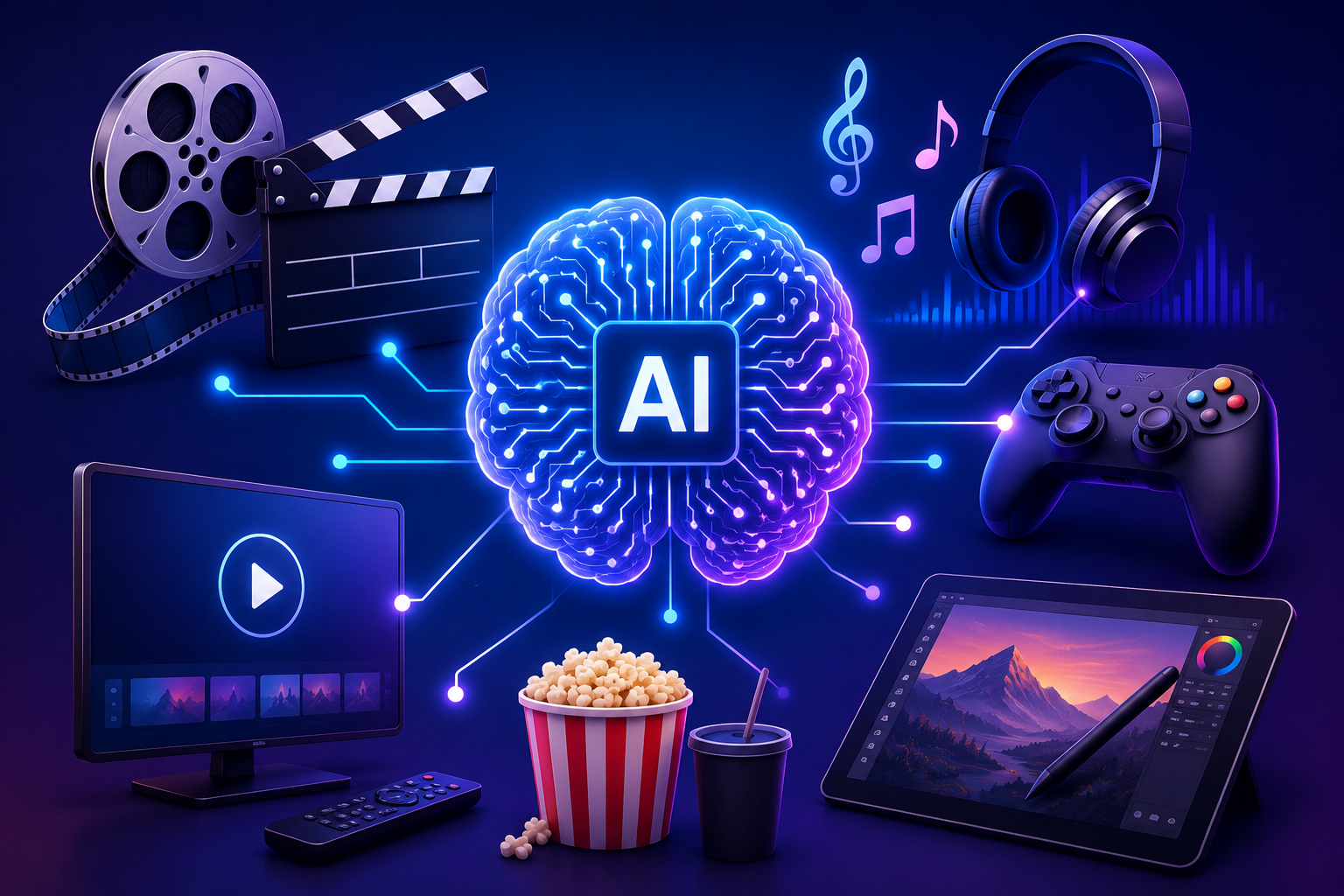
Artificial Intelligence in Entertainment: How AI Is Transforming Movies, Music, Gaming, and Digital Creativity
Artificial Intelligence (AI) is rapidly reshaping the entertainment industry, changing not only how content is created but also how audiences discover, experience, and interact with it. From personalized movie recommendations and AI-generated music to realistic visual effects and intelligent video game characters, AI has become one of the most influential technologies driving the future of entertainment.
Once viewed as a tool for automation, AI is now helping writers brainstorm ideas, filmmakers create stunning visual effects, musicians compose original tracks, and streaming platforms deliver highly personalized recommendations. While these innovations offer exciting opportunities, they also raise important questions about creativity, copyright, ethics, and the future role of human artists.
This guide explores how artificial intelligence is transforming entertainment, its benefits and challenges, and what the future may hold for creators and audiences alike.
What Is Artificial Intelligence in Entertainment?
Artificial Intelligence in entertainment refers to the use of machine learning, deep learning, natural language processing, computer vision, and other AI technologies to create, enhance, distribute, and personalize entertainment content.
AI supports numerous industries, including:
- Film and television
- Music production
- Video games
- Streaming platforms
- Publishing
- Animation
- Social media
- Virtual reality (VR)
- Augmented reality (AR)
- Live events
Rather than replacing creativity, AI is increasingly becoming a collaborative tool that helps creators work faster and explore new possibilities.
Why AI Matters in Entertainment
Entertainment has always embraced new technology—from sound in films and color television to computer-generated imagery (CGI) and streaming services.
AI represents the next major evolution because it can:
- Automate repetitive tasks
- Enhance creative workflows
- Personalize user experiences
- Reduce production costs
- Improve visual effects
- Analyze audience preferences
- Generate realistic digital content
- Increase accessibility
As a result, entertainment companies can produce content more efficiently while offering audiences richer and more engaging experiences.
How AI Works in Entertainment
AI systems learn by analyzing vast amounts of data.
For example, they can study:
- Viewing habits
- Music preferences
- Audience ratings
- Scripts
- Images
- Voice recordings
- Gameplay patterns
- Social media trends
Using these patterns, AI models make predictions, generate content, or recommend entertainment tailored to individual users.
AI in Movies and Television
The film industry increasingly relies on AI throughout production.
Script Development
AI tools can assist writers by:
- Brainstorming ideas
- Suggesting dialogue
- Organizing story structures
- Identifying plot inconsistencies
- Analyzing audience trends
Writers remain responsible for storytelling, while AI serves as a creative assistant.
Visual Effects (VFX)
Modern AI helps artists create:
- Realistic environments
- Digital characters
- Crowd simulations
- Facial animations
- Background enhancements
These tools reduce production time while improving visual quality.
Video Editing
AI-powered editing software can automatically:
- Detect scenes
- Remove unwanted footage
- Balance colors
- Improve audio
- Generate subtitles
- Organize clips
Editors retain creative control while saving significant time.
Voice Technology
AI can enhance dialogue by:
- Removing background noise
- Improving audio quality
- Generating realistic voiceovers
- Assisting with dubbing for international audiences
AI in Music
Artificial intelligence is changing how music is created, produced, and discovered.
Applications include:
- Melody generation
- Songwriting assistance
- Audio mastering
- Music recommendations
- Personalized playlists
- Instrument simulation
Many musicians use AI as a creative partner rather than a replacement for human composition.
AI in Streaming Platforms
Streaming services rely heavily on AI to improve user experiences.
AI analyzes:
- Viewing history
- Search behavior
- Watch time
- Ratings
- Favorite genres
- Time of day
- Device usage
It then recommends movies, television shows, documentaries, or music that users are likely to enjoy.
These recommendation systems help audiences discover new content while increasing viewer engagement.
AI in Video Games
Gaming is one of the industries most transformed by artificial intelligence.
Smarter Non-Player Characters (NPCs)
AI allows NPCs to:
- React naturally
- Adapt to player behavior
- Learn strategies
- Create dynamic gameplay
This makes games feel more realistic and immersive.
Procedural Content Generation
AI can automatically generate:
- Maps
- Levels
- Missions
- Landscapes
- Characters
- Dialogue
Developers can build larger, more varied game worlds with less manual effort.
Adaptive Difficulty
Some games use AI to adjust difficulty based on player skill, creating a more balanced and enjoyable experience.
AI in Animation
Animation studios increasingly use AI to assist with:
- Lip synchronization
- Character movement
- Motion capture cleanup
- Facial expressions
- Background creation
- Frame interpolation
These tools reduce repetitive work while allowing artists to focus on creativity.
AI and Digital Art
Generative AI has opened new possibilities for artists and designers.
AI can create:
- Illustrations
- Concept art
- Posters
- Character designs
- Backgrounds
- Marketing materials
Human designers often refine and customize AI-generated artwork to achieve the desired style and quality.
AI in Live Entertainment
Concerts, sporting events, and live performances are also benefiting from AI.
Examples include:
- Intelligent lighting systems
- Crowd management
- Ticket demand forecasting
- Personalized event recommendations
- Automated translations
- Enhanced security monitoring
AI improves both operational efficiency and audience experiences.
AI for Content Personalization
One of AI’s greatest strengths is personalization.
Instead of offering identical experiences to everyone, AI tailors entertainment based on individual preferences.
Examples include:
- Personalized movie recommendations
- Curated playlists
- Suggested books
- Customized gaming experiences
- Personalized advertisements
This increases engagement while helping audiences discover content aligned with their interests.
Benefits of AI in Entertainment
Artificial intelligence offers numerous advantages.
Faster Production
AI automates repetitive tasks, allowing creators to focus on storytelling and innovation.
Lower Costs
Automation reduces time-consuming production processes, lowering operational expenses.
Enhanced Creativity
AI can inspire new ideas, generate variations, and accelerate experimentation.
Better Accessibility
AI enables:
- Automatic subtitles
- Real-time translation
- Audio descriptions
- Voice control
These features help make entertainment more inclusive.
Personalized Experiences
Viewers receive recommendations tailored to their interests rather than generic suggestions.
Challenges and Ethical Concerns
Despite its advantages, AI also presents important challenges.
Copyright Issues
Questions remain about:
- Ownership of AI-generated content
- Training data
- Licensing
- Artist compensation
Deepfakes
AI can create realistic fake videos and voices that may spread misinformation or damage reputations.
Job Displacement
Automation may reduce demand for certain repetitive production roles, while creating new opportunities in AI-assisted creative work.
Bias
AI systems reflect the data they are trained on.
Poor-quality or biased training data may lead to unfair or inaccurate outcomes.
Authenticity
Audiences increasingly value transparency about whether content was created primarily by humans, AI, or a combination of both.
The Future of AI in Entertainment
Artificial intelligence is expected to become even more integrated into entertainment.
Future developments may include:
- Interactive AI-generated films
- Personalized storylines
- Real-time language translation
- Hyper-realistic virtual actors
- AI-assisted game development
- Immersive virtual reality experiences
- Smarter recommendation systems
- Digital performers for live concerts
Human creativity will likely remain central, with AI acting as a powerful creative partner.
Common Myths About AI in Entertainment
| Myth | Reality |
|---|---|
| AI will completely replace artists. | AI is more likely to assist creators than replace human imagination. |
| AI-generated content requires no human involvement. | Most professional AI-assisted projects require significant human editing and direction. |
| AI only benefits large studios. | Independent creators also use affordable AI tools to improve productivity. |
| AI recommendations are random. | They are based on data, viewing habits, and user preferences. |
| AI creativity is identical to human creativity. | AI generates patterns based on training data, while humans contribute emotion, context, and original experiences. |
Frequently Asked Questions
How is AI used in entertainment?
AI supports content creation, editing, recommendations, visual effects, music production, gaming, animation, and audience personalization.
Does AI create movies on its own?
No. AI assists filmmakers with tasks such as editing, visual effects, script analysis, and production planning, but human creators remain responsible for artistic direction.
How do streaming services recommend content?
AI analyzes viewing history, ratings, watch time, search behavior, and similar user preferences to recommend relevant content.
Can AI compose music?
Yes. AI can generate melodies, harmonies, and accompaniment, although many musicians use these tools as creative assistants rather than complete replacements.
What are AI-generated deepfakes?
Deepfakes are synthetic images, videos, or audio created using AI that can realistically imitate real people. They have legitimate creative uses but also raise ethical and security concerns.
Will AI replace actors, musicians, and writers?
AI is expected to automate some tasks and enhance creative workflows, but human creativity, storytelling, emotional expression, and cultural understanding remain essential to entertainment.
Conclusion
Artificial Intelligence is transforming entertainment at an extraordinary pace, opening new possibilities for creators, businesses, and audiences alike. From smarter streaming recommendations and AI-assisted filmmaking to personalized gaming experiences and innovative music production, the technology is reshaping nearly every corner of the industry.
While AI introduces challenges surrounding ethics, copyright, and authenticity, it also provides powerful tools that can enhance creativity rather than replace it. As technology continues to evolve, the most successful entertainment experiences will likely combine the efficiency of artificial intelligence with the imagination, emotion, and originality that only human creators can provide.
The future of entertainment is not simply artificial—it is collaborative, blending human creativity with intelligent technology to tell richer stories and create more engaging experiences than ever before.



2 Comments
Micle harison
June 7, 2019Lorem ipsum dolor sit amet, usu ut perfecto postulant deterruisset, libris causae volutpat at est, ius id modus laoreet urbanitas. Mel ei delenit dolores.
John Doe
June 7, 2019Some consultants are employed indirectly by the client via a consultancy staffing company.