
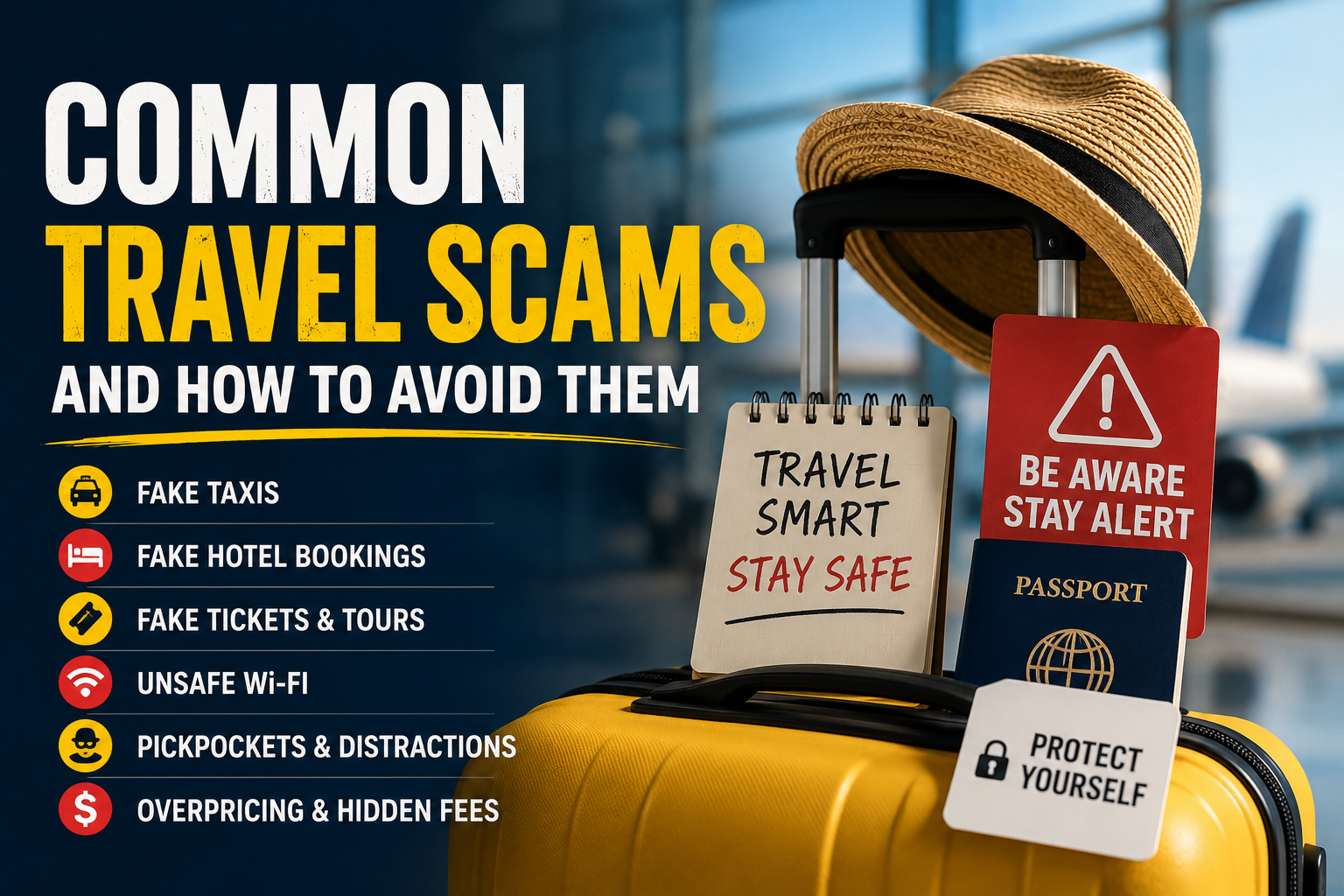
Common Travel Scams and How to Avoid Them
Travel should be about discovering new places, meeting people, trying unfamiliar foods and creating memories—not worrying about whether someone is trying to take advantage of you.
Unfortunately, scams are a reality in many popular tourist destinations. They can range from simple tricks designed to get a few extra dollars to sophisticated schemes involving fake bookings, counterfeit tickets, dishonest transportation providers or stolen personal information.
The good news is that most travel scams are surprisingly predictable. Once you know what to look for, it becomes much easier to recognize suspicious situations before they become expensive problems.
Here are some of the most common travel scams and practical ways to protect yourself.
1. The Fake Taxi or Unofficial Driver Scam
Transportation is one of the easiest areas for scammers to target visitors.
A person may approach you at an airport, bus station, train station or tourist attraction and offer a taxi ride. They may claim that the official taxis are unavailable, closed or too expensive.
The problem often becomes apparent only after the journey begins.
The driver may demand an inflated fare, take a longer route, claim that the agreed price was per person rather than for the entire vehicle or insist on additional charges.
How to avoid it
Use licensed taxis, official airport transportation desks or reputable ride-hailing services whenever possible.
Before getting into a taxi, establish how the fare will be calculated. If the destination uses meters, make sure the meter is running. If you agree on a fixed price, confirm the total amount before leaving.
It is also useful to have the destination written down or saved on your phone so there is less opportunity for confusion.
2. The “Broken Meter” Trick
This is a variation of the taxi scam.
After you get into the vehicle, the driver may announce that the meter is broken and quote a price that sounds reasonable.
At the end of the journey, the price suddenly becomes much higher.
Another version involves a driver claiming the meter showed one amount when it actually showed another.
How to protect yourself
If a taxi is supposed to use a meter and the driver says it does not work, consider finding another vehicle.
If you must accept a fixed fare, negotiate it before the trip begins and confirm that the amount covers the entire journey.
Never feel obligated to remain in a vehicle simply because you have already entered it.
3. The Fake Hotel Booking Scam
Online accommodation scams have become increasingly sophisticated.
A fake listing may use attractive photographs, convincing descriptions and even copied reviews. A scammer may then ask travelers to send money directly through a bank transfer or another payment method outside the booking platform.
Sometimes the property does not exist at all.
In other cases, scammers impersonate legitimate hotels or property managers and contact travelers after they have made a genuine reservation.
How to avoid it
Book accommodation through reputable platforms or directly through the property’s verified website.
Be particularly cautious if someone suddenly asks you to move payment or communication away from the platform.
Check the property’s location independently on a mapping service and compare reviews across multiple sources.
If a deal looks dramatically cheaper than comparable accommodation, investigate before paying.
4. The Friendly Stranger Scam
Not every friendly local is a scammer, of course. Most people you meet while traveling are simply being friendly.
However, some scams begin with an unusually enthusiastic stranger approaching a tourist.
They may invite you to a supposedly authentic restaurant, exclusive shop, local event or private party.
Once you arrive, you may discover that the prices are extremely high—or that the person receives a commission for bringing tourists there.
What to do
Be polite but cautious when strangers approach you with unsolicited offers.
You do not have to accept an invitation simply because someone seems friendly.
If someone recommends a restaurant or attraction, search for it independently before following them.
A little research can quickly reveal whether a place is genuinely popular or primarily dependent on tourist referrals.
5. The “Free Gift” Scam
A stranger may approach you and offer something that appears free—a bracelet, flower, souvenir, photograph or small gift.
Once you accept it, the person demands payment.
If you refuse, they may become aggressive or create an uncomfortable scene.
How to avoid it
Remember that unsolicited gifts from strangers may not actually be gifts.
If someone tries to hand you something you did not request, a simple “No, thank you” is often enough.
Do not feel guilty about refusing something that you did not ask for.
6. The Fake Tourist Attraction Scam
Some scammers claim that a famous attraction is closed, sold out or temporarily unavailable.
They then offer to take you somewhere else.
The alternative attraction may charge an inflated entrance fee, provide a poor experience or simply be a business that pays the scammer a commission.
This scam can be particularly effective because tourists may not know whether the information is true.
How to protect yourself
Check attraction opening hours and ticket information using the official website before leaving your accommodation.
If someone tells you that a major attraction is unexpectedly closed, verify the information independently.
Do not rely entirely on a stranger’s claim.
7. The Overpriced Restaurant Scam
Tourists can easily become targets for restaurants that use misleading menus or unclear pricing.
A server may recommend a special dish without explaining its price. The final bill can then be dramatically higher than expected.
Other restaurants may charge separately for items that appear to be included or add unexplained service fees.
How to avoid it
Look at the menu and prices carefully before ordering.
Ask about the price of anything described as a “special,” particularly seafood, premium meats or dishes priced by weight.
If the restaurant has no visible prices, consider choosing another establishment.
Checking recent reviews can also help identify businesses with recurring complaints about billing practices.
8. The Pickpocket Distraction
Pickpocketing often depends on distraction rather than force.
A stranger may spill something on your clothing, bump into you, ask for directions or create a sudden commotion.
While your attention is elsewhere, an accomplice may take your wallet, phone or other valuables.
Crowded public transportation, busy markets and tourist attractions are particularly attractive environments for this type of theft.
Protect yourself
Keep valuable items in secure, difficult-to-access pockets.
Avoid placing your phone or wallet in an open back pocket.
When carrying a backpack in a crowded area, consider wearing it securely in front of you.
Most importantly, become extra alert when an unusual interaction suddenly draws your attention.
9. The ATM Scam
ATMs can also be targeted by criminals.
A stranger may offer to help you use the machine, claim that your card is stuck or attempt to distract you while another person observes your PIN.
There are also situations involving fake card readers or unauthorized assistance around cash machines.
Safer ATM habits
Use ATMs located inside banks or established businesses whenever possible.
Cover the keypad while entering your PIN.
Do not allow strangers to “help” you with the machine.
If your card appears to be retained, contact your bank using an official telephone number rather than accepting assistance from someone nearby.
Also check your bank statements and account notifications regularly while traveling.
10. Currency Exchange Tricks
Currency exchange scams can involve unfavorable rates, hidden fees or deliberate miscalculations.
A money changer may advertise an attractive exchange rate but apply a different rate when processing the transaction.
Another trick involves counting bills quickly enough that the customer does not notice a missing note.
How to avoid losing money
Use reputable banks or licensed exchange services.
Understand the approximate exchange rate before exchanging money.
Count the cash yourself before leaving the counter.
Keep receipts for significant transactions.
Be especially cautious when someone approaches you on the street offering a much better exchange rate than established businesses.
An unusually good deal may not actually be a good deal.
11. The Fake Police Officer
In some scams, criminals impersonate police officers or other officials.
They may claim that you committed a minor violation, used counterfeit currency or are required to show your wallet or passport.
The goal may be to obtain cash, personal information or access to your belongings.
What should you do?
Remain calm.
Ask for official identification and, where appropriate, request that the situation be handled at a police station or official office.
Do not hand over large amounts of cash simply because someone wearing a uniform demands it.
If you are genuinely unsure, contact local authorities through an official channel.
Keep copies of your passport and important travel documents separately from the originals so that you have backup information if something goes wrong.
12. The Fake Ticket Scam
Fake tickets can be a problem around concerts, sporting events, attractions, transport hubs and other popular activities.
A seller may claim to have a last-minute ticket at an attractive price.
The ticket may turn out to be counterfeit, already used or invalid.
How to stay safe
Buy tickets from official websites, authorized sellers or reputable resale platforms.
Be cautious about purchasing tickets from strangers outside a venue.
If the price is dramatically below the normal market price, investigate why.
Screenshots of tickets or confirmation emails should not automatically be treated as proof that a ticket is legitimate.
13. The Wi-Fi Trap
Travelers often connect to public Wi-Fi without thinking twice.
An unsecured or malicious network can potentially expose sensitive information, particularly if someone is attempting to intercept communications or trick users into visiting fraudulent websites.
Fake networks can even use names that resemble legitimate hotel, airport or café Wi-Fi.
Safer habits
Confirm the official network name with staff before connecting.
Avoid accessing highly sensitive financial accounts on unfamiliar networks when possible.
Keep your phone, browser and operating system updated.
Use multi-factor authentication on important accounts.
Most importantly, do not assume that a Wi-Fi network is safe simply because its name looks familiar.
14. The SIM Card or Phone Shop Scam
Travelers often purchase local SIM cards or mobile data when they arrive in another country.
Unscrupulous sellers may charge inflated prices, activate unnecessary services or sell plans that differ from what was promised.
There can also be risks if someone obtains unnecessary access to your identification documents or personal information.
How to avoid it
Use official telecommunications stores or reputable retailers.
Ask for the exact package, price and validity period before paying.
Keep the receipt and any documentation associated with the SIM card.
If identification is required for registration, make sure you are dealing with a legitimate provider.
15. The “Your Hotel Is Closed” Scam
This scam can be particularly stressful because it targets travelers who have just arrived in an unfamiliar city.
A driver or stranger may tell you that your hotel is closed, unsafe, overbooked or located in a bad area.
They then offer to take you to another hotel.
The alternative property may charge far more than your original booking.
The best defense
Do not panic.
Contact your hotel directly using the phone number from your booking confirmation or official website.
If the person claiming that your hotel is unavailable is telling the truth, the hotel should be able to confirm it.
Do not allow a stranger to decide where you will stay.
16. The Rental Damage Scam
Car, motorcycle and equipment rentals can occasionally lead to disputes over alleged damage.
A rental company may claim that you caused scratches, dents or other damage that was already present.
Protect yourself before taking the vehicle
Inspect the vehicle carefully.
Take clear photographs and videos from multiple angles before leaving.
Make sure existing scratches and damage are recorded on the rental agreement.
Keep copies of all documents and receipts.
When returning the vehicle, document its condition again.
A few minutes spent recording the vehicle can save hours of arguments later.
17. The Fake Charity or Donation Scam
Travelers may encounter people collecting money for children, religious organizations, medical causes or other charitable purposes.
Some campaigns are legitimate. Others may not be.
Scammers often rely on emotional pressure to make tourists donate without asking questions.
A safer approach
If you genuinely want to support a cause, consider donating through an established organization.
Do not feel pressured to hand over money simply because someone presents a sad story.
If you are unsure, politely decline and move on.
18. The Photography Scam
Someone may offer to take your photograph at a famous attraction.
After taking the picture, they demand an unexpectedly high fee.
Sometimes a similar trick involves someone encouraging you to use a particular camera, costume or prop and then demanding payment.
How to avoid it
Ask about the price before agreeing.
If you do not want the service, politely decline.
Travelers can also use a phone tripod, selfie stick or ask another tourist to take a photograph.
19. The Helpful Stranger With Directions
A stranger may offer to help you navigate a city even though you did not ask for assistance.
The person may then demand payment or attempt to lead you toward a particular business.
This can overlap with other tourist scams.
Stay in control of your journey
If you need directions, use a trusted navigation app or ask staff at your hotel, airport, train station or established business.
When someone approaches you unexpectedly, there is no obligation to accept their assistance.
20. Online Travel Scams Before You Leave Home
Not all travel scams happen after you arrive.
Fraud can begin weeks or months before a trip.
Fake accommodation listings, fraudulent visa services, counterfeit travel websites, fake airline promotions and phishing emails can all target people while they are planning a journey.
Protect yourself before booking
Check the website address carefully.
Be suspicious of urgent messages demanding immediate payment.
Avoid sending money through unusual payment methods simply because a seller insists.
Research the company independently rather than relying only on advertisements or social media pages.
If a travel deal seems impossibly cheap, take extra time to verify it.
Warning Signs That a Travel Offer May Be a Scam
Although scams vary considerably, many share the same warning signs.
Be cautious when someone:
- Pressures you to make an immediate decision
- Insists on cash when other payment methods are available
- Offers something dramatically cheaper than everyone else
- Refuses to provide written details
- Becomes aggressive when you ask questions
- Claims that normal procedures do not apply
- Asks you to move a booking or payment outside an established platform
- Wants access to your phone, card or personal documents
- Creates a sense of panic or urgency
- Says an attraction or service is unavailable without providing verifiable information
One warning sign does not automatically mean someone is a scammer. Several warning signs appearing together, however, should make you slow down.
What to Do If You Think You Are Being Scammed
If something feels wrong, prioritize your safety rather than trying to prove that you are right.
Move to a public or secure location.
Do not argue with an aggressive person.
If money is involved, stop the transaction if possible.
Contact your bank immediately if you believe your card or financial information has been compromised.
If your passport or other important documents are stolen, contact the appropriate authorities and your embassy or consular service.
Keep records of transactions, messages, booking confirmations and other evidence that may help with a dispute or report.
How to Travel More Safely Without Becoming Paranoid
Being aware of scams does not mean you should distrust everyone you meet.
Travel is full of genuine acts of kindness. Locals may offer directions, recommend restaurants or help you navigate unfamiliar places simply because they want to help.
The goal is not to become suspicious of every interaction.
Instead, develop a few simple habits:
Verify important information. If something affects your money, accommodation, transportation or personal documents, confirm it independently.
Take your time. Scammers often rely on urgency. If you can slow down, you gain an advantage.
Keep control of your valuables. Phones, wallets, passports and bank cards should remain secure and within your awareness.
Research before traveling. Learning about common scams in your destination can make suspicious situations much easier to recognize.
Trust your instincts. If an interaction feels wrong, you can leave.
Smart Travelers Know When to Slow Down
The vast majority of travel experiences are positive, and scams should not stop anyone from exploring the world.
The most effective protection is not fear. It is preparation.
Know approximately what transportation should cost. Understand how local payments work. Research your accommodation. Keep copies of important documents. Use official services when possible, and be cautious whenever someone creates unnecessary urgency around your money or personal information.
Most scams depend on catching travelers off guard.
When you know the common tricks and give yourself time to verify what you are being told, many of those tricks lose their power. The result is not only a safer trip, but a more relaxed one—because you can spend less time worrying about being taken advantage of and more time enjoying the destination you came to see.




2 Comments
Micle harison
June 7, 2019Lorem ipsum dolor sit amet, usu ut perfecto postulant deterruisset, libris causae volutpat at est, ius id modus laoreet urbanitas. Mel ei delenit dolores.
John Doe
June 7, 2019Some consultants are employed indirectly by the client via a consultancy staffing company.