
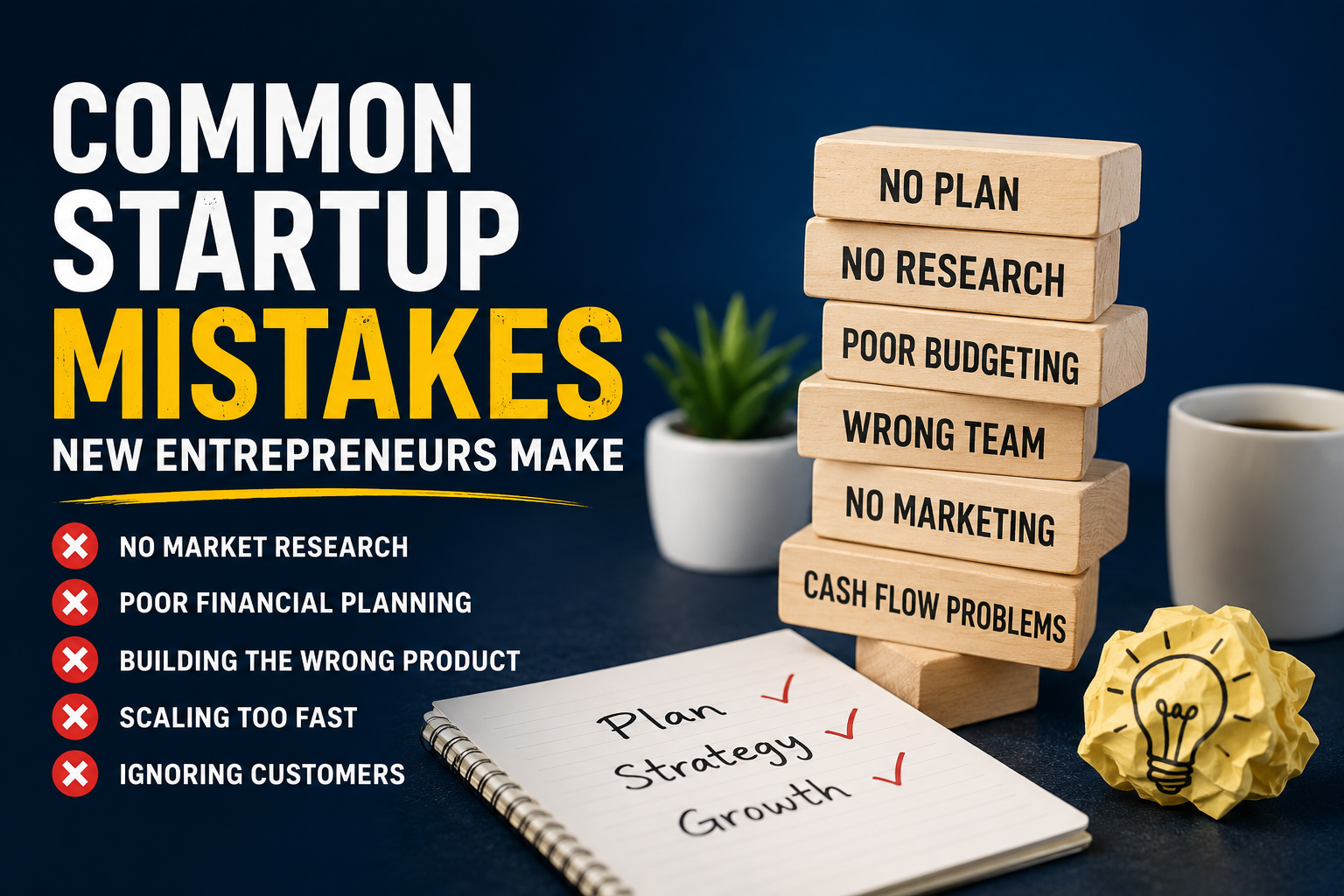
Common Startup Mistakes New Entrepreneurs Make
Starting a business can be exciting. You have an idea, a vision and the motivation to turn something you believe in into a real company.
But enthusiasm alone does not guarantee success.
Many startups fail not because the founders lack intelligence, ambition or a good idea, but because they make avoidable mistakes along the way. Some spend too much money before understanding their customers. Others build products nobody urgently needs. Some hire too quickly, ignore cash flow or try to do everything themselves.
The good news is that most of these mistakes can be identified early.
Whether you are launching your first business, developing a side project or preparing to turn an idea into a full-time company, understanding the common pitfalls can help you make better decisions and protect your limited time and money.
1. Starting With an Idea Instead of a Problem
One of the most common startup mistakes is becoming too attached to an idea.
Founders often think, “This is a great product,” before asking a more important question: What problem does this product solve?
A business becomes much easier to build when it addresses a problem that customers genuinely care about.
Before investing heavily in development, entrepreneurs should understand:
- Who has the problem?
- How serious is it?
- How frequently does it occur?
- How are people solving it today?
- What does the current solution cost?
- Would customers actually pay for a better alternative?
A clever idea is not necessarily a viable business. A relatively simple solution to an expensive, frustrating or widespread problem can be far more valuable.
2. Failing to Research the Market
Another mistake is assuming that customers will automatically appear once a product launches.
Market research does not need to involve an expensive consulting firm. Entrepreneurs can learn a great deal by talking directly to potential customers, studying competitors, analyzing search behavior and observing how people currently solve the problem.
Research should help answer a basic question:
Is there a real market for this business?
Look at the size of the potential customer base, competitors, pricing, industry trends and barriers to entry.
You may even discover that your original idea needs to change.
That is not failure. It is valuable information obtained before you spend months or years building the wrong thing.
3. Trying to Build the Perfect Product
Perfection can be surprisingly dangerous for a startup.
New entrepreneurs sometimes spend months developing features, redesigning websites and polishing details before allowing real customers to use the product.
The problem is that founders are often poor judges of what customers actually want.
A better approach is to create a minimum viable product (MVP) that solves the core problem and put it in front of users as quickly as reasonably possible.
Customer feedback can then guide development.
The first version does not need to be perfect. It needs to be useful enough to generate meaningful feedback.
4. Ignoring Customer Feedback
Launching a product is not the end of the learning process. It is the beginning.
Customers will tell you things that market research cannot always reveal.
They may explain why they hesitate to buy, which feature they value most, what frustrates them or why they choose a competitor instead.
Some founders become defensive when customers criticize their product. Others listen only to positive feedback.
Both reactions can be costly.
Constructive criticism can reveal opportunities to improve the product, pricing, customer service or overall business model.
The goal is not to implement every suggestion. It is to identify recurring patterns and understand what those patterns say about customer needs.
5. Underestimating Cash Flow
A startup can be profitable on paper and still run out of money.
This happens because profit and cash flow are not the same thing.
A business may have sales but still struggle to pay salaries, suppliers, rent, taxes or technology bills if money comes in too slowly or expenses are too high.
New entrepreneurs should keep a close eye on:
- Monthly revenue
- Operating expenses
- Gross margins
- Accounts receivable
- Debt obligations
- Cash reserves
- Customer acquisition costs
- Monthly cash burn
Cash flow management becomes particularly important during the early stages, when revenue can be unpredictable.
Knowing exactly how much money the business has and how long it can operate at its current spending rate can prevent unpleasant surprises.
6. Spending Too Much Too Early
Having access to funding can create another problem: spending it too quickly.
A new company may be tempted to rent an expensive office, purchase unnecessary equipment, hire a large team or invest heavily in branding before establishing product-market fit.
Some expenses are necessary. Others simply make the startup look bigger than it actually is.
Early-stage entrepreneurs should distinguish between spending that creates business value and spending that merely creates the appearance of growth.
Keeping fixed costs manageable gives a startup more time to experiment, adapt and survive difficult periods.
7. Hiring Before the Business Is Ready
Building a team is important, but hiring too early can create unnecessary financial pressure.
Founders sometimes hire because they feel overwhelmed rather than because a specific role has become essential.
Every employee brings more than a salary. There may also be taxes, benefits, equipment, software, management time and training costs.
Before hiring, ask:
Is this role essential to reaching our next important business milestone?
If the answer is no, it may be better to delay the hire or use a freelancer, contractor or automation tool where appropriate.
At the same time, entrepreneurs should avoid the opposite mistake of refusing to hire when additional expertise is genuinely needed.
The objective is not to build the smallest team possible. It is to build the right team for the company’s current stage.
8. Trying to Do Everything Alone
The founder often starts by doing everything.
Marketing, sales, customer service, bookkeeping, product development and administration may all fall on one person’s shoulders.
That can work temporarily.
Eventually, however, trying to control every task can become a bottleneck.
Successful entrepreneurs learn to delegate activities that others can perform more effectively, while focusing their own time on areas where their involvement has the greatest impact.
Delegation also creates room for specialists to contribute skills the founder may not have.
A founder does not need to know everything. They need to know what they are good at, what they need to learn and when to bring in someone else.
9. Choosing the Wrong Business Partner
A co-founder can be one of the startup’s greatest strengths—or one of its biggest risks.
Entrepreneurs sometimes choose partners based primarily on friendship, familiarity or enthusiasm.
Those qualities are helpful, but they are not enough.
Before entering a partnership, founders should discuss difficult issues such as:
- Ownership percentages
- Roles and responsibilities
- Decision-making authority
- Financial contributions
- Salaries
- Intellectual property
- Future fundraising
- What happens if someone leaves
- How major disagreements will be resolved
These conversations may feel uncomfortable at the beginning.
They become much more uncomfortable after the company has raised money, hired employees or started generating significant revenue.
10. Not Understanding the Numbers
Entrepreneurs do not need to become professional accountants, but they do need to understand their company’s financial fundamentals.
A founder should know how much it costs to acquire a customer, how much revenue each customer generates and how much money remains after delivering the product or service.
Important metrics may include:
- Revenue
- Gross profit margin
- Net profit margin
- Customer acquisition cost
- Customer lifetime value
- Monthly recurring revenue
- Churn rate
- Conversion rate
- Burn rate
These numbers help turn business decisions from guesses into informed choices.
11. Pricing Based on Guesswork
Pricing is another area where startups frequently struggle.
Some founders set prices based on what competitors charge. Others choose a low price because they are afraid customers will reject the product.
Neither approach necessarily reflects the product’s actual value.
A sustainable pricing strategy should consider the customer’s willingness to pay, the value delivered, operating costs, competitive positioning and the company’s long-term economics.
Being cheaper is not automatically a competitive advantage.
In some markets, extremely low prices can actually make customers question the quality of the offering.
12. Focusing on Revenue Instead of Sustainable Revenue
Revenue is an important startup metric, but not all revenue is equally valuable.
A company can generate impressive sales while losing money on every transaction.
Discounting heavily can also create the illusion of rapid growth while making it difficult to determine whether customers would continue buying at sustainable prices.
Entrepreneurs should look beyond top-line revenue and understand the economics behind each sale.
The important question is not simply:
“How much did we sell?”
It is:
“How much value did those sales create for the business?”
13. Neglecting Marketing and Sales
Some founders believe that a good product will sell itself.
Occasionally it does.
Usually, however, customers need to discover the product, understand its benefits and develop enough trust to make a purchase.
Marketing helps create awareness. Sales converts interest into revenue. Customer service helps retain customers and generate referrals.
A startup should therefore think about distribution almost as early as it thinks about product development.
A great product that nobody knows about has limited commercial value.
14. Trying to Reach Everyone
New entrepreneurs often describe their target market too broadly.
“Our product is for everyone” may sound attractive, but it makes marketing and product development much harder.
A startup is often better served by identifying a specific group of customers with a clear problem.
For example, instead of targeting “small businesses,” a company might initially focus on independent restaurants, local professional services firms or online retailers.
A clearly defined customer makes it easier to understand their needs, create relevant messaging and develop targeted marketing campaigns.
Once the business establishes itself in one segment, it can expand.
15. Copying Competitors Too Closely
Studying competitors is essential.
Copying everything they do is not.
A startup needs to understand what competitors offer, where they are strong and where customers remain dissatisfied.
That information can reveal opportunities for differentiation.
Perhaps your service is faster. Maybe your software is easier to use. Perhaps your customer support is better, your pricing is simpler or your product serves an overlooked niche.
Competition is not necessarily a reason to abandon an idea.
Sometimes it is evidence that a market exists.
16. Scaling Too Quickly
Growth sounds like the ultimate goal of every startup, but uncontrolled growth can create serious problems.
A company may acquire customers faster than it can serve them. Inventory can become difficult to manage. Customer support can deteriorate. Employees can become overwhelmed.
Growth magnifies both strengths and weaknesses.
If a business has a broken process at 100 customers, that problem can become significantly worse at 10,000 customers.
Before scaling, entrepreneurs should make sure their core operations can handle increased demand.
17. Ignoring Legal and Regulatory Requirements
Legal work may not be exciting, but ignoring it can become extremely expensive.
Depending on the business and location, entrepreneurs may need to consider:
- Business registration
- Tax obligations
- Employment laws
- Licenses and permits
- Contracts
- Intellectual property
- Data protection
- Consumer protection
- Industry-specific regulations
- Insurance
Founders should seek qualified professional advice when a legal or regulatory issue is significant.
A small investment in proper compliance can prevent a much larger problem later.
18. Mixing Personal and Business Finances
Using one bank account for both personal spending and business transactions can quickly create confusion.
It becomes harder to understand how much the business is actually earning, what expenses are legitimate and whether the company has enough cash to operate.
Separating personal and business finances from the beginning makes accounting, tax reporting and financial planning considerably easier.
It also helps establish clearer boundaries between the founder and the company.
19. Ignoring Cybersecurity
Technology has made it easier than ever to launch a business, but it has also created new risks.
Startups often hold sensitive information about customers, employees and business operations. A weak password, compromised account or poorly secured system can cause financial and reputational damage.
Basic security practices should include:
- Strong, unique passwords
- Multi-factor authentication
- Regular software updates
- Secure backups
- Access controls
- Employee security training
- Careful handling of customer information
Cybersecurity should not be treated as something only large corporations need to worry about.
20. Chasing Every New Trend
Every year brings a new technology, marketing strategy or business trend promising extraordinary growth.
Artificial intelligence, social media platforms, cryptocurrencies, automation and other emerging technologies can create genuine opportunities.
But adopting something simply because everyone else is talking about it can distract a startup from its actual customers.
Entrepreneurs should ask:
Does this technology solve a real problem for my business or customers?
If the answer is no, there may be better uses for the company’s limited time and resources.
21. Failing to Adapt
Having a business plan is important. Treating it as unchangeable is not.
Markets change. Customers change. Competitors change. Technology changes.
A startup may begin with one product and eventually discover that customers want something completely different.
The strongest entrepreneurs are willing to change direction when evidence demands it.
This does not mean abandoning the company’s mission every time something goes wrong. It means distinguishing between persistence and stubbornness.
Sometimes the smartest move is to improve the original strategy. Sometimes it is to change it entirely.
22. Measuring Vanity Metrics
Some numbers look impressive without telling you whether the business is healthy.
Social media followers, website visits, app downloads and press mentions can all be useful indicators, but they do not necessarily translate into customers or revenue.
Entrepreneurs should prioritize metrics that connect directly to business objectives.
For example, if the goal is customer growth, paying customers and retention may matter more than total website traffic.
The best metrics help answer a practical question:
Are we moving closer to building a sustainable business?
23. Burning Out the Founder
Startup culture sometimes glorifies working around the clock.
Long hours may occasionally be necessary, especially during launches or difficult periods. But constant exhaustion can eventually damage decision-making, creativity and health.
A founder who cannot think clearly becomes a liability to the business.
Building sustainable routines, delegating responsibilities and taking time away from work are not signs of a lack of commitment.
They can actually help entrepreneurs remain effective for the long term.
Turning Startup Mistakes Into Better Decisions
Mistakes are unavoidable in entrepreneurship.
The goal is not to build a company without ever making one. That is unrealistic. The goal is to make mistakes cheaply, learn quickly and avoid repeating them.
Before spending heavily, validate the problem. Before hiring, understand the workload. Before scaling, make sure the underlying processes work. Before chasing growth, understand the economics behind it.
The most successful startup founders are not necessarily those who make the fewest mistakes. They are often the ones who recognize problems early, respond to evidence and remain willing to change course.
A startup does not need a perfect beginning. It needs a strong enough foundation to keep learning, adapting and moving forward.




2 Comments
Micle harison
June 7, 2019Lorem ipsum dolor sit amet, usu ut perfecto postulant deterruisset, libris causae volutpat at est, ius id modus laoreet urbanitas. Mel ei delenit dolores.
John Doe
June 7, 2019Some consultants are employed indirectly by the client via a consultancy staffing company.