
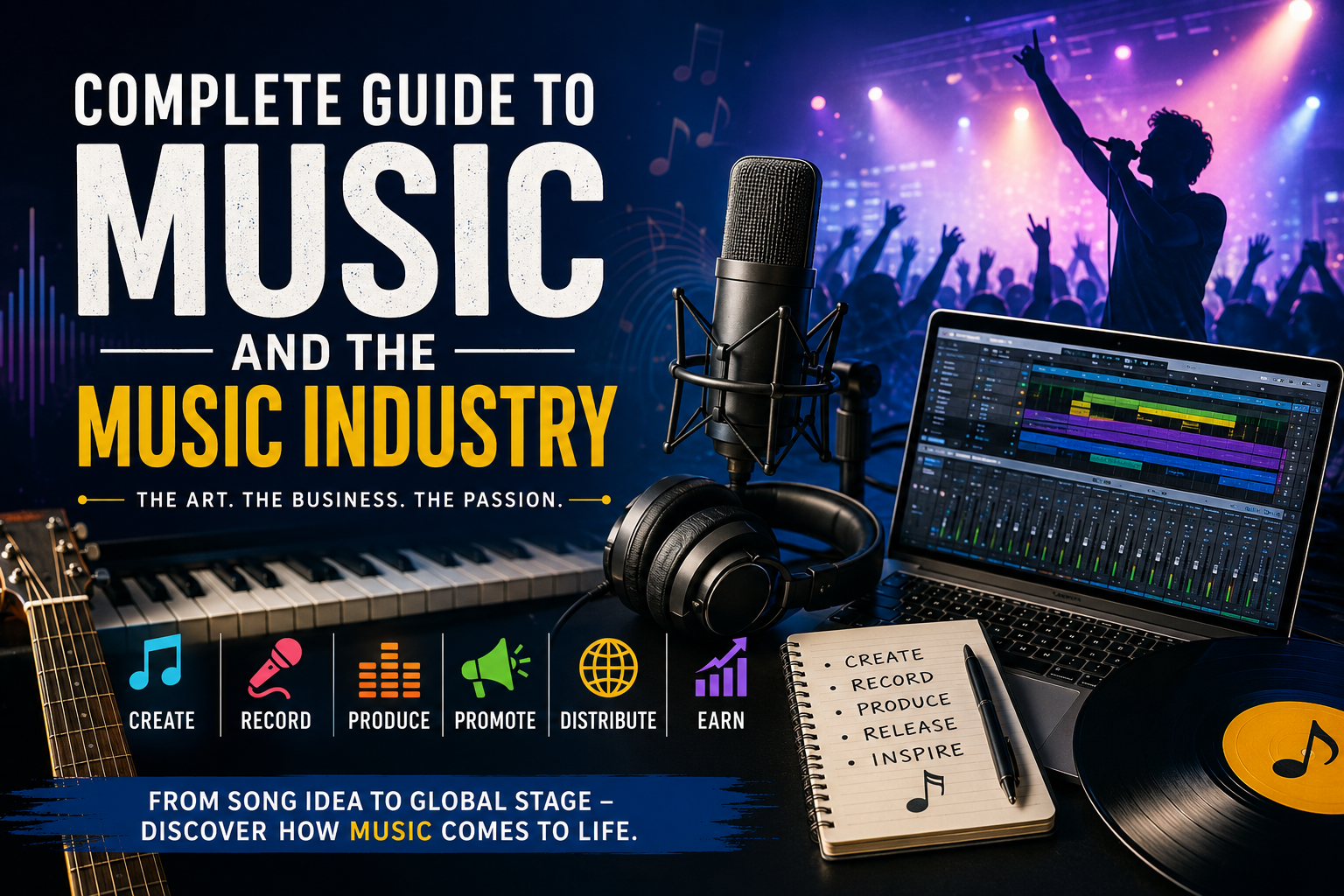
Complete Guide to Music and the Music Industry
Music is one of the world’s most influential forms of entertainment. It can tell stories, shape culture, create communities, and provide a livelihood for millions of people. Behind every song, however, is an industry involving artists, producers, songwriters, record labels, publishers, streaming platforms, promoters, venues, and many other professionals.
Understanding how music works as both an art form and a business makes it easier to appreciate what happens between an idea in a songwriter’s head and the moment a finished track reaches listeners.
This complete guide explains the fundamentals of music, how the music industry operates, how artists make money, how songs are created and distributed, and how technology continues to change the business.
What Is Music?
Music is an organized combination of sound, rhythm, melody, harmony, dynamics, and silence. It can be created with voices, traditional instruments, electronic equipment, digital software, or combinations of these.
Although musical traditions differ enormously between cultures, music commonly serves several purposes:
- Entertainment
- Storytelling
- Cultural expression
- Religious or ceremonial purposes
- Emotional expression
- Social connection
- Education
- Commercial entertainment
Music exists in virtually every culture, and its forms continue to evolve as technology, society, and artistic preferences change.
The Basic Elements of Music
Understanding a few fundamental musical concepts makes it easier to understand how songs are constructed.
Melody
A melody is a sequence of musical notes that forms a recognizable musical idea. It is often the part of a song that listeners remember and sing along to.
Rhythm
Rhythm describes the timing and arrangement of sounds and silences. It gives music movement and can influence how energetic, relaxed, or danceable a song feels.
Harmony
Harmony occurs when different notes are played or sung together. It provides depth and supports the melody.
Tempo
Tempo refers to the speed of a piece of music. A song can have a slow, moderate, or fast tempo, depending on its artistic purpose.
Dynamics
Dynamics describe changes in volume and intensity. A producer or performer may use dynamics to create tension, excitement, intimacy, or dramatic contrast.
Timbre
Timbre is the distinctive character of a sound. It is one reason a guitar, piano, violin, and human voice can play the same note while still sounding completely different.
Major Types of Music
Music can be divided into countless genres and subgenres. Genre classifications are not always strict, and artists frequently combine influences from different traditions.
Some major categories include:
- Pop
- Rock
- Hip-hop
- R&B
- Soul
- Jazz
- Blues
- Country
- Classical
- Electronic music
- Reggae
- Gospel
- Folk
- Metal
- Afrobeat and Afropop
- Latin music
- Reggaeton
- Dance music
Each genre has its own history, conventions, audiences, instruments, production techniques, and cultural influences.
Modern music is increasingly difficult to classify into a single category because artists routinely blend different styles.
How A Song Is Created
A finished song can involve many stages of creative and technical work.
1. Songwriting
The process often begins with a songwriter developing lyrics, melodies, chord progressions, or a basic musical concept.
Some songs begin with lyrics, while others start with a melody, instrumental arrangement, beat, or simple idea.
2. Composition
Composition involves developing the musical structure. This can include decisions about verses, choruses, bridges, introductions, instrumental sections, and endings.
3. Pre-Production
Before recording begins, artists and producers may determine the arrangement, tempo, instrumentation, key, vocal approach, and overall sound.
4. Recording
The performers record their parts, often in multiple takes. Modern recording can take place in professional studios, home studios, or other environments using digital audio equipment.
5. Production
The producer helps shape the artistic and sonic direction of the recording. This may involve selecting sounds, arranging instruments, directing performances, and making creative decisions.
6. Mixing
During mixing, individual recorded elements are balanced and processed to create a cohesive track.
Engineers may adjust:
- Volume
- Equalization
- Compression
- Reverb
- Panning
- Effects
- Stereo positioning
7. Mastering
Mastering is the final technical stage before distribution. It prepares the finished recording for consistent playback across different systems and formats.
What Does a Music Producer Do?
A music producer can play several different roles depending on the project.
Some producers are deeply involved in songwriting and composition. Others focus primarily on recording, arrangement, sound design, or overall creative direction.
A producer may:
- Develop the song’s arrangement
- Choose instruments and sounds
- Direct recording sessions
- Help shape vocal performances
- Create beats
- Work with engineers
- Suggest songwriting changes
- Coordinate musicians
- Help establish the project’s overall sound
The producer’s role has expanded significantly with digital technology, as modern producers can compose, record, edit, and mix music using a computer.
The Role of Songwriters
Songwriters create the underlying musical and lyrical material.
A songwriter may write:
- Lyrics
- Melodies
- Chord progressions
- Hooks
- Complete songs
- Instrumental compositions
The person who performs a song is not necessarily the person who wrote it. Professional songwriting can therefore operate as a separate career from performing.
What Are Music Publishers?
Music publishers help manage and commercially exploit the underlying compositions created by songwriters.
This distinction is important because a recorded song can involve different rights.
For example, there may be rights associated with:
- The underlying composition
- The specific sound recording
A songwriter and recording artist may control different rights depending on how a project was created and contracted.
Publishers can help songwriters with licensing, royalty administration, copyright management, and opportunities to have compositions used commercially.
Understanding Record Labels
A record label is a company involved in developing, releasing, marketing, and commercially managing recorded music.
Labels can provide services such as:
- Recording support
- Marketing
- Promotion
- Distribution
- Public relations
- Artist development
- Financial investment
- Release strategy
The exact relationship between an artist and a label depends on the contract.
Major Labels
The largest record companies operate internationally and work with artists across numerous markets and genres.
They generally have extensive resources for marketing, distribution, promotion, and international operations.
Independent Labels
Independent labels operate outside the largest corporate music groups.
They can range from very small specialist companies to substantial businesses with international reach.
Independent Artists
Artists can also release music without signing with a traditional record label.
Digital distribution has made this model considerably more accessible, although independent artists still need to handle or outsource areas such as marketing, promotion, rights management, and audience development.
How Music Distribution Works
Music distribution is the process of making recorded music available to listeners.
Historically, distribution depended heavily on physical formats such as:
- Vinyl records
- Cassettes
- CDs
Digital distribution transformed the process.
Today, music can reach listeners through streaming services, digital stores, artist websites, social platforms, and other online channels.
A distributor may deliver an artist’s music to multiple digital platforms while also helping manage metadata and royalty reporting.
How Music Streaming Works
Streaming allows listeners to access music without necessarily purchasing an individual copy of every recording.
Users can listen through services that offer:
- On-demand music
- Playlists
- Personalized recommendations
- Artist pages
- Albums
- Radio-style experiences
- Podcasts and other audio content
Streaming has become a central part of the modern recorded music business.
However, streaming revenue is more complicated than simply multiplying the number of plays by a fixed amount.
Payments can involve platform agreements, rights holders, territories, subscription revenue, advertising revenue, distributors, labels, publishers, and other participants.
How Do Musicians Make Money?
Musicians can generate income from many different sources.
Depending on their career and agreements, these can include:
Music Streaming
Artists and rights holders may receive royalties associated with streams.
The amount generated from streaming depends on numerous factors, including the platform, territory, type of revenue, contractual arrangements, and ownership of the relevant rights.
Live Performances
Concerts and performances can represent a major source of income.
Revenue may come from:
- Ticket sales
- Performance fees
- Festival appearances
- Private events
- Venue agreements
Merchandise
Artists can sell products such as:
- Clothing
- Posters
- Physical music
- Accessories
- Collectibles
Merchandise can also help strengthen an artist’s relationship with their audience.
Licensing
Music can be licensed for use in:
- Films
- Television
- Advertising
- Games
- Online video
- Corporate productions
This is often referred to as synchronization licensing when music is combined with visual media.
Publishing Royalties
Songwriters and publishers can earn royalties when compositions are used or performed under applicable licensing arrangements.
Brand Partnerships
Established artists may work with companies through advertising, sponsorships, collaborations, or other commercial arrangements.
Understanding Music Copyright
Copyright is one of the most important concepts in the music industry.
It gives creators and rights holders legal protections over original creative works.
Music generally involves at least two important categories of rights:
Composition Rights
These relate to the underlying musical work, including elements such as lyrics and composition.
Sound Recording Rights
These relate to a particular recorded performance of a composition.
The same composition can therefore exist in multiple sound recordings.
For example, when different artists record the same song, each recording can represent a separate sound recording while the underlying composition remains the same.
Copyright rules vary by jurisdiction, so artists and businesses should obtain appropriate professional legal advice when dealing with contracts, licensing, ownership, or disputes.
Why Music Metadata Matters
Metadata is the information attached to a recording or composition.
It can include:
- Artist name
- Song title
- Album
- Genre
- Release date
- Songwriters
- Producers
- ISRC information
- Publishing information
- Copyright information
Accurate metadata is extremely important because errors can interfere with discovery, attribution, royalty collection, and reporting.
A song can be creatively successful but still encounter administrative problems if the associated rights information is incomplete or incorrect.
The Importance of Music Promotion
Creating a good song does not automatically guarantee that people will discover it.
Promotion helps connect music with potential listeners.
Modern music promotion can include:
- Social media
- Playlists
- Radio
- Music publications
- Interviews
- Live performances
- Email newsletters
- Artist websites
- Short-form video
- Collaborations
- Community building
Effective promotion increasingly focuses on developing a long-term audience rather than simply generating one-time attention.
How Playlists Influence Music Discovery
Playlists have become an important discovery mechanism.
They can be created by:
- Streaming platforms
- Music publications
- Record labels
- Independent curators
- Artists
- Fans
A playlist can introduce listeners to unfamiliar artists and help songs reach audiences that might not otherwise encounter them.
However, playlist placement should not be treated as a guarantee of long-term success. Sustainable careers generally depend on the broader relationship between artists and audiences.
The Role of Social Media in Music
Social media has changed how artists communicate with listeners.
Instead of relying entirely on traditional media organizations, artists can directly share:
- New releases
- Behind-the-scenes footage
- Studio sessions
- Performances
- Announcements
- Personal stories
- Creative experiments
This direct relationship can help artists build communities around their work.
At the same time, maintaining a social presence requires considerable time and does not necessarily translate directly into music sales or streaming revenue.
Live Music and Concerts
Live performance remains a major part of the music ecosystem.
A live event can involve:
- Artists
- Managers
- Promoters
- Booking agents
- Venues
- Sound engineers
- Lighting teams
- Security personnel
- Stage crews
- Ticketing companies
Large concerts can require extensive logistical planning, while smaller performances may involve only a handful of professionals.
Live music also provides an experience that differs from listening to a recorded track, making concerts an important part of how fans interact with artists.
What Does a Music Manager Do?
A manager helps guide an artist’s career and business activities.
Responsibilities can include:
- Career planning
- Business negotiations
- Team coordination
- Release strategy
- Opportunities
- Scheduling
- Industry relationships
Managers do not necessarily handle every part of an artist’s business. Instead, they often coordinate a broader team of specialists.
Other Important Music Industry Careers
The music industry extends far beyond performers.
Important roles include:
- Songwriters
- Producers
- Recording engineers
- Mixing engineers
- Mastering engineers
- Music publishers
- Artist managers
- Booking agents
- Promoters
- Publicists
- Marketing professionals
- A&R professionals
- Music lawyers
- Accountants
- Distribution specialists
- Tour managers
- Session musicians
- DJs
- Venue operators
- Music journalists
This diversity means someone can build a career in music without becoming a recording artist.
How Technology Changed Music
Technology has repeatedly transformed the music business.
Recording technology made it possible to preserve performances. Radio expanded access to recorded music. Vinyl, cassette tapes, and CDs changed how people purchased music.
Digital audio and the internet then transformed production and distribution.
Today, an artist can potentially:
- Write a song.
- Produce it using a laptop.
- Record vocals at home.
- Edit and mix the recording digitally.
- Send it to a distributor.
- Release it internationally.
- Promote it directly to listeners.
The barriers to creating and distributing music have therefore changed dramatically.
Artificial Intelligence and Music
Artificial intelligence is becoming increasingly relevant to music creation, discovery, production, and business operations.
AI-based tools can assist with tasks such as:
- Audio editing
- Mixing assistance
- Sound design
- Music recommendation
- Metadata organization
- Workflow automation
- Creative experimentation
At the same time, AI raises complicated questions about copyright, consent, attribution, training data, human creativity, and ownership.
These issues are likely to remain important as technology develops.
Physical Music Still Matters
Although streaming dominates much of modern music consumption, physical formats continue to have cultural and commercial importance.
Vinyl records, CDs, cassettes, and other physical products can appeal to collectors and fans who want a tangible connection to an artist.
Physical releases can also become part of an artist’s merchandise strategy.
Music and Culture
Music is more than a commercial product.
It can preserve cultural traditions, document historical experiences, bring communities together, and influence language, fashion, dance, politics, and social identity.
Genres often emerge from particular communities and historical circumstances before spreading into wider audiences.
Understanding that history is essential to understanding the music itself.
How to Start a Career in Music
There is no single path into the music industry.
An aspiring professional might begin by:
- Learning an instrument
- Writing songs
- Producing music
- Recording vocals
- Performing locally
- Studying audio engineering
- Working with other musicians
- Building a portfolio
- Learning music business fundamentals
- Developing professional relationships
Practical experience can be particularly valuable because the industry combines creative skills with business, technical, and interpersonal abilities.
Common Mistakes New Artists Make
Artists entering the industry often focus almost entirely on creating music while overlooking the business surrounding it.
Common mistakes include:
Ignoring Rights Ownership
Creators should understand who owns the composition and recording rights associated with their work.
Poor Metadata
Incorrect credits or missing information can create administrative problems later.
Signing Agreements Without Understanding Them
Contracts can have long-term consequences. Professional legal advice can be valuable before signing significant agreements.
Focusing Only on Short-Term Attention
A large number of views or streams does not automatically create a sustainable career.
Neglecting Their Audience
Long-term success often depends on building meaningful relationships with listeners rather than treating every release as an isolated event.
Music Industry Terms Everyone Should Know
A few basic terms can make industry discussions easier to understand.
| Term | Meaning |
|---|---|
| Album | A collection of recorded songs released as a larger project |
| Single | An individual song released separately |
| EP | A release generally shorter than a full album |
| Label | A company involved in releasing and commercially developing recordings |
| Publisher | An entity that manages or exploits rights in musical compositions |
| Master Recording | A particular recorded version of a song |
| Composition | The underlying musical work |
| Royalty | A payment associated with the use of copyrighted work |
| Producer | A professional who helps shape the creative or technical production of a recording |
| Distributor | A service or company that delivers music to platforms and markets |
| Sync Licensing | Licensing music for use with visual media |
| Metadata | Information describing and identifying a musical work or recording |
| A&R | Artist and repertoire, traditionally involving identifying and developing talent |
The Future of the Music Industry
The music industry will continue to evolve as technology changes how people create, discover, consume, and pay for music.
Several areas are likely to remain important:
- Digital distribution
- Artificial intelligence
- Immersive audio
- Direct-to-fan business models
- Independent music
- Global music markets
- Creator-owned platforms
- Advanced music production software
- Personalized discovery
- New forms of live entertainment
The fundamentals, however, are unlikely to disappear. Artists will still need compelling creative work, audiences will still decide what resonates, and the industry will continue to build systems around the creation, distribution, promotion, and monetization of music.
Building a Sustainable Music Career
The modern music industry offers more opportunities for independent creators than ever before, but greater accessibility also means greater competition.
A sustainable career generally requires more than producing songs. Artists need to understand their rights, finances, audience, branding, distribution, promotion, collaborations, and professional relationships.
For listeners, understanding this ecosystem adds another layer to the experience of music. Every recording represents not only a creative performance but also a network of people, technology, rights, and decisions that bring that work to an audience.
Music may continue to change with every new generation and technological breakthrough, but its central role in human creativity and culture remains remarkably durable.




2 Comments
Micle harison
June 7, 2019Lorem ipsum dolor sit amet, usu ut perfecto postulant deterruisset, libris causae volutpat at est, ius id modus laoreet urbanitas. Mel ei delenit dolores.
John Doe
June 7, 2019Some consultants are employed indirectly by the client via a consultancy staffing company.