
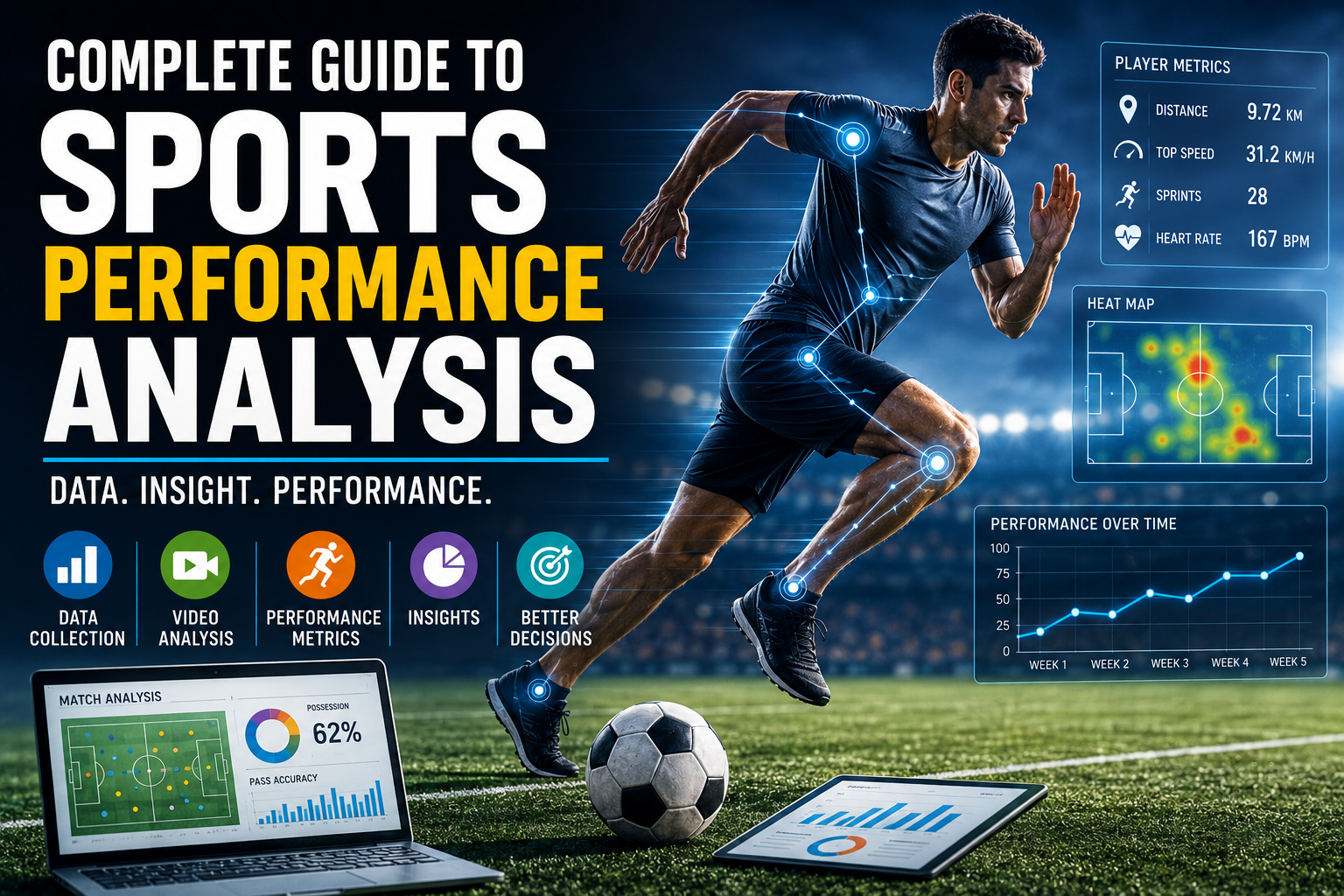
Complete Guide to Sports Performance Analysis
Sports performance is no longer evaluated solely by watching an athlete compete and relying on instinct.
Modern coaches, athletes and performance teams increasingly combine video, statistics, biomechanics, physiological measurements, tracking technology and expert observation to understand what is happening during training and competition.
This systematic approach is known as sports performance analysis.
Performance analysis can help identify strengths and weaknesses, evaluate technique, understand tactical decisions, monitor progress and provide objective feedback. The Australian Sports Commission describes it as a systematic way of recording performance so important elements can be quantified consistently. (Australian Sports Commission)
From professional football and basketball to athletics, swimming, tennis and individual strength sports, performance analysis has become an important part of evidence-based coaching.
But collecting data is only the beginning.
The real value comes from turning information into useful decisions.
What Is Sports Performance Analysis?
Sports performance analysis is the systematic collection, examination and interpretation of information about an athlete, team or competition to improve performance.
It can involve analyzing:
- Technical execution
- Tactical decisions
- Physical workload
- Movement patterns
- Physiological responses
- Skill development
- Competition statistics
- Opponent behavior
- Training progress
- Biomechanics
- Recovery
- Performance trends
The University of Calgary describes performance analysis as using data and information to help accelerate athlete performance, with successful systems depending on appropriate performance indicators, repeatable data collection and effective analysis. (Kinesiology University of Calgary)
The process can be as simple as reviewing match footage or as sophisticated as combining tracking data, force measurements, physiological information and machine-learning models.
Why Sports Performance Analysis Matters
Athletes and coaches constantly make decisions.
They need to determine:
- What should be trained?
- Which skills need improvement?
- Is an athlete becoming more efficient?
- Is training producing the desired adaptation?
- How demanding was a competition?
- What caused a particular performance problem?
- How does an opponent typically play?
- Is an athlete ready for the next competition?
Performance analysis provides evidence that can make these decisions more informed.
Sport Ireland notes that performance analysis can help monitor progress, track changes in performance variables and identify the strengths and weaknesses of both athletes and opponents. (Sport Ireland)
The Main Components of Performance Analysis
Although approaches vary between sports, most performance-analysis systems contain several major components.
1. Technical Analysis
Technical analysis examines how an athlete performs a specific skill or movement.
Examples include:
- Running technique
- Swimming stroke mechanics
- Tennis serve mechanics
- Golf swing
- Basketball shooting
- Soccer passing
- Baseball pitching
- Weightlifting technique
The goal is to identify characteristics associated with efficient and effective execution.
2. Tactical Analysis
Tactical analysis examines decisions and strategies used during competition.
In team sports, this can involve:
- Formation
- Positioning
- Passing patterns
- Defensive organization
- Pressing
- Transition play
- Set pieces
- Spacing
- Shot selection
In individual sports, tactical analysis can include:
- Shot selection
- Pacing
- Positioning
- Opponent patterns
- Energy management
- Competition strategy
3. Physical Performance Analysis
Physical analysis examines the demands placed on the athlete.
Depending on the sport, this may include:
- Distance
- Speed
- Acceleration
- Deceleration
- Sprint frequency
- Jumping
- Work duration
- Recovery periods
- Heart rate
- Training load
Wearable technologies and tracking systems have made this type of analysis increasingly accessible.
4. Statistical Analysis
Statistical analysis converts sporting events into measurable variables.
A basketball analyst might examine:
- Points
- Rebounds
- Assists
- Turnovers
- Shooting efficiency
- Possession efficiency
A soccer analyst could examine:
- Shots
- Passes
- Possession
- Expected goals
- Tackles
- Progressive passes
- Defensive actions
The important point is that statistics should answer meaningful performance questions rather than simply create larger spreadsheets.
5. Biomechanical Analysis
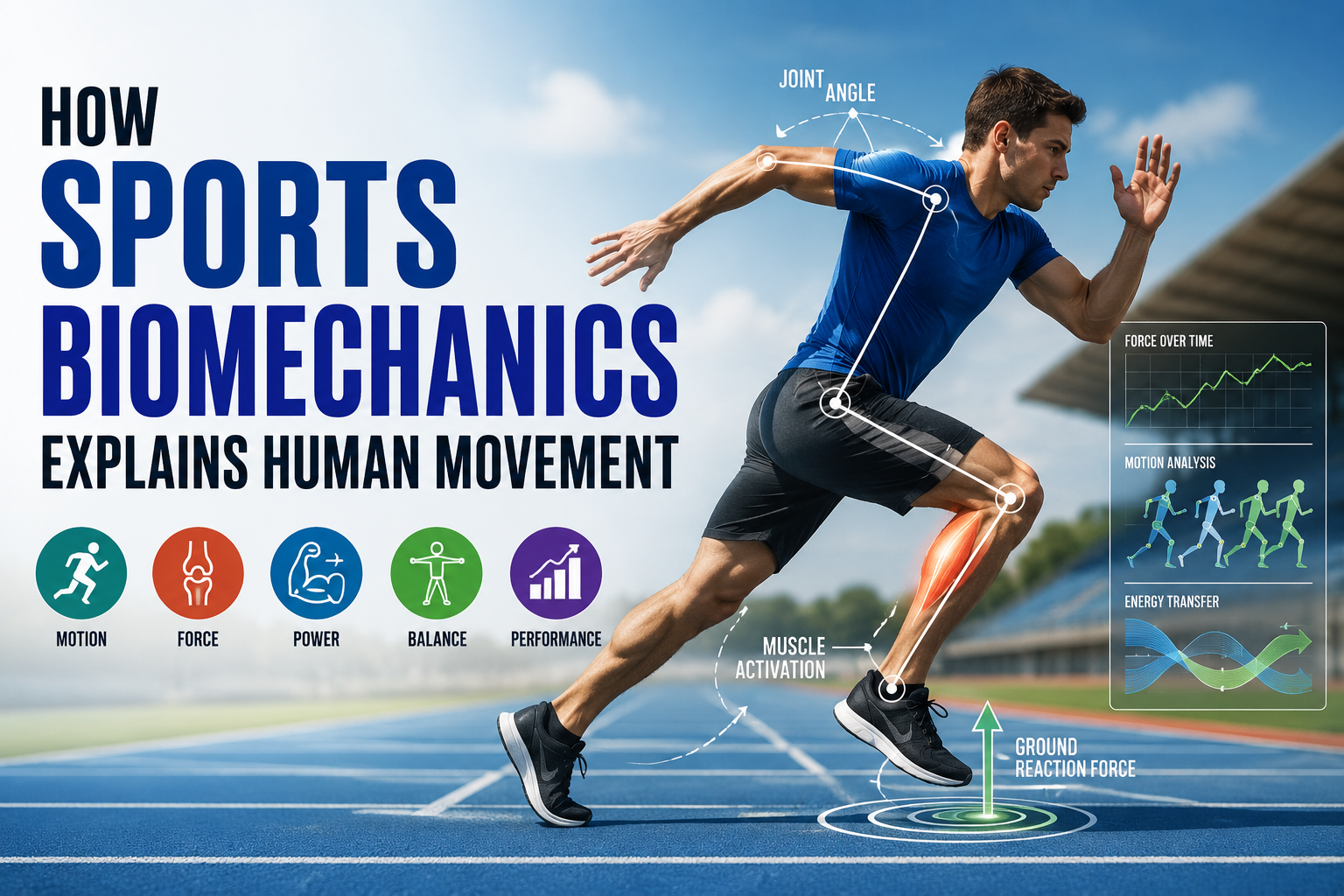
Biomechanics examines how the body moves and how forces act during sporting activities.
It can be used to investigate:
- Joint angles
- Movement patterns
- Force production
- Balance
- Ground reaction forces
- Technique efficiency
- Movement asymmetries
Sport Ireland notes that sports biomechanists may use tools such as high-speed cameras, three-dimensional cameras, force platforms and speed gates to analyze sporting movements. (Sport Ireland)
Video Analysis in Sports
Video remains one of the most useful performance-analysis tools.
A recording allows athletes and coaches to review events that are difficult to fully understand in real time.
Video can show:
- Positioning
- Timing
- Technique
- Decision-making
- Movement
- Tactical patterns
- Opponent behavior
The University of Calgary notes that video can capture athlete technique and team play, while specialized software can allow footage to be reviewed and analyzed in greater detail. (Kinesiology University of Calgary)
How Video Performance Analysis Works
A typical video-analysis workflow involves several stages.
Record
Capture training sessions or competitions from appropriate camera angles.
Organize
Label and store footage so relevant sequences can be found efficiently.
Identify
Mark important events or actions.
Analyze
Examine technical, tactical or physical characteristics.
Compare
Compare performances across athletes, sessions or competitions.
Communicate
Convert findings into practical feedback for athletes and coaches.
The final stage is particularly important.
A beautifully analyzed video has little value if the athlete doesn’t understand what should change.
What Is Athlete Tracking?
Athlete tracking involves measuring an athlete’s position, movement or physical activity over time.
Tracking systems can provide information such as:
- Distance traveled
- Speed
- Acceleration
- Deceleration
- Position
- Movement patterns
- High-speed running
- Workload
Modern tracking systems may use GPS/GNSS, local positioning systems, inertial sensors, optical tracking or combinations of technologies.
Research reviews have found that athlete tracking has become increasingly common in team sports, while also emphasizing that measurement validity and interpretation need careful consideration. (PubMed)
GPS and GNSS Performance Analysis
GPS-based systems are particularly common in outdoor field sports.
A wearable device can track an athlete’s movement during training or competition.
Depending on the system, analysts may examine:
- Total distance
- Running distance
- High-speed distance
- Sprint distance
- Maximum speed
- Accelerations
- Decelerations
- Position
- Work-to-rest patterns
Modern systems may use multiple satellite constellations, which is why the broader term GNSS, or Global Navigation Satellite System, is often more appropriate.
Why GPS Data Must Be Interpreted Carefully
Tracking technology doesn’t produce perfectly objective truth.
Measurements can be influenced by:
- Sampling frequency
- Device placement
- Satellite availability
- Signal quality
- Software processing
- Firmware
- Algorithms
- Movement type
- Speed
- Direction changes
A peer-reviewed review of athlete-tracking systems found substantial variation in validation methods and warned that certain systems can misrepresent distance or speed under some conditions. (PubMed)
Another review emphasizes that device specifications, sampling rates, positioning and processing methods can affect GPS and inertial-monitor measurements. (PubMed)
This means analysts should understand how a number was produced before interpreting what it means.
Wearable Sensors in Sports
Wearable technology can provide information about athlete movement and physiological responses.
Common technologies include:
- GPS/GNSS devices
- Accelerometers
- Gyroscopes
- Magnetometers
- Heart-rate monitors
- Inertial measurement units
- Local positioning systems
Some devices combine multiple sensors.
Inertial sensors are particularly useful because they can measure rapid changes in movement that satellite-based systems may not capture accurately.
External Load Versus Internal Load
One of the most important concepts in sports performance analysis is the difference between external load and internal load.
External Load
External load describes the physical work performed.
Examples include:
- Distance
- Speed
- Acceleration
- Deceleration
- Number of jumps
- Number of repetitions
- Duration of activity
Internal Load
Internal load describes how the athlete responds to that work.
Examples include:
- Heart rate
- Perceived exertion
- Physiological responses
- Subjective fatigue
Two athletes can perform exactly the same external workload while experiencing very different internal responses.
Research on athlete monitoring emphasizes this distinction when describing training-load analysis. (PubMed Central (PMC))
Understanding Training Load
Training load describes the stress imposed on an athlete by training or competition.
It can be considered from multiple perspectives.
Volume
How much work was completed?
Intensity
How hard was the work?
Frequency
How often is training performed?
Density
How closely are demanding sessions or competitions scheduled?
Internal Response
How did the athlete respond?
External Work
What physical workload was completed?
A useful performance-analysis system considers these dimensions rather than relying on a single number.
Rating of Perceived Exertion
Rating of perceived exertion, or RPE, is a subjective measure of how hard an athlete feels they worked.
For example, an athlete may rate a training session on a scale such as 1–10.
RPE can be valuable because it captures information that equipment may not fully measure.
An athlete might report unusually high perceived effort despite completing a normal external workload.
That discrepancy could prompt a coach or performance team to investigate recovery, fatigue, illness, stress or other factors.
Heart Rate Analysis
Heart rate is another common performance metric.
It can help assess:
- Exercise intensity
- Cardiovascular response
- Recovery
- Training response
- Session demands
Heart rate data becomes more useful when interpreted in context.
A high heart rate could reflect high exercise intensity, but other factors can influence heart rate as well.
Therefore, heart rate should rarely be interpreted in isolation.
Performance Metrics
A performance metric is a measurable variable used to describe some aspect of athletic performance.
Good metrics should be:
- Relevant
- Consistent
- Understandable
- Measurable
- Actionable
The goal isn’t to track everything.
It is to track what helps answer the most important performance questions.
Key Performance Indicators
A key performance indicator, or KPI, is a particularly important metric associated with a specific performance objective.
For example, a distance runner might focus on:
- Pace
- Split consistency
- Running economy
- Finishing speed
A soccer team might focus on:
- Chance creation
- Ball progression
- Defensive pressure
- Set-piece efficiency
KPIs should be specific to the sport, athlete and competitive objective.
Why More Data Doesn’t Always Mean Better Analysis
Modern technology can generate enormous amounts of information.
That creates a new problem:
Data overload.
A performance team may have thousands of measurements but only a handful of decisions to make.
The challenge is therefore not merely collecting data.
It is determining:
- Which variables matter?
- Which measurements are reliable?
- Which patterns are meaningful?
- Which findings can be acted upon?
- How should results be communicated?
The strongest systems prioritize useful information over impressive dashboards.
Statistical Analysis in Sports
Statistics can reveal patterns that aren’t immediately obvious through observation.
Analysts can examine:
- Averages
- Percentages
- Rates
- Distributions
- Trends
- Variability
- Correlations
- Probabilities
- Efficiency measures
More advanced analysis can incorporate:
- Regression
- Classification
- Time-series analysis
- Bayesian methods
- Machine learning
- Simulation
- Optimization
The appropriate method depends on the question.
Descriptive Versus Predictive Analytics
Descriptive Analytics
Descriptive analytics asks:
What happened?
Examples:
- How many shots did the team create?
- How far did an athlete run?
- How many turnovers occurred?
Predictive Analytics
Predictive analytics asks:
What might happen next?
Examples:
- How might a player perform under certain conditions?
- Which tactical pattern is likely to produce a scoring opportunity?
- How might workload change over time?
Predictive models can be useful, but predictions are not guarantees.
Machine Learning in Sports Analysis
Machine learning can identify patterns in large datasets that may be difficult to detect manually.
Potential applications include:
- Player evaluation
- Tactical classification
- Injury-risk research
- Performance prediction
- Automated event detection
- Opponent analysis
- Movement classification
- Scouting
Research in sports analytics has increasingly explored machine-learning and statistical approaches to player-tracking data, while also identifying methodological challenges. (Annual Reviews)
The important principle is that machine learning should support sound sporting questions rather than replace human expertise.
Artificial Intelligence and Performance Analysis
Artificial intelligence is increasingly being incorporated into sports-analysis workflows.
AI systems can potentially assist with:
- Video tagging
- Object tracking
- Player detection
- Pattern recognition
- Automated statistics
- Tactical analysis
- Report generation
- Searchable video archives
However, automated analysis still requires validation.
An algorithm can detect a pattern without understanding whether that pattern matters competitively.
Human interpretation remains essential.
Tactical Analysis
Tactical analysis examines how players and teams behave within the competitive environment.
In a team sport, analysts may study:
- Formation
- Shape
- Spacing
- Pressing
- Defensive lines
- Transitions
- Possession patterns
- Set plays
- Player interactions
Modern tracking data has expanded tactical analysis by allowing researchers to examine the positions of multiple players simultaneously rather than analyzing only the player in possession. (Annual Reviews)
Opponent Analysis
Performance analysis isn’t only about improving your own team.
It can also help identify opponent tendencies.
An analyst might examine:
- Preferred formations
- Attacking patterns
- Defensive weaknesses
- Set-piece routines
- Transition behavior
- Individual player tendencies
- Changes under pressure
The objective is to convert observation into preparation.
Individual Athlete Analysis
Individual sports require different analytical approaches.
For a sprinter, analysis might focus on:
- Reaction
- Acceleration
- Maximum velocity
- Stride characteristics
- Race splits
- Deceleration
For a swimmer:
- Stroke rate
- Stroke length
- Turn time
- Start
- Split times
- Finishing speed
For a tennis player:
- Serve percentage
- Serve placement
- Rally patterns
- Return position
- Unforced errors
- Point construction
The best performance indicators are always connected to the demands of the specific sport.
Biomechanics and Movement Analysis
Biomechanical analysis can reveal why a movement succeeds or fails.
For example, a coach may observe that an athlete consistently loses balance during a movement.
Biomechanical analysis could help investigate:
- Joint position
- Center of mass
- Force production
- Timing
- Range of motion
- Movement sequencing
This can help coaches design more targeted technical interventions.
Force Plates and Performance Analysis
Force platforms measure forces produced between an athlete and a surface.
They can be used to examine characteristics related to:
- Jumping
- Landing
- Strength
- Power
- Force production
- Asymmetry
- Explosiveness
They are particularly useful when coaches need information that ordinary video cannot provide.
Video shows what movement looks like.
Force measurement can provide information about what forces are involved.
Timing Gates
Timing gates can measure the time an athlete takes to travel between defined points.
They can be useful for:
- Sprint testing
- Acceleration testing
- Speed development
- Performance comparisons
Because timing gates measure time over a defined distance, they can provide a straightforward way to quantify sprint performance.
High-Speed Cameras
High-speed cameras can capture movements at much greater temporal resolution than ordinary video.
They can help analyze:
- Sprint mechanics
- Throwing
- Jumping
- Striking
- Swimming
- Technical movements
They are particularly valuable when an important movement occurs too quickly for the naked eye to analyze accurately.
Building an Effective Performance Analysis System
A successful performance-analysis program doesn’t begin with buying technology.
It begins with a question.
Step 1: Define the Objective
What are you trying to improve?
Step 2: Identify Relevant Variables
Which measurements actually relate to that objective?
Step 3: Select Appropriate Tools
Choose technology that can measure those variables reliably.
Step 4: Establish Consistent Procedures
Collect data in a repeatable manner.
Step 5: Analyze the Information
Look for meaningful patterns.
Step 6: Interpret the Findings
Determine what the results mean in sporting context.
Step 7: Communicate Clearly
Present findings in a way athletes and coaches can understand.
Step 8: Implement Changes
Turn analysis into training or tactical action.
Step 9: Reassess
Measure whether the intervention produced improvement.
This creates a continuous feedback loop.
The Performance Analysis Feedback Loop
A simple model is:
Observe → Measure → Analyze → Interpret → Act → Reassess
This cycle is more important than any individual piece of technology.
The purpose of analysis is ultimately to improve the next decision.
How Athletes Can Use Performance Analysis
Athletes can use analysis to understand their own performance more objectively.
It can help answer:
- What am I doing well?
- Where am I losing efficiency?
- Which technical mistakes occur repeatedly?
- How does my performance change under fatigue?
- Am I improving over time?
- How do I compare with my previous performances?
The most effective feedback is specific.
Instead of saying:
“You need to improve your technique.”
A coach might identify:
“Your body position changes during the final phase of the movement, which affects consistency.”
Specific observations create clearer opportunities for improvement.
How Coaches Use Performance Analysis
Coaches can use analysis to:
- Design training sessions
- Evaluate tactical systems
- Monitor athlete development
- Prepare for opponents
- Identify technical weaknesses
- Measure training effectiveness
- Communicate feedback
- Evaluate competition performance
Performance analysis can complement coaching experience rather than replace it.
How Performance Analysts Work With Coaches
A performance analyst should not operate independently from the coaching team.
The analyst needs to understand:
- The coach’s objectives
- The team’s tactical model
- The athlete’s role
- Competition demands
- The questions that need answering
The Australian Sports Commission emphasizes integrating performance analysis into the daily training environment and working directly with athletes, coaches and performance teams. (Australian Sports Commission)
Common Mistakes in Sports Performance Analysis
Measuring Everything
More metrics can create confusion.
Ignoring Data Quality
Unreliable measurements can lead to unreliable conclusions.
Treating Correlation as Causation
Two variables moving together doesn’t prove that one caused the other.
Comparing Incompatible Data
Different devices, methods or conditions may produce measurements that aren’t directly comparable.
Ignoring Individual Differences
Athletes respond differently to the same workload.
Focusing Only on Numbers
Context matters.
Producing Reports Nobody Uses
Analysis has little value if it doesn’t influence decisions.
Over-Automating Human Judgment
Technology can assist interpretation but shouldn’t automatically replace expertise.
Data Quality Matters
A performance-analysis system is only as useful as the quality of its measurements.
Important concepts include:
Validity
Does the measurement actually measure what it claims to measure?
Reliability
Does it produce consistent measurements under similar conditions?
Accuracy
How close is the measurement to the true value?
Repeatability
Can the procedure be performed consistently over time?
These concepts are particularly important when using wearable tracking systems.
Research has highlighted substantial differences in how athlete-tracking technologies are validated and the importance of caution when comparing measurements across systems. (PubMed)
Why Context Matters in Sports Data
A number rarely tells the entire story.
Suppose an athlete runs less distance during a match.
That could indicate:
- Reduced fitness
- Tactical instructions
- Different position
- Game state
- Opponent behavior
- Injury
- Fatigue
- Weather
- Coaching strategy
Without context, the number can be misleading.
Good analysis combines quantitative data with qualitative understanding.
Comparing Athletes With Performance Data
Comparisons can be useful but must be performed carefully.
Two athletes may have different:
- Positions
- Roles
- Playing times
- Tactical responsibilities
- Training histories
- Ages
- Physical characteristics
- Competition environments
Raw statistics can therefore produce misleading comparisons.
Normalized or context-adjusted metrics may provide a better picture.
Longitudinal Performance Analysis
One of the greatest strengths of data is the ability to examine changes over time.
Instead of asking:
“How did the athlete perform today?”
analysts can ask:
“How is the athlete developing?”
Longitudinal analysis can reveal:
- Trends
- Improvements
- Plateaus
- Declines
- Consistency
- Responses to training
Time-series approaches are increasingly relevant to athlete monitoring and performance management. (PubMed)
Performance Analysis and Injury Management
Performance data can contribute to broader athlete-management systems.
Monitoring workload and movement patterns may help teams understand how athletes respond to training and competition.
However, performance metrics should not be treated as a definitive injury prediction system.
Injury is complex and influenced by numerous factors.
Tracking data can contribute useful information to multidisciplinary decision-making, but medical assessment remains essential when injury or health concerns are involved.
Performance Analysis in Different Sports
The principles of analysis apply across sports, but the metrics change.
Football
Common areas include:
- Possession
- Passing
- Pressing
- Expected goals
- Progressive actions
- Sprinting
- Tactical positioning
Basketball
Analysis may focus on:
- Shot selection
- Offensive efficiency
- Defensive positioning
- Rebounding
- Ball movement
- Player tracking
Tennis
Analysts may examine:
- Serve placement
- Return effectiveness
- Rally length
- Court positioning
- Shot patterns
- Unforced errors
Athletics
Important variables may include:
- Split times
- Acceleration
- Maximum velocity
- Stride characteristics
- Jump height
- Throw distance
Swimming
Analysis may examine:
- Stroke rate
- Stroke length
- Turn performance
- Start performance
- Split times
- Efficiency
The underlying philosophy remains the same:
Measure what matters to performance.
Sports Analytics Versus Performance Analysis
These terms are closely related but aren’t always identical.
Sports analytics often refers broadly to statistical and computational analysis of sports data.
Performance analysis traditionally emphasizes the systematic analysis of athlete and team performance, including video, tactical observation and statistical information.
In modern sports environments, the boundaries increasingly overlap.
A performance department may combine:
- Video
- Tracking
- Statistics
- Biomechanics
- Machine learning
- Athlete monitoring
into one integrated system.
The Future of Sports Performance Analysis
The next generation of performance analysis is likely to become increasingly integrated.
Instead of separate systems for:
- Video
- GPS
- Heart rate
- Training data
- Match statistics
- Biomechanics
teams can increasingly combine multiple information streams.
This could create more comprehensive athlete profiles.
Artificial intelligence may also help automate parts of the process, including video tagging, pattern detection and data summarization.
However, the central challenge will remain the same:
How do we turn increasingly complex data into better decisions?
Real-Time Performance Analysis
Modern technology can make some information available during training or competition.
Real-time systems can potentially provide feedback about:
- Movement
- Workload
- Position
- Heart rate
- Tactical patterns
This can allow coaches to make adjustments during a session rather than waiting until afterward.
But real-time data can also become distracting.
Not every measurement needs immediate attention.
The Growing Role of Integrated Data
The future of sports performance analysis is likely to involve combining different types of evidence.
Imagine a system that connects:
Video + Tracking + Biomechanics + Physiological Data + Training History + Match Statistics
The resulting picture could be considerably more useful than any individual dataset.
But integration introduces new challenges around:
- Data compatibility
- Privacy
- Standardization
- Measurement quality
- Interpretation
- Storage
- Security
Data Privacy in Sports
Athlete data can be highly sensitive.
Performance systems may contain information about:
- Physical condition
- Training history
- Recovery
- Medical status
- Performance weaknesses
- Tactical information
Organizations need appropriate policies governing:
- Data access
- Storage
- Sharing
- Ownership
- Retention
- Security
The more sophisticated performance technology becomes, the more important responsible data governance becomes.
How to Become a Sports Performance Analyst
A career in performance analysis can combine sport knowledge with technology and data skills.
Useful areas to study include:
- Sports science
- Statistics
- Data analysis
- Video analysis
- Biomechanics
- Physiology
- Programming
- Visualization
- Tactical analysis
Practical experience is equally valuable.
Aspiring analysts can build experience by:
- Recording local competitions
- Analyzing amateur teams
- Creating sample reports
- Learning video-analysis software
- Studying statistics
- Building dashboards
- Practicing observational analysis
Skills of an Excellent Performance Analyst
Technical knowledge is only one part of the job.
Strong analysts also need:
Curiosity
Ask better questions.
Communication
Explain complex information simply.
Critical Thinking
Challenge assumptions and investigate alternative explanations.
Sporting Knowledge
Understand how the sport actually works.
Attention to Detail
Notice small but meaningful patterns.
Data Literacy
Understand the limitations of measurements.
Collaboration
Work effectively with coaches, athletes and multidisciplinary teams.
Frequently Asked Questions About Sports Performance Analysis
What Is Sports Performance Analysis?
It is the systematic collection and interpretation of information about athletic performance to identify improvements, understand strengths and weaknesses and support better coaching decisions.
What Tools Are Used in Performance Analysis?
Common tools include video cameras, analysis software, GPS/GNSS trackers, inertial sensors, heart-rate monitors, force platforms, timing gates and statistical software. (Kinesiology University of Calgary)
Why Is Video Analysis Important?
Video allows coaches and analysts to review technique, positioning, decision-making and tactical behavior that may be difficult to evaluate accurately in real time.
What Is Athlete Monitoring?
Athlete monitoring involves collecting information about training, competition, physical workload and athlete responses over time.
What Is External Training Load?
External load describes the physical work performed, such as distance, speed, accelerations or repetitions. (PubMed Central (PMC))
What Is Internal Training Load?
Internal load describes how the athlete responds to the work, including measures such as heart rate and perceived exertion.
Is GPS Always Accurate?
No. GPS/GNSS measurements can be affected by device characteristics, sampling frequency, signal conditions, movement patterns and data-processing methods. (PubMed)
Can AI Replace Sports Analysts?
AI can automate parts of performance analysis, but human expertise remains important for understanding context, validating findings and translating information into appropriate sporting decisions.
Turning Data Into Better Sporting Decisions
Sports performance analysis has evolved from manual observation and basic statistics into a sophisticated discipline combining science, technology and coaching expertise.
Yet the fundamental purpose hasn’t changed.
The goal isn’t to collect the most data.
The goal is to understand performance well enough to make better decisions.
A coach who knows exactly what an athlete needs to improve can design more targeted training. An athlete who understands a recurring technical weakness can work on it deliberately. A team that understands an opponent’s tendencies can prepare more effectively.
The best performance-analysis systems therefore create a continuous connection between measurement and action:
Question → Measure → Analyze → Understand → Act → Reassess
Technology will continue making it possible to collect more information, track more movements and analyze increasingly complex sporting environments.
But the competitive advantage will belong to the athletes and teams that can distinguish meaningful information from noise—and turn reliable evidence into practical improvements.
That is ultimately what makes sports performance analysis so powerful: it transforms performance from something we simply watch into something we can systematically understand, evaluate and improve.



2 Comments
Micle harison
June 7, 2019Lorem ipsum dolor sit amet, usu ut perfecto postulant deterruisset, libris causae volutpat at est, ius id modus laoreet urbanitas. Mel ei delenit dolores.
John Doe
June 7, 2019Some consultants are employed indirectly by the client via a consultancy staffing company.