
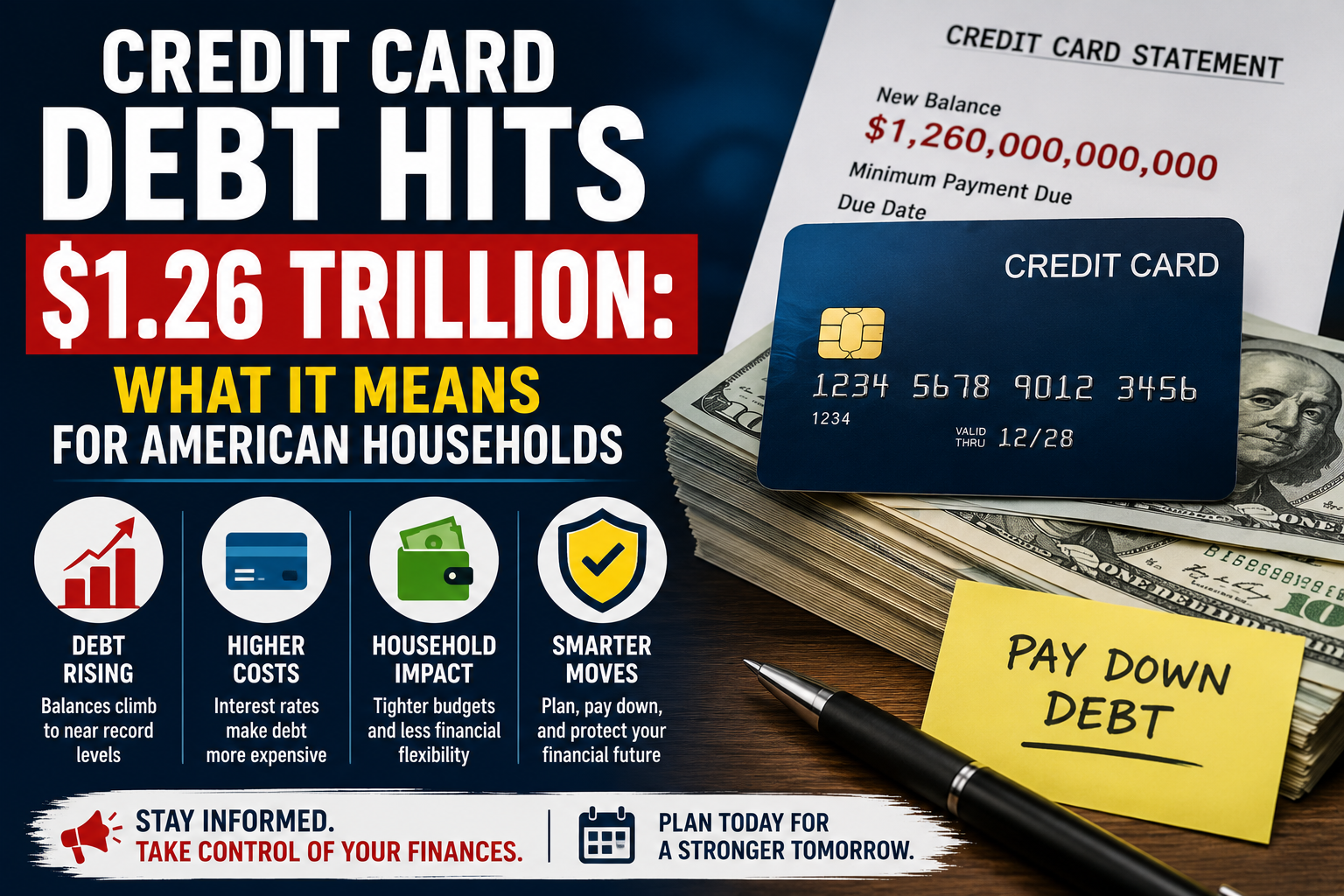
Credit Card Debt Hits $1.26 Trillion: What It Means for American Households
U.S. consumers are carrying an enormous credit-card balance into the second half of 2026, with outstanding credit-card debt reaching roughly $1.26 trillion in the second quarter, according to the Federal Reserve Bank of New York’s latest household debt data.
The figure is close to the record $1.28 trillion reached at the end of 2025. More importantly, the latest increase comes as many households continue to deal with elevated everyday costs and expensive revolving credit.
The result is a financial environment in which credit cards can provide an important source of short-term flexibility while simultaneously becoming a significant long-term burden for households that carry balances from month to month.
Here’s what the latest numbers mean—and why the headline figure doesn’t tell the whole story.
Credit Card Debt Climbed Again in the Second Quarter
Credit-card balances increased by approximately $21 billion in the second quarter, bringing the total to around $1.26 trillion. That follows a seasonal decline during the first quarter, when balances fell by $25 billion to $1.25 trillion. (Federal Reserve Bank of New York)
The latest increase puts outstanding card debt only slightly below the record set in late 2025.
At the same time, overall U.S. household debt remained around $18.8 trillion, meaning credit-card balances represent only one part of a much larger household borrowing picture. Mortgage debt remains by far the largest category, while auto loans and student loans also account for substantial balances. (Federal Reserve Bank of New York)
That distinction matters.
A $1.26 trillion national credit-card balance doesn’t mean every American household is struggling with credit-card debt. Aggregate figures combine households with very different incomes, savings levels, credit profiles and borrowing patterns.
The more important question is who is carrying balances and whether those balances are becoming harder to repay.
Why the $1.26 Trillion Figure Matters
Credit-card debt is different from many other forms of household borrowing.
A mortgage is generally tied to an asset and paid over decades. An auto loan finances a specific purchase over a predetermined period.
Credit cards are revolving debt.
Consumers can borrow, repay, borrow again and carry balances forward.
That flexibility is useful—but it can become expensive when balances remain unpaid.
For a household carrying a balance at a high interest rate, making only minimum payments can cause a relatively modest original purchase to remain on the account for a long time.
This creates a potentially damaging cycle:
Higher balances → more interest → larger payments → less disposable income → greater reliance on credit.
That’s why the national balance deserves attention even though the headline number alone doesn’t prove that American households are in a financial crisis.
Credit-Card Debt Is Rising Even as Total Household Debt Is Relatively Stable
One of the more interesting aspects of the latest data is that credit-card debt is moving differently from some other categories.
The New York Fed reported that total household debt was essentially unchanged at about $18.8 trillion in the first quarter, while credit-card balances subsequently moved higher in the second quarter. (Federal Reserve Bank of New York)
Auto-loan balances have also continued to grow.
That suggests the current borrowing environment isn’t simply a story of households taking on more of every type of debt.
Instead, different categories are behaving differently depending on consumer demand, interest rates, lending conditions and household finances.
The Bigger Concern Is the Cost of Carrying a Balance
The total amount of credit-card debt is only part of the story.
For consumers who pay their statement balance in full every month, a credit card can function primarily as a payment tool.
For consumers who carry balances, interest can become a major expense.
Consider a simplified example.
Suppose someone carries a $5,000 balance on a card with a hypothetical 25% annual percentage rate and makes no additional purchases.
The first month’s interest alone would be roughly:
$5,000 × 25% ÷ 12 = $104.17
That’s more than $100 in interest in one month before the principal is reduced.
Real credit-card calculations can differ because issuers generally calculate interest according to the terms of the card agreement and daily balances.
But the example illustrates why high-rate revolving debt can become difficult to eliminate.
Inflation Can Make Credit-Card Debt More Difficult to Manage
One reason credit cards can become more important to households is that people still have to pay for everyday necessities even when their budgets are under pressure.
Consumers may use revolving credit for:
- Groceries
- Utilities
- Transportation
- Medical expenses
- Home repairs
- Education costs
- Emergency expenses
- Travel
- Household purchases
When income doesn’t keep pace with expenses, credit can temporarily bridge the gap.
But borrowing to cover recurring expenses is fundamentally different from borrowing for a one-time purchase.
If a household repeatedly spends more than it earns and covers the difference with a credit card, the balance can continue growing.
The New York Fed’s consumer-expectations surveys show that households have continued to anticipate relatively strong spending growth while also reporting concerns about their financial situations and future access to credit. (Federal Reserve Bank of New York)
That combination is worth watching.
Credit-Card Delinquencies Tell a More Complicated Story
The headline debt number might sound alarming, but delinquency data provide a more nuanced picture.
In the first quarter of 2026, the New York Fed reported that the annual flow of credit-card balances transitioning into early delinquency was 8.6%, down slightly from 8.7% in the previous quarter. The flow into serious delinquency was broadly stable. (Federal Reserve Bank of New York)
That means rising balances shouldn’t automatically be interpreted as evidence that consumers are suddenly unable to repay their debts.
However, serious delinquency remains an important issue.
New York Fed researchers have also highlighted complications in interpreting long-term delinquency figures because charged-off balances can remain visible on credit reports for extended periods.
In other words, the share of balances reported as seriously delinquent can reflect both current repayment problems and older debt that remains on credit reports.
This distinction is essential when evaluating the health of American consumers.
Why Credit Limits Matter Too
Another important piece of the story is credit availability.
The New York Fed reported that aggregate credit-card limits increased by $60 billion during the first quarter of 2026. (Federal Reserve Bank of New York)
That means lenders were not simply allowing consumers to borrow more because existing balances were rising.
Available credit was expanding as well.
For consumers, a higher credit limit can provide additional financial flexibility.
But it can also increase the amount of debt a household could potentially accumulate.
A larger credit limit is therefore not the same thing as greater financial security.
Higher Credit Limits Can Have Two Very Different Effects
Imagine two consumers who each receive a credit-limit increase.
Consumer A
The consumer continues paying the statement balance in full every month.
The higher limit provides additional emergency capacity without necessarily creating additional interest costs.
Consumer B
The consumer is already carrying a balance and begins spending more because additional credit is available.
The higher limit can then contribute to even greater debt.
The same financial product can therefore have very different consequences depending on how it is used.
What Rising Credit-Card Debt Means for Household Budgets
For households carrying balances, the biggest effect isn’t necessarily the size of the debt itself.
It’s the monthly cash flow consumed by that debt.
Suppose a household has:
- $5,000 in credit-card debt
- $600 in monthly debt payments
- $4,500 in monthly take-home income
That $600 represents more than 13% of take-home pay.
That money can’t simultaneously be used for:
- Emergency savings
- Retirement contributions
- Housing costs
- Food
- Transportation
- Education
- Other financial goals
As debt payments consume more of a household’s income, financial flexibility declines.
This is why credit-card debt can become particularly problematic during periods of unexpected expenses.
Minimum Payments Can Create a False Sense of Progress
One of the most important concepts for cardholders to understand is the difference between making a payment and making meaningful progress.
A minimum payment can keep an account current without substantially reducing the principal.
Suppose a cardholder has a large balance and a high interest rate.
If the minimum payment is only slightly above the interest being charged, the balance may decline very slowly.
That’s why consumers trying to escape credit-card debt should focus on the interest rate, balance and repayment strategy, rather than simply asking whether they made the required minimum payment.
The minimum payment is designed to keep the account from becoming delinquent—not necessarily to eliminate the balance quickly.
The Most Important Number May Be Your APR
Two households can have identical credit-card balances but very different financial situations.
Consider:
| Household A | Household B | |
|---|---|---|
| Card balance | $5,000 | $5,000 |
| APR | 15% | 29% |
| Monthly interest at starting balance* | ~$62.50 | ~$120.83 |
| New purchases | None | None |
*Simplified illustration; actual card interest calculations vary.
The household with the higher APR can face substantially greater interest costs even though the outstanding balance is identical.
That’s why anyone carrying credit-card debt should review the interest rate on every account.
What Consumers Can Do About Rising Credit-Card Debt
National debt statistics don’t determine what happens to an individual household.
There are practical steps consumers can take to reduce their exposure to revolving debt.
1. Stop Adding to the Balance
It’s difficult to eliminate credit-card debt if new purchases continually replace payments.
Where possible, use cash or a debit account for everyday spending while aggressively paying down existing revolving balances.
2. List Every Card
Create a simple debt inventory:
| Card | Balance | APR | Minimum Payment |
|---|---|---|---|
| Card A | $3,500 | 24.99% | $105 |
| Card B | $2,100 | 19.99% | $63 |
| Card C | $800 | 29.99% | $30 |
Seeing the entire picture can make repayment decisions much easier.
3. Prioritize High-Interest Debt
Two common strategies are the avalanche method and snowball method.
The avalanche method directs additional money toward the highest-interest debt first.
The snowball method focuses on the smallest balance first to create quicker psychological wins.
Both can work.
The best method is often the one a household can consistently follow.
4. Pay More Than the Minimum
Even a modest additional payment can reduce the amount of time a balance remains outstanding.
The impact becomes more significant when the additional payment is maintained every month.
5. Avoid Using One Card to Hide Another
Moving debt around doesn’t necessarily eliminate it.
Balance transfers can sometimes reduce interest costs, but consumers need to understand promotional periods, transfer fees and the rate that applies afterward.
6. Build an Emergency Fund
An emergency fund can reduce the need to reach for a credit card when an unexpected expense arrives.
Even a small cash reserve can provide a buffer.
7. Contact Your Card Issuer Early
Consumers struggling to make payments should consider contacting their card issuer before missing payments.
Depending on the circumstances, the issuer may have hardship or repayment options.
Should Americans Be Worried About $1.26 Trillion in Credit-Card Debt?
The answer isn’t as simple as yes or no.
The number is undeniably large, and it is close to the record level reached at the end of 2025.
But aggregate debt doesn’t tell us whether every household is financially stressed.
Some consumers carry no revolving balance.
Others pay their cards in full each month.
Some households may have substantial savings and high incomes alongside credit-card balances.
Others may rely heavily on credit to cover basic expenses.
The distribution matters.
The New York Fed’s broader household data show why it is important to look at balances, credit access and delinquency trends together rather than relying on one headline statistic. (Federal Reserve Bank of New York)
The Role of Interest Rates
Interest rates are particularly important for consumers who carry balances.
When borrowing costs remain high, existing revolving debt can become more expensive to service.
This can create a difficult feedback loop:
Higher interest costs → larger monthly payments → less disposable income → greater reliance on credit.
Consumers who are already carrying balances therefore have a strong incentive to understand exactly what their cards are costing them.
At the same time, people should be cautious about assuming that future changes in interest rates will automatically solve their debt problems.
A lower-rate environment could eventually reduce borrowing costs for some consumers, but the underlying balance still has to be repaid.
What This Means for the Broader U.S. Economy
Credit-card borrowing can provide useful support for consumer spending.
That can matter because household consumption represents a major part of overall economic activity.
But debt-financed spending has limits.
If households increasingly rely on credit because income isn’t sufficient to cover expenses, eventually debt-service costs can constrain future spending.
That creates a delicate balance.
Credit can support consumption today while reducing financial flexibility tomorrow.
The current data don’t indicate that the entire U.S. consumer sector is collapsing. In fact, many delinquency measures have remained relatively stable.
But the continued size of revolving debt is a signal worth watching—particularly alongside household income, employment conditions, spending expectations and delinquency trends.
A $1.26 Trillion Problem Looks Different at the Household Level
National debt figures are useful because they reveal broad trends.
But personal finance decisions happen at the household level.
For one family, a $5,000 credit-card balance might be manageable.
For another, it could represent several months of disposable income.
The appropriate response is therefore not to panic because a national statistic crossed a particular threshold.
Instead, households should ask:
- How much credit-card debt do we have?
- What are our APRs?
- How much interest are we paying each month?
- Are we adding new debt?
- How much of our income goes toward debt payments?
- Do we have emergency savings?
- Could an unexpected expense force us to borrow more?
Those questions provide a much clearer picture of financial health.
The Next Credit-Card Debt Test for American Households
The latest $1.26 trillion figure is a reminder that credit remains deeply embedded in American household finances.
The important issue isn’t simply whether credit-card balances rise or fall by a few billion dollars from one quarter to the next.
It’s whether households can service their existing debt without sacrificing their ability to save, pay essential expenses and absorb financial shocks.
The latest data offer a mixed picture: credit-card balances have climbed close to their recent record, while several delinquency measures have remained relatively stable. (Barron’s)
For individual consumers, the lesson is more practical than alarming. A credit card can be a useful financial tool when balances are controlled, but high-interest revolving debt can quickly turn today’s spending into tomorrow’s budget problem.
For households already carrying balances, the most valuable number isn’t the national $1.26 trillion total.
It’s the balance on their own statement—and how much of it they can eliminate this month.
This article is for general informational purposes and does not constitute individualized financial advice. Credit-card terms, interest rates and hardship options vary by issuer and consumer circumstances.


2 Comments
Micle harison
June 7, 2019Lorem ipsum dolor sit amet, usu ut perfecto postulant deterruisset, libris causae volutpat at est, ius id modus laoreet urbanitas. Mel ei delenit dolores.
John Doe
June 7, 2019Some consultants are employed indirectly by the client via a consultancy staffing company.