
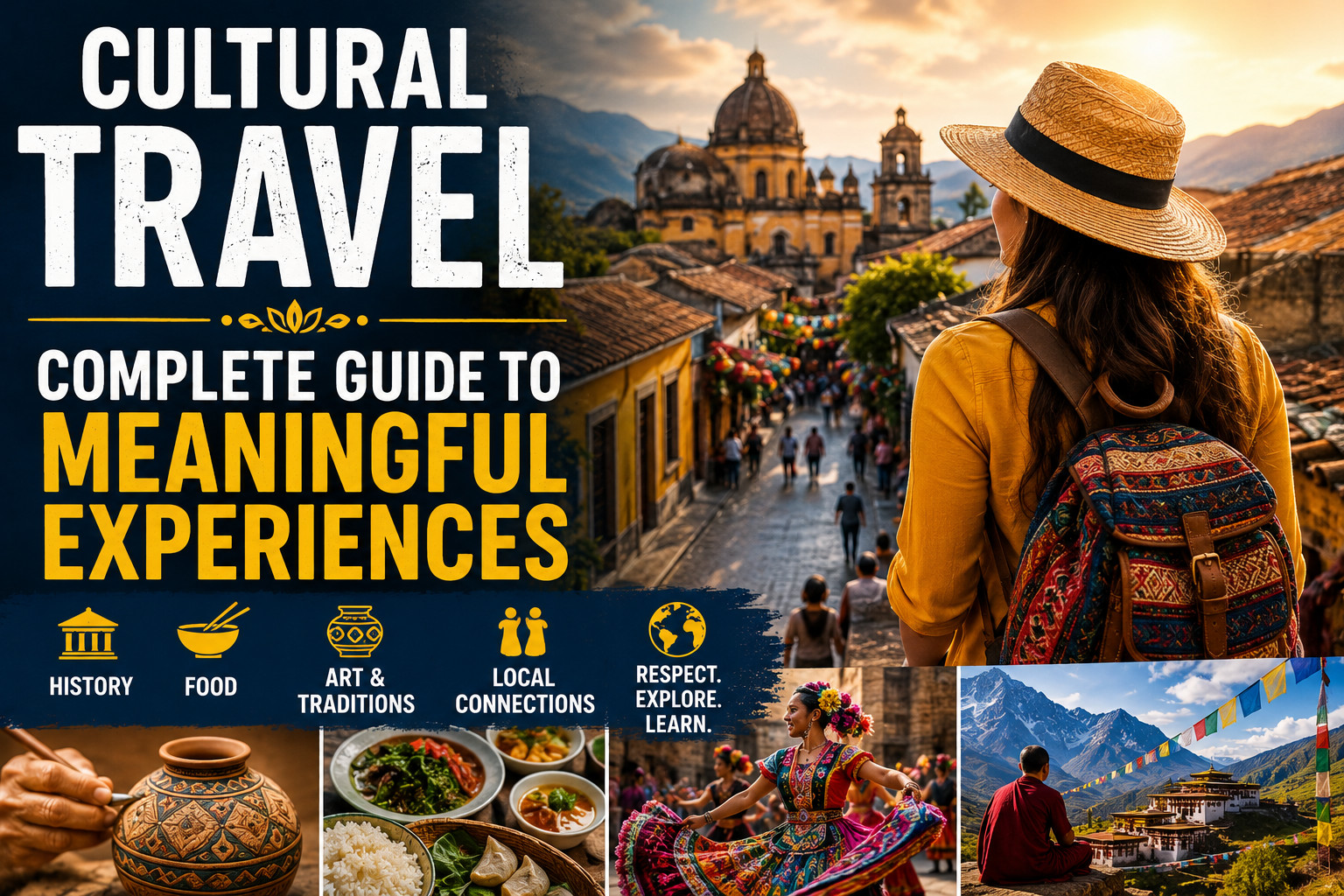
Cultural Travel: Complete Guide to Meaningful Experiences
Travel can be much more than visiting famous landmarks, taking photographs and checking destinations off a list.
Cultural travel offers a deeper way to explore the world by connecting travelers with the history, traditions, food, art, language, communities and everyday life of the places they visit.
Instead of simply asking, “What can I see here?” cultural travelers often ask, “What can I learn here?”
That shift can transform a trip.
A visit to a historic neighborhood becomes an opportunity to understand its origins. A meal becomes a window into local traditions. A conversation with a resident can reveal perspectives that no guidebook can fully capture.
This complete guide explains what cultural travel is, why it matters, how to plan meaningful experiences, how to travel respectfully and how to create memorable journeys without turning local cultures into tourist attractions.
What Is Cultural Travel?
Cultural travel is a form of tourism centered on experiencing and understanding the culture of a destination.
It can involve exploring:
- History
- Food
- Music
- Art
- Architecture
- Language
- Religion
- Traditional crafts
- Festivals
- Literature
- Local communities
- Indigenous traditions
- Everyday lifestyles
- Historic sites
- Museums
- Cultural landscapes
Cultural travel doesn’t require an expensive international trip.
You can experience culture in a neighboring town, another region of your country or a different neighborhood within your own city.
The defining characteristic is meaningful engagement with place and people.
Why Cultural Travel Matters
Travel can broaden perspectives by exposing people to ways of living that differ from their own.
Cultural experiences can help travelers:
- Understand different historical perspectives
- Discover unfamiliar traditions
- Learn about local communities
- Develop greater cultural awareness
- Appreciate regional food and craftsmanship
- Challenge assumptions and stereotypes
- Build meaningful memories
- Support local businesses
- Develop a deeper connection with destinations
Cultural travel can also benefit destinations when tourism revenue reaches local communities rather than being concentrated entirely in large international businesses.
Cultural Travel Versus Conventional Tourism
Traditional tourism isn’t necessarily superficial.
Visiting major attractions, relaxing at resorts or taking organized tours can all be valuable.
The difference is primarily in the traveler’s approach.
| Conventional Sightseeing | Cultural Travel |
|---|---|
| Focuses heavily on attractions | Focuses on people and place |
| Often follows popular routes | May explore less-obvious areas |
| Prioritizes seeing | Prioritizes understanding |
| Can be highly structured | Can involve spontaneous experiences |
| Often emphasizes landmarks | Includes everyday culture |
| Short interactions are common | Deeper engagement is encouraged |
The two approaches can easily coexist.
A traveler might visit a famous monument in the morning and spend the afternoon learning how local artisans make traditional crafts.
What Makes a Travel Experience Meaningful?
A meaningful travel experience doesn’t necessarily have to be expensive, exclusive or unusual.
It usually involves some combination of:
- Genuine interaction
- Curiosity
- Learning
- Respect
- Context
- Personal reflection
- Connection to local communities
For example, eating at a small family-owned restaurant and learning about the origins of a regional dish may be more culturally meaningful than dining at an expensive international hotel.
The goal isn’t to collect experiences.
It’s to understand them.
The Major Types of Cultural Travel
Cultural travel can take many forms.
Historical Travel
Historical travel focuses on understanding the events, people and civilizations that shaped a destination.
It may include:
- Ancient ruins
- Historic cities
- Museums
- Battlefields
- Archaeological sites
- Historic homes
- Monuments
- Archives
A good historical experience goes beyond dates and names.
It connects physical places to the people who lived through the events.
Culinary Travel
Food is one of the most accessible ways to experience culture.
Culinary travel can include:
- Local restaurants
- Markets
- Cooking classes
- Food tours
- Traditional recipes
- Farms
- Bakeries
- Street food
- Regional ingredients
Food often reflects geography, migration, religion, economics and history.
Understanding why people eat certain foods can reveal far more about a culture than simply tasting them.
Art and Craft Travel
Art and craftsmanship can provide insight into a community’s identity.
Travelers might explore:
- Galleries
- Museums
- Craft markets
- Pottery workshops
- Textile studios
- Sculpture
- Woodworking
- Jewelry making
- Traditional painting
Whenever possible, buying directly from independent artisans can provide a more meaningful connection while supporting local creative economies.
Music and Performing Arts
Music can reveal cultural history and identity in ways that don’t require fluency in a language.
Cultural travelers may attend:
- Traditional performances
- Local concerts
- Dance performances
- Theater
- Community events
- Music workshops
The best experiences often involve learning about the meaning behind the performance rather than simply watching it.
Religious and Spiritual Heritage
Religious sites can provide important insight into a destination’s history and traditions.
Examples include:
- Temples
- Churches
- Mosques
- Synagogues
- Shrines
- Monasteries
- Sacred landscapes
Visitors should research appropriate behavior before entering religious spaces.
Dress requirements, photography rules, prayer areas and visitor restrictions can vary considerably.
Indigenous Cultural Experiences
Indigenous cultures are an important part of many destinations.
Responsible cultural travel should avoid treating Indigenous communities as spectacles.
Instead, travelers should prioritize experiences led by Indigenous people themselves, particularly when communities control how their traditions and knowledge are shared.
This might include:
- Indigenous-guided tours
- Cultural centers
- Traditional crafts
- Storytelling
- Food experiences
- Language programs
- Community museums
Respect for cultural ownership and local rules should come before the traveler’s desire for an unusual experience.
How to Plan a Cultural Trip
Meaningful cultural travel often begins before the journey itself.
Step 1: Research the Destination
Learn basic information about:
- History
- Languages
- Religion
- Social customs
- Local food
- Dress norms
- Cultural etiquette
- Political history
- Important communities
- Sensitive historical issues
You don’t need to become an expert.
A little preparation can dramatically improve your interactions.
Step 2: Learn Basic Local Phrases
Even learning a few phrases can make a difference.
Useful expressions include:
- Hello
- Please
- Thank you
- Excuse me
- Goodbye
- How much?
- Where is…?
- Do you speak English?
- I’m sorry
Language isn’t simply a practical tool.
It demonstrates that you’re making an effort to engage with the local environment.
Step 3: Research Local Experiences
Look beyond the most popular attractions.
Consider:
- Local markets
- Neighborhood walking tours
- Community museums
- Independent restaurants
- Artisan workshops
- Cultural centers
- Local guides
- Cooking classes
- Traditional performances
Search for experiences that give local residents an active role rather than simply putting them on display.
Why Local Guides Can Transform Cultural Travel
A local guide can provide context that isn’t available from a standard travel itinerary.
They may explain:
- Why a neighborhood developed in a particular way
- The history behind a monument
- Local traditions
- Regional foods
- Family customs
- Cultural changes
- Stories that aren’t widely documented
A knowledgeable local guide can also help visitors avoid accidental cultural mistakes.
However, travelers should choose guides carefully and prioritize legitimate, community-oriented operators.
How to Experience Local Food Respectfully
Food is a major part of cultural travel, but approaching it with curiosity is important.
Instead of asking only:
“What is the most famous dish?”
consider asking:
- Why is this dish important?
- When is it traditionally eaten?
- Where did the recipe originate?
- What ingredients are locally produced?
- Does the dish have religious or cultural significance?
- How has the recipe changed over time?
A meal becomes much more meaningful when you understand its context.
Exploring Local Markets
Markets are among the best places to observe everyday life.
Depending on the destination, markets can reveal:
- Local ingredients
- Agricultural traditions
- Clothing
- Crafts
- Regional foods
- Trading practices
- Seasonal products
- Social interactions
However, remember that a market is primarily a place where people live and work—not a museum.
Avoid blocking vendors, photographing people without permission or treating ordinary activities as entertainment.
How to Photograph People Respectfully
Photography can preserve wonderful travel memories, but people deserve privacy and dignity.
When photographing someone directly, especially in a close-up portrait, asking permission is often the best approach.
Be particularly careful around:
- Children
- Religious ceremonies
- Funerals
- Medical situations
- Vulnerable communities
- Private homes
- Sacred rituals
A photograph may take only seconds to create, but the person being photographed lives with the image and its consequences.
Cultural Etiquette Every Traveler Should Understand
There is no universal set of cultural rules.
Customs differ from one destination to another.
However, several principles are broadly useful.
Observe Before Acting
Watch how local people behave.
Dress Appropriately
Research expectations for religious and cultural sites.
Ask Before Photographing
Especially when photographing individuals or ceremonies.
Avoid Mocking Customs
Something unfamiliar isn’t automatically strange or inferior.
Respect Personal Space
Physical boundaries vary between cultures.
Don’t Assume Everyone Speaks Your Language
Be patient and use translation tools when necessary.
Learn Table Manners
Eating customs can differ significantly.
Respect Sacred Spaces
Follow posted rules and local guidance.
Cultural Immersion Without Disrespect
The phrase “cultural immersion” is popular in travel marketing, but genuine immersion requires humility.
You are entering a place that other people call home.
That means the experience shouldn’t be structured entirely around what the visitor wants.
Instead, ask:
How can I participate respectfully?
This mindset changes everything from photography to shopping to conversations.
Avoiding the “Tourist Gaze”
One of the problems with poorly managed cultural tourism is the tendency to turn communities into attractions.
Travelers may unintentionally reduce people to stereotypes such as:
- “Traditional villagers”
- “Exotic locals”
- “Authentic tribes”
- “Old-fashioned communities”
These descriptions can oversimplify complex societies.
Local people have modern lives, ambitions, disagreements, professions and diverse identities just like everyone else.
Culture is not frozen in the past.
What Does “Authentic” Travel Really Mean?
Travel marketing often promises “authentic experiences.”
But authenticity isn’t always easy to define.
A traditional restaurant that has served tourists for decades can still be culturally meaningful.
A modern café can also represent local culture.
Cultures naturally change.
Instead of asking whether something is “authentic enough,” consider asking:
- Is it locally rooted?
- Who created the experience?
- Who benefits financially?
- Is the community represented fairly?
- Does the experience provide meaningful context?
This produces a more nuanced understanding of culture.
Responsible Cultural Tourism
Responsible travel attempts to reduce negative effects while increasing benefits for destinations and communities.
Travelers can contribute by:
- Supporting local businesses
- Hiring local guides
- Buying locally produced goods
- Staying at locally owned accommodations
- Respecting community rules
- Avoiding exploitative experiences
- Reducing waste
- Learning local etiquette
- Spending money beyond major tourist chains
The objective isn’t to travel perfectly.
It’s to travel thoughtfully.
Supporting Local Businesses
Where possible, spend part of your travel budget with independent local businesses.
Examples include:
- Family-owned restaurants
- Local guesthouses
- Independent tour companies
- Artisan workshops
- Small cafés
- Local transportation providers
- Community cultural centers
This can help tourism revenue circulate within the destination.
How to Choose Ethical Cultural Experiences
Before booking an experience, ask several questions.
Who Owns the Business?
Is it locally owned?
Who Leads the Experience?
Are local residents directly involved?
Who Gets Paid?
Does the revenue reach the people whose culture is being presented?
How Are People Represented?
Does the experience treat communities with dignity?
Is Consent Clear?
Especially when the experience involves photography, homes, ceremonies or vulnerable people.
Is Cultural Knowledge Being Commercialized Responsibly?
Some traditions and knowledge may not be appropriate for public display.
Cultural Travel With Children
Cultural travel can be particularly valuable for families.
Children can learn through:
- Museums
- Markets
- Cooking classes
- Storytelling
- Historical sites
- Local crafts
- Language activities
- Cultural performances
The best experiences are age-appropriate and interactive.
Instead of giving children a long historical lecture, encourage them to ask questions and observe.
Cultural Travel on a Budget
Meaningful travel doesn’t require a large budget.
Affordable cultural experiences can include:
- Walking tours
- Public markets
- Free museums
- Local festivals
- Public parks
- Neighborhood exploration
- Libraries
- Community events
- Self-guided historical walks
- Local food stalls
Some of the most memorable experiences may cost very little.
Slow Travel and Cultural Connection
Slow travel emphasizes spending more time in fewer places.
Instead of visiting five cities in a week, a traveler might spend several days or weeks exploring one location.
This allows more opportunities to:
- Learn local routines
- Return to favorite businesses
- Build relationships
- Explore beyond tourist centers
- Understand neighborhood differences
- Become familiar with local transportation
Time creates opportunities that rushed itineraries often eliminate.
Why Staying Longer Can Improve Cultural Understanding
A short visit gives you snapshots.
A longer stay gives you patterns.
After several days, travelers may begin noticing:
- Morning routines
- Commuting patterns
- Local dining habits
- Neighborhood rhythms
- Language differences
- Changing social environments
These observations can create a deeper understanding of how a place functions.
Cultural Travel and Language Learning
You don’t need to become fluent to benefit from language learning.
Even basic language skills can help travelers:
- Navigate markets
- Order food
- Ask questions
- Understand signs
- Start conversations
- Show respect
Language also reveals cultural concepts that may not have direct equivalents in another language.
Learning Through Museums
Museums remain powerful tools for cultural travel.
But travelers should avoid simply walking through exhibits without context.
Before visiting, research:
- What the museum specializes in
- Who founded it
- How its collections were acquired
- What historical period it covers
- Whether there are guided tours
Museums can also present multiple perspectives on controversial historical events.
That complexity is part of learning.
Exploring Architecture as Cultural History
Buildings can reveal how societies lived.
Architecture reflects:
- Climate
- Religion
- Available materials
- Technology
- Social organization
- Economic conditions
- Colonial history
- Political power
A neighborhood’s architecture can therefore tell a story even without a formal museum.
Cultural Landscapes
Culture doesn’t exist separately from geography.
Agricultural terraces, fishing villages, historic irrigation systems, vineyards, pastoral landscapes and traditional settlements can all reflect the relationship between people and their environment.
These are examples of cultural landscapes.
Understanding them can reveal how communities have adapted to local geography over generations.
Cultural Travel and Festivals
Festivals can offer powerful insights into local traditions.
However, travelers should remember that festivals are often meaningful events for the people participating in them.
Visitors should:
- Follow local rules
- Avoid interrupting ceremonies
- Ask before taking close-up photographs
- Dress appropriately
- Respect restricted areas
- Avoid treating sacred activities as entertainment
Participating respectfully is different from consuming a cultural event as a spectacle.
Learning Traditional Crafts
Craft experiences can provide an unusually direct connection to cultural heritage.
You might learn:
- Weaving
- Pottery
- Wood carving
- Metalwork
- Basketry
- Painting
- Textile dyeing
- Jewelry making
If purchasing crafts, ask about their origin and production.
Avoid buying products made from protected wildlife, endangered materials or illegally collected cultural artifacts.
Responsible Souvenir Shopping
A good souvenir can preserve a memory while supporting local craftsmanship.
Look for:
- Locally made products
- Independent artisans
- Traditional crafts
- Small producers
- Fairly traded goods
Be cautious about purchasing:
- Antiquities
- Cultural artifacts of uncertain origin
- Wildlife products
- Protected natural materials
- Mass-produced products falsely marketed as local
When in doubt, ask the seller about where and how an item was made.
Cultural Travel and Digital Technology
Technology has transformed cultural travel.
Travelers can now use:
- Translation apps
- Digital maps
- Online archives
- Virtual museum collections
- Audio guides
- Travel forums
- Digital booking platforms
- Language-learning apps
Technology can make cultural exploration easier, but it shouldn’t replace human interaction entirely.
A translation app can translate a phrase.
A local person can explain what that phrase means in context.
How to Document Cultural Experiences
Keeping a travel journal can make cultural experiences more meaningful.
Instead of recording only where you went, write about:
- What you learned
- Conversations you had
- New foods you tried
- Cultural differences you noticed
- Historical information you discovered
- Assumptions that changed
- Questions you still have
This turns travel from a collection of photographs into a learning experience.
Common Mistakes in Cultural Travel
Even well-intentioned travelers can make mistakes.
Treating Culture as Entertainment
Not every tradition exists for visitors.
Assuming One Person Represents Everyone
Individuals have different perspectives.
Photographing Without Permission
A beautiful photograph doesn’t automatically justify taking it.
Ignoring Local Rules
Tourists are still visitors.
Using Stereotypes
Avoid reducing complex communities to simple descriptions.
Seeking “Authenticity” at Any Cost
Your desire for an unusual experience shouldn’t override someone’s privacy or dignity.
Spending Only at International Chains
This can limit the economic benefits reaching local communities.
How to Build a Meaningful Cultural Itinerary
A balanced cultural itinerary can combine different types of experiences.
For example:
Morning
Visit a historical site with a knowledgeable guide.
Afternoon
Explore a local market and try regional food.
Evening
Attend a locally organized cultural performance.
Next Day
Take a workshop led by a local artisan.
Following Day
Explore a neighborhood independently and visit a community museum.
The goal isn’t to fill every hour.
Leave room for unexpected discoveries.
Questions to Ask Before Your Trip
Before traveling, ask yourself:
- What do I already know about this destination?
- What don’t I understand?
- Which local customs should I learn?
- Which experiences are community-led?
- How can my spending benefit local businesses?
- What photography restrictions should I understand?
- Are there cultural or religious sites that require special behavior?
- What historical issues should I learn about?
- How can I avoid stereotypes?
- What do I want to learn rather than simply see?
These questions can fundamentally change the way you travel.
How to Be a Better Cultural Traveler
The most useful mindset is simple:
Arrive curious, observe carefully, ask respectfully and remain willing to learn.
You don’t have to understand everything.
You don’t have to agree with every cultural practice.
You simply need to recognize that your own way of living isn’t the only way people organize their lives.
That realization is one of travel’s greatest educational benefits.
Frequently Asked Questions About Cultural Travel
What Is the Main Purpose of Cultural Travel?
The purpose is to understand and experience the culture, history, traditions, people and everyday life of a destination through meaningful engagement.
What Are Examples of Cultural Travel?
Examples include visiting historical sites, learning local cooking, attending traditional performances, exploring museums, taking artisan workshops and joining community-led tours.
How Can I Travel More Respectfully?
Research local customs, learn basic phrases, ask permission before photographing people, respect sacred spaces and support locally owned businesses.
Is Cultural Travel Expensive?
It doesn’t have to be. Markets, walking tours, public museums, local restaurants and self-guided historical exploration can provide meaningful experiences at relatively low cost.
Can Cultural Travel Be Done Locally?
Absolutely. Exploring the history, food, communities and traditions of your own region can be a form of cultural travel.
What Is Responsible Cultural Tourism?
Responsible cultural tourism seeks to minimize harm and ensure that tourism provides meaningful benefits to local communities while respecting cultural heritage and individual dignity.
Why Is Food Important in Cultural Travel?
Food reflects history, geography, migration, agriculture, religion and family traditions, making it one of the most accessible ways to understand a culture.
How Long Should I Stay in One Destination?
There is no universal answer, but spending more time in fewer places can allow travelers to move beyond major attractions and develop a deeper understanding of local life.
Building Travel Memories That Go Beyond Photographs
The best cultural travel experiences aren’t necessarily the ones that look most impressive on social media.
They may be a conversation with a shopkeeper, a meal prepared using a family recipe, an unexpected museum visit, a lesson from an artisan or a quiet walk through a neighborhood you’ve never heard of.
These moments may not always make the best photographs.
They can, however, become the experiences you remember years later.
Travel With Curiosity, Not Just an Itinerary
Cultural travel offers a different way to understand the world.
Instead of treating destinations as collections of attractions, it encourages travelers to see them as living places shaped by people, history, geography and constantly changing traditions.
The most meaningful journey isn’t necessarily the one that visits the most countries or landmarks. It is the one that leaves you with a better understanding of somewhere—and perhaps a better understanding of yourself.
Travel with an open mind. Learn before judging. Listen before assuming. Support the people whose communities you visit.
Because when travel becomes an opportunity to learn, connect and understand, a destination stops being just somewhere you went.
It becomes somewhere that changed the way you see the world.




2 Comments
Micle harison
June 7, 2019Lorem ipsum dolor sit amet, usu ut perfecto postulant deterruisset, libris causae volutpat at est, ius id modus laoreet urbanitas. Mel ei delenit dolores.
John Doe
June 7, 2019Some consultants are employed indirectly by the client via a consultancy staffing company.