
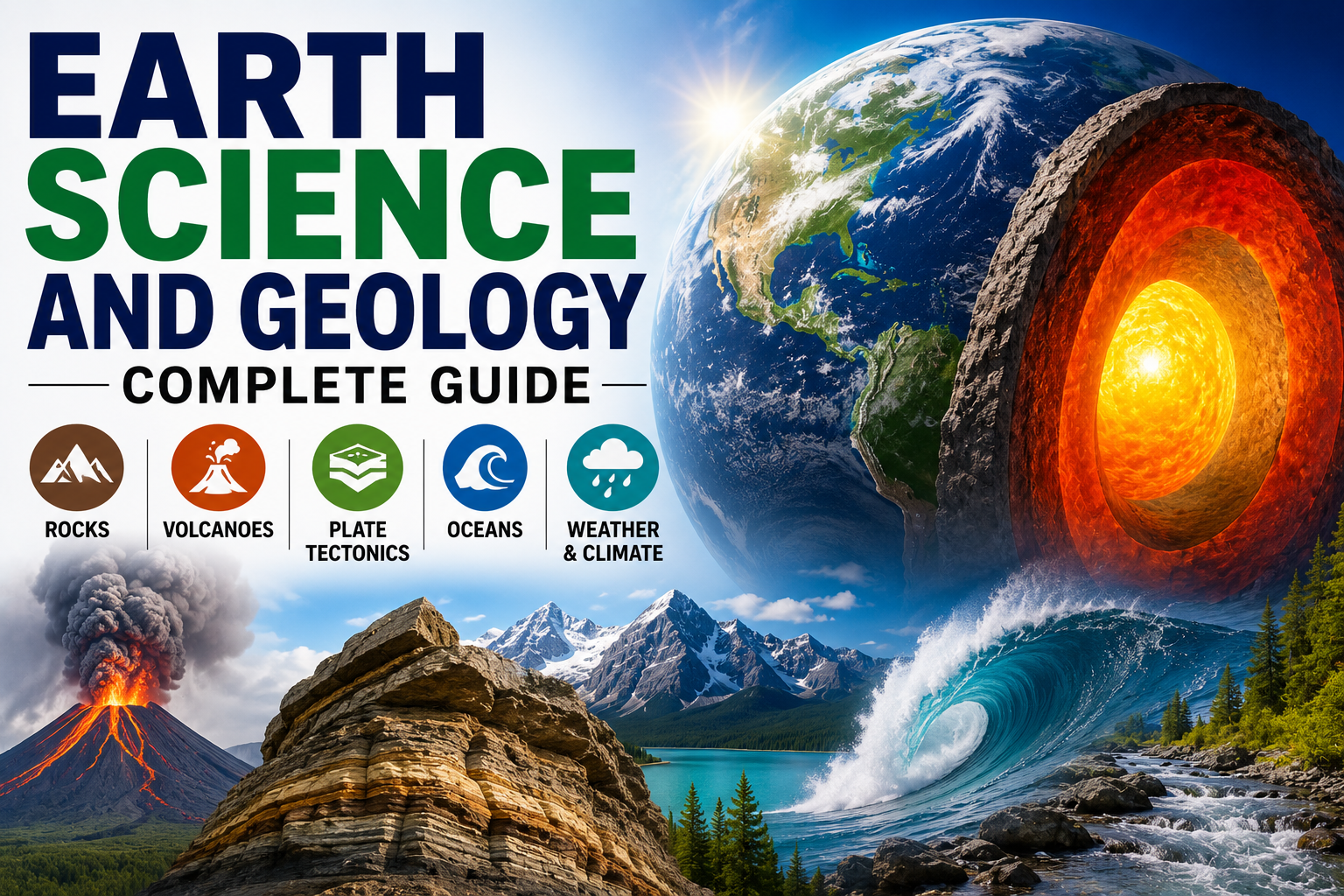
Earth Science and Geology Complete Guide
Earth is far more than the ground beneath our feet. It is a dynamic planet shaped by moving tectonic plates, volcanic activity, erosion, weathering, oceans, glaciers and countless chemical and biological processes.
Earth science is the broad study of our planet and its systems, while geology focuses primarily on Earth’s solid materials, structure, history and the processes that have shaped them.
From the formation of mountains and earthquakes to the creation of minerals, fossils and soils, Earth science helps explain how the planet works—and how scientists reconstruct its history over billions of years.
This complete guide explores the major branches of Earth science and geology, the structure of our planet, the rock cycle, plate tectonics, Earth’s history and the ways geological processes continue to influence modern life.
What Is Earth Science?
Earth science is the scientific study of Earth and the processes that operate within and around it.
It encompasses several interconnected disciplines, including:
- Geology
- Geophysics
- Meteorology
- Oceanography
- Hydrology
- Environmental science
- Soil science
- Atmospheric science
- Planetary science
These fields examine different parts of the Earth system, but they are closely connected.
For example, rainfall is an atmospheric process, but it influences rivers and groundwater. Rivers erode rocks and transport sediment, which can eventually form new geological deposits.
This interconnectedness is one of the central ideas in Earth science.
What Is Geology?
Geology is the study of Earth’s solid materials, structure, history and geological processes.
Geologists investigate:
- Rocks
- Minerals
- Fossils
- Mountains
- Volcanoes
- Earthquakes
- Faults
- Sedimentary deposits
- Earth’s interior
- Geological resources
- Changes in Earth’s environment through time
Geology is both a modern science and a historical science.
A physicist may observe an experiment repeatedly under controlled conditions. A geologist often has to reconstruct events that happened millions or billions of years ago using evidence preserved in rocks.
Why Earth Science Matters
Earth science isn’t simply about understanding rocks.
It has practical applications in everyday life and major global challenges.
Geological knowledge helps societies:
- Locate groundwater
- Identify mineral resources
- Understand earthquakes
- Assess volcanic hazards
- Study landslides
- Manage soils
- Explore energy resources
- Understand erosion
- Plan infrastructure
- Investigate Earth’s climate history
- Protect ecosystems
- Manage natural resources
Engineers, governments, farmers, environmental scientists and urban planners all rely on Earth science in different ways.
The Structure of Earth
Earth is commonly divided into several major layers based on its composition and physical properties.
From the outside toward the center, the principal compositional layers are:
- Crust
- Mantle
- Core
The core can be further divided into the outer core and inner core.
Earth’s Crust
The crust is Earth’s thin outer rocky layer.
There are two major types:
Continental Crust
Continental crust generally forms the continents and some shallow continental margins.
It tends to be:
- Thicker
- Less dense
- More compositionally diverse
Oceanic Crust
Oceanic crust forms the floors of most ocean basins.
It is generally:
- Thinner
- Denser
- Predominantly basaltic in composition
Oceanic crust is continually created and recycled through plate tectonic processes.
The Mantle
The mantle lies beneath the crust and makes up most of Earth’s volume.
It consists primarily of hot, solid rock.
Although the mantle is solid, it can deform extremely slowly over geological timescales. Heat from Earth’s interior drives convection and other forms of mantle movement that contribute to plate tectonics.
The mantle is therefore not simply a static layer beneath the crust.
It is an active part of Earth’s internal system.
Earth’s Core
Earth’s core is primarily composed of iron and nickel, along with smaller amounts of other elements.
It has two major sections.
Outer Core
The outer core is liquid.
Movement of electrically conductive material within it generates Earth’s magnetic field through the geodynamo process.
Inner Core
The inner core is solid because of the enormous pressure at Earth’s center, despite its extremely high temperature.
The interaction between Earth’s core and mantle is important for understanding the planet’s internal heat and magnetic environment.
How Scientists Study Earth’s Interior
Scientists cannot simply drill to Earth’s center.
The deepest human-made boreholes extend only a tiny fraction of the distance toward the planet’s core.
Instead, scientists use indirect evidence.
One of the most important tools is seismology.
Earthquakes generate seismic waves that travel through Earth’s interior. Different types of waves behave differently when they encounter solid and liquid materials.
By studying:
- Wave speeds
- Wave directions
- Reflections
- Refractions
- Shadow zones
scientists can infer the structure of Earth’s interior.
What Are Tectonic Plates?
Earth’s outer rigid layer is divided into large pieces called tectonic plates.
These plates move slowly over geological time.
Their movement is associated with many major geological features, including:
- Mountains
- Ocean trenches
- Mid-ocean ridges
- Earthquakes
- Volcanoes
- Fault systems
Plate movement is typically measured in centimeters per year.
That may seem insignificant, but over millions of years it can completely reorganize continents and ocean basins.
The Three Main Types of Plate Boundaries
Tectonic plates interact primarily at three types of boundaries.
Divergent Boundaries
At divergent boundaries, plates move apart.
Magma can rise into the gap and solidify, creating new crust.
One major example is the system of mid-ocean ridges beneath the world’s oceans.
Divergent movement can also produce continental rifts.
Convergent Boundaries
At convergent boundaries, plates move toward one another.
Several outcomes are possible.
Oceanic-Continental Convergence
Dense oceanic crust may be forced beneath continental crust in a process called subduction.
This can produce:
- Deep ocean trenches
- Earthquakes
- Volcanoes
- Mountain building
Oceanic-Oceanic Convergence
One oceanic plate can subduct beneath another, potentially producing volcanic island arcs.
Continental-Continental Convergence
When two continents collide, neither easily sinks into the mantle.
Instead, enormous forces can fold, fracture and uplift the crust.
This process can create major mountain ranges.
Transform Plate Boundaries
At transform boundaries, plates slide horizontally past one another.
These boundaries are strongly associated with earthquakes.
The movement doesn’t necessarily create or destroy large amounts of crust, but friction can allow stress to accumulate until it is released suddenly.
What Causes Earthquakes?
An earthquake occurs when accumulated stress in Earth’s crust is released, producing seismic waves.
Many earthquakes occur along faults.
A fault is a fracture or zone of fractures in Earth’s crust along which rocks have moved.
Earthquakes can also occur in volcanic regions and through other geological processes.
The point within Earth where an earthquake begins is called the focus or hypocenter.
The location directly above it on Earth’s surface is the epicenter.
How Earthquakes Are Measured
Earthquake size and earthquake effects are not exactly the same thing.
Modern seismology commonly uses moment magnitude to describe the size of an earthquake.
Magnitude relates to the energy released by the earthquake.
Intensity, by contrast, describes the effects experienced or observed at particular locations.
An earthquake can therefore have the same magnitude but produce very different effects in different places depending on:
- Distance from the source
- Local geology
- Building quality
- Population density
- Ground conditions
- Earthquake depth
What Causes Volcanoes?
Volcanoes form where molten or partially molten material from Earth’s interior reaches or approaches the surface.
Volcanic activity is strongly associated with plate tectonics, although not all volcanoes occur directly at plate boundaries.
Volcanic environments can produce:
- Lava flows
- Ash
- Gases
- Pyroclastic flows
- Volcanic rocks
- New landforms
Volcanoes can be destructive, but volcanic activity also contributes to the creation of new crust and fertile soils.
What Is Magma?
Magma is molten or partially molten rock beneath Earth’s surface.
Once magma reaches the surface, it is generally called lava.
Magma can contain:
- Molten rock
- Crystals
- Dissolved gases
Its composition, temperature and gas content influence how volcanic eruptions behave.
What Are Rocks?
Rocks are naturally occurring solid materials composed of one or more minerals or mineral-like substances.
Geologists generally classify rocks into three major groups:
- Igneous
- Sedimentary
- Metamorphic
These groups are connected through the rock cycle.
Igneous Rocks
Igneous rocks form when molten material cools and solidifies.
They can form underground or at the surface.
Intrusive Igneous Rocks
These form when magma cools beneath Earth’s surface.
Because cooling can be relatively slow, crystals may have enough time to grow larger.
Granite is a familiar example.
Extrusive Igneous Rocks
These form when lava cools at or near Earth’s surface.
Cooling is often faster, producing smaller crystals.
Basalt is a common example.
Sedimentary Rocks
Sedimentary rocks form from accumulated sediments or from chemical and biological processes.
Common sedimentary rocks include:
- Sandstone
- Shale
- Limestone
- Conglomerate
Sedimentary rocks are especially important to geologists because they can preserve evidence of past environments.
They may contain:
- Fossils
- Ancient soils
- Ripple marks
- Mud cracks
- Chemical signatures
These features allow scientists to reconstruct ancient landscapes and climates.
Metamorphic Rocks
Metamorphic rocks form when existing rocks are altered by heat, pressure or chemically active fluids without completely melting.
Examples include:
- Marble
- Slate
- Schist
- Gneiss
For example, limestone can transform into marble under suitable metamorphic conditions.
The original rock is called the protolith.
The Rock Cycle Explained
The rock cycle describes how rocks can change from one type to another through geological processes.
An igneous rock can:
- Weather
- Erode
- Become sediment
- Be deposited
- Become sedimentary rock
That sedimentary rock can later be buried and subjected to heat and pressure, becoming metamorphic rock.
If it melts, it can become magma.
When the magma cools, it forms a new igneous rock.
The process is not a simple circle.
Rocks can take many different pathways through the geological system.
What Are Minerals?
A mineral is a naturally occurring inorganic solid with an ordered atomic structure and a characteristic chemical composition or compositional range.
Common minerals include:
- Quartz
- Feldspar
- Mica
- Calcite
- Pyrite
- Gypsum
- Hematite
Minerals are the fundamental building blocks of many rocks.
How Minerals Are Identified
Geologists can identify minerals using several properties.
These include:
Color
Color can be useful but is often unreliable because impurities can change a mineral’s appearance.
Streak
Streak is the color of a mineral’s powdered form.
Hardness
Hardness describes resistance to scratching.
The Mohs hardness scale is commonly used to compare mineral hardness.
Luster
Luster describes how a mineral reflects light.
Cleavage
Cleavage describes how a mineral tends to break along particular planes of weakness.
Crystal Form
The characteristic shape of a crystal can provide additional evidence.
What Is Weathering?
Weathering is the breakdown or alteration of rocks at or near Earth’s surface.
It can be divided into two broad categories.
Physical Weathering
Physical weathering breaks rock into smaller pieces without fundamentally changing its chemical composition.
Processes can include:
- Freeze-thaw activity
- Expansion and contraction
- Abrasion
- Pressure release
- Salt crystal growth
Chemical Weathering
Chemical weathering changes the minerals within rocks.
Processes can include:
- Dissolution
- Oxidation
- Hydrolysis
- Reactions with water and acids
Weathering is an important source of sediment and contributes to soil formation.
What Is Erosion?
Erosion is the movement of weathered material from one location to another.
Major agents include:
- Water
- Wind
- Ice
- Gravity
Weathering and erosion are related but aren’t identical.
Weathering breaks down or alters material.
Erosion transports it.
This distinction is important when studying landscapes.
How Rivers Shape Landscapes
Rivers are powerful geological agents.
They can:
- Erode valleys
- Transport sediment
- Deposit material
- Create floodplains
- Form deltas
- Carve canyons
River systems constantly redistribute sediment.
In mountainous areas, steep gradients can encourage erosion. As rivers reach flatter terrain, their ability to transport sediment may change, resulting in deposition.
How Glaciers Shape Earth
Glaciers are large masses of moving ice that can dramatically reshape landscapes.
They can carve:
- U-shaped valleys
- Fjords
- Cirques
- Arêtes
Glaciers also transport enormous quantities of sediment.
When ice melts, the transported material can be deposited, creating distinctive geological features.
How Wind Changes Landscapes
Wind is especially effective at transporting fine sediment in dry or exposed environments.
Wind erosion can produce:
- Sand dunes
- Deflation surfaces
- Loess deposits
Dunes are not static piles of sand.
They can migrate as wind transports sediment from one location to another.
What Is Soil?
Soil is a complex natural system containing mineral particles, organic matter, water, air and living organisms.
Soils develop through interactions among:
- Parent material
- Climate
- Organisms
- Topography
- Time
Soil is essential for agriculture and terrestrial ecosystems.
Its characteristics influence:
- Water retention
- Plant growth
- Nutrient availability
- Drainage
- Carbon storage
- Erosion risk
The Water Cycle and Earth Science
Water constantly moves between different parts of Earth’s system.
The water cycle includes processes such as:
- Evaporation
- Condensation
- Precipitation
- Infiltration
- Runoff
- Groundwater flow
- Transpiration
Geologists and hydrologists study how water interacts with rocks, soil and underground formations.
What Is Groundwater?
Groundwater is water stored beneath Earth’s surface in pores and fractures within geological materials.
An aquifer is a geological formation or group of formations capable of storing and transmitting usable quantities of groundwater.
Groundwater is an important source of freshwater for many communities and ecosystems.
However, groundwater resources can be vulnerable to:
- Over-extraction
- Pollution
- Saltwater intrusion
- Changes in recharge
- Land-use changes
What Are Fossils?
Fossils are preserved remains, traces or evidence of ancient organisms.
They can include:
- Bones
- Shells
- Teeth
- Leaves
- Footprints
- Burrows
- Impressions
Fossils provide evidence about ancient life and environments.
They are particularly valuable when combined with information from the rocks surrounding them.
How Fossils Form
Fossilization is relatively uncommon.
Most organisms decay or are destroyed before they can become preserved.
Fossilization is more likely when remains are rapidly buried and protected from destructive processes.
Over time, mineralization, compression and other processes can preserve biological material or its impressions.
Some fossils preserve the actual material of an organism, while others preserve traces of its activity.
What Is Geological Time?
Earth is approximately 4.54 billion years old.
Geologists divide this enormous span into units that make Earth’s history easier to study.
The major hierarchy includes:
- Eons
- Eras
- Periods
- Epochs
- Ages
The geological time scale is continually refined as scientists discover new evidence.
The Four Major Eons
Earth’s history is commonly divided into four eons:
Hadean
The earliest period of Earth’s history, associated with the planet’s formation and early development.
Archean
A period during which Earth’s early crust, oceans and primitive life developed.
Proterozoic
A vast interval marked by major changes in Earth’s atmosphere, oceans and life.
Phanerozoic
The eon in which abundant visible fossil life becomes prominent.
We live in the Phanerozoic Eon.
How Scientists Determine the Age of Rocks
Geologists use several dating methods.
Relative Dating
Relative dating determines whether rocks or geological events are older or younger than others.
Important principles include:
- Superposition
- Cross-cutting relationships
- Original horizontality
- Faunal succession
Absolute or Numerical Dating
Numerical dating attempts to determine an actual age or age range.
One important method is radiometric dating.
How Radiometric Dating Works
Some elements have unstable isotopes that decay at predictable rates.
The original radioactive isotope is called the parent, while the product of decay is called the daughter.
Scientists can measure the ratio between parent and daughter materials and use known decay rates to estimate the age of a geological sample.
The concept of half-life is central to radiometric dating.
A half-life is the time required for half of a radioactive parent isotope in a sample to decay.
Different isotopes have different half-lives, making particular systems useful for different age ranges.
What Is a Fossil Record?
The fossil record is the collection of preserved evidence of past life found in geological materials.
It is incomplete.
Many organisms never fossilize, and many fossils are later destroyed by erosion, burial, melting or metamorphism.
Nevertheless, the fossil record provides an extraordinary window into the evolution of life.
Mass Extinctions in Earth’s History
Earth’s history includes several major mass extinction events.
These events caused unusually large losses of biodiversity over relatively short geological intervals.
The causes varied and could include combinations of:
- Climate change
- Volcanic activity
- Ocean chemistry changes
- Asteroid impacts
- Environmental disruption
The fossil record allows scientists to study how ecosystems changed before, during and after these events.
What Is Geophysics?
Geophysics applies physics to the study of Earth.
Geophysicists investigate phenomena such as:
- Earth’s magnetic field
- Gravity
- Seismic waves
- Earth’s interior
- Crustal deformation
- Heat flow
- Electrical properties
Geophysical methods are widely used to study Earth’s subsurface without physically excavating it.
What Is Geochemistry?
Geochemistry combines geology and chemistry to study the chemical composition of Earth and geological processes.
Geochemists investigate:
- Minerals
- Rocks
- Water
- Soil
- Sediments
- Atmospheric materials
- Chemical cycles
Geochemistry can help explain how elements move through Earth’s systems.
What Is Oceanography?
Oceanography is the study of Earth’s oceans.
It includes several areas:
- Physical oceanography
- Chemical oceanography
- Biological oceanography
- Geological oceanography
Ocean scientists investigate currents, waves, marine ecosystems, seafloor geology, ocean chemistry and interactions between oceans and the atmosphere.
What Is Meteorology?
Meteorology is the scientific study of the atmosphere and weather.
Meteorologists examine:
- Temperature
- Pressure
- Humidity
- Wind
- Clouds
- Storms
- Precipitation
Weather occurs over relatively short periods, while climate describes longer-term patterns and statistics.
Earth Science and Climate
Earth’s climate system involves interactions among:
- Atmosphere
- Oceans
- Land
- Ice
- Biosphere
Geology provides important evidence about how Earth’s climate has changed over very long timescales.
Scientists can study past climates using:
- Ice cores
- Fossils
- Sediments
- Tree rings
- Coral records
- Cave deposits
- Isotopic evidence
Understanding Earth’s climate history helps researchers distinguish natural variability from more recent changes and investigate how Earth’s systems respond to different forcing factors.
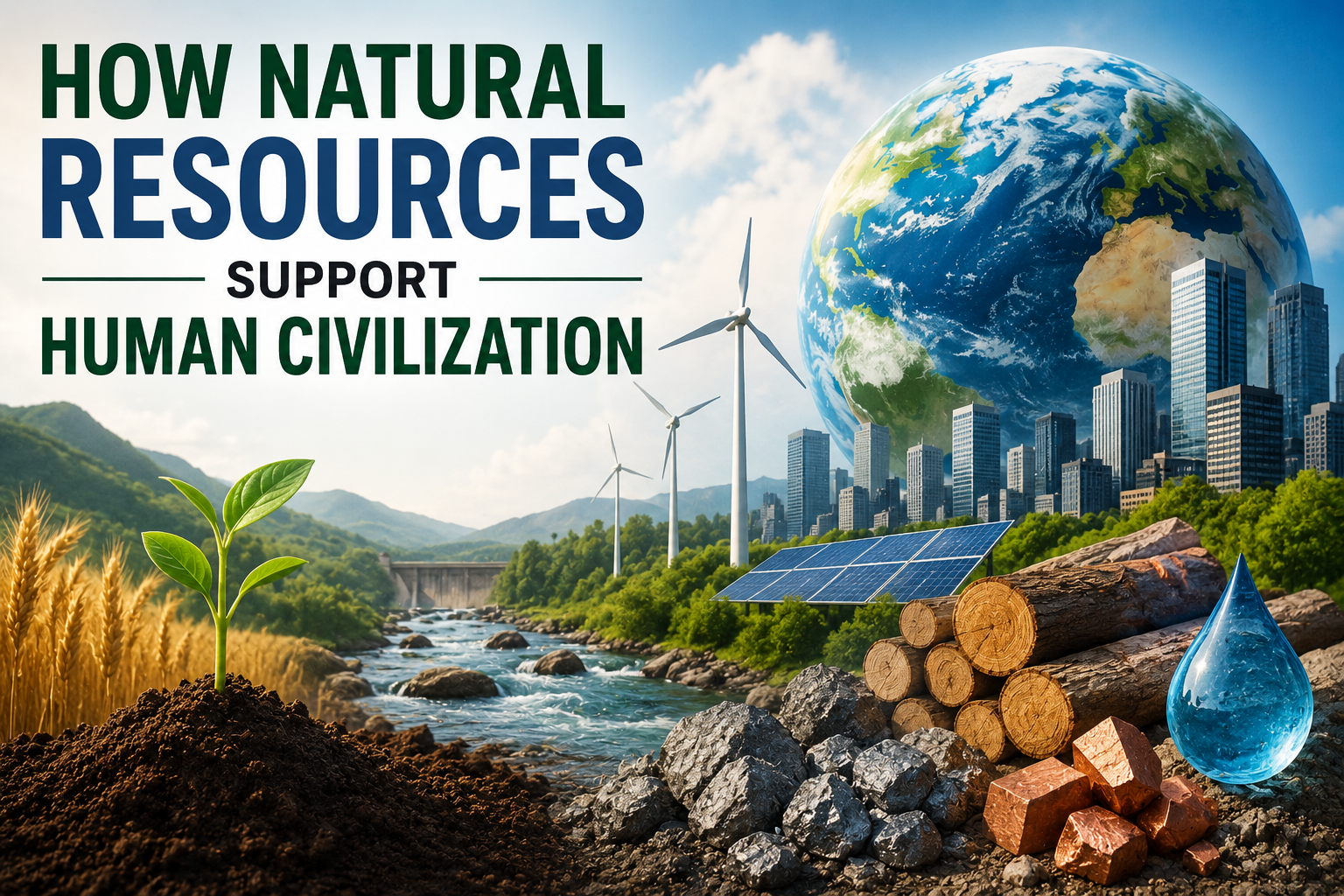
What Are Natural Resources?
Many resources used by modern societies originate from geological processes.
These include:
- Iron
- Copper
- Gold
- Aluminum ores
- Phosphate
- Limestone
- Clay
- Sand
- Gravel
- Coal
- Oil
- Natural gas
- Geothermal resources
- Groundwater
Geologists help identify where resources may occur and assess the geological conditions required for their formation.
Why Critical Minerals Matter
Modern technology depends on numerous mineral resources.
Some minerals are particularly important for:
- Batteries
- Electronics
- Renewable energy technologies
- Electrical infrastructure
- Telecommunications
- Manufacturing
The geological availability of these resources, combined with extraction, processing and supply-chain considerations, makes mineral resources an important part of modern Earth science.
Geological Hazards
Earth processes can create natural hazards.
Important examples include:
- Earthquakes
- Volcanic eruptions
- Landslides
- Tsunamis
- Sinkholes
- Flooding
- Coastal erosion
Geologists and other Earth scientists study these hazards to improve risk assessment and help communities prepare.
How Geologists Investigate the Earth
Fieldwork remains a fundamental part of geology.
A geologist may examine:
- Rock layers
- Faults
- Mineral deposits
- Fossils
- Soil
- Sediment
- Landscape features
They may collect samples, measure structures, create geological maps and use specialized instruments.
Modern geology also increasingly relies on:
- Satellite imagery
- Geographic information systems
- Drones
- Remote sensing
- Computer modeling
- Seismic monitoring
- Laboratory analysis
The combination of field observations and technology allows scientists to build increasingly detailed models of Earth’s systems.
The Importance of Geological Maps
A geological map shows the distribution and relationships of geological materials and structures across an area.
Geological maps can help identify:
- Rock types
- Faults
- Folds
- Mineral deposits
- Groundwater resources
- Geological hazards
They are valuable for construction, resource exploration, environmental management and scientific research.
Earth’s Geological Processes Never Stop
One of the most important lessons in Earth science is that Earth is dynamic.
Mountains are uplifted and eroded.
Oceans open and close.
Rocks form, break down, melt and transform.
Continents move.
Volcanoes build new land.
Rivers transport sediment.
Glaciers reshape landscapes.
The processes may operate too slowly for humans to notice during a normal lifetime, but their cumulative effects can transform entire regions over millions of years.
Common Questions About Earth Science and Geology
What Is the Difference Between Earth Science and Geology?
Earth science is the broader study of Earth and its systems. Geology focuses primarily on Earth’s solid materials, structure, history and geological processes.
How Old Is Earth?
Earth is approximately 4.54 billion years old, based primarily on radiometric dating and evidence from meteorites and ancient rocks.
What Are the Three Main Types of Rocks?
The three major rock groups are igneous, sedimentary and metamorphic.
What Causes Plate Tectonics?
Plate motion is driven by a combination of processes involving Earth’s internal heat, mantle dynamics, gravitational forces and interactions at plate boundaries.
What Is the Rock Cycle?
The rock cycle describes the processes through which rocks can form, break down, melt, deform and transform between different rock types.
Why Are Fossils Important?
Fossils preserve evidence of ancient organisms and environments, allowing scientists to reconstruct aspects of Earth’s biological and geological history.
Why Do Earthquakes Happen?
Earthquakes commonly occur when accumulated stress along faults is released suddenly, producing seismic waves.
Careers in Earth Science
Earth science provides career opportunities across science, engineering, environmental management and natural-resource industries.
Potential careers include:
- Geologist
- Geophysicist
- Hydrologist
- Meteorologist
- Oceanographer
- Environmental scientist
- Soil scientist
- Seismologist
- Volcanologist
- Paleontologist
- Geochemist
- Geological engineer
- GIS specialist
- Environmental consultant
These professionals work in universities, government agencies, research organizations, engineering companies, environmental firms and resource industries.
How to Start Learning Earth Science
Beginners don’t need advanced mathematics or specialized equipment to start exploring geology.
A good learning path is:
Step 1: Learn Earth’s Basic Structure
Understand the crust, mantle and core.
Step 2: Learn About Minerals
Study mineral properties and identification.
Step 3: Learn the Three Rock Types
Practice identifying igneous, sedimentary and metamorphic rocks.
Step 4: Understand Plate Tectonics
Learn how plate boundaries create earthquakes, volcanoes and mountains.
Step 5: Study Earth’s History
Explore geological time, fossils and major evolutionary events.
Step 6: Explore Local Geology
Look at the rocks, soils, rivers and landscapes around you.
Step 7: Learn to Read Geological Maps
Maps turn observations into a larger understanding of regional geology.
Why Local Geology Is Worth Exploring
You don’t need to travel to a famous geological site to study Earth science.
Your local environment contains clues about Earth’s history.
Look for:
- Different rock types
- Soil layers
- River sediments
- Eroded surfaces
- Hills and valleys
- Weathered rock
- Fossil-bearing formations
- Construction exposures
Even an ordinary landscape can reveal information about the geological processes that shaped it.
Always follow local regulations and safety guidance when collecting rocks or fossils, particularly in protected areas or on private land.
Understanding Earth Means Understanding Change
Earth science provides a framework for understanding a planet that is constantly changing.
The mountains around us, the rocks beneath our feet, the water flowing through rivers and the minerals used in modern technology are all products of geological processes operating across enormous spans of time.
Geology gives us a way to read that history.
By studying rocks, minerals, fossils, earthquakes, volcanoes, oceans, soils and Earth’s interior, scientists can reconstruct how our planet formed and changed—and better understand the processes that continue shaping it today.
The deeper lesson is that Earth is not a static backdrop for human activity. It is a dynamic system whose geological, atmospheric, oceanic and biological processes are interconnected. Understanding those connections is essential not only for exploring Earth’s past, but also for making informed decisions about its resources, hazards and future.



2 Comments
Micle harison
June 7, 2019Lorem ipsum dolor sit amet, usu ut perfecto postulant deterruisset, libris causae volutpat at est, ius id modus laoreet urbanitas. Mel ei delenit dolores.
John Doe
June 7, 2019Some consultants are employed indirectly by the client via a consultancy staffing company.