
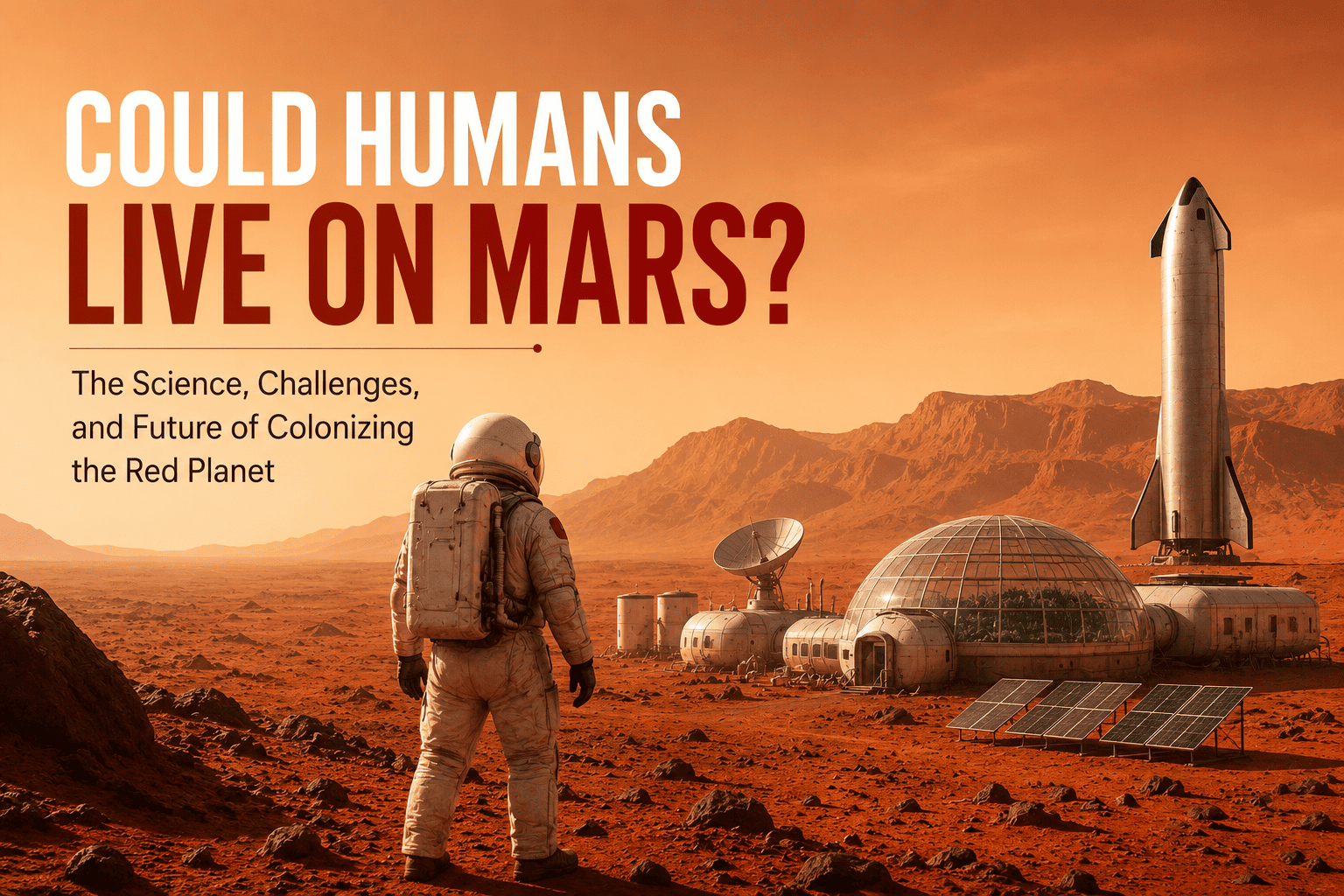
Could Humans Live on Mars? The Science, Challenges, and Future of Colonizing the Red Planet
For centuries, Mars has fascinated humanity. Ancient civilizations saw it as the “Red Star.” Scientists later discovered a cold, dusty world with towering volcanoes, deep canyons, and evidence that liquid water once flowed across its surface. Today, Mars has become much more than an object of scientific curiosity—it is widely considered humanity’s best chance of becoming a multi-planetary species.
The idea of humans living on Mars once belonged entirely to science fiction. Authors imagined futuristic colonies beneath glass domes, while filmmakers portrayed brave astronauts building civilizations millions of kilometers from Earth.
Now, that vision is gradually moving toward reality.
Organizations such as NASA, SpaceX, the European Space Agency (ESA), and China’s space program are actively developing technologies that could eventually send humans to the Red Planet.
Yet reaching Mars is only the beginning.
The real challenge lies in surviving there.
Mars is an incredibly hostile environment, with freezing temperatures, thin air, dangerous radiation, and almost no liquid water on its surface. Building a permanent human settlement would require breakthroughs in engineering, medicine, agriculture, energy production, and psychology.
So, could humans actually live on Mars?
The answer is surprisingly complex.
While science suggests it may eventually be possible, creating a self-sustaining Martian civilization remains one of the greatest engineering challenges humanity has ever attempted.
Why Mars?
Among all the planets in our solar system, Mars stands out as the most realistic destination for future human settlement.
Although Venus is closer in size to Earth, its surface temperatures exceed 460°C (860°F), with crushing atmospheric pressure and clouds of sulfuric acid.
Mars, despite its harsh environment, offers several advantages.
It has:
- A day almost identical to Earth’s (24 hours and 37 minutes)
- Polar ice caps
- Seasons
- Gravity
- Evidence of ancient rivers and lakes
- Accessible water ice beneath the surface
Scientists believe Mars was once warmer and wetter billions of years ago.
Understanding what happened could also help us better understand Earth’s own climate and future.
How Far Away Is Mars?
The distance between Earth and Mars constantly changes because both planets orbit the Sun.
On average:
- Distance: 225 million kilometers (140 million miles)
- Travel time: 6–9 months using current spacecraft technology
That means astronauts cannot simply return home if something goes wrong.
Every mission requires years of planning.
Communication also becomes challenging.
Signals traveling at the speed of light take between 5 and 20 minutes each way.
Real-time conversations with Earth would be impossible.
What Is Mars Like?
Mars is often called Earth’s smaller cousin.
But the similarities only go so far.
| Feature | Earth | Mars |
|---|---|---|
| Diameter | 12,742 km | 6,779 km |
| Gravity | 100% | 38% |
| Atmosphere | Nitrogen & Oxygen | Mostly Carbon Dioxide |
| Average Temperature | 15°C | -63°C |
| Breathable Air | Yes | No |
| Liquid Surface Water | Yes | Extremely Rare |
Despite these differences, Mars remains the most Earth-like planet available.
Can Humans Breathe on Mars?
No.
Mars’ atmosphere contains approximately:
- 95% carbon dioxide
- Less than 1% oxygen
The atmosphere is also extremely thin—about 1% of Earth’s atmospheric pressure.
Without a pressurized spacesuit or habitat, a human would quickly lose consciousness.
Future colonies would need systems capable of producing breathable oxygen.
Fortunately, this may already be possible.
NASA’s MOXIE experiment aboard the Perseverance rover successfully produced oxygen from Martian carbon dioxide, demonstrating an important proof of concept.
Is There Water on Mars?
Water is essential for any long-term human settlement.
Fortunately, Mars appears to contain significant amounts of frozen water.
Scientists have discovered:
- Polar ice caps
- Underground ice deposits
- Water trapped inside minerals
Future astronauts could potentially extract this ice for:
- Drinking
- Hygiene
- Agriculture
- Producing oxygen
- Manufacturing rocket fuel
Water would become one of the colony’s most valuable resources.
How Would Humans Get Food?
Transporting food from Earth indefinitely would be impractical.
Future colonies would need to grow much of their own food.
Scientists are already studying how crops might survive on Mars.
Potential solutions include:
Hydroponics
Plants grow without soil using nutrient-rich water.
Aeroponics
Plant roots receive nutrients through fine mist rather than soil.
Controlled Greenhouses
Pressurized habitats could protect crops from:
- Radiation
- Extreme temperatures
- Dust storms
Researchers have already grown vegetables under Mars-like conditions in experimental laboratories on Earth.
The Radiation Problem
One of Mars’ biggest dangers is invisible.
Unlike Earth, Mars lacks both:
- A strong magnetic field
- A thick atmosphere
Together, those two features protect Earth from harmful cosmic radiation.
Astronauts traveling to Mars would receive significantly higher radiation exposure than people living on Earth.
Long-term exposure increases risks including:
- Cancer
- Nervous system damage
- Vision problems
- Cardiovascular disease
Scientists are investigating several possible solutions:
- Underground habitats
- Thick shielding
- Water-based radiation protection
- Specialized building materials
Would Gravity Affect Human Health?
Mars has only 38% of Earth’s gravity.
Scientists still don’t fully understand how humans would adapt over many years.
Possible effects include:
- Muscle loss
- Bone density reduction
- Cardiovascular changes
- Balance problems
Astronauts aboard the International Space Station already exercise several hours daily to reduce similar problems caused by microgravity.
Mars’ partial gravity may help—but likely won’t eliminate these challenges.
Building Homes on Mars
Transporting construction materials from Earth would be enormously expensive.
Future colonies would instead rely on local resources.
Researchers are exploring methods including:
- 3D printing habitats
- Using Martian soil (regolith)
- Inflatable living modules
- Underground lava tubes
Building with local materials dramatically reduces mission costs while increasing long-term sustainability.
How Would Colonists Produce Energy?
Reliable electricity would be essential.
Potential energy sources include:
Solar Power
Mars receives sunlight, although less than Earth.
Large solar farms could provide substantial energy.
However, dust storms present challenges.
Nuclear Power
Small modular nuclear reactors could provide continuous electricity regardless of weather conditions.
Many experts believe nuclear energy will play a central role in early Martian settlements.
The Psychological Challenge
Living on Mars isn’t only a physical challenge.
It is also a psychological one.
Colonists would experience:
- Extreme isolation
- Long communication delays
- Small living spaces
- Limited social interaction
- No possibility of immediate rescue
Psychologists already study astronauts living aboard the International Space Station to better understand these challenges.
Future Mars crews would require careful psychological preparation and ongoing support.
NASA’s Vision for Mars
NASA views returning humans to the Moon through the Artemis program as preparation for Mars.
The agency aims to develop technologies involving:
- Deep-space travel
- Long-duration habitats
- Advanced life support
- Surface operations
Experience gained on the Moon could significantly reduce risks before attempting the much longer journey to Mars.
SpaceX’s Ambitious Plans
Perhaps no organization has generated more excitement about Mars than SpaceX.
Founder Elon Musk has repeatedly stated his goal of making humanity a multi-planetary species.
Central to that vision is Starship, a fully reusable spacecraft designed to transport both cargo and people to Mars.
SpaceX hopes future missions could establish permanent settlements capable of expanding over time.
Although ambitious timelines have frequently shifted, Starship represents one of the most significant developments in deep-space transportation.
Could Mars Ever Become Self-Sustaining?
Creating an outpost is difficult.
Creating a self-sustaining civilization is far harder.
A permanent settlement would eventually need to produce:
- Food
- Water
- Oxygen
- Medicine
- Construction materials
- Spare parts
- Energy
It would also require:
- Schools
- Medical facilities
- Scientific laboratories
- Manufacturing capabilities
Many experts believe achieving true independence from Earth could take decades—or even centuries.
Should Humans Colonize Mars?
Supporters argue Mars colonization offers several benefits.
These include:
- Expanding scientific knowledge
- Driving technological innovation
- Protecting humanity from global catastrophes
- Inspiring future generations
- Expanding opportunities for exploration
Critics raise important concerns.
Some believe humanity should solve challenges on Earth—including poverty, climate change, and inequality—before investing heavily in another planet.
Others question the enormous financial cost.
The debate continues, but interest in Mars exploration continues growing.
Frequently Asked Questions
Could humans survive on Mars today?
Not without advanced technology.
Humans currently require spacesuits, life-support systems, and pressurized habitats to survive on Mars.
How long would it take to reach Mars?
Using current spacecraft technology, approximately six to nine months, depending on planetary alignment.
Has anyone ever been to Mars?
No.
Every Mars mission so far has involved robotic spacecraft and rovers.
Could people eventually be born on Mars?
Scientists don’t yet know.
Researchers continue studying how reduced gravity and increased radiation might affect pregnancy and human development.
Will humans live on Mars this century?
Many experts believe the first human missions are possible within the coming decades.
Whether permanent settlements emerge during this century remains uncertain.
Final Thoughts
Mars represents one of humanity’s greatest frontiers.
It is close enough to reach with advancing technology, yet challenging enough to push science, engineering, and human endurance to their limits.
Living on the Red Planet would require overcoming obstacles unlike anything civilization has faced before—from producing breathable air and growing food to shielding settlers from radiation and building entire communities from local resources.
While many questions remain unanswered, each new robotic mission, scientific discovery, and technological breakthrough brings humanity one step closer to understanding whether life beyond Earth is truly possible.
Whether the first permanent Martian city arrives in 50 years or 200, one thing is already certain:
The journey to Mars is no longer just about exploring another world—it’s about exploring the future of humanity itself.


2 Comments
Micle harison
June 7, 2019Lorem ipsum dolor sit amet, usu ut perfecto postulant deterruisset, libris causae volutpat at est, ius id modus laoreet urbanitas. Mel ei delenit dolores.
John Doe
June 7, 2019Some consultants are employed indirectly by the client via a consultancy staffing company.