
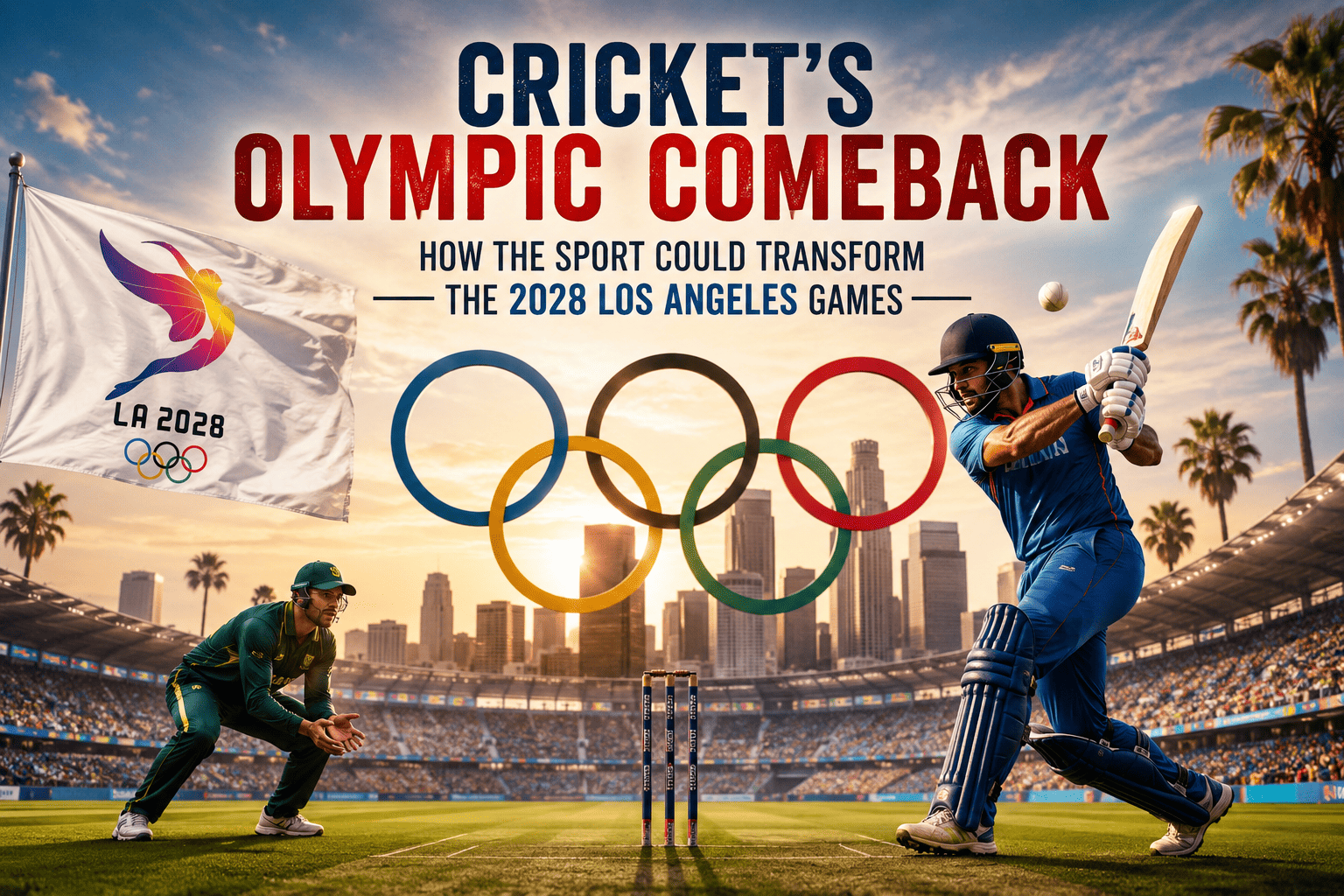
Cricket’s Olympic Comeback: How the Sport Could Transform the 2028 Los Angeles Games
For more than a century, cricket and the Olympic Games have existed in separate worlds.
One has captivated billions of fans from Mumbai to Melbourne, Karachi to Cape Town, and London to Kingston. The other has stood as the pinnacle of global sporting excellence, bringing together athletes from nearly every nation on Earth. Yet despite cricket’s enormous international following, the sport has remained absent from the world’s biggest sporting stage since a lone appearance at the 1900 Paris Olympics.
That extraordinary gap is finally coming to an end.
When the Olympic flame is lit in Los Angeles in 2028, cricket will make its long-awaited return. It is a decision that has thrilled fans, excited broadcasters, energized athletes, and sparked intense debate across the sporting world.
But this is about far more than adding another event to the Olympic schedule.
Cricket’s return could reshape the economics of the Olympic movement, redefine how the Games engage with new audiences, and usher in one of the most significant shifts in international sport in decades.
The question is no longer whether cricket belongs at the Olympics.
The question is just how much the Olympics stand to gain from cricket.
A 128-Year Wait Comes to an End
Cricket’s Olympic history is remarkably brief.
The sport appeared only once, at the 1900 Paris Games, where Great Britain defeated France in a two-team contest that bore little resemblance to the global spectacle cricket has become today.
Since then, cricket has evolved into one of the world’s most popular sports.
International tournaments attract television audiences measured in the hundreds of millions. The ICC Men’s Cricket World Cup, ICC T20 World Cup, and the Indian Premier League have transformed cricket into a commercial powerhouse with worldwide appeal.
Yet for generations of cricketers, one dream remained impossible: winning an Olympic gold medal.
Los Angeles 2028 changes that forever.
The Games will feature men’s and women’s T20 cricket, the shortest and most television-friendly format of the sport. Fast-paced, explosive, and designed for modern audiences, T20 offers exactly the kind of high-energy competition the Olympics thrive on.
Why the Olympics Wanted Cricket
At first glance, adding cricket may seem like a straightforward sporting decision.
In reality, it is also a strategic business move.
The Olympic movement has spent years searching for ways to remain relevant in an increasingly competitive entertainment landscape. Younger audiences have more viewing choices than ever before, while digital platforms have transformed how fans consume sport.
Cricket offers something few sports can match.
A global fan base numbering in the billions.
Countries such as India, Pakistan, Bangladesh, Australia, England, South Africa, New Zealand, Sri Lanka, and the Caribbean live and breathe cricket. Every major international tournament becomes a cultural event, attracting enormous television ratings and unprecedented social media engagement.
By welcoming cricket back into the Olympic family, organizers are opening the door to one of the largest sporting audiences in the world.
The India Factor
No discussion about cricket’s Olympic future can ignore India.
Home to the world’s largest cricket audience, India has become the financial engine of the modern game. Television rights, sponsorship deals, streaming platforms, and corporate partnerships centered around Indian cricket have transformed the economics of the sport.
For the International Olympic Committee, India’s importance extends beyond cricket.
India represents one of the fastest-growing sports markets on the planet, with a young, digitally connected population that consumes sports content at an extraordinary scale.
Cricket’s inclusion gives Olympic organizers a powerful opportunity to strengthen engagement with this audience, potentially boosting global viewership and attracting new commercial partners.
It is a move that aligns with the IOC’s long-term ambition to expand the Games’ reach without compromising their global identity.
A New Generation of Olympic Heroes
Every Olympic cycle creates new legends.
For more than a century, those stories have come from athletics, swimming, gymnastics, cycling, and countless other disciplines.
Beginning in 2028, cricket will join that tradition.
Imagine an Indian captain lifting Olympic gold.
Picture Australia battling England under the Olympic rings.
Envision Pakistan facing India with an Olympic medal on the line.
These are moments capable of captivating audiences far beyond traditional cricket fans.
Unlike bilateral series or annual tournaments, Olympic competition carries a unique emotional weight.
Athletes are no longer representing clubs or leagues.
They are representing their countries on the world’s biggest sporting stage.
That distinction changes everything.
The Business of Global Sport
Cricket’s return is also expected to reshape the commercial landscape surrounding the Olympics.
Broadcasting rights remain one of the IOC’s most valuable assets.
Adding a sport that commands massive television audiences naturally increases the appeal of those rights packages in cricket-loving regions.
Sponsors also stand to benefit.
Global brands constantly seek opportunities to connect with passionate, engaged audiences. Cricket delivers exactly that.
The combination of Olympic prestige and cricket’s devoted fan base creates a compelling proposition for advertisers looking to reach consumers across Asia, Africa, Europe, and Oceania.
For broadcasters, streaming platforms, and digital media companies, Los Angeles 2028 represents an opportunity to create entirely new viewing experiences around Olympic cricket.
Why T20 Is the Perfect Fit
Traditional Test cricket can last five days.
One-Day Internationals stretch across an entire day.
Neither format suits the fast-paced nature of the Olympic Games.
T20, however, is different.
Each match lasts roughly three hours—similar to a football match with pre- and post-game coverage.
Every ball matters.
Aggressive batting, athletic fielding, dramatic finishes, and constant momentum make T20 one of the most exciting formats in modern sport.
For casual viewers unfamiliar with cricket, T20 provides an accessible introduction.
For lifelong fans, it delivers exactly the kind of intensity expected from Olympic competition.
New Rivalries, New Stories
Olympic cricket offers something even established tournaments cannot replicate.
It places cricket alongside every other major Olympic sport.
Imagine a day where fans watch the 100-meter final, a gymnastics gold medal contest, and an India-Australia cricket match—all within the same global sporting festival.
That crossover has enormous potential.
Millions of Olympic viewers who rarely watch cricket may discover the sport for the first time.
Likewise, cricket supporters may become invested in other Olympic disciplines.
The Games have always been about introducing audiences to new sports.
Cricket could become one of the biggest beneficiaries of that tradition.
Challenges Still Remain
The excitement surrounding Olympic cricket does not erase important questions.
Scheduling remains one of the biggest hurdles.
The international cricket calendar is already crowded with bilateral series, franchise leagues, ICC tournaments, and domestic competitions.
National boards, franchise owners, and players will need to balance competing priorities.
There is also the question of qualification.
Only a limited number of teams will participate in Los Angeles, meaning several established cricket nations may miss out.
For those countries, qualifying for the Olympics could become as competitive as the tournament itself.
Yet these challenges also reflect cricket’s remarkable growth.
They are the kinds of problems successful global sports face.
More Than Another Tournament
Perhaps the greatest significance of Olympic cricket lies in what it represents.
For generations, Olympic medals have stood as the highest symbol of sporting achievement.
Football has them.
Basketball has them.
Rugby has them.
Now cricket will too.
Future generations will grow up dreaming not only of winning World Cups or domestic league titles but also of standing atop an Olympic podium as their national anthem echoes through the stadium.
That dream has never existed before.
Soon, it will inspire millions.
Final Thoughts
Cricket’s return to the Olympic Games is not simply the revival of a forgotten event.
It is the beginning of a new chapter in the sport’s extraordinary history.
Los Angeles 2028 has the potential to unite cricket’s immense global audience with the Olympic movement’s unmatched prestige, creating a partnership that benefits players, fans, broadcasters, sponsors, and the Games themselves.
For cricket, it is an opportunity to introduce itself to new audiences while reaffirming its place among the world’s greatest sports.
For the Olympics, it is a chance to embrace one of the planet’s most passionately followed games and secure a stronger future in an increasingly competitive sporting landscape.
History waited 128 years for cricket’s Olympic return.
If the excitement surrounding Los Angeles 2028 is any indication, the wait may prove more than worthwhile.
The countdown has begun, and when the first ball is bowled under the Olympic rings, it will mark far more than the start of a match.
It will signal the beginning of a new era for cricket—and perhaps for the Olympic Games themselves.




2 Comments
Micle harison
June 7, 2019Lorem ipsum dolor sit amet, usu ut perfecto postulant deterruisset, libris causae volutpat at est, ius id modus laoreet urbanitas. Mel ei delenit dolores.
John Doe
June 7, 2019Some consultants are employed indirectly by the client via a consultancy staffing company.