
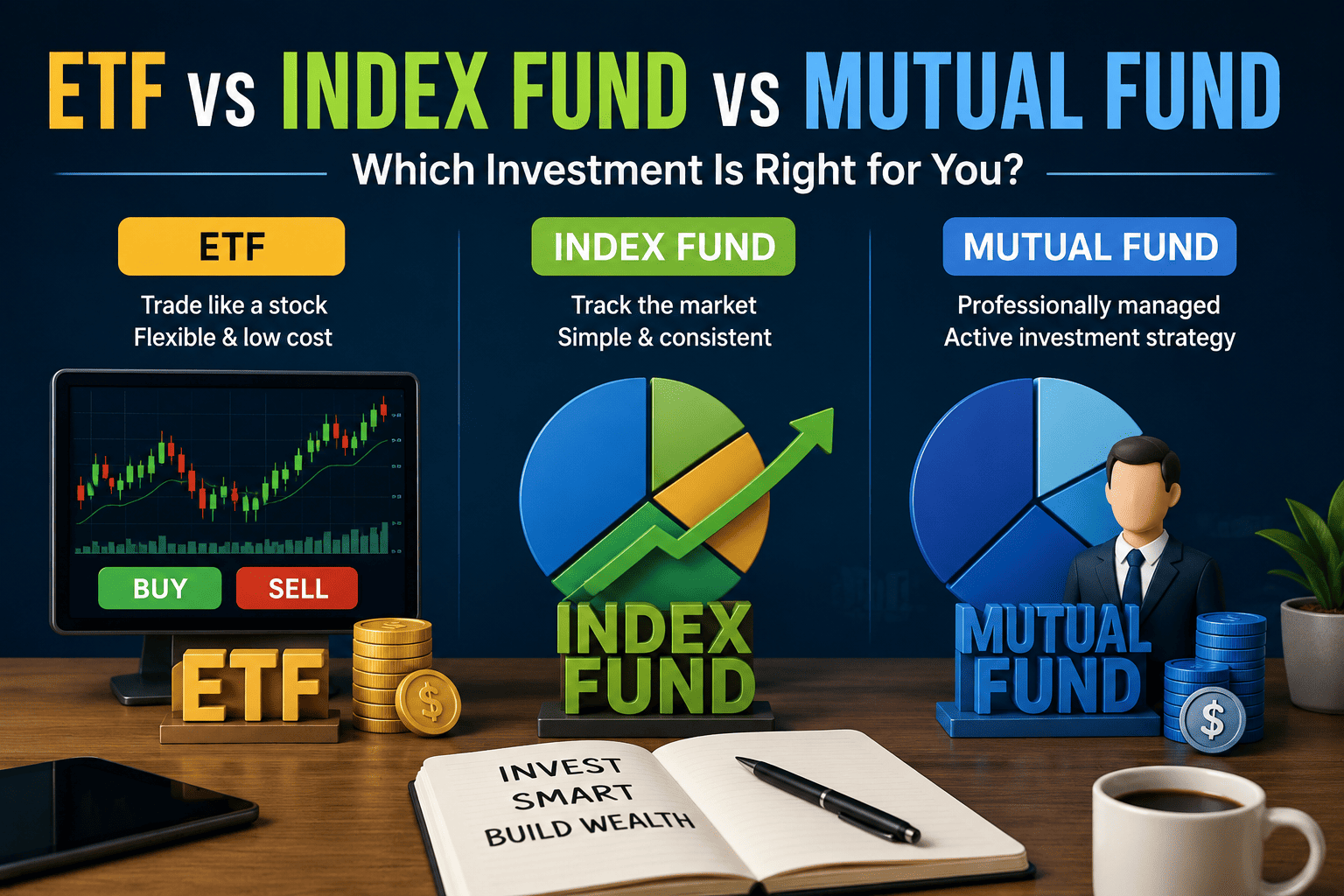
ETF vs Index Fund vs Mutual Fund: Which Investment Is Right for You?
A Complete Beginner’s Guide to Choosing the Right Investment Strategy
Investing has never been more accessible.
With a few clicks on a smartphone, anyone can buy shares of companies, own a piece of the global stock market, and begin building long-term wealth. But for many new investors, the biggest challenge isn’t opening an investment account.
It’s knowing what to buy.
Should you choose an ETF?
Is an index fund better?
What exactly is a mutual fund?
And when financial experts talk about passive investing, which option actually makes the most sense?
These questions confuse millions of beginners because ETFs, index funds, and mutual funds often appear similar. They can all provide diversification, professional management, and exposure to financial markets.
However, important differences exist.
The right choice depends on your goals, investment style, fees, risk tolerance, and how involved you want to be with managing your money.
In this complete guide, we break down ETF vs Index Fund vs Mutual Fund, explain how each investment works, compare their advantages and disadvantages, and help you understand which investment you should choose.
Understanding the Basics: What Are ETFs, Index Funds, and Mutual Funds?
Before comparing these investments, it’s important to understand what they actually are.
At their core, all three are investment funds.
Instead of buying individual stocks yourself, you purchase a collection of investments managed through a fund structure.
For example:
Instead of buying shares of 500 different companies individually, you could buy one fund that tracks those 500 companies.
This approach provides:
- Diversification
- Lower risk compared with owning individual stocks
- Easier portfolio management
- Access to professional investment strategies
The main differences come down to how they are managed, traded, priced, and structured.
What Is an ETF? (Exchange-Traded Fund Explained)
An ETF (Exchange-Traded Fund) is a basket of investments that trades on a stock exchange, similar to an individual stock.
When you buy an ETF, you are buying a small ownership portion of a fund that may contain hundreds or thousands of assets.
Examples include ETFs that track:
- The S&P 500
- Technology companies
- International markets
- Bonds
- Commodities
- Specific industries
A popular example is an ETF that follows the performance of the S&P 500 index.
Instead of selecting individual companies, investors gain exposure to a broad section of the market with one purchase.
How ETFs Work
ETFs are traded throughout the day.
Their prices change constantly based on supply and demand, just like stocks.
For example:
If you buy an ETF at 10:00 AM and sell it at 2:00 PM, the price may be different depending on market movements.
This flexibility is one reason ETFs have become extremely popular among modern investors.
What Is an Index Fund? (Index Fund Explained)
An index fund is an investment fund designed to copy the performance of a specific market index.
Instead of trying to beat the market, index funds attempt to match it.
For example:
A fund tracking the S&P 500 aims to perform similarly to the overall S&P 500.
The philosophy behind index investing is simple:
Rather than searching for the next winning company, own a small piece of many successful companies and allow the market to grow over time.
Index funds are usually considered a form of passive investing because they do not rely on frequent buying and selling decisions.
Why Index Funds Became Popular
Many investors discovered that consistently beating the market is extremely difficult.
Professional fund managers often struggle to outperform broad market indexes over long periods.
Index funds offer:
- Low costs
- Simple strategy
- Broad diversification
- Long-term focus
For many beginners, index funds represent one of the easiest ways to start investing.
What Is a Mutual Fund?
A mutual fund is a pool of money collected from many investors and managed by a professional fund manager.
The manager decides which investments the fund buys and sells according to the fund’s strategy.
Mutual funds can invest in:
- Stocks
- Bonds
- Real estate assets
- International companies
- Specific industries
Unlike index funds, many mutual funds are actively managed.
This means a professional manager attempts to outperform the market by selecting investments they believe will perform well.
ETF vs Mutual Fund: What’s the Difference?
The biggest difference between ETFs and mutual funds is how they are bought, sold, and managed.
| Feature | ETF | Mutual Fund |
|---|---|---|
| Trading | Bought and sold throughout the day | Usually priced once daily |
| Management | Often passive, sometimes active | Often actively managed |
| Minimum Investment | Usually very low | May require minimum amounts |
| Fees | Often lower | Often higher |
| Flexibility | High | Lower |
| Transparency | Usually daily holdings disclosure | May disclose less frequently |
Advantages of ETFs
1. Lower Costs
Many ETFs have very low expense ratios because they simply track an index.
Lower fees matter because investment costs reduce your long-term returns.
2. Flexibility
ETFs can be bought and sold anytime during market hours.
3. Diversification
One ETF can give investors exposure to hundreds or thousands of companies.
4. Tax Efficiency
Many ETFs are structured in a way that can reduce taxable events compared with some mutual funds.
Disadvantages of ETFs
- Prices fluctuate throughout the day
- Investors may be tempted to trade too frequently
- Some specialized ETFs carry higher risks
Index Fund vs ETF: Are They the Same?
This is where many beginners become confused.
An ETF and an index fund are not necessarily opposites.
In fact:
- An ETF can be an index fund.
- An index fund describes the investment strategy.
- An ETF describes the structure.
For example, a fund can be:
- An index mutual fund
- An index ETF
Both may track the same market index.
The difference is mainly how investors buy and sell them.
ETF vs Index Fund: Which Is Better?
Both can be excellent choices.
The better option depends on your preferences.
ETFs May Be Better If You Want:
- Trading flexibility
- Lower investment minimums
- More control over buying and selling
- Tax advantages
Index Funds May Be Better If You Want:
- A simple set-it-and-forget-it approach
- Automatic investing
- Minimal involvement
- Long-term retirement investing
For many beginners, the difference is relatively small.
Consistency matters far more than choosing the “perfect” fund.
Mutual Funds vs Index Funds
This comparison is important because many people assume all mutual funds are actively managed.
That is not true.
An index fund can be a mutual fund.
The difference is strategy.
Actively Managed Mutual Fund
A professional manager chooses investments.
Goal: Beat the market.
Potential advantages:
- Expert decision-making
- Specialized strategies
Potential disadvantages:
- Higher fees
- Managers may underperform
Index Fund
The fund follows a market index.
Goal: Match the market.
Advantages:
- Lower fees
- Simple strategy
- Consistent approach
For many long-term investors, index funds have become the preferred choice because they prioritize reliability over prediction.
Passive Investing Guide: Why It Works for Many Investors
Passive investing follows a simple idea:
Do not try to predict every market movement.
Instead:
- Buy diversified investments
- Keep costs low
- Stay invested for years
- Allow compound growth to work
This strategy is popular because markets are unpredictable in the short term but have historically rewarded patient investors over long periods.
Passive investing reduces emotional decisions.
You are less likely to panic during market downturns or chase investment trends.
Which Investment Should I Choose?
The answer depends on your situation.
If You Are a Beginner Investor
A low-cost diversified ETF or index fund is often a strong starting point.
Why?
Because beginners usually benefit from:
- Simplicity
- Diversification
- Low fees
- Long-term discipline
If You Want Maximum Simplicity
An index fund may be attractive.
You choose a broad market fund, invest consistently, and avoid unnecessary decisions.
If You Want Flexibility
An ETF may be the better choice.
It provides more control over buying and selling.
If You Want Professional Management
A mutual fund may appeal to you.
However, carefully compare fees and performance history before investing.
Common Mistakes Beginners Make
Choosing Based Only on Past Performance
A fund that performed well last year may not perform well in the future.
Past returns do not guarantee future results.
Ignoring Fees
A small difference in fees can significantly affect long-term wealth.
Always check expense ratios.
Investing Without a Plan
Before investing, understand:
- Your goals
- Your timeline
- Your risk tolerance
Constantly Changing Investments
Successful investing often requires patience.
Frequent buying and selling can hurt returns.
A Simple Beginner Investment Approach
Many successful investors follow a simple formula:
- Build an emergency fund.
- Pay down expensive debt.
- Invest regularly.
- Use diversified funds.
- Keep costs low.
- Think long term.
The goal isn’t to find the hottest investment.
The goal is to build a sustainable financial system.
Final Thoughts: ETF, Index Fund, or Mutual Fund?
The debate between ETF vs Index Fund vs Mutual Fund is not about finding one universal winner.
Each option has strengths.
- ETFs provide flexibility and efficiency.
- Index funds provide simplicity and long-term consistency.
- Mutual funds provide professional management and specialized strategies.
For many beginners, the best investment is often the one they can understand, afford, and stick with for decades.
Successful investing is rarely about making one perfect decision.
It is about making good decisions repeatedly.
Start early.
Invest consistently.
Keep learning.
And remember:
The most powerful investment tool you have is not the fund you choose.
It’s time.





2 Comments
Micle harison
June 7, 2019Lorem ipsum dolor sit amet, usu ut perfecto postulant deterruisset, libris causae volutpat at est, ius id modus laoreet urbanitas. Mel ei delenit dolores.
John Doe
June 7, 2019Some consultants are employed indirectly by the client via a consultancy staffing company.