
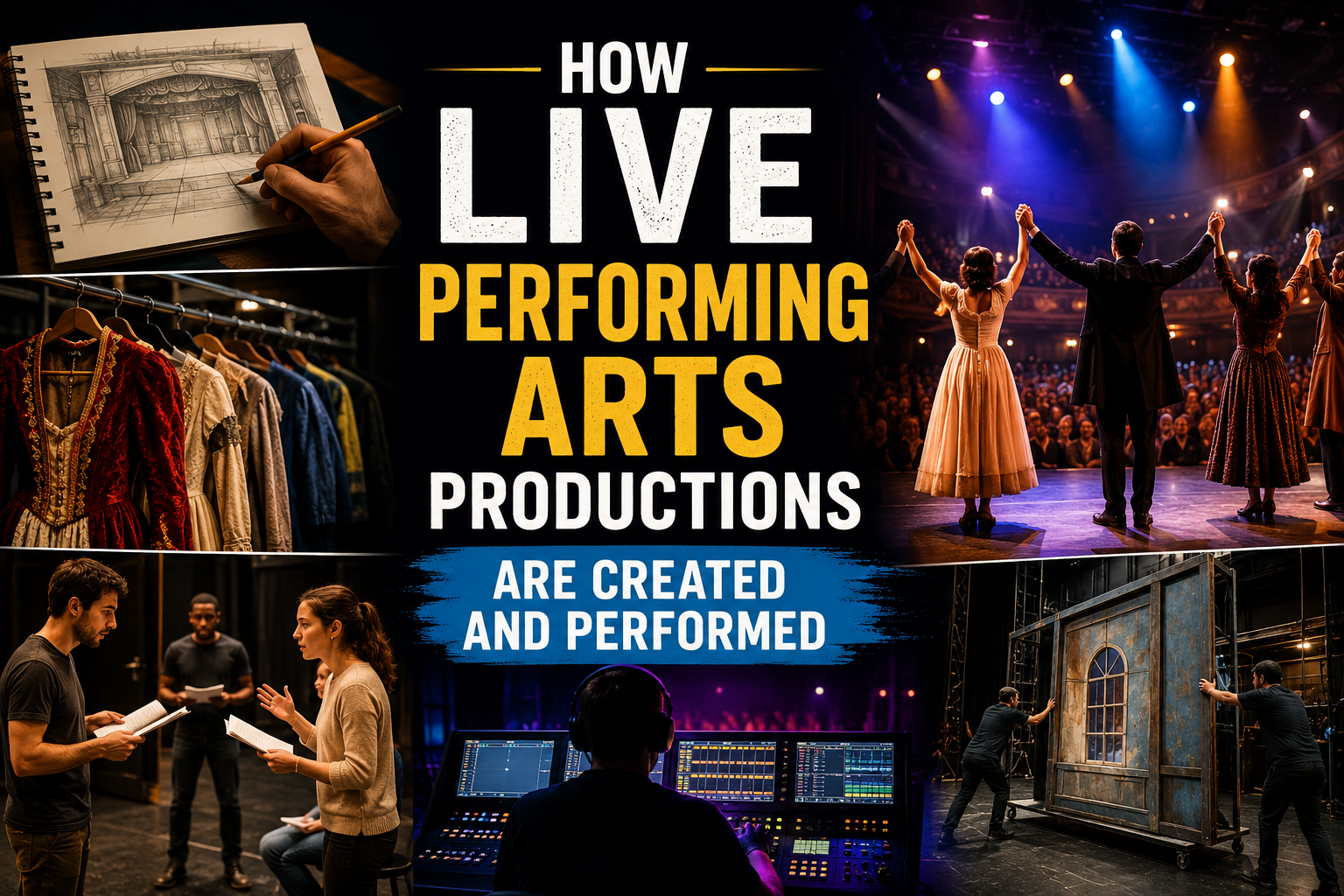
How Live Performing Arts Productions Are Created and Performed
A live performing arts production can look effortless from the audience. Actors deliver their lines, dancers move in precise patterns, musicians perform together, lights change at exactly the right moment, and sets appear to transform the stage.
Behind that polished performance, however, is a complex creative and technical process involving dozens—or sometimes hundreds—of people.
From the first idea to opening night, a live production requires planning, artistic collaboration, rehearsals, technical preparation, marketing, and careful coordination. Theater, dance, opera, musicals, concerts, and other performing arts may differ in style, but many share the same basic production journey.
Understanding how live performing arts productions are created reveals just how much work happens before the audience takes its seat.
What Is a Live Performing Arts Production?
A live performing arts production is a planned performance presented before an audience in real time.
It can include:
- Theater productions
- Musicals
- Dance performances
- Opera
- Live music performances
- Comedy shows
- Spoken-word performances
- Circus and physical theater
- Multidisciplinary performances
- Cultural and traditional performances
Unlike recorded entertainment, live productions unfold in the presence of an audience. Performers cannot simply edit out a mistake or redo a scene after it has happened.
That immediacy is one of the defining characteristics of live performance.
How a Production Begins With an Idea
Every production begins with a creative concept.
The idea might come from an existing play, musical score, novel, historical event, cultural tradition, choreographic concept, or an entirely original story.
A creative team may ask:
- What story are we trying to tell?
- Who is the audience?
- What should the audience feel?
- What themes should the production explore?
- What style should the performance have?
- What resources will be required?
At this stage, the production may exist only as a concept.
Turning that concept into a performance requires a series of creative and practical decisions.
The Role of the Producer
The producer is often responsible for helping turn a creative idea into an achievable production.
Depending on the size and structure of the organization, producers may oversee:
- Budgeting
- Scheduling
- Hiring
- Contracts
- Venue arrangements
- Fundraising
- Marketing
- Production logistics
- Administrative planning
The producer works closely with artistic and technical teams to balance creative ambitions with practical limitations.
A production may have an ambitious vision, but the team still has to determine whether the necessary performers, equipment, venue, time, and funding are available.
The Director Shapes the Artistic Vision
For many theater and performance productions, the director plays a central role in translating the concept into a coherent stage experience.
The director interprets the material and works with performers and designers to establish how the production should look, sound, and feel.
A director may make decisions about:
- Acting style
- Movement
- Pacing
- Blocking
- Character relationships
- Scene transitions
- Tone
- Visual composition
- Interpretation of the script
The director is not necessarily responsible for every creative decision. Instead, the director often coordinates different artistic departments so they work toward a shared vision.
Scripts and Scores Provide the Foundation
The production process depends heavily on the material being performed.
For theater, this may be a script containing dialogue, stage directions, characters, and scenes.
For musical productions, the material can include both a script and musical score.
Dance productions may begin with choreography, music, movement concepts, or a broader artistic framework.
Opera combines several elements, including music, singing, dramatic performance, staging, costumes, and orchestration.
The production team analyzes this material carefully before rehearsals begin.
Designing the World of the Performance
One of the most important stages is transforming the creative concept into a physical and visual environment.
This involves several design disciplines.
Set Design
Set designers determine how the performance space should look and function.
A set might recreate a realistic home, suggest an abstract landscape, represent multiple locations, or use minimal scenery.
Designers must consider both appearance and practicality. Performers need enough space to move safely, while scenery may need to be changed during the performance.
Costume Design
Costumes help communicate character, time period, social position, personality, and artistic style.
Costume designers also need to consider movement.
A costume that looks impressive but restricts an actor’s ability to perform may not be practical.
Dance and physical theater can present particularly demanding costume requirements because performers need freedom of movement.
Lighting Design
Lighting does much more than make performers visible.
Lighting can establish:
- Time of day
- Location
- Mood
- Focus
- Atmosphere
- Transitions
- Visual rhythm
A lighting designer works with the director and other designers to ensure that lighting supports the production’s overall artistic language.
Sound Design
Sound can include music, microphones, recorded effects, environmental sounds, and other audio elements.
In a large venue, sound designers and engineers must ensure that performers can be heard clearly throughout the audience area.
For musical performances, sound also involves balancing multiple instruments and voices.
Casting the Performers
Once the creative direction is established, performers need to be selected.
Casting can involve auditions, invitations, interviews, workshops, or combinations of these approaches.
The creative team considers factors such as:
- Acting ability
- Vocal ability
- Movement skills
- Musical ability
- Physical requirements
- Character interpretation
- Experience
- Chemistry between performers
Casting is not simply about finding the most technically skilled person.
A performer may be excellent individually but unsuitable for a particular production’s artistic requirements. Directors therefore consider how performers work together as an ensemble.
Rehearsals Turn Plans Into Performance
Rehearsals are where the production begins to come alive.
Early rehearsals often focus on understanding the material, exploring characters, learning movement, and establishing relationships between performers.
As rehearsals continue, the team becomes more precise.
Actors may memorize lines and blocking. Dancers refine choreography. Musicians practice arrangements. Singers work on harmonies and interpretation.
The director gradually shapes these individual contributions into a complete performance.
What Is Blocking?
In theater, blocking refers to the planned movement and positioning of performers on stage.
Directors determine where performers stand, when they move, where they enter and exit, and how their movements relate to the action.
Blocking serves artistic and practical purposes.
It can direct the audience’s attention while also ensuring that performers can interact safely with scenery, props, other performers, and technical equipment.
Over time, blocking becomes increasingly precise.
Rehearsals Become More Technical Over Time
Early rehearsals may take place in a simple rehearsal room without the final set, costumes, or lighting.
Later, the production moves toward increasingly realistic conditions.
Technical elements are gradually introduced, including:
- Stage scenery
- Props
- Lighting
- Sound
- Costumes
- Special effects
- Microphones
- Video projections
This process allows the production team to discover problems before audiences arrive.
A scene transition that works on paper may prove too slow in practice. A costume may interfere with movement. A microphone may create unwanted noise. A lighting cue may happen too early.
Technical rehearsals provide an opportunity to identify and correct these problems.
The Importance of Technical Rehearsals
Technical rehearsals bring artistic and technical departments together.
The production may run through scenes while lighting operators, sound engineers, stage managers, and other crew members practice their cues.
For a complex production, dozens of technical changes may happen during a single performance.
These can include:
- Lighting changes
- Sound cues
- Music entrances
- Scene changes
- Video projections
- Curtain movements
- Prop changes
- Performer entrances and exits
The goal is to make these changes appear seamless to the audience.
Dress Rehearsals Simulate the Real Performance
A dress rehearsal is generally performed with costumes and as many production elements as possible.
It gives performers and crew an opportunity to experience the show as a complete performance rather than as separate scenes or technical exercises.
Dress rehearsals can reveal problems that were not obvious during earlier rehearsals.
The team may discover that:
- A costume change takes too long.
- A scene transition needs additional crew.
- A performer cannot see a lighting cue.
- A microphone needs repositioning.
- A prop is difficult to move.
- The pacing of a scene needs adjustment.
Making these corrections before opening night can significantly improve the audience experience.
The Stage Manager Keeps Everything Coordinated
The stage manager is one of the most important organizational figures in a live production.
While responsibilities vary between productions, stage managers often coordinate rehearsals, maintain production information, communicate between departments, and oversee the running of the performance.
During a show, the stage manager or stage management team may call technical cues.
This means a lighting change, sound effect, scene transition, or other event happens at the appropriate moment.
To the audience, these changes may appear automatic. In reality, they can depend on carefully timed instructions.
What Happens During a Live Performance?
Once the performance begins, every department has a role.
Performers focus on their artistic responsibilities.
The stage crew manages scenery and props.
Lighting operators execute cues.
Sound engineers manage microphones, music, and effects.
Stage management coordinates the overall performance.
Front-of-house staff assist audiences and manage the public areas of the venue.
The production functions as a coordinated system.
A successful live performance therefore depends on much more than what happens on stage.
Why Timing Matters So Much
Live performance is highly dependent on timing.
A performer may need to enter immediately after another character exits. A lighting cue may need to happen at a specific line. A piece of scenery may need to move during a musical transition.
Small delays can affect everything that follows.
This is why performers and crew members rehearse not only individual actions but also the transitions between them.
Precision creates the illusion that everything is happening naturally.
Audience Interaction Changes the Performance
Unlike recorded entertainment, live performance involves a physical audience.
Audience reactions can affect the atmosphere of a performance.
Laughter may change the timing of a comedic scene. Applause can temporarily interrupt the performance. Silence can intensify a dramatic moment.
Performers learn to respond without losing the structure of the production.
This relationship between performer and audience is one reason two performances of the same production may never feel exactly identical.
How Live Performances Handle Mistakes
Mistakes are inevitable in live entertainment.
A performer may forget a line. A prop may fail. A costume problem may occur. A technical cue may happen incorrectly.
Professional performers and crews learn how to recover without unnecessarily disrupting the experience.
Improvisation can sometimes help actors recover from unexpected situations, while stage crews may quietly solve technical problems behind the scenes.
The audience may never realize that something went wrong.
This ability to adapt is one of the skills that distinguishes live performance from rehearsed practice.
Marketing Brings the Audience Into the Theater
Creating a production is only part of the challenge.
The production also needs an audience.
Marketing teams may promote performances through:
- Social media
- Websites
- Email campaigns
- Posters
- Media coverage
- Partnerships
- Community outreach
- Promotional events
- Word-of-mouth recommendations
Marketing typically communicates what makes the production worth seeing and provides practical information such as dates, venue, ticket prices, and performance times.
For smaller organizations, marketing can be especially important because audience revenue may be a major part of the production’s financial sustainability.
Ticket Sales and Production Economics
Live performing arts can be expensive to produce.
Costs may include:
- Performer fees
- Staff salaries
- Venue rental
- Set construction
- Costumes
- Lighting equipment
- Sound equipment
- Insurance
- Transportation
- Marketing
- Licensing
- Administrative expenses
Revenue can come from ticket sales, sponsorships, grants, donations, merchandise, partnerships, and other sources.
Producing a financially sustainable performance therefore requires both artistic ambition and careful management.
Accessibility Is Part of Modern Production
Performing arts organizations increasingly consider accessibility when designing productions and audience experiences.
Accessibility may include:
- Wheelchair-accessible seating
- Accessible entrances
- Captioning
- Sign-language interpretation
- Audio description
- Relaxed performances
- Accessible restrooms
- Clear information about venue conditions
Accessibility can allow more people to participate in cultural life.
It should be considered during production planning rather than treated solely as an afterthought.
The Role of Technology in Live Performance
Technology has expanded what live productions can accomplish.
Modern performances can incorporate:
- Digital projection
- Automated lighting
- Wireless microphones
- Video screens
- Motion tracking
- Computer-controlled effects
- Interactive installations
- Digital ticketing
- Livestreaming
Technology can create new artistic possibilities, but it also introduces additional technical complexity.
The best productions generally use technology to support the artistic purpose rather than relying on technology simply because it is available.
Why Collaboration Is at the Heart of Performing Arts
A live production is fundamentally collaborative.
The director may have the artistic vision, but the final performance depends on the contributions of many people.
A single production may involve:
Creative teams: directors, writers, choreographers, composers, designers, and performers.
Technical teams: lighting technicians, sound engineers, stage technicians, costume specialists, and production crews.
Administrative teams: producers, marketers, administrators, ticketing staff, and venue managers.
Each group contributes specialized knowledge.
When communication works well, these different skills combine to create something that none of the individuals could produce alone.
From First Idea to Opening Night
The journey from concept to performance can be thought of as a sequence:
Idea → Planning → Funding → Design → Casting → Rehearsal → Technical Integration → Dress Rehearsal → Opening Night → Performances → Evaluation
The process is rarely perfectly linear.
Designs change during rehearsals. Scripts may be revised. Performers may discover new interpretations. Technical problems may require creative solutions.
The production evolves as the team learns what works.
What Happens After Opening Night?
Opening night is not necessarily the end of the creative process.
Performers and production teams may continue making adjustments throughout a run.
They may respond to:
- Audience reactions
- Technical difficulties
- Performer observations
- Timing problems
- Changes in venue conditions
- Artistic discoveries
Some productions also undergo substantial revisions before being transferred to another venue or produced by another company.
The performance can therefore continue evolving long after its first public presentation.
Why Live Performance Remains Different
Digital entertainment has made movies, music, theater recordings, and other forms of content available almost anywhere.
Yet live performance retains a distinctive appeal.
The audience and performers occupy the same physical space. The performance happens once, in real time, with no guarantee that every moment will unfold exactly as planned.
That uncertainty creates a sense of presence.
A live production is not simply a finished product being delivered to consumers. It is an event created collectively by performers, technicians, and audiences.
The Many People Behind the Curtain
The next time the lights dim before a theater performance, dance production, concert, or other live event, it is worth remembering how much has already happened.
Long before the audience enters, someone developed the idea. Producers organized resources. Directors shaped the artistic vision. Designers created the visual and technical environment. Performers rehearsed repeatedly. Technicians tested equipment. Stage managers coordinated countless details. Marketing teams brought the audience through the doors.
Then, for a few hours, all those separate efforts come together.
That is the remarkable nature of live performing arts: an intricate combination of creativity, preparation, technology, teamwork, and human presence that exists for a moment in time and can never be reproduced in exactly the same way.





2 Comments
Micle harison
June 7, 2019Lorem ipsum dolor sit amet, usu ut perfecto postulant deterruisset, libris causae volutpat at est, ius id modus laoreet urbanitas. Mel ei delenit dolores.
John Doe
June 7, 2019Some consultants are employed indirectly by the client via a consultancy staffing company.