
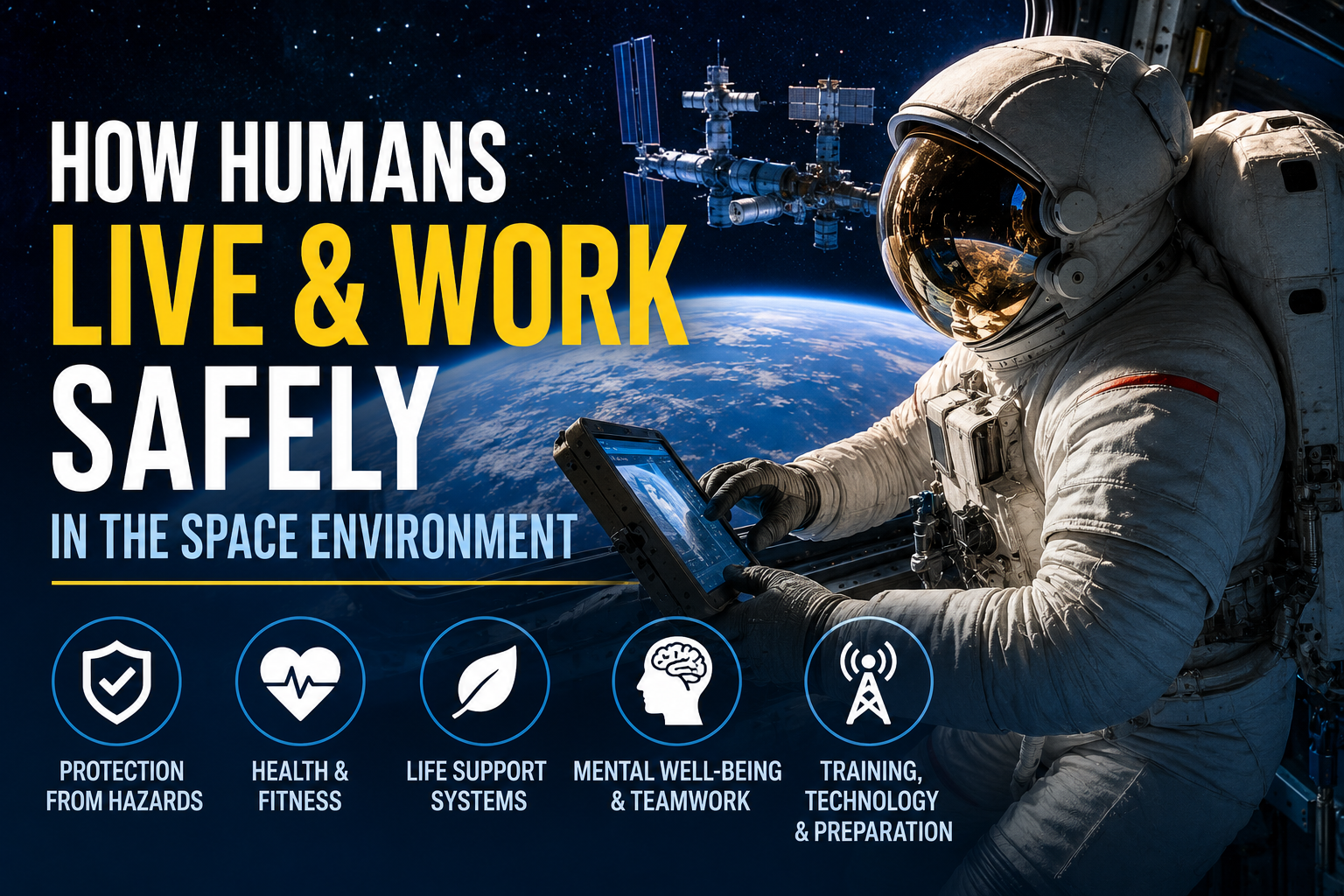
How Humans Live and Work Safely in the Space Environment
Space may look calm from Earth, but the environment beyond our planet is extremely hostile to the human body. There is no breathable atmosphere, temperatures can vary dramatically, radiation levels are higher than on Earth, and microgravity changes the way muscles, bones, fluids and other body systems function.
Yet astronauts routinely live and work in orbit for months at a time.
That is possible because human spaceflight is built around an extensive system of engineering, medical monitoring, training, protective equipment and carefully designed daily routines. From the air inside a spacecraft to the spacesuit worn outside it, almost every part of an astronaut’s environment has to be deliberately controlled.
As space agencies prepare for longer missions to the Moon and eventually Mars, keeping people healthy and productive away from Earth is becoming one of the most important challenges in exploration.
Why space is such a difficult environment for humans
Earth provides a remarkable natural life-support system.
Its atmosphere supplies oxygen and pressure, its magnetic field and atmosphere provide protection from much of the space radiation environment, and its gravity helps maintain the structure and function of the human body.
Remove those protections and humans quickly face serious hazards.
NASA groups the major challenges of human spaceflight into five broad categories: space radiation, isolation and confinement, distance from Earth, altered gravity, and hostile or closed environments. These hazards can interact with one another, potentially increasing their effects on astronaut health and performance. (NASA)
Safe spaceflight therefore depends on managing the entire environment rather than addressing one danger at a time.
Keeping astronauts alive inside a spacecraft
A spacecraft is essentially a carefully engineered artificial habitat.
Environmental control and life-support systems help maintain the conditions humans need to survive, including breathable air, appropriate temperature and pressure, carbon-dioxide removal and waste management.
NASA describes reliable life-support systems as critical to extended human missions because astronauts must live in an environment where outside rescue is extremely limited and air and water may need to be reused. (NASA)
Water is particularly valuable.
Transporting supplies from Earth becomes increasingly difficult as missions travel farther away, so future spacecraft and habitats will need increasingly efficient recycling systems. The same principle applies to oxygen and other consumable resources.
The goal is to move from a system that simply carries everything from Earth toward one that can increasingly recycle, regenerate and reuse resources.
Spacesuits are more than protective clothing
When astronauts leave their spacecraft, the spacesuit becomes their personal spacecraft.
Outside a pressurized vehicle, there is no atmosphere to breathe and no normal environmental pressure to support the human body. A spacesuit therefore has to provide an artificial environment while allowing the astronaut to move, communicate and perform complex tasks.
NASA describes spacesuits as miniature spacecraft that provide life support, thermal regulation and protection from the vacuum of space. (NASA)
A modern suit must perform several jobs at once.
It helps maintain appropriate pressure around the astronaut, supplies oxygen, removes carbon dioxide and excess heat, and protects against the harsh external environment. It also has to provide enough mobility for activities such as maintenance, scientific experiments and exploration.
That creates a difficult engineering compromise: the suit must be protective without becoming so restrictive that astronauts cannot perform their jobs.
Microgravity changes the human body
One of the most significant differences between Earth and orbit is gravity.
Astronauts aboard the International Space Station live in microgravity, where their bodies no longer experience the same gravitational loading they do on Earth. Over time, this can lead to changes in muscles, bones and cardiovascular function.
NASA notes that prolonged exposure to microgravity can cause muscles and bones to lose strength and mass without appropriate countermeasures. (NASA)
The body also has to adapt to changes in fluid distribution and balance.
On Earth, gravity pulls bodily fluids toward the lower part of the body. In microgravity, fluids shift toward the upper body and head. This contributes to some of the physical changes astronauts experience in orbit and is part of the reason researchers continue studying how long-duration missions affect human physiology.
The challenge becomes even more complicated when considering destinations such as the Moon and Mars, where gravity is weaker than Earth’s but stronger than the microgravity experienced aboard an orbiting spacecraft.
Exercise is a critical part of spaceflight
For astronauts, exercise is not simply about staying fit.
It is an important countermeasure against some of the physical effects of living in microgravity.
Spacecraft such as the International Space Station are equipped with exercise systems that allow astronauts to perform activities designed to place loads on muscles and bones and maintain cardiovascular fitness.
This is especially important for longer missions.
An astronaut traveling to Mars could spend years away from Earth. Maintaining sufficient strength and physical capacity would be essential not only for health but also for the ability to perform demanding tasks during the mission and after landing.
NASA continues to study strategies for reducing bone and muscle loss and other physiological changes associated with spaceflight. (NASA)
Radiation is an invisible threat
Radiation represents one of the biggest differences between living on Earth and traveling through deep space.
Earth’s atmosphere and magnetic field provide substantial protection, but astronauts traveling beyond Earth’s protective environment face greater exposure to energetic particles.
NASA identifies space radiation as one of the most significant hazards of human exploration. Galactic cosmic rays and radiation associated with solar events can damage biological tissue and increase health risks. (NASA)
Long-term exposure can increase the risk of cancer and may affect the cardiovascular system, eyes and central nervous system. (NASA)
Protection therefore requires several strategies.
Spacecraft can incorporate shielding, mission planners can monitor radiation conditions, and crews can have access to areas offering greater protection during significant solar events.
Radiation monitoring is also important because astronauts cannot rely on their senses to detect exposure. Radiation is invisible and cannot normally be felt, meaning instruments and operational procedures have to provide the warning system.
Spacecraft design has to account for tiny details
Living in a closed spacecraft creates problems that rarely exist in ordinary homes.
Air quality has to be monitored. Temperature and humidity must remain within acceptable ranges. Carbon dioxide must be controlled. Equipment generates noise and heat. Microorganisms can behave differently in closed environments, while human immune responses can also change during spaceflight.
NASA identifies these factors as part of the hostile and closed-environment hazard of human spaceflight. (NASA)
Even lighting matters.
Astronauts have to maintain healthy sleep and wake cycles despite living in an environment where natural day and night conditions may differ significantly from those on Earth.
Future spacecraft will therefore need to be designed not merely as machines that can keep people alive, but as habitats that support long-term human health and performance.
Sleep and mental health are part of mission safety
Physical health is only one side of the equation.
Astronauts also have to cope with confinement, demanding schedules, separation from family and friends, limited privacy and the psychological pressure of operating in an environment where mistakes can have serious consequences.
The farther a spacecraft travels from Earth, the more difficult communication and emergency assistance become.
NASA identifies isolation and confinement as a major human-spaceflight hazard and notes that sleep loss, disrupted circadian rhythms and work overload can affect performance and health. (NASA)
Crew selection and training therefore go beyond technical competence.
Astronauts need to function effectively as a team, communicate clearly, resolve disagreements and continue making good decisions under pressure.
NASA also studies behavioral health, workload, sleep and other factors that could affect crew performance during long-duration missions. (NASA)
Distance from Earth changes the rules
On the International Space Station, astronauts can communicate with Earth and receive supplies or assistance relatively quickly compared with what would be possible on a deep-space mission.
A journey to Mars would be very different.
The distance means crews cannot depend on immediate instructions, rapid medical evacuation or frequent deliveries. Communication delays also mean astronauts may have to make decisions with limited real-time support.
That creates a requirement for greater crew autonomy.
Future astronauts may need advanced onboard medical capabilities, highly reliable equipment, extensive training and artificial intelligence or decision-support systems that can help them respond to unexpected situations.
The farther humans travel, the more important self-sufficiency becomes. NASA specifically identifies distance from Earth as one of the core hazards of human exploration. (NASA)
Food and water become strategic resources
Nutrition is another essential part of keeping astronauts healthy.
Space missions require food that is safe, stable, nutritious and practical to store. The food also has to provide enough energy and nutrients to support physically demanding work while accounting for the physiological changes associated with spaceflight.
Water is even more strategically important because it is needed for drinking, food preparation, hygiene and life-support processes.
Long-duration missions will put increasing pressure on systems capable of recovering and reusing water efficiently.
NASA is also researching ways to grow fresh food in space. Experiments involving plants can potentially provide nutritional benefits while also helping researchers understand how food-production systems could support future missions. (NASA)
Technology has to work when repair options are limited
Reliability becomes critical when humans are hundreds of thousands or millions of kilometers from Earth.
A broken household appliance can usually be replaced. A failed spacecraft component may have to be repaired with whatever tools and spare parts are already available.
This is why astronauts train extensively for emergencies and routine maintenance.
Spacecraft are designed with redundancy wherever practical, allowing backup systems to take over when primary systems fail. Crews also practice procedures for fires, pressure leaks, equipment failures and other emergencies.
NASA’s Orion spacecraft, for example, incorporates environmental control and life-support capabilities intended to maintain a safe environment for astronauts during deep-space missions, including contingency situations involving cabin pressure or air quality. (NASA)
For future missions, reliability will become even more important as crews travel farther from Earth and spend longer periods away.
Medical care must come with the crew
Astronauts cannot depend on a hospital being nearby.
Space missions therefore require medical capabilities, monitoring systems and trained crew members capable of handling a range of potential health problems.
NASA’s human-spaceflight research includes risks involving cardiovascular changes, muscle and bone loss, immune responses, sleep, radiation, behavioral health, hearing, vision and other physiological effects. (NASA)
Researchers are also developing technologies that could allow health information to be collected and assessed remotely.
NASA’s current research includes work on commercial telemedicine systems designed to collect and integrate health data, potentially supporting near-real-time medical assessment during missions. (NASA)
That could become particularly valuable during deep-space exploration, when communication delays make traditional forms of remote medical support more difficult.
Safety starts long before launch
Keeping humans safe in space does not begin when a rocket leaves the launchpad.
Astronauts undergo extensive physical and psychological screening, technical training, emergency preparation and simulations before missions.
Researchers also use Earth-based environments to study how people respond to isolation, confinement and other conditions that resemble aspects of spaceflight. NASA’s Human Research Program uses ground-based analog environments alongside space-station research to investigate the hazards astronauts may face farther from Earth. (NASA)
The International Space Station itself serves as an important research platform.
Experiments conducted there help scientists understand how humans respond to long-duration exposure to microgravity and other aspects of spaceflight, providing information that can be used to design future missions.
The next challenge is living safely beyond low Earth orbit
Humanity has learned how to keep people alive in orbit for extended periods, but longer journeys will introduce additional challenges.
A mission to the Moon requires crews to operate farther from Earth and deal with a different radiation and gravity environment. A mission to Mars would magnify almost every challenge: longer isolation, greater communication delays, more radiation exposure and a much greater need for self-sufficiency.
NASA’s current human-spaceflight research continues to focus on the five broad hazards of radiation, isolation and confinement, distance from Earth, gravity and hostile or closed environments. (NASA)
Solving these problems will require more than better rockets.
It will require better habitats, life-support systems, spacesuits, medical technologies, exercise equipment, radiation protection, food systems, communications and autonomous technologies.
Building a sustainable human presence in space
Humans can survive in space because technology creates an artificial environment around them.
Every breath depends on life-support equipment. Every spacewalk depends on a spacesuit. Every day of physical activity helps counter the effects of altered gravity. Every mission plan accounts for radiation, equipment failures, medical emergencies and the psychological demands of confinement.
The longer humans remain away from Earth, the less practical it becomes to treat space as a place where people simply visit.
Future exploration will require humans to live and work in space as safely and sustainably as possible.
The ultimate test will not be whether astronauts can survive a short journey beyond Earth. It will be whether spacecraft and habitats can provide enough protection, resources, medical support and psychological stability for crews to remain healthy and productive throughout missions lasting months or years—and eventually establish a durable human presence beyond Earth.


2 Comments
Micle harison
June 7, 2019Lorem ipsum dolor sit amet, usu ut perfecto postulant deterruisset, libris causae volutpat at est, ius id modus laoreet urbanitas. Mel ei delenit dolores.
John Doe
June 7, 2019Some consultants are employed indirectly by the client via a consultancy staffing company.