
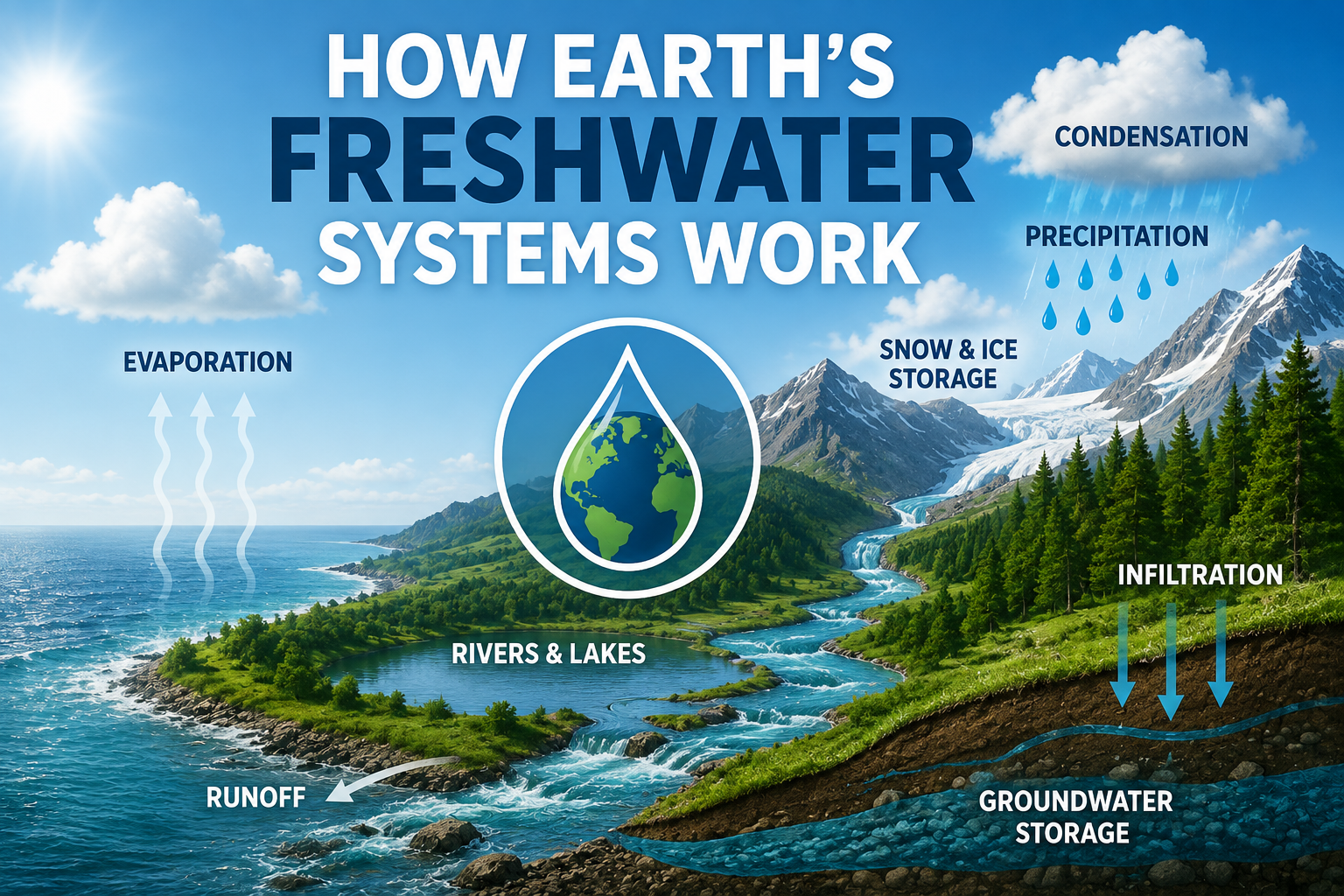
How Earth’s Freshwater Systems Work
Freshwater is one of Earth’s most important natural resources, supporting people, wildlife, agriculture, forests, wetlands and countless ecosystems. Although water covers most of the planet, only a small fraction of it is freshwater, and an even smaller portion is readily available for human use.
Freshwater systems are not isolated bodies of water. Rivers, lakes, wetlands, groundwater, glaciers, soil moisture, precipitation and the atmosphere are connected through the water cycle. Water constantly moves between these environments, changing form and location along the way.
Understanding how Earth’s freshwater systems work helps explain everything from river formation and groundwater recharge to droughts, floods and the availability of drinking water.
What Is Freshwater?
Freshwater is water that contains relatively low concentrations of dissolved salts compared with seawater.
It occurs naturally in several forms, including:
- Rivers and streams
- Lakes and ponds
- Wetlands
- Groundwater
- Glaciers and ice sheets
- Snow
- Soil moisture
- Water vapor in the atmosphere
Freshwater is essential for terrestrial life because plants and animals depend on water with suitable chemical conditions for biological processes.
However, freshwater is not distributed evenly across the planet. Some regions receive abundant rainfall and have extensive rivers and groundwater reserves, while others depend heavily on seasonal precipitation, underground aquifers or stored water.
How the Earth’s Water Cycle Moves Freshwater
The freshwater system is closely connected to the global hydrologic cycle, commonly called the water cycle.
The cycle describes the continuous movement of water between Earth’s surface, underground environments and the atmosphere.
A simplified version looks like this:
Evaporation → condensation → precipitation → runoff and infiltration → rivers, lakes and groundwater → evaporation
The process is continuous rather than a simple one-way sequence.
Evaporation
The Sun provides much of the energy that drives the water cycle.
When sunlight warms oceans, lakes, rivers and wet soil, some liquid water changes into water vapor and enters the atmosphere.
Plants contribute to this process through transpiration, in which water absorbed through their roots eventually escapes from their leaves as water vapor.
The combined movement of water from evaporation and plant transpiration is called evapotranspiration.
Condensation
As moist air rises and cools, water vapor can condense into tiny liquid droplets or ice crystals.
These particles form clouds.
Cloud formation does not necessarily mean precipitation will immediately occur. Atmospheric conditions determine whether droplets and ice crystals grow large enough to fall toward Earth’s surface.
Precipitation
When water returns from the atmosphere to Earth’s surface, it can take several forms.
These include:
- Rain
- Snow
- Sleet
- Freezing rain
- Hail
The type of precipitation depends largely on atmospheric temperature and conditions.
Once precipitation reaches the ground, it can follow several different pathways.
Some flows across the surface, some enters the soil, some is absorbed by plants and some can remain temporarily stored as snow or ice.
How Rivers and Streams Work
Rivers and streams are among the most visible parts of Earth’s freshwater system.
A river typically begins in an area where water accumulates or emerges, such as mountains, springs, wetlands, lakes or areas receiving substantial precipitation.
Small streams can merge to form larger streams and rivers.
This network is known as a drainage basin, or watershed.
A drainage basin is an area of land in which water flows toward a common outlet.
Rain falling on one side of a watershed may eventually enter one river system, while rain falling just a short distance away may drain into another.
Surface Runoff
When precipitation falls faster than soil can absorb it, or when the ground is already saturated, water can move across the surface.
This is called surface runoff.
Runoff can enter streams and rivers, carrying dissolved materials and sediments along with it.
The amount of runoff depends on factors such as:
- Rainfall intensity
- Soil type
- Vegetation
- Ground slope
- Ground saturation
- Temperature
- Land use
- Snow and ice conditions
Forests and other vegetation can slow water movement, allowing more water to infiltrate the ground.
Urban surfaces such as roads, roofs and concrete generally allow much less infiltration, which can increase rapid runoff during heavy rainfall.
How Lakes Store Freshwater
Lakes act as natural freshwater reservoirs.
They can form through many geological processes, including glacial activity, volcanic activity, tectonic movements and erosion.
Some lakes are fed primarily by rivers and streams, while others receive substantial water directly from rainfall, snowmelt or groundwater.
Water leaves lakes through:
- River outflow
- Groundwater movement
- Evaporation
- Human withdrawals
Because lakes can store water for extended periods, they help regulate freshwater availability within many watersheds.
Lakes also provide habitat for fish, aquatic plants, microorganisms, birds and other wildlife.
Why Wetlands Are Important Freshwater Systems
Wetlands are areas where water covers or saturates the soil for long enough to influence the plants, animals and physical characteristics of the ecosystem.
Examples include:
- Marshes
- Swamps
- Bogs
- Floodplains
- Peatlands
Wetlands are sometimes described as natural filters because they can trap sediments and influence the movement of nutrients and pollutants.
They can also store substantial amounts of water and slow its movement through landscapes.
During periods of heavy rainfall, wetlands and floodplains can provide space for excess water to spread and temporarily remain in the landscape.
During drier periods, stored water can contribute to the persistence of streams and surrounding ecosystems.
How Groundwater Works
A large portion of Earth’s accessible freshwater exists underground as groundwater.
Groundwater is water stored beneath Earth’s surface in spaces within soil, sediment and rock.
It does not normally exist as enormous underground lakes. Instead, it occupies pores, fractures and other spaces in geological materials.
Infiltration
Groundwater begins with water entering the ground.
When rain or melting snow reaches the surface, some of it infiltrates the soil.
The water can then move downward under the influence of gravity and other forces.
Some of it is taken up by plant roots or evaporates back into the atmosphere.
The portion that continues downward can eventually reach the saturated zone and become groundwater.
Aquifers
An aquifer is a geological formation capable of storing and transmitting groundwater in useful quantities.
Aquifers can occur in layers of sand and gravel as well as fractured or porous rock.
Some aquifers are relatively shallow and can receive water from recent rainfall. Others are much deeper and may contain groundwater that has been underground for very long periods.
The rate at which an aquifer is replenished depends on local geology, climate, vegetation, land cover and precipitation.
What Is the Water Table?
The water table is the upper boundary of the saturated zone in an unconfined groundwater system.
Above the water table, soil and rock may contain both air and water.
Below it, spaces are generally filled with groundwater.
The water table is not necessarily flat. Its shape can vary depending on topography, geology, rainfall, groundwater pumping and nearby rivers or lakes.
It can also rise during periods of substantial recharge and fall during extended dry periods or heavy groundwater extraction.
How Groundwater Connects With Rivers
Groundwater and surface water are often closely connected.
A river can lose water to the surrounding ground in some locations, while groundwater can feed a river in others.
When groundwater naturally flows into a river, it can help maintain streamflow between rainfall events.
This relationship is particularly important during dry periods.
A river that appears to contain only surface water may therefore depend partly on underground water moving through the surrounding landscape.
The opposite can also occur. In some geological settings, river water can seep downward and replenish groundwater.
Springs Reveal Underground Water
A spring occurs when groundwater naturally reaches Earth’s surface.
This can happen when the water table intersects the land surface or when geological structures force groundwater upward.
Springs can create streams and wetlands and provide important habitats for plants and animals.
Their flow can vary depending on rainfall, groundwater recharge and geological conditions.
How Snow and Ice Store Freshwater
A substantial proportion of Earth’s freshwater is stored as ice.
Glaciers, ice sheets and permanent snowpacks act as long-term freshwater reservoirs.
In cold regions and mountainous areas, snow can accumulate during colder periods and melt later.
This seasonal storage can be extremely important for rivers.
Snow accumulated during winter can gradually melt during warmer months, supplying water to streams, reservoirs, ecosystems and communities.
This means mountain snowpack can function as a natural seasonal water-storage system.
Why Freshwater Does Not Stay in One Place
One of the most important characteristics of freshwater is that it is constantly moving.
A molecule of water can potentially:
- Fall as rain.
- Flow into a river.
- Enter a lake.
- Evaporate into the atmosphere.
- Return as precipitation.
- Infiltrate into soil.
- Become groundwater.
- Emerge from a spring.
- Return to a river.
- Eventually reach the ocean.
The timescale can vary enormously.
Water can remain in the atmosphere for relatively short periods, while groundwater and ice can store water for much longer.
This difference creates what scientists sometimes describe as water residence time.
Freshwater and the Ocean Are Connected
Freshwater systems ultimately connect with the world’s oceans.
Many rivers carry water from land toward the sea.
Groundwater can also discharge into coastal environments and oceans.
At the same time, water evaporating from oceans becomes part of the atmospheric water cycle and can eventually return to land as precipitation.
The ocean therefore plays a major role in the global water cycle even though most ocean water is saline.
Freshwater systems should not be viewed as separate from the oceans. They are components of one interconnected planetary system.
How Plants Influence Freshwater
Vegetation plays a major role in determining how water moves through landscapes.
Plants intercept rainfall with their leaves and branches, slowing the rate at which water reaches the ground.
Their roots can create pathways through soil that allow water to infiltrate.
Plants also remove water from soil and release it into the atmosphere through transpiration.
Vegetation can therefore influence:
- Soil moisture
- Groundwater recharge
- Surface runoff
- Erosion
- River flow
- Atmospheric moisture
- Local ecosystem conditions
Forests, grasslands and wetlands can each influence water movement in different ways.
How Soil Controls Water Movement
Soil is another critical part of freshwater systems.
Different soils have different abilities to absorb and retain water.
Sandy soils often allow water to move relatively quickly, while clay-rich soils can restrict movement and retain water differently.
Organic matter can improve soil structure and increase its ability to hold water.
The condition of soil therefore influences whether rainfall becomes runoff, remains available to plants or moves deeper underground.
Healthy soils can be an important part of managing water within landscapes.
Human Activities Can Change Freshwater Systems
Although freshwater systems are naturally dynamic, human activities can significantly alter them.
Some major influences include:
- Dam construction
- Groundwater pumping
- Agriculture
- Urban development
- Deforestation
- Wetland drainage
- Pollution
- Water diversion
- Mining
- Industrial activity
Dams and Reservoirs
Dams can store water for drinking supplies, irrigation, flood management and electricity generation.
However, they can also change the natural timing and movement of river water.
Dams may alter sediment transport, fish migration, downstream habitats and seasonal river patterns.
Their effects depend heavily on the design, location and operation of the individual system.
Groundwater Extraction
Groundwater can be an essential source of drinking and irrigation water.
However, pumping groundwater faster than it is naturally replenished can cause groundwater levels to decline.
In severe cases, excessive groundwater extraction can contribute to land subsidence, reduce spring flows or affect connected rivers and wetlands.
How Pollution Enters Freshwater
Freshwater pollution can originate from many sources.
Agricultural runoff can carry nutrients and chemicals into rivers and lakes.
Urban runoff can transport oil, metals, sediments and other contaminants.
Industrial activities can introduce a variety of pollutants if water and waste are not properly managed.
Wastewater is another important consideration.
Pollution can affect water chemistry, aquatic organisms and the suitability of water for human use.
Excess nutrients such as nitrogen and phosphorus can also contribute to excessive algae growth in some lakes and other freshwater environments.
Freshwater Supports Entire Ecosystems
Freshwater is not simply a resource for human consumption.
It supports complex ecosystems containing microorganisms, plants, insects, fish, amphibians, reptiles, birds and mammals.
A freshwater ecosystem can include organisms that live:
- In the water column
- On the bottom sediments
- Along riverbanks
- In surrounding wetlands
- On aquatic plants
- In groundwater environments
Changes to water temperature, flow, oxygen levels, sediment and nutrient concentrations can therefore affect entire food webs.
Why Freshwater Availability Varies Around the World
Freshwater availability depends on geography, climate, geology and seasonal patterns.
Some areas receive abundant rainfall throughout much of the year.
Others experience long dry periods and depend on stored groundwater, snowmelt or reservoirs.
Mountainous regions can receive substantial precipitation and store water as snow and ice.
Arid regions may receive little rainfall but can sometimes have significant groundwater reserves.
However, the presence of groundwater does not necessarily mean that it can be sustainably extracted.
The rate of natural recharge is an important consideration.
Freshwater Systems and Climate
Changes in temperature and precipitation can influence freshwater systems in numerous ways.
Warmer conditions can affect evaporation and snowmelt.
Changes in precipitation patterns can alter river flows and groundwater recharge.
In some regions, changing snow conditions can affect the timing of water availability.
The effects are not identical everywhere because freshwater systems respond differently depending on local geography and climate.
This makes long-term water management a complex environmental challenge.
The Difference Between Water Availability and Water Accessibility
Having freshwater somewhere within a region does not necessarily mean people can easily access it.
Water may be stored deep underground, frozen in glaciers, located far from population centers or contaminated by pollutants.
Access also depends on infrastructure.
Treatment facilities, reservoirs, pipelines, wells and distribution networks can determine whether available freshwater can actually be used safely.
This distinction is important when discussing global water resources.
How Freshwater Systems Naturally Regulate Water
Healthy freshwater landscapes contain numerous natural mechanisms that slow, store and redistribute water.
Forests can intercept rainfall.
Wetlands can store water.
Soils can absorb precipitation.
Groundwater systems can hold water underground.
Lakes can temporarily store surface water.
Rivers transport water across landscapes.
Floodplains can accommodate excess water during high-flow events.
Together, these processes create a dynamic system that continually moves water while temporarily storing it in different parts of the environment.
Why Understanding Freshwater Matters
Freshwater systems are among the most interconnected components of Earth’s environment.
A change in one part of the system can influence another. Removing vegetation can alter runoff. Changing a river’s flow can affect wetlands. Pumping groundwater can influence springs and streams. Pollution entering a watershed can move downstream.
The key is to think of freshwater not as a collection of isolated rivers, lakes and wells, but as one interconnected system operating across landscapes and through the atmosphere, soil, rocks and living organisms.
That perspective is increasingly important for managing water sustainably.
The Continuous Journey of Earth’s Freshwater
Earth’s freshwater is constantly being recycled through natural processes. Rain falls on mountains and forests, flows through rivers, infiltrates soils, replenishes groundwater, fills lakes and wetlands, becomes part of living organisms and eventually returns to the atmosphere or ocean.
Some water moves quickly through this cycle, while other water can remain stored underground or frozen for much longer periods.
This continuous movement is what makes Earth’s freshwater systems both resilient and vulnerable. They can naturally store, filter and redistribute water, but their ability to do so depends on the health of the landscapes and ecosystems through which water moves.
Protecting rivers, wetlands, groundwater, soils and watersheds therefore means protecting not separate resources, but interconnected parts of the planet’s freshwater system.




2 Comments
Micle harison
June 7, 2019Lorem ipsum dolor sit amet, usu ut perfecto postulant deterruisset, libris causae volutpat at est, ius id modus laoreet urbanitas. Mel ei delenit dolores.
John Doe
June 7, 2019Some consultants are employed indirectly by the client via a consultancy staffing company.