
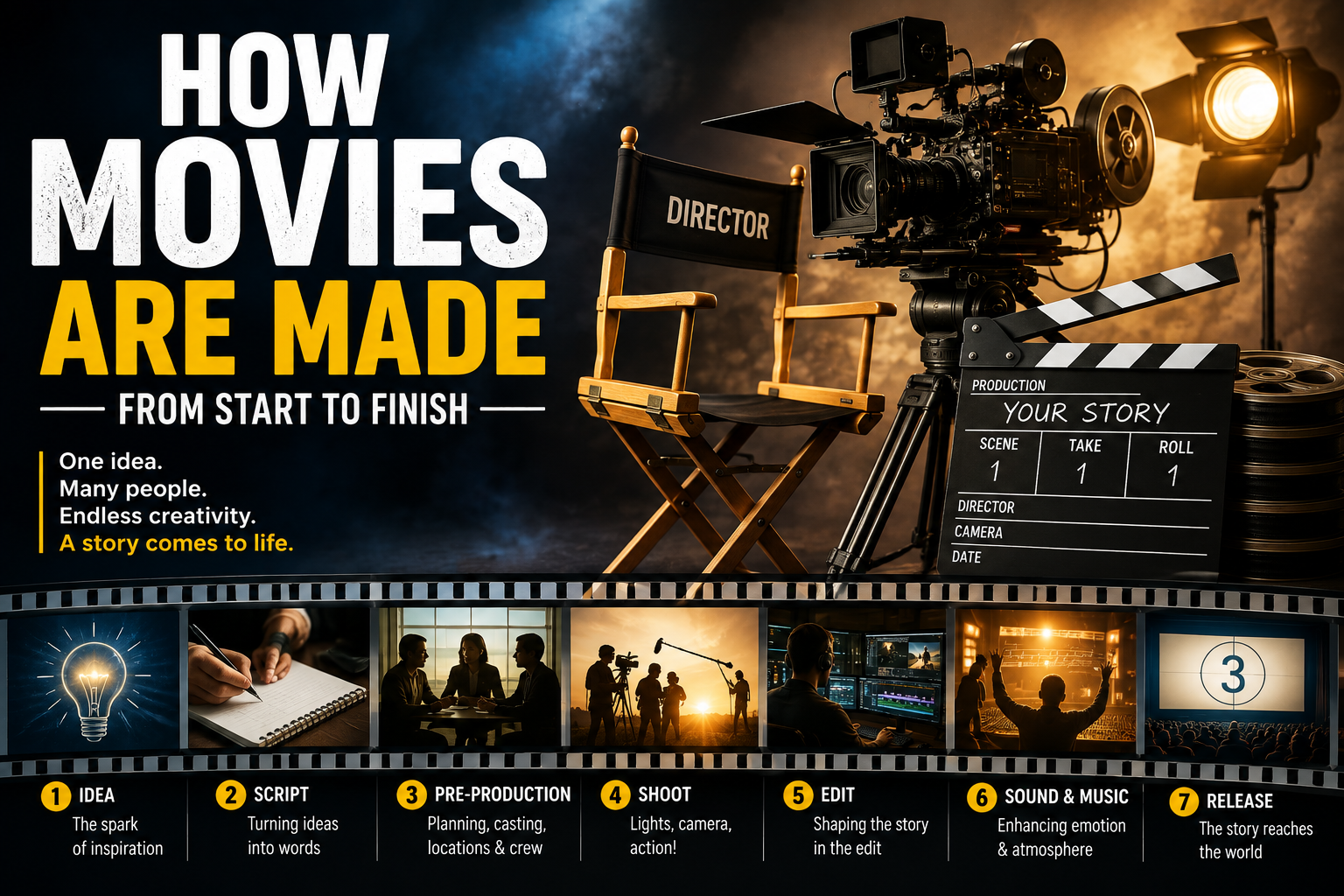
How Movies Are Made From Start to Finish
Ever wondered how an idea becomes a movie that eventually appears in a cinema, on television, or on a streaming service? A finished film may look like the work of a director and a cast, but filmmaking is actually a large collaborative process involving hundreds of people and multiple stages.
From the first story idea to the final sound mix, a movie can take months or even years to complete. Producers, writers, directors, actors, cinematographers, editors, designers, composers, visual-effects artists, and many other specialists each contribute to the finished product.
Here is how movies are made from start to finish.
1. The Story Begins With an Idea
Every movie starts with an idea.
That idea might come from an original screenplay, a novel, a historical event, a true story, a comic book, a play, or another source of inspiration. Sometimes a filmmaker develops the concept personally. In other cases, a producer or studio finds an existing story and begins developing it for the screen.
At this early stage, the concept is usually refined into a basic premise that explains what the movie is about, who the main characters are, and what kind of story the filmmakers want to tell.
A simple idea can eventually become a detailed screenplay through many rounds of development.
2. The Screenplay Is Developed
The screenplay is the blueprint for the movie.
Screenwriters turn the basic concept into scenes containing dialogue, character actions, locations, and descriptions of what audiences are expected to see and hear.
A screenplay usually goes through multiple revisions. Producers, directors, studios, and sometimes actors may provide feedback as the story develops.
Important questions are considered during this stage:
- Does the story have a clear beginning, middle, and ending?
- Are the characters believable and engaging?
- Does each scene serve a purpose?
- Is the pacing appropriate?
- Can the story realistically be produced within the available budget?
- What audience is the movie intended to reach?
Once the screenplay is sufficiently developed, the project can move toward production.
3. Producers Build the Project
Producers play a central role in turning a screenplay into an actual movie.
They help organize financing, production schedules, hiring, locations, contracts, logistics, and many other aspects of the project. Depending on the production, there may be several producers with different responsibilities.
The producer’s job is not simply to provide money. Producing involves coordinating creative and business decisions so that the production can move forward.
At this point, filmmakers also begin developing a realistic budget.
4. The Movie Gets Financed
Making a movie can be extremely expensive, particularly when it requires large sets, extensive visual effects, international locations, or well-known performers.
Funding can come from studios, production companies, investors, distributors, broadcasters, streaming companies, or combinations of these sources.
The budget affects almost every production decision.
A larger budget may allow filmmakers to build elaborate sets, travel to more locations, hire larger crews, or create complex visual effects. A smaller production may rely more heavily on practical locations, smaller crews, and carefully controlled shooting schedules.
5. The Director Develops the Vision
The director is responsible for guiding the creative execution of the movie.
Before cameras begin rolling, the director works closely with key members of the filmmaking team to determine how the screenplay will become a visual story.
This can involve deciding:
- How scenes should look
- How actors should perform
- Where cameras should be positioned
- How scenes should be paced
- What emotional tone the movie should have
- How characters should interact
- How visual effects and practical effects should be incorporated
The director’s vision must also work alongside the practical requirements established by the producers.
6. Casting Finds the Actors
Casting is another major stage of filmmaking.
Casting directors search for performers who fit the characters described in the screenplay. Depending on the production, actors may audition, participate in screen tests, or be approached directly for major roles.
The casting process can take considerable time.
A successful casting choice is important because an actor’s interpretation can significantly influence how audiences understand a character.
Once the principal cast is selected, actors may participate in rehearsals and preparation before filming begins.
7. Locations and Sets Are Prepared
Filmmakers need places where the story can take place.
Some movies are filmed in real locations, while others use studios, constructed sets, or a combination of both.
The production design department determines how environments should look. Production designers work with art directors, set decorators, prop teams, costume designers, and other specialists to create the visual world of the film.
A single scene might require an ordinary room to be transformed into a hospital, spaceship, restaurant, courtroom, or historical setting.
Everything visible within the frame can contribute to the story.
8. Costumes, Makeup, and Props Complete the Characters
Actors do not simply arrive on set and begin performing.
Costume designers determine what characters wear, while makeup and hair departments help create their appearance.
Props are also carefully selected or created.
These details can communicate information without dialogue. A character’s clothing might reveal their profession, personality, social position, or stage of life. A particular object might also become an important part of the story.
For period films and fantasy productions, these departments can be especially important because they help establish the world in which the story takes place.
9. Cinematographers Plan the Visuals
The cinematographer, also known as the director of photography, is responsible for the visual photography of the movie.
Working closely with the director, the cinematographer helps determine camera placement, lenses, lighting, movement, framing, and other visual elements.
Lighting can dramatically change the atmosphere of a scene. Camera angles can make a character appear powerful, vulnerable, isolated, or threatening.
The cinematography therefore does much more than simply record actors performing lines.
It helps tell the story visually.
10. Production Begins
Once preparation is complete, the movie enters principal photography.
This is the stage most people associate with filmmaking: cameras roll and actors perform their scenes.
However, filming is rarely done in the same order audiences eventually see the story.
A movie might shoot a scene from the ending before filming a scene from the beginning. Production schedules are normally organized around locations, actors, sets, equipment, availability, and efficiency rather than the chronological order of the screenplay.
A single scene may also require multiple takes.
The director may ask actors to repeat a performance to adjust timing, emotion, movement, or dialogue. The camera team may also capture different angles and compositions.
11. Multiple Camera Angles Are Recorded
A finished movie may contain only a few seconds from a particular moment, but filmmakers can record much more material to create those seconds.
A conversation, for example, might be filmed using:
- A wide shot showing both actors
- Medium shots of individual performers
- Close-ups
- Over-the-shoulder shots
- Reaction shots
- Additional visual details
These pieces give the editor options when constructing the final sequence.
Sound is recorded at the same time, although additional dialogue and sound effects may be created later.
12. Production Design Creates the World
While filming is underway, dozens of departments work together behind the scenes.
Set construction teams build environments. Prop teams prepare objects. Costume departments manage clothing changes. Makeup artists maintain performers’ appearances. Lighting crews adjust the scene. Camera operators and assistants prepare equipment.
Continuity teams also track details between takes.
For example, if an actor holds a cup in one take, the production team needs to know where the cup is positioned if the scene is filmed again from another angle.
Small inconsistencies can become surprisingly noticeable once the footage is edited together.
13. The Film Moves Into Post-Production
After filming finishes, the movie is far from complete.
The footage enters post-production, where editors and other specialists transform the raw material into the finished film.
This stage can include:
- Picture editing
- Sound editing
- Dialogue replacement
- Visual effects
- Color correction
- Music composition
- Sound mixing
- Titles and graphics
Post-production can take months for complex productions.
14. Editors Build the Story
The editor works with the director and other filmmakers to assemble the recorded footage.
This is where the structure and pacing of the movie become much clearer.
Editors decide which takes to use, where to cut between shots, how long scenes should last, and how individual moments connect.
A powerful performance can feel completely different depending on how it is edited.
A scene that lasts several minutes during filming might become only a short sequence in the final movie.
Editing is therefore one of the most important creative stages in filmmaking.
15. Visual Effects Are Added
Many modern movies use visual effects, often called VFX.
Some effects are obvious, such as digitally created creatures, environments, explosions, or futuristic cities. Others are subtle and may be invisible to audiences.
Visual-effects artists can remove unwanted objects, extend sets, modify backgrounds, create digital environments, or combine practical footage with computer-generated imagery.
Not every effect is created digitally. Filmmakers also use practical effects, miniatures, physical sets, prosthetics, pyrotechnics, and other techniques.
Modern productions frequently combine practical and digital methods.
16. Sound and Music Shape the Experience
Sound is one of the most important parts of a movie.
The sound team works on dialogue, background sounds, environmental effects, footsteps, vehicles, impacts, atmosphere, and many other elements.
Some sounds heard in movies are recorded separately from filming and added during post-production.
A composer may also create an original musical score.
Music can change how audiences interpret a scene. The same image can feel suspenseful, emotional, mysterious, uplifting, or frightening depending on the accompanying sound and music.
17. Color Grading Gives the Film Its Look
After editing, the movie goes through color correction and color grading.
Colorists adjust brightness, contrast, color balance, skin tones, and the overall visual appearance of scenes.
This helps maintain consistency between shots and can also establish a particular mood.
A filmmaker might use warmer tones for certain scenes and cooler tones for others to create a visual distinction between locations, time periods, or emotional states.
18. Test Screenings Help Refine the Movie
Some productions show an early version of the movie to selected audiences.
These screenings can provide feedback about pacing, clarity, character development, humor, emotional impact, and other elements.
The filmmakers may then make changes.
Scenes can be shortened, reordered, rewritten, or removed entirely. Additional photography may sometimes be required if important material needs to be changed.
Not every movie follows the same testing process, but feedback can help identify problems before a wider release.
19. The Movie Is Prepared for Release
Once the film is complete, distribution becomes the next major stage.
Depending on the project, a movie may be released in cinemas, through streaming platforms, on television, through digital rental or purchase services, or using a combination of these methods.
Marketing also becomes increasingly important.
Studios and distributors may release trailers, posters, interviews, promotional clips, advertisements, and other materials designed to introduce the movie to audiences.
The release strategy depends on the movie, its target audience, distribution arrangements, and business objectives.
20. Audiences Finally See the Movie
After months or years of development and production, the movie reaches its audience.
But even at this point, the filmmaking journey does not necessarily end.
The movie may continue through different distribution platforms and international markets. Awards campaigns, home entertainment releases, streaming availability, and other forms of distribution can extend the life of a film long after its initial release.
Why Movie Production Takes So Many People
One of the most remarkable things about filmmaking is the number of specialized skills involved.
A movie can require contributions from:
- Writers
- Producers
- Directors
- Actors
- Cinematographers
- Editors
- Production designers
- Costume designers
- Makeup artists
- Sound engineers
- Visual-effects artists
- Composers
- Camera crews
- Lighting technicians
- Location managers
- Stunt performers
- Marketing teams
- Distribution specialists
Each department has a specific responsibility, but filmmaking works because these departments coordinate their work toward one finished production.
From First Idea to Finished Screen
The journey from an initial movie idea to a finished production is a long chain of creative, technical, and business decisions.
A screenplay provides the foundation, producers organize the project, directors guide the creative work, actors bring characters to life, crews capture the performances, and post-production teams turn hours of footage and sound into a coherent story.
What audiences see on screen may last only a couple of hours, but creating those hours can involve years of planning, thousands of individual decisions, and the combined work of an enormous team.
That collaborative process is what turns a story on a page into a movie people can experience on screen.





2 Comments
Micle harison
June 7, 2019Lorem ipsum dolor sit amet, usu ut perfecto postulant deterruisset, libris causae volutpat at est, ius id modus laoreet urbanitas. Mel ei delenit dolores.
John Doe
June 7, 2019Some consultants are employed indirectly by the client via a consultancy staffing company.