
How Large Is the Known Universe?
The universe is so vast that even the numbers scientists use to describe it can be difficult to imagine.
Earth is one planet orbiting one star. That star is part of the Milky Way, a galaxy containing hundreds of billions of stars. The Milky Way itself is only one galaxy among an enormous population of galaxies spread across the observable universe.
But exactly how large is the universe?
The short answer is that we do not know the total size of the entire universe. What scientists can estimate, however, is the size of the observable universe — the portion of the cosmos whose light has had enough time to reach us since the universe began.
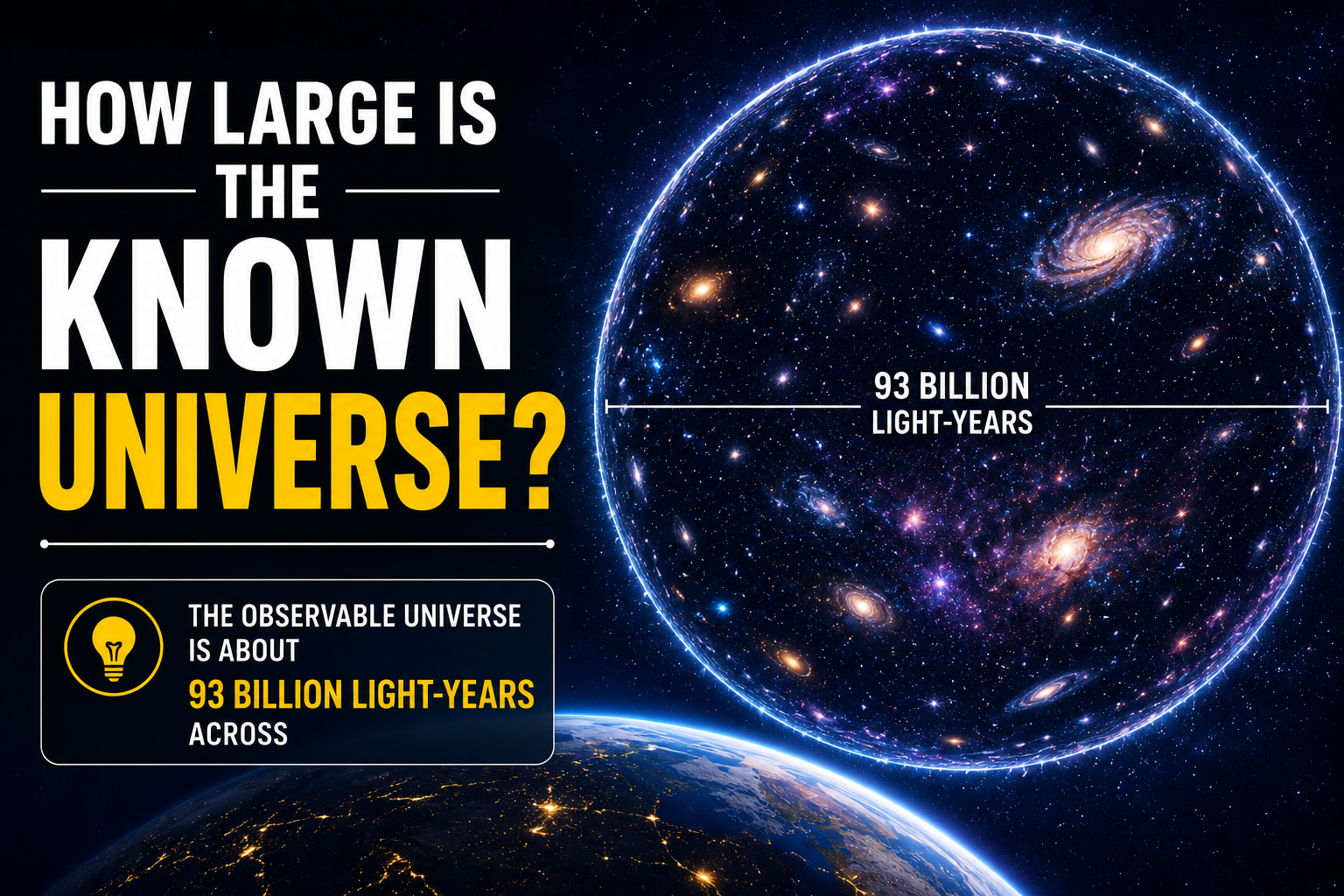
The Observable Universe Is About 93 Billion Light-Years Across
Current estimates put the diameter of the observable universe at roughly 93 billion light-years.
That figure may seem surprising because the universe is approximately 13.8 billion years old. If light travels one light-year per year, it might seem that we should be able to see only about 13.8 billion light-years in every direction.
The difference comes from the expansion of space itself.
While light has been traveling toward Earth for billions of years, the space between distant objects has continued to expand. As a result, galaxies whose ancient light is reaching us today can now be much farther away than the distance that light originally traveled.
The observable universe therefore extends roughly 46 billion light-years from Earth in every direction, giving it a diameter of approximately 93 billion light-years.
What Is a Light-Year?
A light-year is a measurement of distance, not time.
It represents the distance light travels through empty space in one year — about 9.46 trillion kilometers, or approximately 5.88 trillion miles.
Because light travels incredibly quickly, the light-year provides a useful scale for describing astronomical distances.
For comparison, light from the Sun takes about eight minutes to reach Earth. The nearest star beyond our Sun, Proxima Centauri, is more than four light-years away.
The distances between galaxies are vastly greater.
Why Can’t We See Beyond the Observable Universe?
The universe has a finite age, and light travels at a finite speed.
That means there are regions of space so distant that their light has not had enough time to reach Earth. Those regions are beyond our current observable horizon.
This does not necessarily mean that nothing exists there.
In fact, scientists have strong reasons to believe the universe extends far beyond the portion we can observe. There could be countless additional galaxies, stars and other structures outside our cosmic horizon.
We simply cannot currently receive information from those regions.
This distinction is important: the observable universe is not necessarily the entire universe.
The Universe Is Still Expanding
One of the most important discoveries in modern cosmology is that the universe is expanding.
Galaxies are, on large scales, moving away from one another as space itself expands. The farther away a galaxy is, the faster it generally appears to be receding from us.
This relationship is known as Hubble’s law, named after astronomer Edwin Hubble, whose observations helped establish that the universe is expanding.
The expansion also explains why extremely distant objects can currently be much farther away than the distance their light has traveled.
Space has been stretching during the journey.
Some Galaxies We See Are Extremely Ancient
Looking deep into space is also looking back in time.
Because light takes time to travel, astronomers see distant galaxies as they appeared billions of years ago.
A galaxy located billions of light-years away is not being observed as it looks today. Instead, telescopes are receiving light that began its journey billions of years in the past.
The farther astronomers look, the earlier in cosmic history they can observe.
This makes powerful space telescopes more than simply enormous cameras. They are effectively time machines for observing the universe’s past.
The Cosmic Microwave Background Reaches Even Farther Back
Scientists can observe the universe at an even earlier stage through the cosmic microwave background, often abbreviated as CMB.
The CMB is ancient radiation left over from the early universe. It was released roughly 380,000 years after the Big Bang, when the universe had cooled enough for atoms to form and light to travel freely through space.
Today, that ancient radiation fills the universe and can be detected with specialized instruments.
The CMB provides one of the strongest windows into the early universe and helps scientists determine important properties such as its age, composition and large-scale structure.
How Many Galaxies Are There?
There is no precise count of every galaxy in the observable universe.
However, astronomical surveys indicate that the observable universe contains hundreds of billions of galaxies, and some estimates have suggested that the total could be much higher depending on how faint and distant galaxies are accounted for.
Each galaxy can contain enormous numbers of stars.
The Milky Way alone contains hundreds of billions of stars, and many of those stars have planets.
This means the number of individual worlds in the observable universe could be extraordinarily large.
Is the Universe Infinite?
Scientists do not currently know whether the universe is infinite.
One possibility is that space extends indefinitely.
Another possibility is that the universe is finite but enormously larger than the observable region. A finite universe does not necessarily have an ordinary “edge” where space simply stops; its geometry could be considerably more complicated.
Measurements of the universe’s large-scale geometry have provided important clues, but they have not given scientists a definitive answer about whether the entire universe is infinite.
What Is Beyond the Observable Universe?
This is one of the most intriguing questions in cosmology.
If the universe extends beyond our observable horizon, there could be regions containing galaxies and structures that are fundamentally inaccessible to us.
Because light and information cannot travel to Earth from beyond our cosmic horizon within the relevant timescale, observations alone may never reveal exactly what lies there.
Scientists can nevertheless use physical theories and observations of the visible universe to investigate possibilities about the larger cosmos.
The boundary of what we can observe is therefore not necessarily a physical boundary of existence.
The Universe Could Be Far Larger Than We Can Imagine
The observable universe already contains distances far beyond everyday human experience.
Yet it may represent only a fraction of the entire cosmos.
Consider the scale:
- Earth: about 12,742 kilometers across
- Earth to Sun: about 150 million kilometers
- Milky Way: roughly 100,000 light-years across
- Observable universe: roughly 93 billion light-years across
And the final figure may still not describe the full size of reality.
The observable universe is defined by what information has been able to reach us, not necessarily by where the universe ends.
Why Measuring the Universe Matters
Determining the size and structure of the universe is not simply an exercise in measuring enormous distances.
Cosmologists use observations of distant galaxies, ancient radiation, supernovae and other astronomical phenomena to understand how the universe evolved.
These observations help scientists investigate fundamental questions:
- How old is the universe?
- How quickly is space expanding?
- What is the universe made of?
- How did the first galaxies form?
- What role does dark matter play?
- Why is the expansion of the universe accelerating?
- What is the ultimate geometry of space?
- Does the universe extend infinitely?
The answers could reshape our understanding of reality itself.
A Cosmic Horizon, Not a Cosmic Edge
The biggest misconception about the size of the universe is that the approximately 93-billion-light-year figure represents a giant spherical boundary surrounding everything that exists.
It does not.
It represents the approximate diameter of the observable universe — the region from which light or other information has had the opportunity to reach us.
Beyond that horizon, the universe may continue for an enormous distance, or potentially without end.
For now, humanity’s view of the cosmos remains limited by the speed of light, the age of the universe and the expansion of space.
And that may be one of the most remarkable facts of all: the universe we can see is already unimaginably large, yet it may be only a small window into something vastly greater.


2 Comments
Micle harison
June 7, 2019Lorem ipsum dolor sit amet, usu ut perfecto postulant deterruisset, libris causae volutpat at est, ius id modus laoreet urbanitas. Mel ei delenit dolores.
John Doe
June 7, 2019Some consultants are employed indirectly by the client via a consultancy staffing company.