
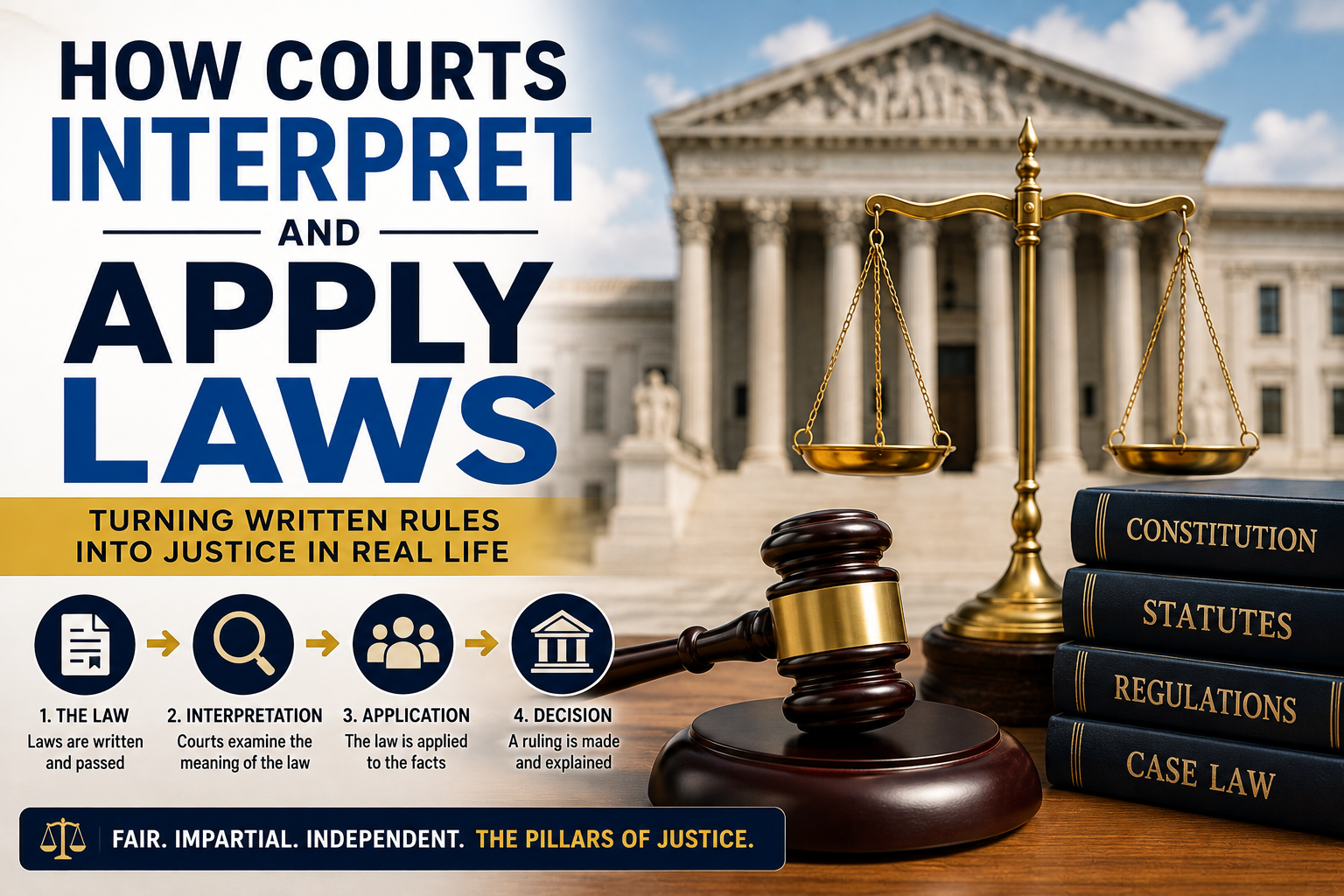
How Courts Interpret and Apply Laws
When lawmakers pass legislation, the words written into a statute do not always answer every legal question that later arises. Real-world disputes can involve circumstances that lawmakers did not specifically anticipate, ambiguous language, conflicting provisions, or disagreements about what a particular phrase means.
That is where courts play an important role.
Courts interpret laws to determine what legal rules mean and then apply those rules to specific disputes. This process can influence individual cases, government decisions, businesses, and sometimes entire areas of public policy.
Understanding how courts interpret and apply laws provides a useful window into how a legal system works.
What Does It Mean to Interpret a Law?
Legal interpretation is the process of determining the meaning of a law.
A judge may need to interpret a statute when the parties involved in a case disagree about what the law requires. The disagreement might involve the meaning of a particular word, the relationship between two sections of a statute, or whether a law applies to a specific situation.
For example, a law might prohibit a particular activity but use language that does not clearly address a new circumstance. A court may then have to determine whether the existing wording covers that situation.
Interpretation is not simply about what a judge personally thinks a law should say. Courts generally rely on established legal methods and sources when determining statutory meaning.
The Text of the Law Usually Comes First
One of the most important sources courts examine is the actual language of the statute.
Judges may look closely at:
- The ordinary meaning of words
- The structure of the provision
- Definitions contained elsewhere in the law
- Grammar and punctuation
- How different sections relate to one another
- Exceptions and limitations
- The overall wording of the statute
The precise wording can be particularly important when a dispute centers on a single phrase.
Courts generally try to read statutory language in context rather than examining isolated words without considering the surrounding provisions.
Courts Consider the Structure of Legislation
A statute is normally treated as a whole rather than as a collection of unrelated sentences.
If one interpretation of a provision would make another part of the law meaningless or contradictory, a court may consider whether an alternative interpretation better fits the legislation as a whole.
This approach recognizes that lawmakers typically intend the different parts of a statute to work together.
For example, if one section establishes a general rule and another creates a specific exception, the court may need to determine how those provisions interact.
Legislative Purpose Can Matter
Courts may also consider the purpose behind a law.
The purpose of legislation can sometimes help resolve ambiguity or determine how a provision should operate in practice.
However, the weight given to legislative purpose varies depending on the legal system, the wording of the statute, and the interpretive approach used by the court.
Judges may examine the broader problem the legislation was designed to address and ask whether a particular interpretation is consistent with that objective.
What Happens When the Language Is Ambiguous?
Not every statute is perfectly clear.
A provision may contain words that have multiple possible meanings, or two reasonable interpretations may produce different results.
When statutory language is ambiguous, courts can turn to additional interpretive tools.
These may include:
- The broader structure of the legislation
- The purpose of the law
- Related statutes
- Earlier court decisions
- Established legal principles
- Legislative history, where permitted and relevant
- Administrative interpretations in appropriate circumstances
The specific tools available depend on the jurisdiction and the type of case.
Courts Often Look to Earlier Decisions
Previous judicial decisions can be an important source of guidance.
In legal systems that follow the doctrine of precedent, earlier decisions may establish principles that lower courts are expected to follow when deciding similar cases.
Even when an earlier decision is not strictly binding, it may still be persuasive.
Courts may compare the facts of a current case with earlier cases and determine whether the same legal reasoning should apply.
This helps promote consistency and predictability in the legal system.
The Role of Precedent
Precedent means that previous judicial decisions can influence later cases.
A higher court’s interpretation of a statute may become an important legal authority for lower courts.
For example, if a country’s highest court determines how a particular statutory phrase should be interpreted, lower courts may generally be required to follow that interpretation in future cases involving the same legal issue.
Precedent does not necessarily mean that every case is decided identically. Courts must still examine the facts and determine whether the earlier decision actually applies.
Judges Apply Laws to Facts
Interpreting a law is only part of the judicial process.
Courts must also apply the interpreted rule to the facts of the case.
Consider a hypothetical law that establishes certain requirements for obtaining a government license. A dispute might arise over whether an applicant satisfies those requirements.
The court may first determine what the statutory requirements mean. It then examines the evidence and decides whether the applicant meets them.
This distinction between interpreting the rule and applying the rule to the facts is fundamental to judicial decision-making.
Courts Examine Evidence
Applying the law requires courts to determine what actually happened.
The evidence presented in a case may include:
- Documents
- Contracts
- Witness testimony
- Expert evidence
- Digital records
- Photographs or video
- Government records
- Physical evidence
The court evaluates the evidence according to the applicable rules of procedure and evidence.
Once the relevant facts have been established, the judge can apply the appropriate legal rules.
Different Courts Can Have Different Roles
Courts within a legal system often have different responsibilities.
Trial courts generally focus heavily on establishing facts and applying the law to individual disputes.
Appeal courts usually review decisions made by lower courts. Their role may include determining whether the lower court made a legal error, misinterpreted a statute, improperly applied precedent, or committed another significant mistake.
Higher courts may also resolve important questions of law that affect future cases.
The Difference Between Interpretation and Lawmaking
A common question is whether judges effectively make law when they interpret statutes.
The answer depends partly on the legal system and the nature of the judicial decision.
Courts generally do not have the same legislative role as elected lawmakers. Their primary responsibility is to resolve legal disputes under the law.
However, judicial interpretations can have significant consequences beyond the individual case.
When a court resolves an ambiguous statutory provision, its interpretation may become a precedent that influences how similar cases are decided in the future.
In that sense, judicial decisions can contribute to the development of law even when courts are interpreting existing legislation rather than creating statutes.
When Laws Conflict
Sometimes legal provisions appear to conflict.
A court may then need to determine whether the provisions can reasonably be interpreted in a way that allows both to operate.
Courts may consider factors such as:
- The specific wording of each provision
- The relationship between the provisions
- Whether one provision is more specific than another
- The structure of the legislation
- The apparent purpose of the law
- Whether one interpretation would produce an unreasonable result
The goal is often to construct a coherent interpretation of the legal framework.
Constitutional Questions Are Different
Some disputes involve more than ordinary statutory interpretation.
A court may be asked whether legislation is consistent with a constitution or another higher legal authority.
In such cases, the court may examine constitutional principles, rights, institutional powers, and limitations on government authority.
The precise powers of courts in constitutional cases differ significantly between countries.
In some jurisdictions, courts have broad authority to invalidate legislation that conflicts with constitutional requirements. In others, constitutional review operates differently.
Courts Can Also Interpret Regulations
Laws passed by legislatures are not the only legal texts that require interpretation.
Government agencies and other public bodies may issue regulations under authority granted by legislation.
Courts can sometimes be asked to determine what those regulations mean or whether an agency acted within the authority granted to it.
Such cases can involve questions about the relationship between legislation, administrative rules, and government decision-making.
Why Legal Interpretation Matters
Judicial interpretation affects more than lawyers and judges.
Court decisions can influence:
- Individual rights
- Government programs
- Business obligations
- Employment relationships
- Property disputes
- Contracts
- Criminal proceedings
- Consumer protections
- Regulatory requirements
A single interpretation of an important legal provision can therefore have consequences for many people beyond the parties who originally brought the case.
What Makes Legal Interpretation Difficult?
Legal disputes are often difficult because laws operate in complex real-world environments.
A statute may have been written years before a new technology, business practice, or social circumstance emerged.
Language can also change meaning depending on context.
Furthermore, different legal principles can sometimes point in different directions. Judges may have to balance the text of a law with its structure, purpose, precedent, and broader legal principles.
This is why legal interpretation often requires careful analysis rather than simply reading a provision once and reaching an immediate answer.
The Importance of Judicial Reasoning
When courts issue decisions, they generally explain the reasoning behind their conclusions.
A judicial opinion may discuss:
- The facts of the dispute
- The legal questions involved
- The relevant statutes
- Previous court decisions
- The competing arguments
- The court’s interpretation
- How the law applies to the facts
- The final decision
This reasoning allows lawyers, lower courts, governments, businesses, and the public to understand how the court reached its conclusion.
It also provides guidance for future cases.
How Courts Balance Consistency and Change
Legal systems need both stability and the ability to adapt.
If courts changed the interpretation of laws constantly, individuals and organizations could have difficulty predicting their legal obligations.
At the same time, rigidly applying old interpretations to circumstances that have changed dramatically can create problems.
Courts therefore operate within a framework that attempts to maintain consistency while allowing legal principles to develop when appropriate.
Higher courts generally play an especially important role when existing precedent needs to be reconsidered or clarified.
Why the Process Matters to Everyday Life
Most people will not regularly read judicial opinions or study statutory interpretation, but court decisions can still affect everyday life.
Rules concerning employment, housing, contracts, consumer rights, taxes, public services, business activity, and personal rights can all be shaped by how courts interpret legislation.
The process also helps resolve disputes when people disagree about what the law requires.
Rather than leaving competing interpretations unresolved, courts provide authoritative decisions within the boundaries of their jurisdiction.
From Written Words to Enforceable Rules
The path from legislation to practical legal consequences is not always straightforward.
Lawmakers create statutes, but courts may later be asked to determine how those statutes apply to particular circumstances. Judges examine the text, context, precedent, applicable legal principles, and facts before reaching a decision.
That process helps transform broad legal rules into decisions that can be applied to real disputes.
Understanding this process makes it easier to see why the words contained in a law matter—and why the way courts interpret those words can sometimes be just as important as the legislation itself.



2 Comments
Micle harison
June 7, 2019Lorem ipsum dolor sit amet, usu ut perfecto postulant deterruisset, libris causae volutpat at est, ius id modus laoreet urbanitas. Mel ei delenit dolores.
John Doe
June 7, 2019Some consultants are employed indirectly by the client via a consultancy staffing company.